

Phase 1: 공감 (Story Immersion Opening)
안녕하세요! 매일한글 에디터입니다. (Hello! This is your Daily Hangul editor.)
Picture this: You are sitting in a sleek glass conference room in Yeouido, Seoul’s premier financial and corporate hub. Across from you sit senior directors of a major Korean steel and battery conglomerate. The projector screen glows with complex supply-chain diagrams and European Union regulatory charts. The discussion suddenly pivots to the Carbon Border Adjustment Mechanism (CBAM) and its shockwaves across South Korea’s export-reliant economy. Someone turns to you and asks: “이번 탄소 국경세 도입으로 인해 우리 주력 수출 품목의 가격 경쟁력 약화와 공급망 재편이 불가피해 보이는데, 이에 대한 대응 전략을 어떻게 수립해야 할까요?”
If your mind instinctively defaults to simplistic expressions like “환경이 중요해요” or “세금이 비싸요”, you immediately hit the C2 glass ceiling. At the executive and policy level, Korean corporate discourse demands sophisticated economic phraseology, strategic hedging, and high-register rhetoric. In this masterclass, based on real feedback from bilingual executives, trade lawyers, and diplomatic consultants, we will unpack how native Korean industry leaders dissect green trade barriers, carbon tariffs, and sustainable competitiveness. Let’s elevate your Korean to executive fluency!
Phase 2: 핵심 표현 3선 심층 분석 (Top 3 Core Expressions)
1. 선제적 대응이 불가피하다 (Seonjejeok daeeung-i bulgahpihada)
- Pronunciation: [Seon-je-jeok dae-eung-i bool-ga-pi-ha-da] (Think Sun-jay-juck day-oong-ee bull-gah-pee-ha-dah)
- Meaning: Literal: “Preemptive counteraction is unavoidable” | Actual Nuance: “Taking proactive measures before the crisis hits is an absolute imperative.”
- K-Culture Moment: Evocative of boardroom clashes in high-stakes K-Dramas like Misaeng or Reborn Rich, where forward-thinking strategists urge top brass to pivot before regulatory storms hit.
- Editor’s Insight:
불가피하다(inevitable/unavoidable) combined with선제적 대응(preemptive response) represents the gold standard of Korean corporate crisis management jargon. It conveys both urgency and strategic foresight. - Situation Spectrum:
- Casual (친구 사이): 🚫 (Too heavy and academic)
- Semi-formal (팀 회의): ⚠️ (Use cautiously unless pitching a strategic initiative)
- Formal (경영진 보고 / 세미나): ✅ (The ideal executive phrasing)
- 🤔 Think About It: In English, we often say “we must act now.” Why does Korean use the double-nuance of “preemptive” and “unavoidable” (
선제적+불가피) to build consensus without sounding overly aggressive?
2. 가격 경쟁력의 잠식을 초래하다 (Gagyeok gyeongjaengnyeog-ui jamsig-eul choraehada)
- Pronunciation: [Ga-gyeok gyeong-jaeng-nyeok-ui jam-shig-eul cho-rae-ha-da] (Think Gah-gyuck gyung-jeng-nyuck-wee jahm-sheeg-eul cho-ray-ha-dah)
- Meaning: Literal: “To bring about the nibbling away/encroachment of price competitiveness” | Actual Nuance: “To severely erode our cost advantage in the global market.”
- K-Culture Moment: Frequently heard on YouTube economic debate shows like Sampro TV (삼프로TV) when macroeconomic analysts discuss rising tariff barriers against Korean semiconductors and heavy industries.
- Editor’s Insight:
잠식(蠶食) literally comes from silkworms slowly eating mulberry leaves. In modern economics, it paints a vivid picture of incremental yet lethal market erosion. - Situation Spectrum:
- Casual: 🚫
- Semi-formal: ⚠️
- Formal (대외 브리핑 / 논문 / 경제 분석): ✅
- 🤔 Think About It: How does the visual metaphor of
잠식(slow erosion) differ from direct Western terms like “loss of margin” or “market disruption”?
3. 공급망 전반의 탈탄소화가 시급하다 (Gonggeupmang jeonban-ui taltansohwaga sigeuphada)
- Pronunciation: [Gong-geup-mang jeon-ban-ui tal-tan-so-hwa-ga shi-geup-ha-da] (Think Gong-geup-mahng jun-bahn-ee tahl-tahn-so-hwah-gah she-geup-ha-dah)
- Meaning: Literal: “Decarbonization across the entire supply chain is urgent” | Actual Nuance: “We must urgently implement end-to-end Scope 3 decarbonization across all tier suppliers.”
- K-Culture Moment: Key phrase echoed by ESG steering committees in major Korean conglomerates (Chaebol) balancing green transition mandates with supplier profitability.
- Editor’s Insight: The prefix
탈-(脫, escaping/detaching) is essential for C2 mastery—found in탈탄소(decarbonization),탈원전(nuclear phaseout), and탈세계화(deglobalization). - Situation Spectrum:
- Casual: 🚫
- Semi-formal: ⚠️
- Formal: ✅
- 🤔 Think About It: Reflect on how modern sustainability policies transform Sino-Korean prefixes into concise, high-impact business shorthand.
Phase 3: 교과서 한국어 vs 진짜 한국어 (Textbook vs. Real Native C2 Korean)
Scenario 1: Discussing Carbon Border Tax Compliance
- 📖 교과서 한국어 (Textbook Korean):
- “유럽에 물건을 팔 때 탄소세를 내야 해서 비용이 많이 듭니다.”
- (When selling goods to Europe, we have to pay carbon tax, so costs are high.)
- 🗣️ 진짜 한국어 (Executive Native Korean):
- “EU CBAM 본격 시행에 따른 탄소 국경세 부담은 국내 주력 제조업의 영업이익률에 직격탄이 될 공산이 큽니다.”
- (The carbon border tax burden following full EU CBAM implementation is highly likely to deal a direct blow to the operating profit margins of key domestic manufacturing sectors.)
- 💡 왜 다를까? (Why the difference?): Standard textbooks use basic verb connectives (
-아서/어서), whereas executive Korean employs Sino-Korean nominal clauses (공산이 크다,직격탄이 되다) to project analytic authority and precision.
Scenario 2: Proposing Renewable Energy Infrastructure
- 📖 교과서 한국어 (Textbook Korean):
- “우리는 친환경 에너지를 더 많이 써서 세금을 줄여야 합니다.”
- (We must use more eco-friendly energy to reduce taxes.)
- 🗣️ 진짜 한국어 (Executive Native Korean):
- “RE100 이행을 가속화하고 재생에너지 조달 구조를 다변화함으로써 통상 규제 리스크를 헷지해야 합니다.”
- (We must hedge against trade regulatory risks by accelerating RE100 compliance and diversifying our renewable energy procurement portfolio.)
- 💡 왜 다를까? (Why the difference?): Real-world business Korean seamlessly incorporates international acronyms (RE100, CBAM, ESG) paired with advanced Sino-Korean verbs (
다변화하다,가속화하다) and financial loanwords (헷지하다).
Phase 4: K-Culture 딥다이브 & 비언어적 매너 (Culture Deep Dive & Non-Verbal Manners)
4-1. 눈치(Nunchi) & Gestures in High-Level Economic Briefings
- The Executive Nod & Gaze (
경청의 시선): When delivering a grim economic forecast (e.g., tariff impacts), maintain steady eye contact with the lead decision-maker, but soften your gaze slightly down toward the presentation dossier when acknowledging institutional constraints. - Strategic Hedging Stance: In Korean corporate governance, direct confrontation is considered poor form. Before presenting radical green transition costs, preface with “우려하시는 바와 같이…” (As you may rightfully be concerned about…) accompanied by an open two-handed posture over the desk.
4-2. Cultural Code: The Chaebol Dilemma & Global Trade Realities
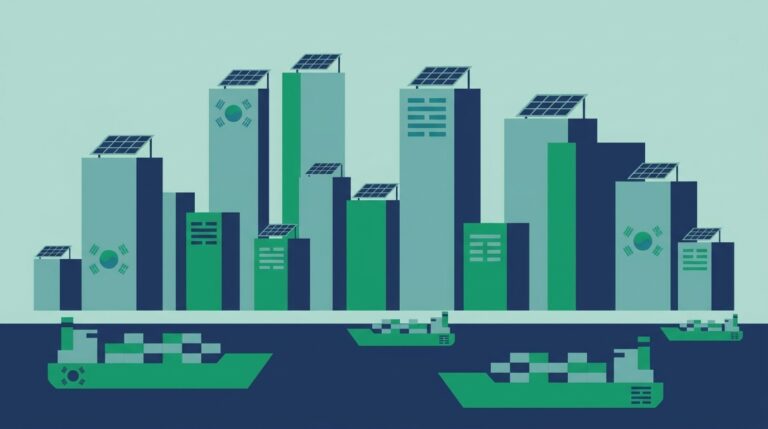
South Korea’s economic miracle (한강의 기적) was built on energy-intensive heavy manufacturing (steel, petrochemicals, automotive, shipbuilding). Carbon border taxes represent not merely an environmental guideline, but an existential restructuring of Korea’s export architecture. Understanding this historical vulnerability enables you to frame sustainable transition proposals not as theoretical ideals, but as survival strategies for Korean industry.
Phase 5: 실전 롤플레이 시나리오 (Interactive Role-Play Scenario)
Setting: Strategic Planning Conference Room, Gwanghwamun HQ.
Characters:
* 박 전무 (Executive Director Park): Veteran operations strategist, protective of short-term quarterly margins.
* 학습자 (You / Strategy Consultant): Global Trade & ESG Policy Advisor.
- Turn 1 (박 전무): 🎭 (서류를 넘기며 안경을 고쳐 쓰고) “이번 EU의 탄소국경조정제도 전환 기간이 끝나면, 우리 철강 및 이차전지 수출 라인에 실질적인 관세 부담이 얼마나 가중되는 겁니까?”
(Turning over documents and adjusting glasses: “Once the EU CBAM transition period ends, how much actual tariff burden will be placed on our steel and secondary battery export lines?”) -
Turn 2 (You): 🎭 (차트를 가리키며 단호하지만 차분한 어조로) “현재 배출량 산정 기준을 적용할 경우, 연간 수천억 원 규모의 인증서 구매 비용이 발생하여 유럽 시장 점유율 하락이 불가피합니다.”
(Pointing to the chart in a firm yet calm tone: “Applying current emission calculation baselines, purchasing certificate costs will reach hundreds of billions of KRW annually, making a decline in European market share unavoidable.”) -
Turn 3 (박 전무): 🎭 (미간을 찌푸리며 한숨을 쉬고) “결국 협력업체들의 탄소 배출 데이터까지 검증받아야 한다는 뜻인데, 2·3차 벤더들은 인프라가 전무한 실정 아닙니까?”
(Frowning and sighing: “In the end, that means even our suppliers’ carbon emission data must be audited, but tier-2 and tier-3 vendors have zero infrastructure, don’t they?”) -
Turn 4 (You): 🎭 (고개를 끄덕이며 공감을 표하고) “맞습니다. 따라서 단순한 규제 준수를 넘어, 협력사 탄소 회계 시스템 구축을 지원하는 상생형 공급망 플랫폼 도입이 시급합니다.”
(Nodding with empathy: “Precisely. Therefore, moving beyond mere regulatory compliance, it is urgent that we establish a shared-growth supply chain platform supporting our vendors’ carbon accounting systems.”) -
Turn 5 (박 전무): 🎭 (턱을 괴고 고민하며) “단기적인 설비 투자비용(CAPEX) 증가로 주주들의 반발이 만만치 않을 텐데요. 이를 설득할 명분이 있습니까?”
(Resting chin on hand thoughtfully: “With the short-term CAPEX surge, shareholder pushback will be formidable. Do we have the justification to persuade them?”) -
Turn 6 (You): 🎭 (태블릿으로 글로벌 경쟁사 동향을 띄우며) “친환경 저탄소 제품군으로의 조기 전환은 단순 비용 지출이 아닌, 글로벌 프리미엄 밸류에이션을 확보하는 미래 먹거리 투자입니다.”
(Displaying global competitor trends on tablet: “An early transition to eco-friendly, low-carbon product lines is not a mere expenditure, but a future growth engine investment securing global premium valuation.”) -
Turn 7 (박 전무): 🎭 (고개를 끄덕이며 엷은 미소를 띠고) “흠… 설득력이 있군요. 그렇다면 다음 주 이사회 보고 안건에 어떤 정책적 제언을 최우선으로 올릴 생각입니까?”
(Nodding with a subtle smile: “Hmm… that is convincing. Then what policy recommendation do you intend to prioritize for next week’s board meeting agenda?”) -
Turn 8 (You): [Choose your response from the interactive branches below]
🔀 인터랙티브 분기점 (Interactive Branching):
- Option A: “탄소 배출권 거래제(K-ETS)와 연계한 재생에너지 PPA 구매 계약 확대 및 저탄소 공정 R&D 예산 배정을 선제적으로 상정해야 합니다.”
- 🏆 Best Choice: Flawless C2 executive phrasing. Direct, actionable, incorporates specific energy market instruments (PPA, K-ETS). Director Park will approve immediately.
- Option B: “유럽 바이어들에게 사정을 설명하고 세금 감면을 요청하는 로비 활동을 벌여야 합니다.”
- ⚠️ Risk Choice: Demonstrates a misunderstanding of statutory trade law. EU CBAM is a non-negotiable multilateral regulation, not a discretionary buyer rebate.
- Option C: “공장 가동률을 줄여서 일단 배출량 수치부터 낮추는 게 좋겠습니다.”
- 🚫 Bad Choice: Sacrifices core manufacturing revenue; completely unfeasible in corporate strategic planning.
Phase 6: 10초 감정 섀도잉 드릴 (10-Second Emotion Shadowing Drill)
Practice the cadence, breath control, and professional gravity of these executive statements:
- [🧐 냉철하고 단호하게 / Analytical & Decisive]
“탄소 국경세 도입은 / 단순한 환경 규제가 아니라, / 글로벌 무역 질서의 패러다임 시프트입니다.”
(Tanso gukgyeongse do-ib-eun / dansunhan hwangyeong gyujega anira, / geullobeol muyeok jilseo-ui paereodaim sipeuteu-imnida.)
(The introduction of carbon border taxes is not mere environmental regulation, but a paradigm shift in the global trading order.) -
[🚨 위기감과 절박함을 담아 / Urgent & Strategic Concern]
“공급망 전반의 / 탄소 집약도를 낮추지 못한다면, / 주력 수출 시장에서의 도태는 / 시간문제일 뿐입니다.”
(Gonggeupmang jeonban-ui / tanso jib-yakdoreul natchuji mothandamyeon, / juryeok suchul sijang-eseoui dotaeneun / siganmunje-il ppunimnida.)
(If we fail to reduce the carbon intensity across our supply chain, our obsolescence in key export markets is merely a matter of time.) -
[🌟 자신감 넘치고 미래지향적으로 / Confident & Visionary]
“선제적인 탈탄소 기술 개발이야말로 / 규제 장벽을 넘어 / 독보적 초격차를 유지할 수 있는 열쇠입니다.”
(Seonjejeogin taltanso gisul gaebal-iyamallo / gyuje jangbyeog-eul neomeo / dokbojeok chogyeokchareul yujihal su inneun yeolsoe-imnida.)
(Preemptive development of decarbonization technologies is indeed the key to transcending regulatory barriers and sustaining an unrivaled super-gap advantage.)
Phase 7: K-Culture 미니 사전 (Core Executive Glossary)
- 초격차 (Chogyeokcha) | Super-Gap / Unassailable Lead
- Meaning: A distinct Korean business philosophy (popularized by Samsung Electronics) referring to widening technological and strategic capability gaps so massively that competitors cannot catch up. Applied frequently to green battery and hydrogen technology.
- 공급망 실사법 (Gonggeupmang Silsabeop) | Corporate Sustainability Due Diligence Directive (CSDDD)
- Meaning: Mandatory human rights and environmental audit laws holding lead companies liable for supply chain emissions and labor standards.
- 배출권 거래제 (Baechulkwon Georaeje – K-ETS) | Emissions Trading Scheme
- Meaning: The statutory carbon cap-and-trade market in South Korea operated under the Ministry of Environment.
- 직격탄을 맞다 (Jikgyeoktan-eul Matda) | To take a direct hit / direct blow
- Meaning: Business idiom describing severe operational or financial shocks caused by external geopolitical/macroeconomic shifts.
Phase 8: 비즈니스 전문가를 위한 서바이벌 키트 (Survival Kit for Business Leaders)
-
Top 3 High-Register Negotiation Expressions:
- “상계관세 리스크에 대한 면밀한 법리 검토가 선행되어야 합니다.” (Sang-gyegwanse riseukeue daehan myeonmilhan beobli geomtoga seonhaengdoe-eoya hamnida.)
- Pro Tip: Use when demanding legal due diligence regarding countervailing duties before signing global supply contracts.
- “탄소 집약적 사업 포트폴리오의 구조조정을 적극 검토해야 합니다.” (Tanso jib-yakjeok sa-eop poteupollioui gujojojeong-eul jeokgeuk geomtohaeya hamnida.)
- Pro Tip: Perfect board-level phrase recommending divestment from high-emission assets.
- “민관 합동 거버넌스를 통한 정책 금융 지원이 절실합니다.” (Min-gwan hapdong geobeoneonseureul tonghan jeongchaek geumyung jiwoni jeolsilhamnida.)
- Pro Tip: High-level lobbying and policy advocacy phrase when petitioning government institutions for green transition subsidies.
- Editor’s Travel & Field Note:
- When attending international climate symposiums or trade forums at COEX or Songdo Convensia, install 네이버 지도 앱 다운로드 to navigate high-speed business transit lines. For monitoring real-time Korean economic legislation, bookmark 국회 의안정보시스템 모바일 포털 to reference ongoing green taxonomy bills directly during client consultations.
Phase 9: “한 발 더 깊이” (Cultural & Economic Reflection)
South Korean industry has long thrived under the banner of “속도전” (Speed Battles)—rapid manufacturing execution, aggressive capital deployment, and unmatched supply delivery. However, the advent of carbon border taxes forces a structural shift from speed of output to depth of sustainability. In Korean corporate sociology, this tension creates a unique leadership paradox: how to honor long-standing supplier relationships (상생협력) while demanding brutal carbon compliance audits. When you discuss green trade in Korean, acknowledging this collective industrial transition reveals that you understand not just the grammar of the language, but the very soul of modern Korea’s economic evolution.
💬 Your Turn: Does your home country prioritize technological innovation or regulatory penalties when driving the green transition? How would you articulate that contrast in Korean? Share your thoughts below!
Phase 10: FAQ & 오해 방지 (FAQ Schema & Pitfalls)
Q: Is 탄소세 (Carbon Tax) the exact same concept as 탄소 국경세 (Carbon Border Adjustment Tax)?
A: Not quite. 탄소세 (Carbon Tax) refers to domestic taxation on fossil fuel carbon emissions, whereas 탄소 국경세 (Carbon Border Tax / CBAM) specifically refers to trade equalization tariffs levied on imported products originating from regions with laxer environmental regulations.
Q: Can I use basic expressions like ‘돈이 많이 들어요’ in formal Korean ESG presentations?
A: While grammatically correct, at the C2 executive level, replacing colloquial phrases with 비용 부담이 가중되다 (cost burden increases) or 수익성 악화 요인으로 작용하다 (acts as a profitability deterioration factor) conveys strategic competence and builds institutional authority.
Q: What is the difference between 저탄소 and 무탄소 in Korean trade terminology?
A: 저탄소 (Low-carbon) denotes emission minimization technologies (e.g., LNG hybrid processes), while 무탄소 (Carbon-free / Zero-carbon) specifically designates technologies with absolute zero direct emissions (e.g., Green Hydrogen, CF100 nuclear/renewable combinations).
🚨 흔한 실수 (Common Mistakes) 경고판:
- Mistake: Using “탄소 국경세를 지불하다” casually instead of “인증서를 구매하여 의무를 이행하다” or “관세를 납부하다”.
- Correct Action: Use precise legal verbs:
인증서 제출 의무를 이행하다(fulfill certificate surrender obligations).
- Correct Action: Use precise legal verbs:
- Mistake: Confusing
탈탄소화(Decarbonization) with탄소중립(Carbon Neutrality / Net-Zero).- Correct Action:
탈탄소화describes the process of eliminating carbon output;탄소중립represents the net balance equilibrium.
- Correct Action:
- Mistake: Treating
Scope 3supply chain emissions as ‘3차 협력업체’ (Tier 3 suppliers).- Correct Action: Refer to Scope 3 accurately as
기타 간접 배출량 (스코프 3)across the entire value chain.
- Correct Action: Refer to Scope 3 accurately as
Phase 11: 액션 미션 & 참여 유도 (Action Missions)
- 🥉 Bronze Mission (혼자 연습): Read Phase 6 Shadowing sentences aloud 3 times, focusing on rhythmic pauses at each slash mark (
/). - 🥈 Silver Mission (SNS 공유): Post a summary sentence on LinkedIn or your study account explaining CBAM’s impact on Korean exports using
선제적 대응이 불가피하다and tag#DailyHangul. - 🥇 Gold Mission (실전 사용): In your next Korean professional exchange or language exchange, debate whether renewable energy subsidies or carbon taxes are more effective using Sino-Korean transition markers (
이에 반해,그럼에도 불구하고,선결 과제로서).
🎮 K-Culture Mission: Watch a recent Korean business news analysis segment (e.g., KBS News, SBS Biz, or 삼프로TV) covering 탄소국경조정제도. Jot down 3 Sino-Korean terms you hear and verify their context in your notes!
Phase 12: 인터랙티브 퀴즈 챌린지 (Interactive Quiz Challenge)
Q1. Situation Analysis
다음 중 이사회 보고 시 ‘유럽 연합의 탄소 관세 규제에 따른 위험을 줄이기 위한 사전 조치’를 가장 격조 높은 한국어로 표현한 것은?
1. 세금이 많이 나오니까 유럽 수출을 그만둬야 합니다.
2. 규제 장벽에 대응하기 위한 선제적 저탄소 R&D 투자 확대가 불가피합니다.
3. 공장 사람들에게 탄소를 조금만 배출하라고 지시해야 합니다.
4. 유럽 규제 담당관에게 밥을 사며 부탁해야 합니다.
🔍 정답 및 해설 확인 (Click to expand)
정답: 2번
해설: 2번은 C2 수준의 격조 높은 경영 어휘(선제적, R&D 투자 확대, 불가피하다)를 완벽하게 조합하여 전략적 솔루션을 제시하고 있습니다. 1번과 3번은 지나치게 구어적이며 비현실적이고, 4번은 부적절한 대응입니다.
Q2. Fill in the Blank
글로벌 통상 규제에 대응하기 위해 제품의 생애주기 전반에 걸친 ( ) 발자국을 정밀하게 산정해야 합니다.
1. 석탄
2. 탄소
3. 매연
4. 쓰레기
🔍 정답 및 해설 확인 (Click to expand)
정답: 2번 (탄소)
해설: ‘탄소 발자국 (Carbon Footprint)’은 제품 생산, 유통, 폐기 전 과정에서 발생하는 온실가스 총량을 의미하는 표준 환경 경제 전문 용어입니다.
Q3. True / False Cultural & Trade Quiz
“한국의 RE100 및 CBAM 대응 논의에서 협력 중소기업의 배출량 데이터 산정 지원은 주요 기업의 사회적 책임(CSR)이자 공급망 유지 필수 과제로 꼽힌다.” ( True / False )
🔍 정답 및 해설 확인 (Click to expand)
정답: True
해설: 글로벌 공급망 실사법 및 CBAM 체제에서는 원청 대기업뿐만 아니라 부품을 납품하는 협력업체의 Scope 3 배출량 데이터까지 모두 감사 대상이 되므로, 대기업과 중소기업의 상생형 데이터 거버넌스가 핵심 과제로 다뤄집니다.







