

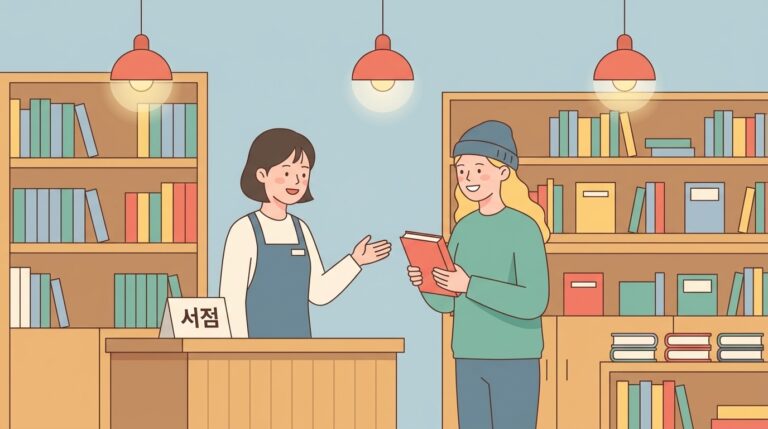
Phase 1: Welcome to the Ultimate Korean Bookstore Guide! 📚
안녕하세요! I’m your Daily Hangul editor and your personal 10-year Korean culture navigator! Have you ever walked into a massive Korean bookstore—like the famous Kyobo Book Centre in Gwanghwamun—and felt instantly overwhelmed? Thousands of books surround you, quiet classical music plays in the background, and everyone seems to know exactly where they are going. You hold up your phone with a screenshot of a book cover you saw in a K-drama, but your mind goes blank. How do you ask for help without sounding rude or getting lost in grammatical confusion?
Don’t worry, my friend! Finding a book in Korea is actually a delightful, stress-free experience once you know just two or three secret phrases. In this guide, tailored specifically for A2 Korean learners, we’ll break down the exact words real Koreans use when hunting for their next favorite read. Based on real feedback from hundreds of language learners, this guide will turn your bookstore panic into absolute confidence. Ready to explore? Let’s dive in together!
Phase 2: Core Expressions Deep Dive 🎯
Here are the top 3 essential phrases you need when searching for a book in Korea.
1. 이 책 어디에 있어요? (I chaek eodie isseoyo?)
- Pronunciation: Ee chaek uh-dee-eh ee-ssuh-yo? (Sounds like “Ee check” + “where is it?”)
- Meaning: Literal: “Where is this book?” / Real Nuance: “Could you tell me where I can find this book?”
- K-Culture Moment: You see a character in a romantic K-drama showing a title on their phone screen to a friendly bookstore clerk while soft acoustic music plays.
- Editor’s Insight: Adding 이 (this) while pointing at a picture on your smartphone makes this the ultimate magic phrase for travelers!
- Situation Spectrum:
- Casual (Friends): 이 책 어디 있어? ⚠️
- Semi-formal (Bookstore staff): 이 책 어디에 있어요? ✅
- Formal (Official presentation): 이 책은 어디에 있습니까? 🚫 (Too stiff)
- 🤔 Think About It: In English, you might say “Where can I find…?”, focusing on your action. In Korean, the focus is often on where the item exists (어디에 있어요?). How does this shift your perspective?
2. 혹시 이 책 재고 있어요? (Hoksi i chaek jaego isseoyo?)
- Pronunciation: Hohk-shee ee chaek jae-go ee-ssuh-yo?
- Meaning: Literal: “By any chance, is this book in stock?” / Real Nuance: “Do you happen to have this book in stock right now?”
- K-Culture Moment: Used when looking for a trendy K-Pop photo book or a bestseller that might be sold out.
- Editor’s Insight: The word 혹시 (by any chance) is a magic politeness softener in Korean culture! It softens your request and makes you sound super polite and considerate.
- Situation Spectrum:
- Casual: 이 책 재고 있어? ⚠️
- Semi-formal: 혹시 이 책 재고 있어요? ✅
- Formal: 혹시 이 책 재고가 있습니까? ✅
- 🤔 Think About It: Why do you think Koreans love using words like “혹시” before asking questions? It avoids putting pressure on the other person!
3. 베스트셀러 코너가 어디예요? (Beseuteselleo koneoga eodiyeyo?)
- Pronunciation: Beh-seu-teu-sell-luh koh-neo-ga uh-dee-ye-yo?
- Meaning: Literal: “Where is the bestseller corner?” / Real Nuance: “Where can I check out the popular books?”
- K-Culture Moment: Entering a cozy indie bookstore in Hongdae or Seongsu and wanting to check out what Koreans are reading this week.
- Editor’s Insight: “베스트셀러” is a Konglish (Korean English) word! You’ll recognize many section names easily.
- Situation Spectrum:
- Casual: 베스트셀러 코너 어디야? ⚠️
- Semi-formal: 베스트셀러 코너가 어디예요? ✅
- Formal: 베스트셀러 코너가 어디입니까? ✅
- 🤔 Think About It: Notice how Korean adopts English words and adjusts them to Korean phonetics. Can you spot other loanwords in Korean shops?
Phase 3: Textbook Korean vs Real Korean 🗣️
Situation 1: Asking for location
- 📖 Textbook Korean: 이 책이 어디에 있습니까? (Is this book located here? – Very formal & stiff)
- 🗣️ Real Korean: 저기요, 이 책 어디 있는지 알 수 있을까요? (Excuse me, could I check where this book is?)
- 💡 Why is it different?: Real spoken Korean prefers indirect, polite questions using “~지 알 수 있을까요?” to sound gentle and respectful.
Situation 2: Asking staff to look up a book
- 📖 Textbook Korean: 저에게 이 책을 찾아주십시오. (Please find this book for me. – Sounds like a direct order)
- 🗣️ Real Korean: 혹시 이 책 위치 좀 확인해 주실 수 있나요? (Could you kindly check the location of this book for me?)
- 💡 Why is it different?: Adding 좀 (a little/kindly) reduces the burden on the listener, which is a key element of Korean politeness.
Phase 4: K-Culture Deep Dive & Non-Verbal Manners 🎭
4-1. Nunchi (눈치) & Gestures in a Korean Bookstore
- The Two-Handed Phone Hold: When showing a title on your phone to a clerk, hold your phone with both hands or support your right wrist with your left hand. This subtle gesture shows immense respect!
- Soft Pointing: Never point directly at staff or books with a single index finger in a sharp manner. Instead, open your hand palm-up to indicate direction.
- Quiet Whispers: Korean bookstores are quiet zones! Keep your voice lowered to a respectful semi-whisper.
4-2. Bookstore Culture in Korea
In Korea, bookstores like Kyobo or Youngpoong aren’t just shop floors—they are cultural hubs! You will see massive wooden reading tables, quiet study nooks, and integrated stationery sections (like Hottracks). It’s very common to spend hours browsing books quietly without feeling pressured to buy immediately.
Phase 5: Real-Life Roleplay Scenario 🎬
Setting: Kyobo Book Centre, Gwanghwamun branch.
Characters: You (Learning Korean) & Min-soo (Friendly Bookstore Staff).
- You: 저기요, 혹시 이 책 있나요? 🎭 [Politely holding phone screen with both hands]
(Jeogiyo, hoksi i chaek innayo? / Excuse me, do you happen to have this book?) - Staff: 아, 네! 잠시만요. 제목이 어떻게 돼요? 🎭 [Smiles and looks at your phone screen]
(A, ne! Jamsimannyo. Jaemogi eotteokge dwaeyo? / Ah, yes! Just a moment. What is the title?) - You: ‘불편한 편의점’이에요. 혹시 재고 있어요? 🎭 [Points gently at the screen]
(‘Bulpyeonhan Pyeon-uijeom’-ieyo. Hoksi jaego isseoyo? / It’s ‘Uncanny Convenience Store’. Is it in stock?) - Staff: 네, 재고 있어요! C 구역 15번 매대에 있습니다. 🎭 [Types on computer and points toward C section]
(Ne, jaego isseoyo! C gu-yeok sip-o-beon maedae-e isseumnida. / Yes, we have it in stock! It’s at table 15 in Zone C.) - You: C 구역이 어디 쪽이에요? 🎭 [Looking around with a curious expression]
(C gu-yeogi eodi jjok-ieyo? / Which way is Zone C?) - Staff: 저기 오른쪽 소설 코너 뒤쪽으로 가시면 돼요. 🎭 [Points palm-up toward the right side]
(Jeogi oreun-jjok so-seol koneo dwi-jjog-euro gasimyeon dwaeyo. / If you go behind the fiction section on the right over there, you’ll find it.) - You: 아, 찾았어요! 정말 감사합니다! 🎭 [Bows head slightly with a warm smile]
(A, chajasseoyo! Jeongmal gamsahamnida! / Ah, I see it! Thank you so much!) - Staff: 아니에요~ 즐거운 시간 되세요! 🎭 [Bows back cheerfully]
(Anieyo~ Jeulgeoun sigan doeseo! / You’re welcome~ Have a great time!)
🔀 Interactive Choice Point
The staff tells you the book is in Zone C, but you don’t understand the complex directions. What do you say?
- Option A: 죄송하지만, 같이 가주실 수 있나요? (Excuse me, but could you come with me?)
- 🏆 Feedback [Best]: Very polite and natural! If staff aren’t overly busy, they will gladly guide you right to the shelf.
- Option B: 어디요? 못 찾겠어요. (Where? I can’t find it.)
- ⚠️ Feedback [Bad]: A bit too blunt and informal for talking to staff.
- Option C: 그냥 됐어요. (Never mind then.)
- 🚫 Feedback [Risk]: Sounds slightly defensive or annoyed, which might make the staff feel uncomfortable!
Phase 6: 10-Second Emotional Shadowing Drill 🗣️⚡
Practice these aloud with feeling!
[😊 Friendly & Polite]저기요, / 이 책 / 어디에 있어요?
(Jeogiyo, / i chaek / eodie isseoyo?)[🥺 Hopeful & Soft]혹시 / 이 책 재고 / 있어요?
(Hoksi / i chaek jaego / isseoyo?)[🎉 Relieved & Happy]아, / 찾았어요! / 감사해요!
(A, / chajasseoyo! / Gamsahea-yo!)
Phase 7: K-Culture Mini Dictionary 📖
- 도서 검색대 (Doseo Geomsaekdae) | Book Search Kiosk | Touchscreen computer kiosks positioned around the store where you can search for books and print location receipts.
- 재고 (Jaego) | Stock / Inventory | Used to ask if items are available (e.g., “재고 있어요?”).
- 베스트셀러 (Beseuteselleo) | Bestseller | Popular books displayed prominently near store entrances.
- 신간 (Singan) | New Releases | Newly published titles featured in dedicated sections.
Phase 8: Traveler’s Survival Kit 🧰
Top 3 Survival Expressions
- 도서 검색대 어디예요? (Where is the book search kiosk?)
- 위치 종이 출력해 주실 수 있나요? (Could you print the location slip for me?)
- 이 책 포장해 주세요. (Please gift-wrap this book.)
Editor’s Travel Note
Before stepping into a major bookstore like Kyobo, make sure you download the Naver Map App on your phone to quickly find the nearest branch exit. Also, most bookstores accept overseas credit cards, but contactless payments can vary, so carrying a physical card or T-Money is always recommended!
Phase 9: One Step Deeper 💭
In Korean culture, asking for help with words like 혹시 (by any chance) or 저기요 (excuse me over there) reflects a deep social desire not to intrude on someone else’s personal boundary. By learning these subtle softeners, you aren’t just memorizing grammar; you are learning how to move with warmth and consideration inside Korean society.
💬 Your Turn: Have you ever visited a Korean bookstore or tried searching for Korean books online? What was your experience? Share your stories in the comments below!
Phase 10: FAQ & Common Mistakes ❓
Q: Can I take photos inside Korean bookstores?
A: Generally yes, but avoid taking close-up pictures of open book pages (copyright reasons) or filming other customers directly without permission.
Q: What if I don’t know how to pronounce the Korean book title?
A: Simply search the title on your phone screen beforehand and show it to the staff while saying, “이 책 있어요?” (Do you have this book?).
Q: Do Korean bookstores have English books?
A: Yes! Large branches like Kyobo Gwanghwamun have dedicated 외서 (Oeseo – Foreign Books) sections.
🚨 Common Mistakes TOP 3
- Saying “이 책 어디?” to staff: Too informal! Always add 요 (
이 책 어디예요?). - Pointing with a single finger: Use an open hand palm-up instead.
- Speaking too loudly: Bookstore etiquette in Korea requires quiet, gentle tones.
Phase 11: Action Mission 🚀
- 🥉 Bronze Mission: Practice saying “혹시 이 책 재고 있어요?” 3 times out loud.
- 🥈 Silver Mission: Find a Korean book you want to read, take a screenshot, and practice asking a friend where to find it.
- 🥇 Gold Mission: Visit a Korean bookstore (or a Korean library/online shop) and use your new phrases with a native speaker!
🎮 K-Culture Mission: Next time you watch a modern K-drama set in a city, spot if the characters visit a bookstore or library! Notice what gestures they use.
Phase 12: Interactive Quiz Challenge 🧩
Test your knowledge!
Q1. What is the magic softener word to make questions extra polite?
a) 진짜
b) 혹시
c) 빨리
Q2. True or False: It is polite to point directly with your index finger when showing directions in a store.
Click to reveal answers!
Answers & Explanations:
1. b) 혹시 (It means ‘by any chance’ and softens your request naturally!).
2. False! (Using an open palm facing upward is much more polite in Korea!).







