

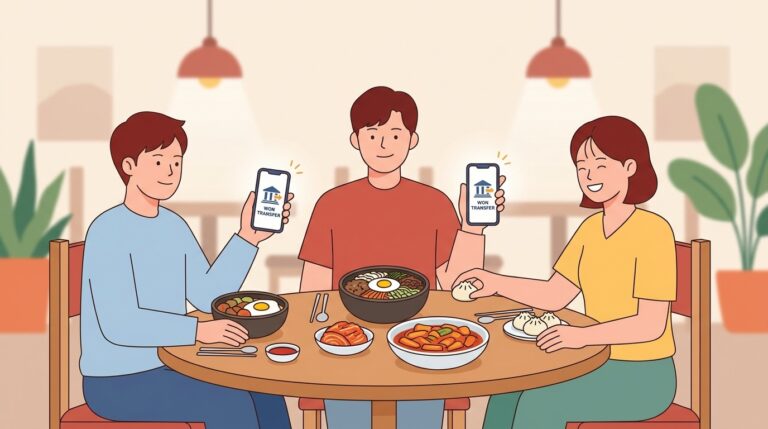
Phase 1: Welcome! Let’s Talk About Splitting the Bill in Korea
안녕하세요! 매일한글 에디터입니다. (Hello! This is your Daily Hangul Editor.) Have you ever finished a delicious BBQ meal with local Korean friends, only to face that awkward moment when the bill arrives? You pull out your credit card to split it at the counter, but the staff politely asks if one person can pay first. In Korea, splitting bills directly at restaurant cash registers isn’t always common during busy hours. Instead, one friend pays the full amount, and everyone else sends their share via a quick bank transfer!
For absolute beginners (A1), talking about bank accounts and transfers can sound scary. You might worry about using the wrong numbers or sounding rude. But don’t worry! This guide is built on real learner feedback and practical tips. By mastering just three simple phrases today, you will confidently split bills, exchange bank transfer info, and join Korean dining culture like a seasoned local. Let’s dive in together!
Phase 2: Top 3 Core Expressions Deep Dive
1. 계좌 번호 알려 주세요. (Gyejwa beonho allyeo juseyo.)
- Pronunciation: Gye-jwa beon-ho al-lyeo ju-se-yo (Sounds like: Gyeh-jwa bun-ho ahl-lyuh joo-seh-yo)
- Meaning: “Please give me your bank account number.” (Literal: Account number please let me know.)
- K-Culture Moment: Seen in almost every K-drama where coworkers finish team dinners (회식) and send account numbers over KakaoTalk.
- Editor’s Insight: This is polite and clear. You can use it with friends, older acquaintances, or coworkers without sounding demanding.
- Situation Spectrum: Casual ✅ | Semi-formal ✅ | Formal ✅
- 🤔 Think About It: In your home country, do people use apps like Venmo/Zelle, or do they hand over cash? How does instant mobile banking shape social habits?
2. N빵해요! (En-ppang-hae-yo!)
- Pronunciation: N-ppang-hae-yo (Sounds like: N-pahng-hae-yo)
- Meaning: “Let’s split the bill equally!” (“N” stands for the number of people, and “ppang” means breaking/dividing.)
- K-Culture Moment: Frequently shouted by university students or young friends at a Pocha (street pub) after ordering chicken and beer.
- Editor’s Insight: This is super casual slang! Use it only with close friends or peers of the same age.
- Situation Spectrum: Casual ✅ | Semi-formal ⚠️ | Formal 🚫
- 🤔 Think About It: Why do young Koreans love combining English letters like ‘N’ with fun Korean sound words?
3. 돈 보냈어요. (Don bonaesseoyo.)
- Pronunciation: Don bo-naes-seo-yo (Sounds like: Dohn boh-naess-uh-yo)
- Meaning: “I sent the money.”
- K-Culture Moment: Texted immediately after tapping the transfer button on a banking app while walking to the dessert cafe.
- Editor’s Insight: Short, sweet, and essential. Adding ‘요’ at the end keeps it polite.
- Situation Spectrum: Casual ✅ | Semi-formal ✅ | Formal ✅
- 🤔 Think About It: How fast is banking in your country compared to Korea’s 3-second bank transfer apps?
Phase 3: Textbook Korean vs Real Korean
Situation 1: Asking to split the bill
- 📖 Textbook Korean: 각자 계산하겠습니다. (Gak-ja gye-san-ha-geess-seub-ni-da. – “We will pay individually.”)
- 🗣️ Real Korean: N빵해요! (En-ppang-hae-yo! – “Let’s do N-ppang!”)
- 💡 Why? Textbook Korean sounds like a formal contract! Young locals prefer fun, light language like N빵 (En-ppang) when eating out together.
Situation 2: Confirming payment transfer
- 📖 Textbook Korean: 송금을 완료하였습니다. (Song-geum-eul wan-ryeo-ha-yeoss-seub-ni-da. – “I have completed the remittance.”)
- 🗣️ Real Korean: 돈 보냈어요! (Don bo-naes-seo-yo! – “I sent the money!”)
- 💡 Why? Real people use simple verbs like ‘보내다’ (to send) rather than stiff financial terms like ‘송금’ (remittance).
Phase 4: K-Culture Deep Dive & Non-Verbal Manners
4-1. Nunchi (눈치) & Gestures
When someone pays the whole bill first at a restaurant, don’t rush to hand them physical cash unless they ask. Instead, pull out your phone, make eye contact, and give a polite head nod while asking for their bank info. Showing your phone screen with your banking app ready demonstrates great Nunchi (social tact).
4-2. Culture Code: KakaoPay & Toss Culture
In Korea, cash is rarely used for splitting bills. Everyone uses mobile apps like KakaoPay or Toss. It takes less than 5 seconds to transfer money via phone number or QR code. It’s so fast that people often transfer money before even stepping out of the restaurant!
Phase 5: Real-Life Roleplay Scenario
Scenario: You just finished eating Tteokbokki with your Korean friend, Minji (민지).
- Turn 1 (Minji): 내가 먼저 계산할게! (Nae-ga meon-jeo gye-san-hal-ge! / I will pay first! 🎭 Taps card at cashier)
- Turn 2 (You): 고마워요! N빵해요. (Go-ma-weo-yo! En-ppang-hae-yo. / Thank you! Let me pay my share. 🎭 Pulls out phone)
- Turn 3 (Minji): 그래, 좋아! (Geu-rae, jo-ha! / Sure, sounds good! 🎭 Smiles)
- Turn 4 (You): 계좌 번호 알려 주세요. (Gye-jwa beon-ho al-lyeo ju-se-yo. / Please tell me your bank account number. 🎭 Opens bank app)
- Turn 5 (Minji): 카카오톡으로 보낼게. (Ka-ka-o-tok-eu-ro bo-nael-ge. / I’ll send it via KakaoTalk. 🎭 Typing on phone)
- Turn 6 (You): 확인했어요. 돈 보냈어요! (Hwak-in-haess-eo-yo. Don bo-naes-seo-yo! / I checked it. I sent the money! 🎭 Shows confirmation screen)
- Turn 7 (Minji): 확인했어, 고마워! (Hwak-in-haess-eo, go-ma-weo! / Got it, thanks! 🎭 Gives thumbs up)
- Turn 8 (You): 맛있게 잘 먹었어요! (Mas-iss-ge jal meog-eoss-eo-yo! / Thank you for the great meal! 🎭 Bows head slightly)
🔀 Interactive Choice Point
Minji pays the bill. What do you say right away?
* Option A: 계좌 번호 알려 주세요! (Gye-jwa beon-ho al-lyeo ju-se-yo!)
* Option B: 공짜예요? (Gong-jja-ye-yo? / Is it free?)
* Option C: 나중에 줄게요. (Na-jung-e jul-ge-yo. / I’ll give it to you later.)
- Feedback:
- Option A (Best!): Polite, proactive, and clear! Shows respect and readiness to pay.
- Option B (Bad): Joking about money can sound awkward or cheeky to new friends.
- Option C (Risk): Procrastinating payment can make your friend uncomfortable.
Phase 6: 10-Second Emotion Shadowing Drill
Practice saying these with natural rhythm and feeling!
[😊 Friendly & Enthusiastic]우리 / N빵해요! (U-ri / En-ppang-hae-yo! / Let’s split it!)[🙋♂️ Polite & Clear]계좌 번호 / 알려 주세요. (Gye-jwa beon-ho / al-lyeo ju-se-yo. / Please give me your account number.)[🎉 Happy & Relieved]방금 / 돈 보냈어요! (Bang-geum / don bo-naes-seo-yo! / Just sent the money!)
Phase 7: K-Culture Mini Dictionary
- 계좌 (Gye-jwa) | Bank Account | Used in banking, transfers, and online shopping.
- 더치페이 (Deo-chi-pe-i) | Dutch Pay | The English-derived word commonly used in formal/written Korean for bill splitting.
- 카카오페이 (Ka-ka-o-pe-i) | KakaoPay | Korea’s premier mobile wallet app built into KakaoTalk.
- 송금 (Song-geum) | Wire Transfer | The formal financial term for sending money electronically.
Phase 8: Traveler’s Survival Kit
Top 3 Survival Phrases
- 계좌 번호 주세요. (Gye-jwa beon-ho ju-se-yo.) – Account number please.
- 얼마예요? (Eol-ma-ye-yo?) – How much is it?
- 보냈어요! (Bo-naes-seo-yo!) – Sent it!
Editor’s Travel Note
Before traveling to South Korea, download travel-friendly financial and navigation apps. Check out our guide on Naver Map App Download and Usage Guide to easily locate ATMs and banks near popular food streets.
Phase 9: One Step Deeper
In Korean culture, food is deeply tied to affection and community. Traditionally, older friends or hosts insisted on paying for everyone. Today, while younger generations embrace mobile transfers and splitting bills, expressing gratitude with words like “잘 먹었습니다” (Thank you for the meal) remains an essential part of dining etiquette.
💬 Your Turn: Have you ever split a bill in another country? How is it different from Korea? Share your story in the comments below!
Phase 10: FAQ & Common Mistakes
Q: Can I use physical cash to pay my friend back?
A: Yes, cash is acceptable! However, mobile transfers are much preferred because young Koreans rarely carry paper change.
Q: Is ‘N빵’ acceptable with my university professor or manager?
A: No! ‘N빵’ is slang. With professors or bosses, use ‘각자 계산’ or simply thank them if they offer to buy.
Q: What if I don’t have a local Korean bank account?
A: You can ask your friend to pay cash with you or send money via international remittance apps like Wise or Revolut.
🚨 Common Mistakes TOP 3
- Saying “돈 주세요” (Give me money) to a friend: Sounds aggressive! Instead say, “N빵 금액 알려 주세요” (Let me know my share).
- Forgetting ‘요’ at the end: Saying “돈 보냈다” is informal (반말). Always add ‘요’ -> “돈 보냈어요”.
- Asking cashier to split card payment into 5 cards during lunch rush: Avoid this! Have one person pay and transfer later.
Phase 11: Action Mission & Engagement
- 🥉 Bronze Mission: Practice saying “계좌 번호 알려 주세요” 3 times out loud.
- 🥈 Silver Mission: Write “N빵해요!” in a comment below.
- 🥇 Gold Mission: Next time you eat with a Korean friend, offer to transfer your share using KakaoPay or bank transfer!
🎮 K-Culture Mission: Watch a modern K-drama episode and spot the moment a character checks their smartphone banking notification after dinner!
Phase 12: Interactive Quiz Challenge
1. Situation Quiz
You want to politely ask your friend for their bank account number. What should you say?
* A) 계좌 번호 알려 주세요.
* B) 돈 주세요.
Click for Answer & Explanation
Answer: A
‘계좌 번호 알려 주세요’ is polite and clear. ‘돈 주세요’ sounds like ‘Give me money!’ which is too direct and impolite.
2. Fill in the Blank
“Let’s split the bill!” -> _____빵해요! (Fill in the English letter)
Click for Answer & Explanation
Answer: N
The phrase is ‘N빵해요!’ where N represents the number of people dividing the bill.
3. True / False
True or False: Using ‘N빵해요’ with your company boss is recommended.
Click for Answer & Explanation
Answer: False
‘N빵’ is slang for close friends or peers. Avoid using it with elders or supervisors!







