

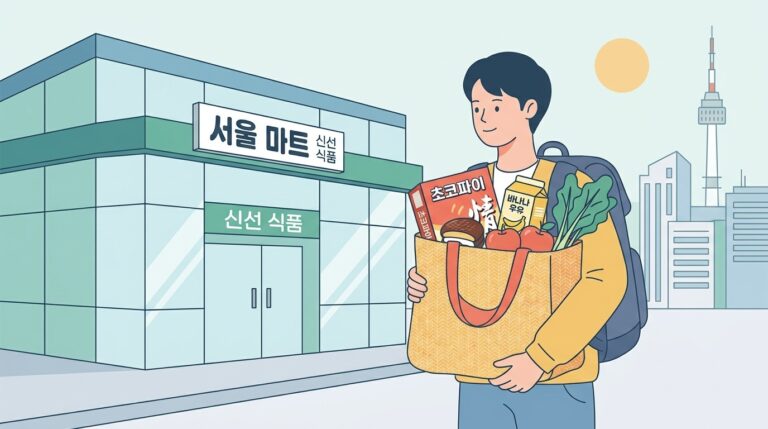
Phase 1: Empathy
안녕하세요! I’m your Daily Hangul editor, your friendly neighborhood cultural navigator! Imagine this scenario: You are standing at the checkout counter of a busy local supermarket in Seoul after picking up some delicious snacks and fresh fruit. The cashier swiftly scans your items, looks up at you, and asks: “봉투 필요하세요?” (Do you need a bag?). You freeze for a second. Plastic bags cost extra, paper bags tear easily, and you suddenly remember that you left your cloth bag at home—or maybe you actually brought one, but you aren’t quite sure how to say “I brought my own shopping bag!” in natural Korean.
Navigating eco-friendly habits in a foreign country can feel intimidating, especially when Korea has strict rules regarding waste disposal and eco-conscious shopping. But don’t worry! Today, we are mastering how to seamlessly use your own shopping bag (장바구니) like a local. Based on real feedback from B1-level learners, mastering these everyday supermarket expressions will boost your confidence, save you money, and make your daily eco-friendly routine in Korea feel totally effortless!
Phase 2: Core Expressions Deep Dive
1. 장바구니 챙겨 왔어요.
- Pronunciation: [Jang-ba-gu-ni chaeng-gyeo wa-sso-yo] (Sounds like: “Jang-bah-goo-nee chaeng-gyoh wah-sso-yoh”)
- Meaning: Literal: “I packed and brought a market basket.” / Real Niuance: “I brought my own reusable shopping bag!”
- K-Culture Moment: When you pull out a cute folded tote bag at a local market or supermarket check-out line.
- Editor’s Insight: The verb 챙기다 (chaeng-gi-da) means to pack, prepare, or take care of something. Using 챙겨 오다 shows proactive action.
- Situation Spectrum: Casual ⚠️ | Semi-formal ✅ | Formal ✅
- 🤔 Think About It: In your country, do cashiers automatically assume you need a bag, or do they ask first?
2. 봉투는 안 주셔도 돼요.
- Pronunciation: [Bong-tu-neun an ju-syeo-do dwae-yo] (Sounds like: “Bong-too-neun ahn joo-syuh-doh dway-yoh”)
- Meaning: Literal: “As for a bag, even if you don’t give it, it’s okay.” / Real Niuance: “No bag needed, thank you!”
- K-Culture Moment: When you have only one or two small items to carry by hand or put into your backpack.
- Editor’s Insight: ~도 돼요 is the ultimate standard formula for expressing permission or saying “it’s fine to/not to do something”.
- Situation Spectrum: Casual ⚠️ | Semi-formal ✅ | Formal ✅
- 🤔 Think About It: Notice how Korean polite refusals state what the other person doesn’t need to do, making it sound gentle and considerate.
3. 종량제 봉투로 주세요.
- Pronunciation: [Jong-ryang-je bong-tu-ro ju-se-yo] (Sounds like: “Jong-nyang-jeh bong-too-roh joo-seh-yoh”)
- Meaning: Literal: “Please give it as a volume-based waste disposal bag.” / Real Niuance: “Please put it in a government plastic trash bag.”
- K-Culture Moment: When you forgot your shopping bag and want a bag you can later use as official trash disposal at home.
- Editor’s Insight: In Korea, regular single-use plastic bags are banned or charged. Instead, marts sell 종량제 봉투 which double as official municipal trash bags!
- Situation Spectrum: Casual ⚠️ | Semi-formal ✅ | Formal ✅
- 🤔 Think About It: How does your city encourage residents to reduce waste during shopping?
Phase 3: Textbook Korean vs. Real Korean
Situation 1: Declining a disposable bag
- 📖 Textbook Korean: 비닐 봉투를 사지 않겠습니다. (I will not buy a plastic bag.)
- 🗣️ Real Korean: 담아가 가방 있어요. / 그냥 가져갈게요! (I have a bag to put it in. / I’ll just carry it by hand!)
- 💡 Why the difference?: Direct refusal sounds unnaturally rigid; native speakers prefer expressing their current state or immediate plan naturally.
Situation 2: Asking for an official trash bag instead of a shopping bag
- 📖 Textbook Korean: 쓰레기 봉투에 물건을 넣어 주세요. (Please put items in a trash bag.)
- 🗣️ Real Korean: 종량제 20리터 하나 같이 계산해 주세요. (Please scan one 20-liter trash bag together.)
- 💡 Why the difference?: At Korean grocery stores, people specify the exact volume size (리터) when buying a trash bag at the register.
Phase 4: K-Culture Deep Dive & Non-verbal Manners
4-1. Nunchi & Gestures
When saying “장바구니 있어요” (I have a shopping bag), hold up your folded tote bag slightly so the cashier sees it before scanning starts. A slight head nod accompanied by holding out your bag makes the checkout process fast and courteous!
4-2. Culture Code Analysis: The Pay-for-Trash Bag System
Korea introduced the Pay-As-You-Throw (PAYT) system in 1995. Grocery marts rarely supply plain single-use plastic bags. If you forget your 장바구니, you pay around 200-500 KRW for a 종량제 봉투 specific to your district (구). You use it as a tote bag today, and as your household trash bag tomorrow. Talk about extreme eco-efficiency!
Phase 5: Real Roleplay Scenario
Setting: Checkout counter at a neighborhood grocery store in Seoul.
Characters: Cashier (Mart Staff), You (Eco-conscious Shopper).
- Cashier: 어서 오세요! 포인트 적립 있으세요?
(Eo-seo o-se-yo! Po-in-teu jeok-rip i-sseu-se-yo?)
“Welcome! Do you have a store membership point account?”
🎭 Action: Scanning items quickly on the barcode reader. -
You: 아니요, 없어요.
(A-ni-yo, eop-seo-yo.)
“No, I don’t.”
🎭 Action: Shaking your head lightly with a smile. -
Cashier: 봉투 필요하세요?
(Bong-tu pil-yo-ha-se-yo?)
“Do you need a bag?” -
You: 아, 저 장바구니 챙겨 왔어요!
(A, jeo jang-ba-gu-ni chaeng-gyeo wa-sso-yo!)
“Ah, I brought my own shopping bag!”
🎭 Action: Pulling out your reusable bag from your coat pocket. -
Cashier: 아, 네! 여기에 바로 담으시면 됩니다.
(A, ne! Yeo-gi-e ba-ro da-meu-si-myeon doem-ni-da.)
“Ah, okay! You can pack them directly right here.” -
You: 네, 감사합니다!
(Ne, gam-sa-ham-ni-da!)
“Yes, thank you!”
🎭 Action: Open your tote bag wide on the packing counter. -
Cashier: 모두 15,000원입니다. 카드 찍어 주세요.
(Mo-du man-o-cheon-won-im-ni-da. Ka-deu jji-geo ju-se-yo.)
“That’s 15,000 KRW in total. Please tap your credit card.” -
You: 여기 있습니다. 수고하세요!
(Yeo-gi i-sseum-ni-da. Su-go-ha-se-yo!)
“Here you go. Have a nice day!”
🎭 Action: Tapping card and giving a polite nod.
🔀 Interactive Choice:
If the cashier asks: “봉투 필요하세요?” and you forgot your bag, what do you say?
- Choice A: “종량제 봉투 하나 주세요!” (Give me one municipal trash bag!)
- Choice B: “그냥 손으로 들고 갈게요.” (I’ll just carry it in my hands.)
- Choice C: “왜 봉투를 안 주나요?” (Why don’t you give me a bag?)
Feedback:
* Choice A (Best ✅): Excellent! You got a useful trash bag for your home while packing your groceries.
* Choice B (Good ⚠️): Great if you only bought 1 or 2 items!
* Choice C (Risk 🚫): Sounds aggressive! Plastic bags are legally restricted in Korea, so cashiers must charge for them.
Phase 6: 10-Second Emotion Shadowing Drill
- [😊 Proud & Upbeat]
저 / 장바구니 / 챙겨 왔어요!
(Jeo / jang-ba-gu-ni / chaeng-gyeo wa-sso-yo!) -
[😌 Gentle & Polite]
봉투는 / 안 주셔도 / 돼요~
(Bong-tu-neun / an ju-syeo-do / dwae-yo~) -
[🙋 Everyday Casual]
종량제 봉투 / 하나만 / 넣어 주세요!
(Jong-ryang-je bong-tu / ha-na-man / neo-eo ju-se-yo!)
Phase 7: K-Culture Mini Dictionary
- 장바구니 (Jang-ba-gu-ni) | Reusable shopping tote / Eco-bag. Originally derived from market (장) baskets (바구니).
- 종량제 봉투 (Jong-ryang-je bong-tu) | Pay-as-you-throw trash bags used across South Korea.
- 분리배출 (Bun-ri-bae-chul) | Waste sorting / recycling rules mandated in residences.
- 장보기 (Jang-bo-gi) | Grocery shopping at a supermarket or traditional market.
Phase 8: Traveler’s Survival Kit
Top 3 Survival Phrases
- 장바구니 있어요. (I have a shopping bag.)
- 그냥 가져갈게요. (I will just carry it by hand.)
- 영수증은 버려주세요. (Please throw away the receipt.)
Editor’s Travel Note
When traveling around Seoul, make sure to check store locations using 네이버 지도 앱 다운로드. Keep a light folded eco-bag inside your daypack at all times. Not only will you save money on plastic bags, but you will also experience grocery shopping just like a true local!
Phase 9: One Step Deeper
In Korean society, eco-friendly shopping isn’t just a personal choice; it is a shared community standard. When people say “장바구니 챙겨 왔어요,” there is a quiet sense of pride in contributing to environmental effort. Noticing these small civic daily rituals helps you appreciate how personal responsibility and community etiquette intertw in modern South Korea.
💬 Your Turn: Do you carry an eco-bag when grocery shopping in your town? Drop a comment below in Korean!
Phase 10: FAQ & Common Mistakes
Q: What is the difference between 비닐봉투 and 종량제봉투?
A: 비닐봉투 refers to general plastic bags (often restricted or charged), whereas 종량제봉투 is the official government-designated garbage bag that you must use to throw away household general waste.
Q: Can I use a 종량제봉투 bought in Gangnam-gu if I live in Mapo-gu?
A: Usually no! 종량제봉투 bags are district-specific (구). You should use bags belonging to the district where your accommodation or home is located.
Q: What should I say if I don’t need a receipt?
A: You can say: “영수증은 안 주셔도 돼요” (You don’t need to give me a receipt) or “영수증 버려주세요” (Please discard the receipt).
🚨 Common Mistakes TOP 3
- Mistake: Demanding a free plastic bag.
Correct Action: Understand plastic bags cost 50-100 KRW legally, or buy a 종량제 봉투. - Mistake: Saying “쓰레기 봉지 주세요” (Give me a trash sack).
Correct Action: Say “종량제 봉투 20리터짜리 하나 주세요” politely. - Mistake: Forgetting to present your eco-bag before scanning starts.
Correct Action: Hold up your bag early so the cashier doesn’t scan an extra plastic bag fee.
Phase 11: Action Mission & Engagement
- 🥉 Bronze: Practice saying “장바구니 챙겨 왔어요” 3 times out loud!
- 🥈 Silver: Post a picture of your favorite reusable eco-bag on social media with Korean captions.
- 🥇 Gold: Visit a local store or supermarket and decline a plastic bag using Korean!
🎮 K-Culture Mission: Watch a scene from a modern Korean slice-of-life drama (like Reply 1988 or Work Later, Drink Now) and spot characters carrying grocery items in cloth shopping bags!
Phase 12: Interactive Quiz Challenge
Question 1: Fill in the blank
“봉투는 안 주셔도 ____.” (No bag needed, thank you.)
🔍 Click to reveal answer
Answer: 돼요 (dwae-yo)
Explanation: ~아/어/여도 돼요 expresses that something is acceptable or fine.
Question 2: True or False?
In Korea, you can get free disposable plastic bags at all large supermarkets.
🔍 Click to reveal answer
Answer: False!
Explanation: Single-use plastic bags are legally banned or charged in grocery stores to encourage eco-friendly habits.







