

Phase 1: Empathy
안녕하세요! 매일한글 에디터입니다. (Hello! This is your Daily Hangul editor.)
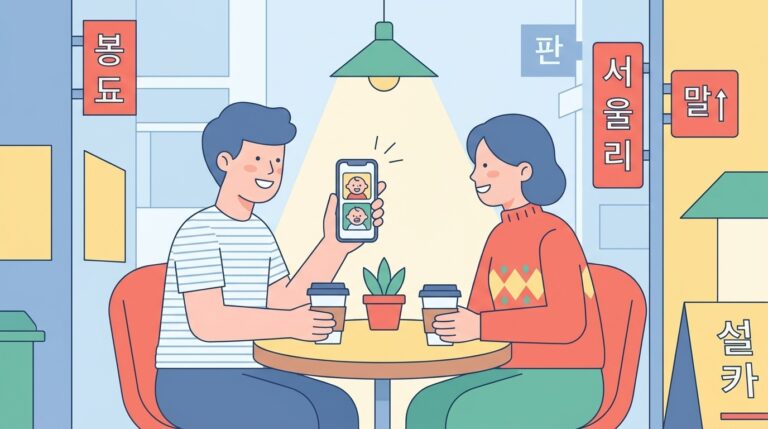
Picture this: You are sitting at a cozy cafe in Hongdae with your Korean friends. Everyone is sharing photos on their phones. Suddenly, you pull up a photo of your adorable niece or nephew doing something silly. You want to pour your heart out and say, “Isn’t my niece the absolute cutest? I can’t stop looking at her!” But suddenly, your mind goes blank. You end up just pointing at the screen and saying, “Baby… cute.” Sound familiar?
Bragging about family—especially cute little nieces and nephews—is a universal joy! In Korea, there’s even a special word for people obsessed with their nieces and nephews: Joka-babo (조카바보, meaning “niece/nephew fool”). Learning how to express this endearment in natural, warm Korean will instantly bring you closer to Korean native speakers. Based on real feedback from over 500 beginner learners at Daily Hangul, mastering just a few authentic phrases transforms awkward photo-sharing moments into joyful, bonding conversations!
Phase 2: Core Expressions Deep Dive
1. 우리 조카 너무 귀엽지 않아요?
- Pronunciation: [u-ri jo-ka neo-mu gwi-yeop-ji an-a-yo?] (Sounds like: oo-ree jo-kah nuh-moo gwee-yup-jee ahn-ah-yoh?)
- Meaning: “Isn’t my niece/nephew so cute?”
- K-Culture Moment: Seen frequently in K-dramas when characters proudly swipe through phone galleries during lunch breaks to brag about kids.
- Editor’s Insight: Notice how Koreans say 우리 (our) instead of 내 (my). In Korean culture, using “our” creates a warm, shared bond with the listener, making your enthusiasm contagious!
- Situation Spectrum: Casual ✅ | Semi-formal ✅ | Formal ⚠️
- Think About It: Why does Korean culture emphasize “our” (우리) even when talking about one’s own relative?
2. 완벽한 조카바보 다 됐어요
- Pronunciation: [wan-byeok-han jo-ka-ba-bo da dwae-sseo-yo]
- Meaning: “I’ve become a total niece/nephew fool!”
- K-Culture Moment: K-Pop idols often use this phrase during live streams when talking about gifts they bought for their sibling’s children.
- Editor’s Insight: 조카바보 (Joka-babo) literally translates to “niece/nephew fool”—someone who is so foolishly in love with their nephew/niece that they can’t stop spoiling them.
- Situation Spectrum: Casual ✅ | Semi-formal ✅ | Formal 🚫
- Think About It: Do you have a word in your native language that affectionately calls someone a “fool” for loving someone so much?
3. 보기만 해도 미소가 나와요
- Pronunciation: [bo-gi-man hae-do mi-so-ga na-wa-yo]
- Meaning: “Just looking at them brings a smile to my face.”
- K-Culture Moment: Common in heartwarming reality TV shows like The Return of Superman when watching kids grow up.
- Editor’s Insight: This phrase sounds very gentle and sincere. It shows deep warmth without sounding boastful.
- Situation Spectrum: Casual ✅ | Semi-formal ✅ | Formal ✅
- Think About It: How does expressing emotion through gentle physical reactions (smiling) change the tone of conversation?
Phase 3: Textbook Korean vs. Real Korean
Situation 1: Pointing out how cute a photo is
* 📖 Textbook Korean: 제 조카는 매우 귀엽습니다. (Je jo-ka-neun mae-u gwi-yeop-seum-ni-da.)
* 🗣️ Real Korean: 우리 조카 너무 귀엽죠? (U-ri jo-ka neo-mu gwi-yeop-jyo?)
* 💡 Why the difference? Textbook forms sound like a police report! Asking with -죠? invites the listener to agree with your joy.
Situation 2: Explaining your obsession
* 📖 Textbook Korean: 저는 조카를 아주 사랑합니다. (Jeo-neun jo-ka-reul a-ju sa-rang-ham-ni-da.)
* 🗣️ Real Korean: 저 완전 조카바보예요! (Jeo wan-jeon jo-ka-ba-bo-ye-yo!)
* 💡 Why the difference? Native speakers prefer colloquial slang like 조카바보 to express personal affection humorously.
Phase 4: K-Culture Deep Dive & Non-verbal Manners
4-1. Nunchi & Gestures
- Two-Handed Phone Hold: When showing photos of your niece/nephew on your smartphone, slightly tilt the phone toward your friend while holding it softly with both hands or supporting one wrist.
- The Squeal & Head Tilt: Tilting your head slightly while pressing your hand against your cheek (볼 ) shows overload of cuteness (심쿵 ).
4-2. Cultural Code: The ‘Joka-Babo’ Phenomenon
In modern Korea, young adults loved spending time with nephews and nieces (랜선이모/삼촌 – cyber aunts/uncles). Showing photos of family children isn’t seen as self-centered bragging; rather, it is viewed as sharing 힐링 (healing energy) with stressed friends.
Phase 5: Real-life Roleplay Scenario
Setting: A trendy cafe in Yeonnam-dong. You are chatting with your Korean friend, Minji (민지).
- 민지: [😊 Curiously looking at your phone] 어? 배경화면 아기 누구예요? 너무 귀엽다!
(Eeo? Bae-gyeong-hwa-myeon a-gi nu-gu-ye-yo? Neo-mu gwi-yeop-da! / Oh? Who is the baby on your wallpaper? So cute!) - You: [🎭 Smile proudly, tilting the phone] 우리 조카예요! 너무 귀엽지 않아요?
(U-ri jo-ka-ye-yo! Neo-mu gwi-yeop-ji an-a-yo? / It’s my niece! Isn’t she super cute?) - 민지: [😲 Eyes wide with awe] 와, 진짜 인형 같아요! 몇 살이에요?
(Wa, jin-jja in-hyeong gat-a-yo! Myeot sal-i-e-yo? / Wow, she really looks like a doll! How old is she?) - You: [🎭 Pointing to the photo excitedly] 이제 두 살이에요. 보기만 해도 미소가 나와요.
(I-je du sal-i-e-yo. Bo-gi-man hae-do mi-so-ga na-wa-yo. / She’s two years old now. Just looking at her makes me smile.) - 민지: [ㅋㅋ Laughing softly] 선물도 많이 사주겠어요!
(Seon-mul-do ma-ni sa-ju-get-seo-yo! / I bet you buy her lots of presents!) - You: [🎭 Shrugging happily] 맞아요, 저 완전 조카바보 다 됐어요!
(Ma-ja-yo, jeo wan-jeon jo-ka-ba-bo da dwae-sseo-yo! / That’s right, I’ve become a total niece-fool!) - 민지: [👍 Thumbs up] 인정! 사진 더 보여주세요!
(In-jeong! Sa-jin deo bo-yeo-ju-se-yo! / I agree! Show me more photos!) - You: [🎭 Swiping fast] 여기 보세요, 이 영상이 진짜 대박이에요!
(Yeo-gi bo-se-yo, i yeong-sang-i jin-jja dae-bak-i-e-yo! / Look here, this video is absolutely amazing!)
🔀 Interactive Branching Point
Minji asks: “선물 사주는 거 좋아해요?” (Do you like buying her presents?)
* Option A: 네, 옷이랑 장난감 다 사줘요. (Yes, I buy her clothes and toys.)
* Option B: 맞아요, 내 통장은 조카 거예요! (Right, my bank account belongs to my niece!)
* Option C: 아니요, 너무 비싸요. (No, it’s too expensive.)
Feedback:
* Option A (Good): Clear and natural for A2 level!
* Option B (Best! ✨): Hilarious, native-level humor! Shows deep familiarity with Korean cultural slang.
* Option C (Risk ⚠️): A bit blunt; might damp the cheerful atmosphere.
Phase 6: 10-Second Emotion Shadowing Drill
[😊 Proud & Excited]우리 조카 / 너무 귀엽지 않아요?
(U-ri jo-ka / neo-mu gwi-yeop-ji an-a-yo?)[🥺 Tender & Loving]보기만 해도 / 미소가 나와요.
(Bo-gi-man hae-do / mi-so-ga na-wa-yo.)[😆 Laughing & Playful]저 완전 / 조카바보 다 됐어요!
(Jeo wan-jeon / jo-ka-ba-bo da dwae-sseo-yo!)
Phase 7: K-Culture Mini Dictionary
- 조카바보 (Joka-babo): Noun. Someone endlessly devoted to their niece or nephew.
- 심쿵 (Sim-kung): Noun/Verb. Heart-throbbing/heart-stopping cuteness.
- 우쭈쭈 (U-jju-jju): Interjection. Baby-talk expression used to soothe or praise young kids.
- 랜선이모/삼촌 (Ranseon-imo/samchon): Noun. “Online aunt/uncle” who loves kids seen on social media.
Phase 8: Traveler’s Survival Kit
Top 3 Survival Phrases
- 사진 보여줄게요. (Sa-jin bo-yeo-jul-ge-yo.) – I’ll show you a photo.
- 진짜 귀엽죠? (Jin-jja gwi-yeop-jyo?) – Isn’t it really cute?
- 동영상도 있어요. (Dong-yeong-sang-do it-seo-yo.) – I also have a video.
Editor’s Travel Note
When traveling in Korea, storing photos on local apps makes sharing fast! Make sure to Install KakaoTalk Messenger to easily exchange adorable photos with your new Korean friends.
Phase 9: One Step Deeper
In Korean society, family ties extend beyond biological parents and children. Nieces and nephews are loved like one’s own children, reflecting Korea’s deep-rooted community culture (정, Jeong). When you share photos of your niece or nephew, you aren’t just showing a picture—you are inviting the listener into your warm family circle.
💬 Your Turn: Do you have nieces, nephews, or younger relatives? Tell us in the comments using the phrase: “우리 조카 ____예요!”
Phase 10: FAQ & Common Mistakes
Q: Can I use ‘조카바보’ in formal settings?
A: It is a casual slang term! Use it with friends or coworkers during lunch, but avoid it in formal business presentations.
Q: What is the difference between 조카 (Joka) for boys vs. girls?
A: Korean uses 조카 (Joka) for both nieces and nephews! If you want to specify gender, say 조카딸 (niece) or 조카아들 (nephew).
Q: Should I say ‘내 조카’ or ‘우리 조카’?
A: Always prefer 우리 조카! It sounds warmer and more natural to Korean speakers.
🚨 Common Mistakes TOP 3
- Mistake: Calling them 내 아기 when they are your niece/nephew.
Correct Action: Use 우리 조카 (our niece/nephew). - Mistake: Saying 매우 귀엽다 robotically.
Correct Action: Use 너무 귀엽죠? with rising pitch. - Mistake: Forgetting honorifics with adults while using baby words.
Correct Action: Balance casual slang with proper sentence endings (-요 ).
Phase 11: Action Mission
- 🥉 Bronze Mission: Practice saying “우리 조카 너무 귀엽죠?” 3 times out loud.
- 🥈 Silver Mission: Post a photo of your niece/nephew or pet on Instagram with the hashtag
#조카바보. - 🥇 Gold Mission: Use “보기만 해도 미소가 나와요” in your next Korean conversation class!
🎮 K-Culture Mission: Watch an episode of a Korean reality show (like The Return of Superman) and spot when someone says “귀여워!”.
Phase 12: Interactive Quiz Challenge
Quiz 1: Situation Judgment
What is the best phrase to say when showing a cute video of your nephew to a friend?
– A) 제 조카는 위험합니다.
– B) 우리 조카 너무 귀엽지 않아요?
– C) 조카가 없습니다.
🔍 Click to view Answer & Explanation
Correct Answer: B
Explanation: “우리 조카 너무 귀엽지 않아요?” is the natural, friendly way to brag about your nephew!
Quiz 2: Fill in the Blank
Complete the slang for a niece-obsessed person: 조카___
– A) 천재 (Cheon-jae)
– B) 바보 (Ba-bo)
– C) 박사 (Bak-sa)
🔍 Click to view Answer & Explanation
Correct Answer: B
Explanation: 조카바보 (Joka-babo) literally means “niece/nephew fool”!
Quiz 3: True / False Culture Quiz
In Korea, saying “our niece” (우리 조카) means the niece belongs to everyone in the room. (True/False?)
🔍 Click to view Answer & Explanation
Correct Answer: False
Explanation: 우리 is used affectionately to mean “my family’s” or to create warm rapport with the listener!







