

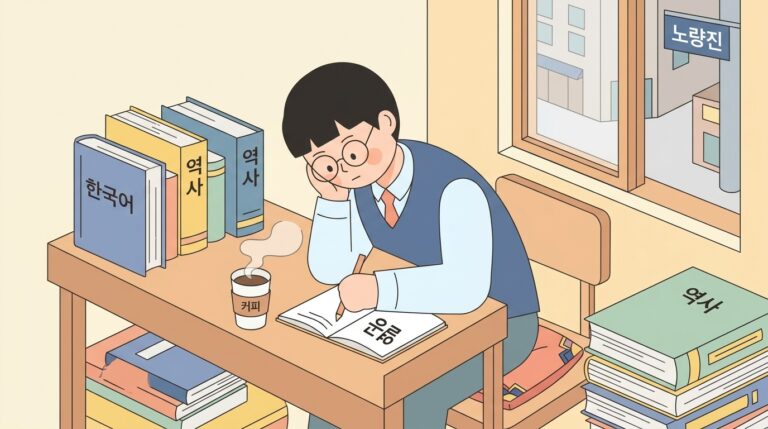
Phase 1: Empathy (Welcome to the World of Gongsisaeng!)
안녕하세요! 매일한글 에디터입니다. (Hello! I’m your lead editor at Daily Hangul!)
Imagine stepping into a dimly lit study cafe in Noryangjin, Seoul at 6:00 AM. Surrounding you are rows of quiet cubicles filled with young Koreans surrounded by towers of high-density civil service prep books, sticky notes, and drained cans of energy drinks. Welcome to the intense world of 공시생 (Gongsisaeng)—civil service exam prep students. In South Korea, passing the civil service exam isn’t just getting a job; for many, it represents ultimate stability, pride, and the pinnacle of Korean Education Fever (교육 열기).
If you’ve ever watched K-dramas depicting test prep life or chatted with Korean friends grinding through exams, you might feel confused by expressions like “뼈를 묻다” (burying one’s bones) or “존버하다” (enduring stubbornly). Standard textbooks teach you formal vocabulary, but they rarely capture the emotional grit, solidarity, and cultural weight behind this lifestyle. Based on real learner feedback and cultural insights, this guide will equip you with B2-level natural expressions to sound like an authentic insider while navigating Korea’s high-stakes education mindset!
Phase 2: Deep-Dive Analysis of 3 Core Expressions
1. 합격하다 (Hap-gyeok-ha-da) / 붙다 (But-da)
- Pronunciation: [Hap-gyeok-ha-da] / [But-da] (Sounds like hap-gyeok-ha-da / boot-da, where ‘but’ clings like sticky rice tape!)
- Meaning: Literal: To pass an exam / To stick. Nuanaced: Passing a competitive test; “붙다” feels much more colloquial and intimate.
- K-Culture Moment: On the day exam results drop at midnight, students refresh the official web page frantically. When the screen flashes blue, they scream, “나 붙었어!” (I passed/I stuck!)
- Editor’s Insight: While “합격하다” is used on official certificates, native Koreans almost exclusively use “붙다” when telling friends and family. It visualizes your name literally sticking to the pass list.
- Situation Spectrum: Casual (붙다 ✅) / Semi-formal (붙었어요 ✅) / Formal (합격했습니다 ✅)
- 🤔 Think About It: Why do Koreans eat sticky rice cakes (찹쌀떡) or taffy (엿) before big exams? How does your culture metaphorically describe success?
2. 피, 땀, 눈물을 흘리다 (Pi, ttam, nun-mul-eul heul-li-da)
- Pronunciation: [Pi, ttam, nun-mul-eul heul-li-da] (Pee, ttam like ‘stomp’ without s, noon-mool-eul)
- Meaning: Literal: To shed blood, sweat, and tears. Nuanced: Pouring every ounce of soul and energy into a monumental goal.
- K-Culture Moment: Exam takers talking about their 14-hour daily routine: “이번 시험에 내 피, 땀, 눈물을 다 쏟았어.” (I poured all my blood, sweat, and tears into this exam.)
- Editor’s Insight: Famous globally through BTS, this idiom deeply resonates with Korean work ethics. When applied to Gongsisaeng, it acknowledges the sheer sacrifice required to beat 50:1 competition ratios.
- Situation Spectrum: Casual (✅) / Semi-formal (✅) / Formal (✅)
- 🤔 Think About It: Is effort celebrated more than innate talent in your home culture?
3. 존버하다 (Jon-beo-ha-da)
- Pronunciation: [Jon-beo-ha-da] (Jahn-boh-ha-da, rhymes with ‘john-bore-ha-dah’)
- Meaning: Literal: Extremely stubborn endurance (Slang: 존나 버티다). Nuanced: Holding out stubbornly through extreme struggle until victory arrives.
- K-Culture Moment: Two test takers sharing a cheap cup-bap (rice bowl) outside Noryangjin station saying, “조금만 더 존버하자. 곧 끝난다.” (Let’s hold out just a bit longer. It’ll end soon.)
- Editor’s Insight: Originating in gaming and crypto communities, this slang is now widely accepted among young Koreans facing economic or educational endurance tests. Use it with close peers!
- Situation Spectrum: Casual (✅) / Semi-formal (⚠️ Use with caution) / Formal (🚫 Never in interviews)
- 🤔 Think About It: What informal words do youth in your country use to encourage resilience?
Phase 3: Textbook Korean vs. Real Korean
Scenario 1: Encouraging a friend who is studying for a big exam
- 📖 Textbook Korean: “시험 준비를 열심히 하세요. 좋은 결과가 있을 것입니다.” (Study hard for the exam. There will be good results.)
- 🗣️ Real Korean: “이번엔 꼭 붙을 거야! 조금만 더 힘내!” (You’re definitely going to pass this time! Hang in there just a bit more!)
- 💡 Why is it different? Textbook phrases sound like an impersonal fortune cookie. Real Korean uses emotive verb forms (“붙을 거야”) to build warm solidarity.
Scenario 2: Expressing extreme fatigue from long studying hours
- 📖 Textbook Korean: “공부를 많이 해서 매우 피곤합니다.” (I studied a lot so I am very tired.)
- 🗣️ Real Korean: “오늘 진짜 멘붕 왔어. 집중력이 완제 깎였네.” (I had a total mental breakdown today. My focus is completely drained.)
- 💡 Why is it different? “멘붕” (Mental collapse) and gaming-inspired verbs express psychological exhaustion far better than generic adjectives like “피곤하다”.
Phase 4: K-Culture Deep Dive & Non-Verbal Manners
4-1. Nunchi & Gestures in Noryangjin
- Quiet Nod & Double Fist (파이팅): In study zones, loud cheerleading is strictly forbidden. Friends encourage each other by making eye contact, tightly clenching two fists near the chest, and giving a firm, silent nod.
- Whisper Etiquette: If speaking inside an exam academy corridor, tilt your body inward, cover your mouth slightly with your hand, and speak using minimal vocal cord vibration.
4-2. Cultural Code: The Noryangjin Ecosystem & Cup-bap
Noryangjin (노량진) in Seoul is the epicenter of Korea’s exam culture. Here, time is money. Students eat 컵밥 (Cup-bap)—inexpensive, high-calorie rice bowls cooked in under 2 minutes—so they can rush back to study. The culture values sacrifice today for stability tomorrow. Watching study live streams called 공방 (Gong-bang / Study with me) is a popular way students hold themselves accountable.
Phase 5: Interactive Roleplay Scenario
Setting: A quiet study cafe lounge in Noryangjin. You meet Minjun (민준), a friend who has been preparing for the 9th-grade Civil Service Exam for two years.
Characters:
* You (B2 Learner): A supportive friend visiting Minjun during his study break.
* Minjun (NPC): An exhausted but determined exam prep student.
Dialogue (8 Turns)
- You: 민준 씨, 요즘 공부 잘돼 가요? 얼굴이 좀 파리해 보여요. (Minjun, is studying going well these days? You look a bit pale.)
- 🎭 Action: Looking at Minjun with genuine concern while handing him a warm warm canned coffee.
- Minjun: 아, 왔어요? 말도 마세요. 모의고사 성적이 기복이 심해서 요즘 진짜 멘붕이에요. (Ah, you came? Don’t even ask. My mock test scores fluctuate so much, I’m having a total mental breakdown.)
- You: 아이구, 슬럼프가 왔나 보네요. 피, 땀, 눈물 흘리며 준비했으니 잘될 거예요. (Oh dear, sounds like a slump. You’ve poured your blood, sweat, and tears into this, so it’ll work out.)
- Minjun: 고마워요. 근데 경쟁률이 40 대 1이라 가끔 불안해서 잠이 안 와요. (Thanks. But the competition ratio is 40 to 1, so sometimes anxiety keeps me awake.)
- You: 당연히 부담스럽죠. 하지만 지금까지 잘 버텨왔잖아요. 이번엔 진짜 붙을 거예요! (Of course it’s stressful. But you’ve endured well so far. You’ll definitely pass this time!)
- 🎭 Action: Clenching a light fist and offering a quiet ‘Fighting’ gesture.
- Minjun: 맞아요. 여기서 포기할 순 없죠. 조금만 더 존버해 볼게요! (You’re right. I can’t give up here. I’ll endure stubbornly a bit longer!)
- You: 그래요! 합격하면 맛있는 거 사주세요. 제가 노량진 컵밥 말고 진짜 맛집 예약할게요. (Right! Buy me something delicious when you pass. I’ll book a real restaurant, not just Noryangjin cup-bap.)
- Minjun: 하하, 좋아요! 꼭 합격증 들고 나타날게요! (Haha, sounds good! I’ll definitely show up with a passing certificate!)
🔀 Interactive Choice Point
Minjun sighs deeply and says: “오늘따라 집중이 안 되는데 그냥 집에 가서 쉴까요?” (I can’t focus today… Should I just go home and rest?)
- Option A: “네, 그냥 집에서 편하게 쉬세요.” (Go home and relax.)
- Option B: “안 돼요! 공시생이 쉬면 합격 못 해요!” (No! If a test candidate rests, you can’t pass!)
- Option C: “오늘 너무 지쳤으면 머리도 식힐 겸 10분만 산책하고 다시 집중해 봐요.” (If you’re drained, take a 10-minute walk to clear your head and refocus.)
Feedback:
* Option A (Risk): Too passive. For a dedicated Gongsisaeng, quitting early can trigger guilt.
* Option B (Bad): Too harsh! Comes across as cold and judgmentally pushy.
* Option C (Best! 🎉): Empathetic yet encouraging. Balances self-care with his ultimate goal.
Phase 6: 10-Second Emotion Shadowing Drill
Practice pronouncing these sentences with accurate pitch and emotional tone. Focus on pauses indicated by /.
[🥺 걱정과 공감 / Empathetic Concern]- 이번 시험 / 진짜 부담되겠다… / 그래도 너는 꼭 붙을 거야!
- I-beon si-heom / jin-jja bu-dam-doe-get-da… / geu-rae-do neo-neun kkok bu-teul geo-ya!
[🔥 단호함과 격려 / Determined Encouragement]- 피, 땀, 눈물 흘린 만큼 / 결과가 나올 거야! / 조금만 더 존버하자!
- Pi, ttam, nun-mul heul-lin mang-keum / gyeol-gwa-ga na-ol geo-ya! / jo-geum-man deo jon-beo-ha-ja!
Phase 7: K-Culture Mini Dictionary
- 공시생 (Gong-si-saeng) | Student preparing for public civil service examinations.
- Usage: Used everywhere in news, social media, and drama titles to describe test-prep youth.
- 노량진 (No-ryang-jin) | Neighborhood in Seoul known as the Mecca of private tutoring academies and test prep.
- Usage: Symbolic of youthful sacrifice, cheap food stalls, and intense academic effort.
- 컵밥 (Cup-bap) | Rice topped with various ingredients like kimchi, egg, and pork in a paper cup.
- Usage: A iconic street food beloved by busy students needing quick, budget-friendly meals.
- 합격수기 (Hap-gyeok-su-gi) | Personal essay/review written by successful candidates detailing their study strategies.
- Usage: Read obsessively by new students searching for proven roadmaps to victory.
Phase 8: Traveler & Learner Survival Kit
Survival Phrases TOP 3
- 공부하기 좋은 카페인가요? (Gong-bu-ha-gi jo-eun ca-fe-in-ga-yo?)
- Is this cafe good for studying?
- Pro Tip: Look for power outlets (콘센트) and low ambient music.
- 여기 와이파이 비밀번호가 뭐예요? (Yeo-gi wi-fi bi-mil-beon-ho-ga mwo-yeo-yo?)
- What is the Wi-Fi password here?
- 조용히 해야 하는 구역인가요? (Jo-yong-hi hae-ya ha-neun gu-yeok-in-ga-yo?)
- Is this a quiet zone?
Editor’s Travel Note
When visiting Korea to experience study cafes or public libraries, use the Naver Map App Download to search for ‘스터디카페’ (Study Cafe). Unlike regular cafes, study cafes use automated kiosk payment systems at the entrance where you buy time passes (e.g., 2-hour or 4-hour passes).
Phase 9: One Step Deeper (Humanities Essay)
Why are so many young Koreans obsessed with civil service exams? In a hyper-competitive society driven by fast tech shifts and corporate restructuring, civil service jobs (공무원) offer absolute job security until retirement and a stable pension. It reflects a cultural transition where young adults balance high social expectations against economic uncertainty. Passing the exam is seen as winning freedom from financial anxiety.
💬 Your Turn: Is job stability or pursuing personal passion more valued in your country’s education system? Tell us in the comments below!
Phase 10: FAQ & Common Mistakes
Q: What is the difference between 합격하다 and 붙다?
A: “합격하다” is a Sino-Korean formal verb used in official writing, resumes, and announcements. “붙다” is a native Korean verb used widely in everyday speech, spoken messages, and informal encouragement.
Q: Is it rude to say “존버하세요” to a teacher or boss?
A: Yes! “존버” stems from vulgar slang. Never use it with teachers, elders, or superiors. Use formal alternatives like “끝까지 견디겠습니다” (I will endure until the end) instead.
Q: What food should I NEVER give to someone taking an exam?
A: Seaweed soup (미역국)! Because seaweed is slippery, Koreans believe eating it will cause you to “slip” (미끄러지다) and fail the exam.
🚨 Common Mistakes Alert
- Mistake: Saying “시험을 잘 보세요” after the exam is over.
- Correct Action: Say “시험 잘 봤어요?” (Did you take the exam well?) post-exam, and save “잘 보세요” for before the test!
- Mistake: Using “파이팅” too loudly in quiet study zones.
- Correct Action: Give a silent fist gesture or write a small sticky note encouragement.
- Mistake: Translating “I failed the test” as “시험을 잃었어요”.
- Correct Action: Say “시험에 떨어졌어요” (I fell from the exam) or “시험 망쳤어요” (I ruined the exam).
Phase 11: Action Mission & Engagement
3-Step Action Mission
- 🥉 Bronze: Write a comment below using “붙을 거예요!” to cheer on a friend.
- 🥈 Silver: Watch a K-drama clip featuring student life (e.g., Reply 1988 or Crash Course in Romance) and post one sentence you heard on Instagram tagging @DailyHangul.
- 🥇 Gold: Visit a local Korean study cafe or practice using “붙다” with your Korean language partner today!
🎮 K-Culture Mission
Find a K-Pop song or K-drama scene where a character drinks canned coffee while studying late at night. Take a screenshot and identify if they look like a Gongsisaeng!
Phase 12: Interactive Quiz Challenge
Question 1: Situation Judgment
Your Korean friend is taking the civil service exam tomorrow morning. What is the BEST gift to give them?
* A) Slippery seaweed soup (미역국)
* B) Sticky rice cake (찹쌀떡)
* C) A pair of scissors (가위)
🔍 Click to reveal Answer & Explanation
Correct Answer: B) Sticky rice cake (찹쌀떡)
Explanation: Sticky food represents “sticking” (붙다) to the test pass list! Seaweed soup is avoided because its slippery texture symbolizes slipping/failing.
Question 2: Fill in the Blank
Complete the natural sentence: “2년 동안 열심히 공부했으니까 이번엔 꼭 ________!” (Because I studied hard for 2 years, I will definitely pass this time!)
* A) 미끄러질 거야
* B) 붙을 거야
* C) 잃어버릴 거야
🔍 Click to reveal Answer & Explanation
Correct Answer: B) 붙을 거야
Explanation: “붙다” is the natural colloquial verb for passing an exam.
Question 3: True or False
True or False: “존버하다” is an appropriate expression to use in a formal job interview with a company director.
🔍 Click to reveal Answer & Explanation
Correct Answer: False
Explanation: “존버하다” is informal youth slang derived from strong language. Use formal terms like “끝까지 노력하겠습니다” in job interviews!







