

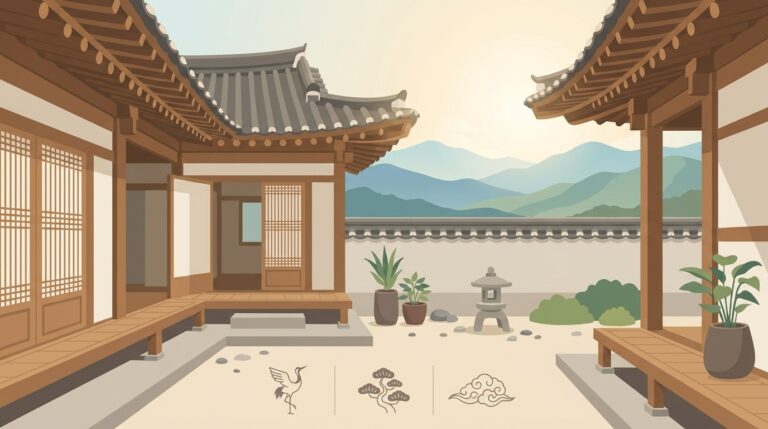
Master the Architectural Wisdom of Hanok: C1 Korean Expressions for Traditional Science & Heritage
안녕하세요! 매일한글 에디터입니다. Welcome back to another deep dive into high-level Korean language and culture! Have you ever stepped inside a traditional Hanok (한국 전통 가옥) on a humid summer afternoon or a freezing winter morning in Bukchon, only to feel surprisingly comfortable without modern air conditioning or electric heaters?
Many advanced Korean learners tell me, “I can describe modern buildings easily, but when discussing the scientific engineering behind Hanok—like passive heating or microclimate regulation—my Korean suddenly feels limited to simple vocabulary.” If you have ever struggled to articulate concepts like borrowed scenery (차경) or thermal dynamic flooring (온돌) during guided heritage tours or high-level conversations, this guide is crafted specifically for you. Drawing from authentic architectural discourses and feedback from our advanced C1 cohort, today we elevate your vocabulary from simple descriptions to insightful cultural analysis.
Phase 2: Top 3 Core Expressions for Hanok Science
1. 처마의 선이 빚어내는 그늘 (Cheoma-ui seon-i bijeonaeneun geuneul)
- Pronunciation: [Cheo-ma-ui seon-i bi-jeo-nae-neun geu-neul] (Sounds like “chaw-mah-wee seon ee bee-jaw-nae-neun geu-neul”)
- Meaning: “The shade crafted by the curves of the eaves.” (Literal: The line of the eaves brewing shade).
- K-Culture Moment: Seen in documentary features or historical dramas (사극) when characters reflect on how the roof angle block hot summer rays while letting low winter sunlight penetrate deep into the room.
- Editor’s Insight: Beyond aesthetics, 처마 (eaves) embodies solar angle calculation. Use 빚어내다 (to craft/mold) instead of simple verbs like 만들다 to sound sophisticated.
- Situation Spectrum: Casual 🚫 | Semi-formal ⚠️ | Formal ✅
- Thinking Question: How does your culture’s traditional architecture adapt to seasonal sun angles compared to Korea’s eaves?
2. 자연을 집 안으로 들이는 차경 (Jayeon-eul jip an-euro deuri-neun chagyeong)
- Pronunciation: [Ja-yeon-eul jip an-eu-ro deu-ri-neun cha-gyeong] (Sounds like “jah-yeon-eul jeep ahn-eu-ro deu-ree-neun chah-gyeong”)
- Meaning: “Borrowed scenery: bringing nature into the living space.”
- K-Culture Moment: Discussed in eco-friendly architecture forums or high-end Hanok stays where windows serve as natural picture frames (프레임).
- Editor’s Insight: 차경 (借景) literally means “borrowing scenery.” In Korean philosophy, nature is not conquered; it is temporarily invited into one’s home.
- Situation Spectrum: Casual ⚠️ | Semi-formal ✅ | Formal ✅
- Thinking Question: Why do you think ancient Koreans prioritized framing nature over decorating interior walls with artificial art?
3. 온돌과 대청마루의 공존 (Ondol-gwa daecheongmaru-ui gongjon)
- Pronunciation: [On-dol-gwa dae-cheong-ma-ru-ui gong-jon] (Sounds like “ohn-dohl-gwah dae-chawng-mah-roo-wee gong-john”)
- Meaning: “The coexistence of Ondol (radiant floor heating) and Daecheongmaru (open wooden hall).”
- K-Culture Moment: Architectural lectures explaining how two opposite thermal systems (heating and cooling) exist within a single wooden structure.
- Editor’s Insight: 온돌 uses conductive heat while 대청마루 uses convection currents created by the courtyard’s pressure difference. Highlighting this duality showcases true C1 fluency.
- Situation Spectrum: Casual ⚠️ | Semi-formal ✅ | Formal ✅
- Thinking Question: How do modern smart homes integrate similar thermodynamic principles without electricity?
Phase 3: Textbook Korean vs. Real Native C1 Korean
Situation 1: Explaining how Hanok stays cool in summer
- 📖 Textbook: 한옥은 바람이 잘 통해서 여름에 시원합니다. (Hanok is cool in summer because wind passes well.)
- 🗣️ Real Native (C1): 마당과 대청마루 사이의 기압 차이로 인해 자연 기류가 형성되어 여름철에도 서늘함을 유지합니다. (Due to atmospheric pressure differences between the courtyard and the wooden hall, natural air currents form, maintaining cool temperatures even in peak summer.)
- 💡 Why it differs: Native C1 speakers use precise scientific nouns (기압 차이, 자연 기류) and nuanced verbs (유지하다) to explain cause and effect naturally.
Situation 2: Praising the view through a Hanok window
- 📖 Textbook: 창문 밖으로 보이는 풍경이 예쁩니다. (The scenery visible outside the window is pretty.)
- 🗣️ Real Native (C1): 창틀을 프레임 삼아 계절의 변화를 담아내는 차경의 미학이 돋보이네요. (The aesthetics of borrowed scenery, which uses the window frame to capture seasonal transitions, really stand out.)
- 💡 Why it differs: Replacing standard adjectives with conceptual expressions (차경의 미학, 담아내다) demonstrates high cultural literacy.
Phase 4: K-Culture Deep Dive & Non-Verbal Manners
4-1. Nunchi & Etiquette in Hanok Spaces
When visiting a historical Hanok or attending an architectural tour, proper etiquette reflects your respect for heritage:
* Stepping on threshold (문턱): Never step directly on the wooden threshold (문턱을 밟지 않기). It signifies respect for the home’s boundaries and structural frame.
* Walking on Daecheongmaru: Walk gently with soft footsteps (사뿐사뿐 걷기) to avoid damaging the ancient unvarnished wood.
* Lowering head at doors: Hanok doorframes are intentionally low to encourage modest posture (겸손한 자세) upon entering.
4-2. Cultural Code Analysis: The Thermal Science of Clay and Wood
A Hanok is a breathing structure. The walls made of clay mixed with straw (황토와 짚) regulate humidity automatically: absorbing moisture during humid monsoon seasons and releasing it during dry winters. This zero-carbon, self-regulating design philosophy is currently experiencing a revival among modern eco-architects worldwide.
Phase 5: Real Roleplay Scenario
Setting: A guided masterclass tour at Namsangol Hanok Village between an Architectural Historian (Master Park) and an Advanced Foreign Scholar (Alex).
- Master Park: 어서 오세요, 알렉스 님. 한옥의 지붕 선을 유심히 보신 적이 있으신가요?
(Eoseo oseyeo, Alex-nim. Hanok-ui jibung seon-eul yusimhi bosin jeog-i iss-eusin-gayo?)
“Welcome, Alex. Have you ever closely observed the roofline of a Hanok?”🎭 [Pointing up gracefully toward the eaves] - Alex: 네, 처마의 곡선이 매우 완만하면서도 단아하다고 느꼈습니다.
(Ne, cheoma-ui gokseon-i mae-u wanmanhamseondod dana-hadago neukkeoss-seumnida.)
“Yes, I felt that the curve of the eaves is very gentle yet elegant.”🎭 [Nodding respectfully with hand on chest] - Master Park: 맞습니다. 하지만 이건 단순한 미학적 곡선이 아닙니다. 계절별 태양의 고도를 계산한 과학적 설계죠.
(Mat-seumnida. Hajiman igeo-neun dansunhan mihak-jeok gokseon-i animnida. Gyejeol-byeol taeyang-ui godo-reul gyesan-han gwahak-jeok seolgye-jyo.)
“Correct. However, this is not merely an aesthetic curve. It is a scientific design calculated based on the seasonal solar altitude.”🎭 [Explaining with open palms] - Alex: 아, 여름에는 뜨거운 햇살을 차단하고 겨울에는 깊숙이 햇살을 들여오는 원리군요!
(A, yeoreum-eneun tteugeo-un haetsal-eul chadan-hago gyeoeul-eneun gipsugi haetsal-eul deuri-eo-oneun weon-ri-gunyo!)
“Ah, so it’s the principle of blocking hot sunlight in summer and allowing sunlight deep inside in winter!”🎭 [Brightens eyes with an inspired expression] - Master Park: 정확합니다! 더불어 뒷산과 마당 사이의 기압 차가 만들어내는 바람길도 한몫을 하지요.
(Jeonghwak-hamnida! Deobulleo dwitsan-gwa madang sai-ui giap cha-ga mandeur-eo-naeneun baramgil-do hanmok-eul haji-yo.)
“Exactly! Furthermore, the wind path created by the pressure difference between the back mountain and the front courtyard plays a big role.”🎭 [Smiling approvingly] - Alex: 한옥은 단순한 주거 공간을 넘어 자연과 호흡하는 하나의 생태계 같습니다.
(Hanok-eun dansunhan jugeo gonggan-eul neomeo jayeon-gwa hohup-haneun hana-ui saengtae-gye gat-seumnida.)
“Hanok seems to go beyond a simple residential space; it’s like an ecosystem breathing with nature.”🎭 [Speaking with deliberate admiration] - Master Park: 훌륭한 통찰입니다. 차경(借景)의 정신을 정확히 파악하셨네요.
(Hullyung-han tongchal-imnida. Chagyeong-ui jeongsin-eul jeonghwak-hi pa-ak-hasyeot-neyeo.)
“Wonderful insight. You’ve accurately grasped the spirit of borrowed scenery.”🎭 [Gently clapping hands in appreciation] - Alex: 선생님 덕분에 한옥의 정교한 매력을 깊이 깨닫게 되었습니다.
(Seonsaeng-nim deokbune hanok-ui jeonggyo-han maeryeok-eul gipi kkaedat-ge doe-eoss-seumnida.)
“Thanks to you, Master, I have come to deeply appreciate the sophisticated charm of Hanok.”🎭 [Bowing head respectfully]
🔀 Interactive Branching Point:
If Master Park asks you: *
Frequently Asked Questions (FAQ)
Q: What does "처마의 선이 빚어내는 그늘 (Cheoma-ui seon-i bijeonaeneun geuneul)" mean in Korean and how do you pronounce it?
A: In Korean, "처마의 선이 빚어내는 그늘 (Cheoma-ui seon-i bijeonaeneun geuneul)" is pronounced [Cheo-ma-ui seon-i bi-jeo-nae-neun geu-neul] and means: "The shade crafted by the curves of the eaves." (Literal: The line of the eaves brewing shade).
Q: What does "자연을 집 안으로 들이는 차경 (Jayeon-eul jip an-euro deuri-neun chagyeong)" mean in Korean and how do you pronounce it?
A: In Korean, "자연을 집 안으로 들이는 차경 (Jayeon-eul jip an-euro deuri-neun chagyeong)" is pronounced [Ja-yeon-eul jip an-eu-ro deu-ri-neun cha-gyeong] and means: "Borrowed scenery: bringing nature into the living space."
Q: What does "온돌과 대청마루의 공존 (Ondol-gwa daecheongmaru-ui gongjon)" mean in Korean and how do you pronounce it?
A: In Korean, "온돌과 대청마루의 공존 (Ondol-gwa daecheongmaru-ui gongjon)" is pronounced [On-dol-gwa dae-cheong-ma-ru-ui gong-jon] and means: "The coexistence of Ondol (radiant floor heating) and Daecheongmaru (open wooden hall)."







