

Phase 1: Empathy (Storytelling Opening)
안녕하세요! 매일한글 에디터입니다.
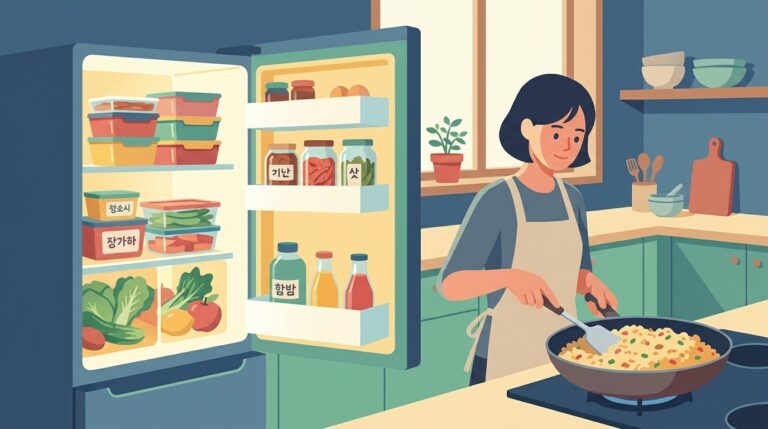
Picture this: It’s 8:00 PM on a Tuesday evening in Seoul. You open your apartment refrigerator after a long day of work or studying, hoping for a culinary miracle. Instead, you’re greeted by half an onion, two lonely sausages, a tub of gochujang (chili paste), and three small plastic containers of week-old banchan (side dishes) from the local market. Eating out feels like too much effort, but ordering food delivery again feels guilty for your wallet.
This is where every Korean adult—especially those living alone (jachwijok)—masters a sacred survival skill: 냉장고 털기 (Raid the Fridge Cooking). In Korean culture, transforming mismatched leftovers into a sizzling pan of Kimchi Fried Rice or Budae Jjigae isn’t just frugal; it’s an art form celebrated in viral videos and popular variety shows.
Learning how to talk about clearing out your fridge in Korean will elevate your everyday conversational skills from textbook rigid to delightfully authentic. Based on feedback from our B1-level learners who live or study in Korea, mastering these casual housework expressions builds instant rapport with Korean housemates, friends, and co-workers. Let’s dive in!
Phase 2: Top 3 Core Expressions Deep Dive
1. 냉장고를 털다 (Naeng-jang-go-reul teol-da)
- Pronunciation: Naeng-jang-go-reul teol-da (Sounds like “nang-jang-go” + “teol-da” as in dusting off a rug)
- Meaning: Literal: To rob/shake out the refrigerator | Real Nuance: To raid the fridge and use up every last ingredient.
- K-Culture Moment: You’ll hear this constantly in reality shows like I Live Alone (나 혼자 산다) when someone cooks before grocery shopping day.
- Editor’s Insight: While 털다 literally means to rob or brush off dust, when paired with 냉장고, it carries a fun, lighthearted vibe of making do with what you have.
- Situation Spectrum:
- Casual (Friends, Housemates): ✅ “오늘 저녁은 냉장고 털자!” (Let’s raid the fridge tonight!)
- Semi-formal (Co-workers): ⚠️ “오늘 집에서 냉장고 좀 털어야겠어요.” (I need to clean out my fridge at home today.)
- Formal (Boss, Elders): 🚫 (Use “남은 재료를 정리하려고 합니다” instead)
- 🤔 Think About It: Why do you think Korean society values not wasting food and turning random leftovers into shared meals?
2. 남은 재료로 만들다 (Nam-eun jae-ryo-ro man-deul-da)
- Pronunciation: Nam-eun jae-ryo-ro man-deul-da (Focus on connecting nam-eun smoothly)
- Meaning: Literal: To make with remaining ingredients | Real Nuance: To whip up a quick dish using whatever leftovers are at hand.
- K-Culture Moment: Commonly used in YouTube cooking vlogs titled “남은 재료로 만드는 초간단 요리” (Super simple dish made with leftover ingredients).
- Editor’s Insight: The particle -로 (with/using) is key here. It shows resourcefulness and flexibility in your cooking process.
- Situation Spectrum:
- Casual: ✅ “냉장고에 남은 재료로 대충 만들었어.” (I just whipped it up with leftover stuff in the fridge.)
- Semi-formal: ✅ “남은 재료로 만든 요리인데 드셔보세요.” (This is a dish made from leftover ingredients, please try some.)
- Formal: ✅ “남은 재료를 활용하여 조리했습니다.” (Prepared utilizing remaining ingredients.)
- 🤔 Think About It: In your country, is cooking with leftovers viewed as budget savings, creative cooking, or just lazy? How does that compare to Korea?
3. 해먹다 (Hae-meok-da)
- Pronunciation: Hae-meok-da (Blend hae and meok smoothly without a harsh pause)
- Meaning: Literal: To make and eat | Real Nuance: To cook oneself a quick meal at home instead of eating out.
- K-Culture Moment: Friends often ask each other on weeknights, “오늘 저녁 집에서 해먹을 거야?” (Are you cooking yourself dinner at home tonight?)
- Editor’s Insight: 해먹다 combines 하다 (to do/make) and 먹다 (to eat). It sounds far more intimate and casual than 요리하다 (to cook standard dishes).
- Situation Spectrum:
- Casual: ✅ “귀찮은데 그냥 볶음밥이나 해먹자.” (It’s a hassle, so let me just cook and eat fried rice.)
- Semi-formal: ⚠️ “집에서 자주 해먹는 편이에요.” (I tend to cook and eat at home often.)
- Formal: 🚫 (Use “직접 요리해서 먹습니다” instead)
- 🤔 Think About It: Notice how Korean compounds two verbs (make + eat) to describe a single daily habit. What compound verbs exist in your native language?
Phase 3: Textbook Korean vs. Real Korean
Situation 1: Deciding to cook leftovers
- 📖 Textbook Korean: “남은 재료를 사용하여 요리하겠습니다.” (I will cook using the remaining ingredients.)
- 🗣️ Real Korean: “오늘 저녁은 냉파 해야겠어요!” (I gotta do some fridge-raiding for dinner tonight!)
- 💡 Why is it different?: Korean speakers love shortening phrases. 냉파 comes from 냉장고 파먹기 (digging through the fridge). It sounds much more natural and witty in daily life.
Situation 2: Proposing a quick shared meal with a friend
- 📖 Textbook Korean: “냉장고에 있는 음식을 함께 먹읍시다.” (Let us eat the food in the refrigerator together.)
- 🗣️ Real Korean: “냉장고 털어서 라면이나 끓여 먹자!” (Let’s raid the fridge and cook up some ramen!)
- 💡 Why is it different?: Real Korean uses vague suggestions like ~이나 (or something like) to sound non-demanding and casual.
Phase 4: K-Culture Deep Dive & Non-Verbal Etiquette
4-1. Nunchi (눈치) & Kitchen Gestures
When opening a Korean friend’s or roommate’s fridge to prepare a meal:
* The Double-Check Peek: Open the fridge door at a 45-degree angle, tilt your head slightly, and mutter “뭐 있나~” (Let’s see what we have~). This signals you are inspecting ingredients rather than judging their cleanliness.
* Side-Dish Box Politeness: Always ask before using half-empty container contents. Point gently and say: “이거 쓴다?” (Using this, okay?).
4-2. Cultural Code: The ‘Naeng-pa’ (냉파) Trend
The popularity of raiding the fridge in Korea stems from modern urban living. Programs like Please Take Care of My Refrigerator (냉장고를 부탁해) turned random, forgotten leftover containers into gourmet meals. For young Koreans, 냉파 represents financial independence, sustainability, and home-cooking pride.
Phase 5: Interactive Roleplay Scenario
Setting: It’s 7:30 PM. You and your Korean roommate, Minji (민지), are standing in front of an open refrigerator in your Seoul apartment.
- Turn 1 (Minji): 🎭 Opening the fridge door and sighing
- 한글: “아, 배고픈데 집에 먹을 게 하나도 없네…”
- Romanization: A, bae-go-peun-de jip-e meok-eul ge ha-na-do eop-ne…
- English: “Ah, I’m hungry but there’s nothing to eat at home…”
- Turn 2 (You): 🎭 Looking inside and pointing at small containers
- 한글: “잠깐만! 냉장고 털면 뭐 나올 것 같은데?”
- Romanization: Jam-kkan-man! Naeng-jang-go teol-myeon mwo na-ol geot gkat-eun-de?
- English: “Wait! If we raid the fridge, I think we’ll find something.”
- Turn 3 (Minji): 🎭 Reaching inside and pulling out Kimchi and eggs
- 한글: “진짜? 김치랑 계란밖에 없어. 이걸로 뭐 해먹게?”
- Romanization: Jinj-ja? Gim-chi-rang gye-ran-bak-ke eop-seo. I-geol-ro mwo hae-meok-ge?
- English: “Really? There’s only kimchi and eggs. What can we cook with this?”
- Turn 4 (You): 🎭 Smiling confidently and grabbing a skillet
- 한글: “남은 재료로 김치볶음밥 해먹자! 내가 맛있게 볶아줄게.”
- Romanization: Nam-eun jae-ryo-ro gim-chi-bok-keum-bap hae-meok-ja! Nae-ga mas-it-ge bok-ga-jul-ge.
- English: “Let’s whip up Kimchi fried rice with the leftovers! I’ll stir-fry it nicely for you.”
- Turn 5 (Minji): 🎭 Clapping her hands in delight
- 한글: “와, 좋은 생각이다! 참치 통조림도 하나 찾아볼까?”
- Romanization: Wa, jo-eun saeng-gak-i-da! Cham-chi tong-jo-rim-do ha-na cha-ja-bol-kka?
- English: “Wow, great idea! Should I look for a can of tuna too?”
- Turn 6 (You): 🎭 Nodding enthusiastically
- 한글: “좋아! 참치 넣으면 완전 꿀조합이지.”
- Romanization: Jo-ha! Cham-chi neo-eu-myeon wan-jeon ggul-jo-hap-i-ji.
- English: “Awesome! Adding tuna is the absolute ultimate combo.”
- Turn 7 (Minji): 🎭 Handing over the pan and laughing
- 한글: “역시 너랑 있으면 냉장고 파먹기 달인이야!”
- Romanization: Yeok-si neo-rang is-seu-myeon naeng-jang-go pa-meok-gi dal-in-i-ya!
- English: “As expected, around you, we are masters of fridge digging!”
- Turn 8 (You): 🎭 Turning on the gas stove burner
- 한글: “10분만 기다려. 금방 요리해 줄게!”
- Romanization: Sip-bun-man gi-da-ryeo. Geum-bang yo-ri-hae jul-ge!
- English: “Just wait 10 minutes. I’ll cook it up in a jiffy!”
🔀 Interactive Choice Point
Minji asks if you should also throw in some leftover melted cheese from yesterday’s pizza delivery. What do you say?
- Option A: “치즈도 넣자! 완전 맛있겠다.” (Let’s add cheese too! It’ll be delicious.)
- Option B: “아니요, 치즈는 요리 규칙에 위배됩니다.” (No, cheese violates cooking rules.)
- Option C: “그거 유통기한 지났어, 버려.” (That’s expired, throw it out.)
Feedback & Outcome:
* Best Choice (A): 🎉 Perfect! Flexible, friendly, and enhances the cozy home cooking vibe.
* Risk Choice (B): 😅 Too stiff and formal! Sounds like a textbook robot.
* Bad Choice (C): 🚫 Unnecessarily blunt. Unless you checked the date label, it ruins the light mood.
Phase 6: 10-Second Emotion Shadowing Drill
Practice these lines out loud with exact rhythm and feeling:
[😊 Excitement & Bright Tone]- “오늘 저녁은 / 냉장고 털어서 / 맛있는 거 해먹자!”
- (O-neul jeo-nyeok-eun / naeng-jang-go teol-eo-seo / mas-in-neun geo hae-meok-ja!)
[🥺 Playful Persistence]- “남은 재료밖에 없지만 / 내가 진짜 맛있게 만들어 줄게!”
- (Nam-eun jae-ryo-bak-ke eop-ji-man / nae-ga jin-jja mas-it-ge man-deul-eo jul-ge!)
[😋 Smug Satisfaction]- “완전 꿀조합이다 / 진짜 대박이야!”
- (Wan-jeon ggul-jo-hap-i-da / jin-jja dae-bak-i-ya!)
Phase 7: K-Culture Mini Dictionary
- 냉파 (Naeng-pa)
- Short for 냉장고 파먹기. Refers to the lifestyle habit of cooking strictly with ingredients currently inside the fridge until it is empty.
- 잔반처리 (Jan-ban-cheori)
- Literally “garbage disposal / leftover processing”. Humorously used when eating up remaining food so it doesn’t spoil.
- 꿀조합 (Ggul-jo-hap)
- Translates to “honey combination”. Refers to two or more food items that taste amazingly delicious when paired together (e.g., Kimchi + Tuna).
- 자취요리 (Ja-chwi-yo-ri)
- Single-person home cooking. Quick, easy, low-budget meals made with minimal equipment.
Phase 8: Traveler & Resident Survival Kit
Survival Phrases TOP 3
- “냉장고에 뭐 남아 있어요?” (Naeng-jang-go-e mwo nam-a is-seo-yo?)
- Pro Tip: Use this with housemates when deciding what to cook together.
- “남은 음식 좀 싸주세요.” (Nam-eun eum-sik jom ssa-ju-se-yo.)
- Pro Tip: Use this at restaurants to pack leftovers for your fridge at home!
- “대충 해먹자.” (Dae-chung hae-meok-ja.)
- Pro Tip: High-utility casual phrase meaning “Let’s just make a quick low-effort meal.”
Editor’s Travel & Living Note
Living in Korea and missing key ingredients? Check groceries nearby using the Naver Map App Download to find local discount supermarkets (식자재 마트) which offer budget-friendly small ingredient portions perfect for single households.
Phase 9: One Step Deeper (Thinking Question)
In modern Korean society, 냉장고 털기 represents a shifting boundary between traditional communal sharing and individual resourcefulness. In older generations, home fridges were packed with large clay jars (onggi) of Kimchi meant to feed entire families for seasons. Today, young solo dwellers (자취족) transform small modular fridge spaces into creative, personal cooking hubs.
💬 Your Turn: What is your go-to dish when you raid your own refrigerator late at night? Share your regional leftover secrets in the comments below!
Phase 10: FAQ & Common Mistakes
Q: Is the term ‘냉장고를 털다’ impolite to use in front of elders?
A: Yes, 털다 is a slang-adjacent casual verb. In front of elders or supervisors, use refined phrases like “남은 재료로 요리하다” or “냉장고를 정리하며 음식 만들기”.
Q: What is the difference between ‘해먹다’ and ‘요리하다’?
A: 요리하다 sounds formal and implies preparing a proper recipe or dish. 해먹다 is casual, focusing on the everyday act of making food for yourself or close friends to consume.
Q: Can I say ‘냉파’ at a restaurant?
A: No, 냉파 is strictly a home cooking / house chore context. At restaurants, you order from the menu!
🚨 Common Mistakes TOP 3
- Mistake: Saying “남은 음식을 요리했어요” for quick casual cooking.
- Correct Action: Use “남은 재료로 해먹었어요” to sound natural and context-appropriate.
- Mistake: Using 털다 in formal writing.
- Correct Action: Reserve 털다 for conversations with peers and close friends.
- Mistake: Mispronouncing 해먹다 as two distinct disconnected words 해 and 먹다.
- Correct Action: Say it fluently as one unit: 해먹다 [해먹따].
Phase 11: Action Mission & Engagement
3-Step Action Mission
- 🥉 Bronze: Open your fridge today and name three ingredients out loud in Korean!
- 🥈 Silver: Record yourself saying “오늘 저녁은 냉장고 털자!” with proper rhythm.
- 🥇 Gold: Prepare a simple meal from leftover ingredients and post a picture with the hashtag #DailyHangul_Naengpa!
🎮 K-Culture Mission
Watch a clip from a Korean cooking vlog or variety show. Listen carefully for when they say “해먹다” or “꿀조합” and note down the context!
Phase 12: Interactive Quiz Challenge
Quiz 1: Situation Judgement
You want to invite your Korean roommate to quickly make dinner using what’s in the fridge. Which phrase is best?
* A) 오늘 남은 재료를 조리합시다.
* B) 오늘 저녁은 냉장고 털어서 해먹자!
* C) 식당에서 잔반을 처리합시다.
Quiz 2: Fill-in-the-Blank
“김치랑 계란의 조합은 완전 ( )이야!”
* A) 꿀조합
* B) 잔반처리
* C) 유통기한
Quiz 3: True or False
Is 냉파 an abbreviation for 냉장고 파먹기? (True / False)
👉 Check Answer & Explanation
- Quiz 1 Answer: B) 오늘 저녁은 냉장고 털어서 해먹자! (Option A is unnaturally formal, Option C makes no sense at a restaurant).
- Quiz 2 Answer: A) 꿀조합 (Honey combination = amazing food pair!).
- Quiz 3 Answer: True (냉장고 파먹기 = Digging through the fridge to clear it out!).







