

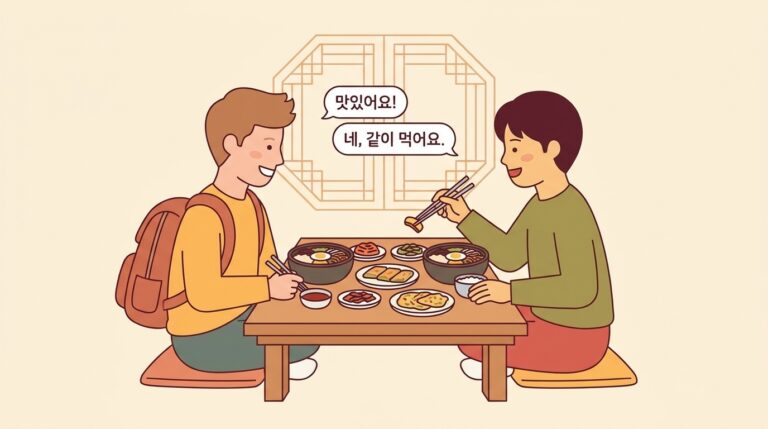
Master Korean Dining Etiquette: Eat with Confidence and Respect
Phase 1: 공감 (Empathy & Warm Welcome)
안녕하세요! 매일한글 에디터입니다. Have you ever sat down at a traditional Korean BBQ restaurant or a formal Korean home with your friends, only to feel a sudden wave of panic? You grab your chopsticks, but wait—should you pick up your rice bowl like in some other Asian cultures, or leave it flat on the table? Is it considered rude to take a drink before the eldest person at the table takes their first sip?
Dining in Korea is much more than just filling your stomach; it is a warm, communal ritual built on respect, age hierarchy, and caring for others. In Western dining, lifting a bowl or pouring your own drink is second nature, but in Korea, these subtle differences matter deeply. Through years of helping foreign learners navigate Korean culture, I have seen so many people worry about making embarrassing dining mistakes. Don’t worry! By the end of this guide, you will master key Korean table manners and speak authentic expressions with complete confidence. Let’s dig in together!
Phase 2: 핵심 표현 3선 심층 분석 (Core Expressions)
1. 잘 먹겠습니다 (Jal meokgeotseumnida)
- Pronunciation: [Jal meok-geot-seum-ni-da] (Sounds like “Jahl mock-gut-seum-nee-dah”)
- Meaning: “I will eat well” (Literal) vs. “Thank you for this meal, I’m looking forward to enjoying it!” (Nuance)
- K-Culture Moment: In K-dramas, you will always see characters clap their hands lightly or smile warmly toward the host before saying this before a feast.
- Editor’s Insight: This is the ultimate mealtime icebreaker. Saying this shows respect to whoever cooked or bought the food. Never skip it!
- Situation Spectrum: Casual (⚠️ 잘 먹을게) / Semi-formal (✅ 잘 먹겠습니다) / Formal (✅ 맛있게 잘 먹겠습니다)
- 🤔 Think About It: Does your native culture have a phrase said before eating, or do you wait until after the meal to express gratitude?
2. 먼저 드세요 (Meonjeo deuseyo)
- Pronunciation: [Meon-jeo deu-se-yo] (Sounds like “Myeon-joh deu-say-yo”)
- Meaning: “Please eat first” (Literal) vs. “After you! Please go ahead and enjoy your food.”
- K-Culture Moment: In Korean workplace dramas, junior employees always wait for their senior manager to pick up their chopsticks first or politely say “먼저 드세요”.
- Editor’s Insight: Respect for seniority is core to Korean table manners. Offering elders or hosts to eat first highlights your cultural awareness.
- Situation Spectrum: Casual (⚠️ 먼저 먹어) / Semi-formal (✅ 먼저 드세요) / Formal (✅ 먼저 드십시오)
- 🤔 Think About It: How does age or social status affect dining order in your hometown?
3. 잘 먹었습니다 (Jal meogeotseumnida)
- Pronunciation: [Jal meo-geot-seum-ni-da] (Sounds like “Jahl muh-gut-seum-nee-dah”)
- Meaning: “I ate well” (Literal) vs. “Thank you so much for the wonderful meal!”
- K-Culture Moment: Said at the end of every meal when placing chopsticks down on the rest or table.
- Editor’s Insight: It acts as the official sign that you are finished eating and appreciate the hospitality.
- Situation Spectrum: Casual (⚠️ 잘 먹었어) / Semi-formal (✅ 잘 먹었습니다) / Formal (✅ 정말 잘 먹었습니다)
- 🤔 Think About It: What signals the end of a meal in your home country?
Phase 3: 교과서 한국어 vs 진짜 한국어 (Textbook vs. Real Korean)
Situation 1: Wishing others a good meal
- 📖 교과서 한국어: 맛있게 드십시오. (Mas-it-ge deu-sip-si-o.)
- 🗣️ 진짜 한국어: 많이 드세요! (Man-i deu-se-yo!)
- 💡 왜 다를까?: While “맛있게 드십시오” is extremely formal and usually heard in television announcements or high-end hotels, real Koreans naturally say “많이 드세요” (“Please eat a lot!”) to express warmth and generosity.
Situation 2: Asking for more side dishes
- 📖 교과서 한국어: 반찬을 더 주시겠습니까? (Ban-chan-eul deo ju-si-get-seum-ni-ka?)
- 🗣️ 진짜 한국어: 저기요, 이 반찬 좀 더 주실 수 있으세요? (Jeo-gi-yo, i ban-chan jom deo ju-sil su it-seu-se-yo?)
- 💡 왜 다를까?: Direct textbook forms can sound overly stiff. Real restaurant interactions use friendly markers like “저기요” (Excuse me) and “~좀 더 주실 수 있으세요?” for a softer tone.
Phase 4: K-Culture 딥다이브 & 비언어적 매너 (Culture Deep Dive & Non-Verbal Manners)
4-1. 눈치 (Nunchi) & Non-Verbal Gestures
- Keep bowls on the table: Unlike in Japan or China, picking up your rice bowl or soup bowl to hold near your mouth is traditionally considered unrefined in Korea. Leave bowls on the table and use your spoon for rice and soup.
- Two-handed etiquette: When pouring or receiving drinks (or passing dishes to elders), use both hands or place your left hand gently under your right wrist/forearm as a sign of respect.
- Drinking angle: When drinking alcohol with someone older or higher in status, turn your torso slightly away from them and cover your cup with your hand while taking a sip.
4-2. Culture Code Analysis
In Korean culinary culture, food is meant to be shared. The table is filled with banchan (side dishes) surrounding a central main dish or stew. Sharing food builds Jeong (정, emotional connection). Recognizing these table gestures shows that you understand the heart of Korean togetherness.
Phase 5: 실전 롤플레이 시나리오 (Practical Roleplay Scenario)
Setting: You are invited to dinner at a traditional Korean restaurant with your Korean colleague, Minjun (민준).
- Turn 1 (Minjun): 오늘 구이집 왔는데 마음에 들어요? (O-neul gu-i-jip wan-neun-de ma-eum-e deu-reo-yo?) — We came to a BBQ place today, do you like it?
- Turn 2 (You): 🎭 Smiling enthusiastically 네, 정말 기대돼요! (Ne, jeong-mal gi-dae-dwae-yo!) — Yes, I’m really looking forward to it!
- Turn 3 (Minjun): 고기가 다 익었네요. 자, 어서 드세요! (Go-gi-ga da ig-eot-ne-yo. Ja, eo-seo deu-se-yo!) — The meat is fully cooked now. Go ahead, eat!
- Turn 4 (You): 🎭 Clapping hands lightly 잘 먹겠습니다! 민준 씨도 많이 드세요. (Jal meokgeotseumnida! Minjun-ssi-do man-i deu-se-yo.) — Thank you for the meal! Minjun, please eat a lot too.
- Turn 5 (Minjun): 음복으로 음료수나 맥주 한 잔 할까요? 제가 한 잔 따라드릴게요. (Eum-bok-eu-ro eum-ryo-su-na maek-ju han jan hal-kka-yo? Je-ga han jan tta-ra-deu-ril-ge-yo.) — Shall we have a drink? Let me pour you a glass.
- Turn 6 (You): 🎭 Holding the glass with both hands 감사합니다! (Gam-sa-ham-ni-da!) — Thank you!
- Turn 7 (Minjun): 오늘 식사 즐거우셨나요? (O-neul sik-sa jeul-geo-u-syeot-na-yo?) — Did you enjoy the meal today?
- Turn 8 (You): 🎭 Satisfied tone 네! 정말 잘 먹었습니다. (Ne! Jeong-mal jal meogeotseumnida.) — Yes! I really ate well. Thank you!
🔀 Interactive Choice Point
Situation: Minjun offers to pour you a drink. What do you do?
* Option A: Hold the glass with one hand casually while looking away.
* Option B: Hold the glass with both hands, bow your head slightly, and say “감사합니다.”
* Option C: Grab the bottle from his hands and pour your own drink immediately.
Feedback:
* Option A (Risk): Holding a glass with one hand when receiving a pour from someone can look overly casual or disinterest.
* Option B (Best): Perfect! Using two hands and acknowledging with thanks displays exemplary Korean dining etiquette.
* Option C (Bad): In Korean drinking culture, pouring your own drink (jajak) in front of others can ruin the shared rhythm of pouring for each other.
Phase 6: 10초 감정 섀도잉 드릴 (10-Second Emotion Shadowing Drill)
Practice saying these sentences with genuine emotion and proper rhythmic pauses (/):
[😊 Warm and Enthusiastic]
잘 먹겠습니다! / 맛있게 / 잘 먹을게요!
(Jal meokgeotseumnida! / Mas-it-ge / jal meok-eul-ge-yo!)-
[🤝 Polite and Respectful]
먼저 / 드세요! / 저는 / 괜찮습니다.
(Meon-jeo / deu-se-yo! / Jeo-neun / gwaen-chan-seum-ni-da.) -
[😋 Satisfied and Grateful]
정말 / 잘 먹었습니다! / 너무 / 맛있었어요.
(Jeong-mal / jal meogeotseumnida! / Neo-mu / mas-it-eot-seo-yo.)
Phase 7: K-Culture 미니 사전 (Mini Dictionary)
- 수저 (Sujeo) | Spoon and Chopsticks set
Refers to the pair of utensils used in Korean meals. Koreans always use both spoons (for rice/soup) and metal chopsticks (for side dishes). - 밑반찬 (Mit-ban-chan) | Complimentary Side Dishes
Small side dishes placed on the table such as kimchi, bean sprouts, and radish. They are refillable for free in most traditional Korean dining spots. - 회식 (Hwae-sik) | Company / Group Dinner
After-work dining events where understanding seniority and alcohol table manners becomes vital. - 앞접시 (Ap-jeop-si) | Individual Personal Plate
A small plate used to transfer food from shared center pots to your own spot.
Phase 8: 여행자를 위한 생존 키트 (Traveler’s Survival Kit)
Top 3 Survival Phrases
- 이거 어떻게 먹어요? (I-geo eo-tteoh-ge meok-eo-yo?)
How do I eat this? (Pro Tip: Use this when faced with novel dishes like whole fish grilled at the table!) - 물 좀 더 주실 수 있나요? (Mul jom deo ju-sil su it-na-yo?)
Could I please get some more water? - 계산서 주세요. (Gye-san-seo ju-se-yo.)
Please give me the bill.
💡 Editor’s Travel Note
When traveling around Seoul, finding authentic local dining spots is easy when you download and check reviews on the 네이버 지도 앱 다운로드. Remember that at many local restaurants, water and additional side dishes may be self-service (셀프).
Phase 9: 한 발 더 깊이 (One Step Deeper)
In Western dining cultures, individualism dominates: everyone orders their own personal plate, pours their own drinks, and eats independently. In Korea, dining reflects collectivism (Uri – 우리, “us/we”). Shared stew pots and shared side dishes symbolize community connection. Respecting table hierarchy isn’t about rigid authority; it’s about showing care and maintaining harmony at the table.
💬 Your Turn: Have you ever experienced table etiquette differences while traveling? Share your funniest or most memorable dining story in the comments below!
Phase 10: FAQ & 오해 방지 (FAQ & Common Mistakes)
Q: Is it rude to leave rice in your bowl at the end of a meal?
A: Leaving a small amount of rice is not inherently offensive, but finishing your food generally signals that you enjoyed the meal. Leaving large amounts might make the host worry that the food wasn’t to your liking.
Q: Can I use my chopsticks to lift rice from my bowl?
A: While you can use chopsticks for side dishes and main meats, Koreans traditionally use spoons for eating rice and drinking soup broth. Using spoons keeps rice from falling everywhere!
Q: What should I do if an elder pours me a drink, but I don’t drink alcohol?
A: It is polite to accept the glass with both hands first. You can place the glass on the table and politely say “죄송하지만 제가 술을 못 마십니다” (I’m sorry, I cannot drink alcohol) and ask for a soft drink instead.
🚨 Common Mistakes TOP 3
- Sticking chopsticks vertically into a bowl of rice: Never do this! This resembles incense sticks used in Korean funeral rituals (Jesa) and brings bad luck.
- Blowing your nose at the dining table: Blowing your nose loudly at the table is considered unhygienic. Step away to the restroom if needed.
- Eating before elders start: Always wait until the eldest person picks up their spoon or chopsticks before you begin eating.
Phase 11: 액션 미션 & 참여 유도 (Action Missions)
- 🥉 Bronze Mission: Practice saying “잘 먹겠습니다” and “잘 먹었습니다” out loud 3 times in front of a mirror.
- 🥈 Silver Mission: The next time you visit a Korean restaurant, use two hands when receiving water or food, and post a photo of your meal on social media!
- 🥇 Gold Mission: Enjoy a meal with a Korean friend and execute all etiquette points: wait for them to start, pour drinks with both hands, and say your greetings fluently.
🎮 K-Culture Mission: Watch a scene in your favorite K-drama where characters have dinner together. Count how many times they say “잘 먹겠습니다” or use two hands to pour drinks!
Phase 12: 인터랙티브 퀴즈 챌린지 (Interactive Quiz Challenge)
Q1. What is the correct phrase to say BEFORE starting a meal?
A) 잘 먹었습니다
B) 잘 먹겠습니다
C) 많이 드셨어요?
🔍 Click to see Answer & Explanation
Answer: B) 잘 먹겠습니다
Explanation: “잘 먹겠습니다” means “I will eat well” and is said before dining. “잘 먹었습니다” is said after completing your meal.
Q2. True or False: You should lift your rice bowl close to your face while eating in Korea.
🔍 Click to see Answer & Explanation
Answer: False
Explanation: Rice and soup bowls should stay flat on the table in Korean dining etiquette. Use your spoon to lift the rice instead.
Q3. Fill in the blank: When receiving a drink from an elder, you should use _____ hands.
🔍 Click to see Answer & Explanation
Answer: Both (두 손)
Explanation: Using both hands to hold your glass shows high respect in Korean culture.







