

Phase 1: Empathy & Storytelling Opening
안녕하세요! 매일한글 에디터입니다. Welcome back to another immersive deep-dive with Daily Hangul!
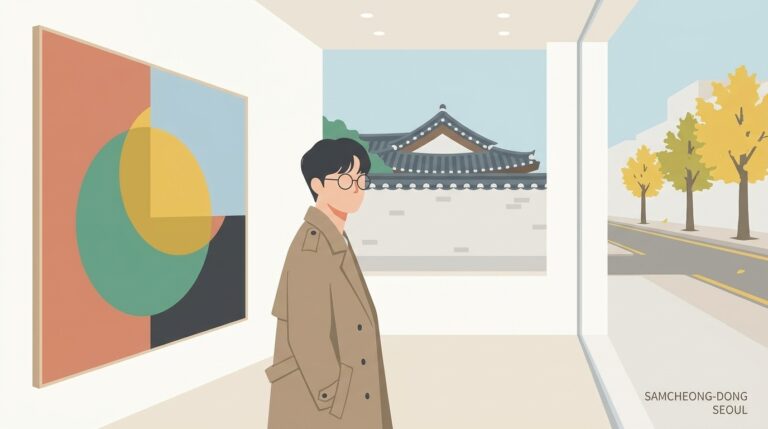
Picture this: You are walking through the minimalist, sunlit halls of the National Museum of Modern and Contemporary Art (MMCA) in Samcheong-dong, Seoul. Outside, traditional Hanok roofs blend effortlessly with contemporary concrete architecture. Inside, you find yourself standing in front of a giant canvas with a single, dark blue slash painted across the center, flanked by a stack of discarded neon acrylic tubes. Next to you, two sophisticated local art lovers in sleek trench coats are whispering. One cocks her head and says, “작품은 참 신선한데, 대중과의 거리감이 좀 느껴지지 않나요? 너무 난해해요.” (The piece is quite fresh, but don’t you feel a distance from the general public? It’s far too obscure.)
At the C2 proficiency level, your goal is no longer just ordering coffee or making simple small talk. You are reaching for the nuances of intellectual discourse—debating aesthetics, evaluating cultural accessibility, and articulating the subtle friction between artistic vision and public popularity (대중성). Navigating Korea’s burgeoning contemporary art scene requires a refined vocabulary that conveys critical nuance without sounding dismissive.
Based on feedback from our C2 advanced learners, discussing high art in Korean often feels intimidating because of Sino-Korean terminology (한자어) and subtle social etiquette in aesthetic debate. Today, we will unpack three sophisticated expressions that will transform you from a passive visitor into an articulate participant in Seoul’s vibrant art dialogue. Let’s elevate your Korean to expert precision!
Phase 2: Deep Dive into 3 Core Expressions
1. 난해하다 (難解–) (Nanhaehada)
- Pronunciation: [nan-hae-ha-da] (Sounds like “nan-hae-ha-da”; think of “nan” as in ‘none’, paired with a smooth ‘hae’)
- Meaning: Literal: Difficult to solve or analyze | Nuance: Obscure, inscrutable, highly abstract, or intellectually challenging to unpack.
- K-Culture Moment: Commonly heard during debates on indie art cinema, modern dance, or experimental installations at the Busan International Film Festival (BIFF) or Leeum Museum of Art.
- Editor’s Insight: Unlike simple words like 어렵다 (difficult), 난해하다 implies an intrinsic complexity or abstraction within the subject itself, rather than a lack of learning on the part of the audience.
- Situation Spectrum:
- Casual: ⚠️ (Can sound overly formal in trivial daily contexts)
- Semi-formal: ✅
- Formal: ✅
- 🤔 Think About It: In your native culture, do people openly criticize abstract art as “too obscure,” or do they prefer subtle expressions? How does using 난해하다 protect both the critic’s sophistication and the artist’s prestige?
2. 대중성을 갖추다 (Daejungseong-eul gatchuda)
- Pronunciation: [dae-jung-seong-eul gat-chu-da] (‘Dae-jung’ rhymes with ‘buy-jong’; ‘gat-chu-da’ sounds like ‘got-choo-da’)
- Meaning: Literal: To be equipped with public popularity | Nuance: To possess broad appeal, accessibility, or commercial resonance without losing quality.
- K-Culture Moment: Used by film critics reviewing box-office hits that also win awards, or K-Pop producers discussing tracks that balance artistic integrity with global chart success.
- Editor’s Insight: 대중성 (public appeal) is often paired with 예술성 (artistic merit). To say a piece 대중성을 갖추다 is a high compliment indicating harmonic balance.
- Situation Spectrum:
- Casual: ⚠️
- Semi-formal: ✅
- Formal: ✅
- 🤔 Think About It: Why is the concept of 대중성 so vital in modern Korea’s rapidly evolving cultural export industry compared to traditional Western art criticism?
3. 괴리감이 들다 (Goerigam-i deulda)
- Pronunciation: [goe-ri-gam-i deul-da] (‘Goe-ri’ sounds close to ‘gray-ree’; ‘gam’ as in ‘calm’)
- Meaning: Literal: To feel a sense of estrangement/gap | Nuance: To experience a jarring disconnect or rift between expectations and reality, or between elite art and the public.
- K-Culture Moment: Frequently used in cultural commentaries regarding gentrification in art districts like Seongsu-dong or the gap between high-concept installations and everyday life.
- Editor’s Insight: 괴리 specifically refers to a dynamic gap where two entities drift apart despite belonging to the same sphere.
- Situation Spectrum:
- Casual: 🚫
- Semi-formal: ✅
- Formal: ✅
- 🤔 Think About It: Have you ever felt a 괴리감 when visiting an elite contemporary gallery in a traditional neighborhood?
Phase 3: Textbook Korean vs. Real-World Korean
Situation 1: Expressing that an art installation is difficult to understand
- 📖 Textbook Korean: 이 작품은 이해하기가 매우 어렵습니다. (I- jakpumeun ihaehagiga maeu eoryeopsnida. – This artwork is very difficult to understand.)
- 🗣️ Real-World Korean: 이 작품, 생각보다 제법 난해한 편이네요. (I- jakpum, saenggakboda jebeop nanhaehan pyeon-ineyo. – This piece is actually quite obscure, isn’t it?)
- 💡 Why the Difference?: Native speakers at C2 level avoid blunt assessments like “it’s hard.” Using 제법 (quite/fairly) alongside 난해한 편이다 adds refined softness and intellectual nuance.
Situation 2: Commenting on balancing artistic depth with broad public interest
- 📖 Textbook Korean: 예술가들은 대중의 길을 따라가야 합니다. (Yesulga-deureun daejung-ui gireul ttaragaya hamnida. – Artists must follow the public path.)
- 🗣️ Real-World Korean: 예술성과 대중성 사이에서 균형을 맞추기가 참 쉽지 않죠. (Yesulseong-gwa daejungseong saieseo gyunhyeong-eul matchugiga cham swipji antjo. – Balancing artistic integrity and public appeal is truly no easy feat, is it?)
- 💡 Why the Difference?: Highlighting the balance (균형) demonstrates a sophisticated, multi-dimensional worldview rather than making a black-and-white judgment.
Phase 4: K-Culture Deep Dive & Non-Verbal Etiquette
4-1. Nunchi & Gallery Gestures
When discussing modern art in Korean galleries like Leeum or MMCA, non-verbal cues carry significant weight:
* The Thoughtful Tilt (고개를 갸웃거리다): Tilting your head slightly while looking at a piece signals that you are actively pondering its depth, avoiding a quick or dismissive judgment.
* Subtle Nod & Quiet Voice (지그시 바라보며 끄덕이기): Speaking loudly in Korean galleries is considered impolite. Use low-pitched tones and soft nods to invite the interlocutor into your inner thought space.
4-2. Cultural Code Analysis: Samcheong-dong vs. Seongsu-dong
In Seoul, contemporary art lives in two contrasting spaces. Samcheong-dong represents institutional, high-concept art near historic palaces, where expressions like 난해함 and 괴리감 naturally arise during discussions on heritage vs. modernity. Conversely, Seongsu-dong merges pop-up galleries with commercial fashion, epitomizing how modern artists actively pursue 대중성 (pop appeal). Understanding these locations allows you to apply art terminology seamlessly within context.
Phase 5: Real-World Roleplay Scenario
Setting: Inside the gallery café at MMCA Seoul. You are discussing a newly opened experimental exhibition with Min-woo, a local gallery curator.
- Min-woo: 이번 기획전, 전체적으로 어떻게 보셨어요? (What did you think of this special exhibition overall?)
- You: 🎭 [Looking thoughtful] 개념 미술 위주라 그런지, 생각보다 제법 난해한 작품이 많더라고요.
- Min-woo: 맞아요. 작가가 의도적으로 대중과의 거리를 둔 것 같다는 평가도 있어요. (True. Some critics say the artist intentionally kept a distance from the public.)
- You: 🎭 [Nodding gently] 네, 예술성과 대중성 사이에서 약간의 괴리감이 느껴지는 건 어쩔 수 없는 것 같아요.
- Min-woo: 그래도 마지막 설치 미술은 반응이 좋지 않나요? (Still, wasn’t the final installation piece received well?)
- You: 🎭 [Smiling softly] 아, 그 작품은 미디어를 잘 활용해서 대중성까지 확실히 갖췄더군요.
- Min-woo: 역시! 깊이 있게 관람하셨네요. 관람평 쓰셔도 되겠어요. (As expected! You viewed it with such depth. You could write a formal review!)
- You: 🎭 [Humbly hand waving] 과찬이십니다. 현대 미술은 알수록 더 오묘한 것 같아요.
🔀 Interactive Branching Choice
When Min-woo asks if high-concept art should be easier to understand for everyone, how do you respond?
* Option A (Best): “난해함 자체도 예술의 한 영역이지만, 최소한의 소통의 문은 열어두어야겠죠.” (Obscurity itself is a domain of art, but the door to minimal communication should remain open.)
* Option B (Bad): “이해 못 하는 대중이 문제예요.” (The public that doesn’t understand is the problem.)
* Option C (Risk): “그냥 그림이 너무 어려워서 짜증 났어요.” (I was just annoyed because the painting was too difficult.)
- Feedback:
- Option A: Perfect C2 response! Balances philosophical understanding with accessible communication.
- Option B: Risk of sounding arrogant and culturally tone-deaf.
- Option C: Too blunt and uses low-level vocabulary (짜증 났다).
Phase 6: 10-Second Emotional Shadowing Drill
Practicing native pause rhythms and emotional pitch is vital for C2 fluency. Try repeating these aloud:
[🤔 심오하고 신중하게]이 작품은 / 예술성은 뛰어난데 / 대중성이 살짝 아쉽네요.
(I- jakpumeun / yesulseong-eun ttyeonande / daejungseong-i saljjak asipneyo.)[😊 감탄하며]난해해 보였는데 / 설명을 듣고 나니 / 괴리감이 완전히 사라졌어요.
(Nanhaehae boyeotneunde / seolmyeong-eul deutgo nani / goerigam-i wanjeonhi sarajyeossoyo.)
Phase 7: K-Culture Mini Dictionary
- 현대미술 (Hyeondae-misul) | Contemporary Art | Refers to art produced in the late 20th and 21st centuries; often used in urban cultural discourse.
- 관람객 (Gwallamgaek) | Gallery/Museum Visitor | A formal term for art attendees or patrons.
- 줄타기 (Jultagi) | Tightrope walking (Metaphor for balancing act) | Frequently used to describe artists balancing commercial success (대중성) and artistic expression (예술성).
- 취향 존중 (Chwihyang Jonjung) | Respecting personal taste | Often abbreviated as ‘취존’, essential when holding aesthetic debates in Korea.
Phase 8: Traveler’s Survival Kit
Survival Expressions for Gallery Lovers
- 인디오디오 가이드 있나요? (Odio gaideu-ga issnayo?) – Is an audio guide available?
- 이 작품에 대한 도슨트 설명은 몇 시에 시작하나요? (I jakpume daehan doseonteu seolmyeongeun myeot si-e sijakhanayo?) – What time does the docent tour for this artwork start?
- 사진 촬영이 허용되나요? (Sajin chwaryeong-i heoyongdoenayo?) – Is photography allowed?
Editor’s Travel Note
Before heading to art galleries in Samcheong-dong or Hannam-dong, check exhibition schedules beforehand using the Naver Maps app download. Many boutique galleries require advance reservations through local apps. Also, T-money cards are universally accepted on city buses running directly to gallery alleys.
Phase 9: “One Step Deeper” Humanities Essay
In modern Korean society, art is transitioning rapidly from an elite enclave to an everyday lifestyle accessory shared via social media. This shift creates a fascinating dynamic: while younger generations celebrate photogenic installations, critics debate whether art is losing its conceptual depth to commercialism. Using nuanced expressions like 괴리감 and 대중성 allows you to participate in this broader cultural dialogue regarding how modern Korea negotiates tradition, luxury, and public accessibility.
💬 Your Turn: Have you ever experienced a artistically obscure moment in a museum? Leave a comment below sharing your thoughts using the word 난해하다!
Phase 10: FAQ & Common Mistakes
Q: Can I use ‘난해하다’ to describe a difficult math problem or complex software?
A: While technically possible, 난해하다 is predominantly reserved for abstract concepts, literary works, philosophy, and modern art. For math or software, stick to 어렵다 or 복잡하다.
Q: What is the difference between ‘대중적이다’ and ‘대중성을 갖추다’?
A: 대중적이다 is a simple adjective meaning “popular/mainstream.” 대중성을 갖추다 is an active verb phrase implying that something has successfully integrated qualities that appeal to the general public.
Q: Is ‘괴리감’ too formal for social situations?
A: It is ideal for intellectual discussions, work meetings, or cultural chats. Avoid using it in extremely casual contexts like choosing what to eat for lunch!
🚨 Common Mistakes TOP 3
- Mistake: Using 어려운 미술 instead of 난해한 미술 when criticizing conceptual art.
- Correct Action: Use 난해하다 to reflect intellectual abstraction.
- Mistake: Confusing 대중성 (public appeal) with 대중 (the general public).
- Correct Action: Say 대중성을 얻다/갖추다, not 대중을 갖추다.
- Mistake: Pronouncing 괴리감 as 개리감.
- Correct Action: Ensure the clear double-vowel sound [Goe-ri-gam].
Phase 11: Action Mission & Engagement
- 🥉 Bronze: Write 1 sentence in Korean using 난해하다 in your study notebook.
- 🥈 Silver: Visit a contemporary art museum website (like MMCA) and post a short Korean impression using 대중성 on your social media.
- 🥇 Gold: Engage in a 3-minute discussion with a native speaker or language partner comparing high art and pop culture using all three target expressions.
🎮 K-Culture Mission: Watch an episode of a Korean arts documentary or film review on YouTube. Listen for when critics use the words 대중성 and 예술성 together!
Phase 12: Interactive Quiz Challenge
Test your knowledge with these quick questions!
1. Situation Quiz: Which expression best describes an abstract modern sculpture that feels completely disconnected from the daily life of local residents?
* A) 대중성을 갖추다
* B) 괴리감이 들다
* C) 친근감이 들다
2. Fill-in-the-blank: 이 영화는 감독의 철학이 너무 (_____)해서 일반 관객이 이해하기 어렵다.
* Hint: Meaning “obscure/inscrutable”.
3. True or False: 대중성 refers exclusively to traditional Korean art techniques. (True / False)
Click to reveal answers & explanations!
- Answer: B) 괴리감이 들다. (This expression precisely captures the emotional disconnect between elite art and daily life.)
- Answer: 난해 (난해해서 – because it is obscure).
- Answer: False. (대중성 refers to public appeal or commercial popularity across modern media and culture.)







