

Phase 1: Empathy & Storytelling
안녕하세요! (Annyeonghaseyo!) I am your Daily Hangul editor and your Korean culture best friend! Have you ever sat down at a cozy, bustling restaurant in Seoul, smelled the mouth-watering aromas of red rice cakes (tteokbokki) or seafood noodle soup (jjambbong), and suddenly felt a wave of anxiety? You look at the bright red color of the broth and ask yourself: “Is this going to burn my tongue off?”
If you have ever stared helplessly at a menu board while sweating in fear of hidden chili peppers, you are definitely not alone! Asking if food is spicy is one of the most critical survival skills for travelers in Korea. Korean “spicy” can range from a gentle warmth to a fire-breathing challenge. But don’t worry! After learning today’s super simple A1 expressions, you will be able to ask your waiter about spiciness with total confidence, avoid accidental mouth burns, and enjoy every single meal in Korea stress-free. Let’s dive in together!
Phase 2: Core Expressions Deep Dive
1. 이거 매워요? (Igeo maewoyo?)
- Pronunciation: [ee-geo mae-wo-yo?] (Think of saying “eager” without the ‘r’ + “may-war-yo”)
- Meaning: “Is this spicy?”
- K-Culture Moment: You often hear international K-pop idols ask this exact phrase when doing street food mukbangs in Hongdae!
- Editor’s Insight: Igeo means “this”, and maewoyo comes from maepda (to be spicy). Simply point at any menu item and say this sentence with a rising tone at the end.
- Situation Spectrum: Casual (⚠️) / Semi-formal (✅) / Formal (✅)
- 🤔 Think About It: In Korean restaurants, asking staff about food is totally encouraged! How often do you ask servers questions about ingredients in your home country?
2. 조금 매워요? (Jogeum maewoyo?)
- Pronunciation: [jo-geum mae-wo-yo?]
- Meaning: “Is it a little spicy?”
- K-Culture Moment: Seen in many food travel shows when a guest wants to check if the dish has just a mild kicked flavor.
- Editor’s Insight: Jogeum means “a little bit”. Adding jogeum softens your question and helps you gauge if the spiciness level is manageable.
- Situation Spectrum: Casual (⚠️) / Semi-formal (✅) / Formal (✅)
- 🤔 Think About It: Why do you think adding words like “a little” makes questions sound softer and more polite in Korean?
3. 안 매운 것 있어요? (An maewun geot issoyo?)
- Pronunciation: [an mae-woon geot ees-so-yo?]
- Meaning: “Do you have non-spicy dishes?”
- K-Culture Moment: Used by characters in Korean dramas when dining with friends who cannot tolerate chili peppers.
- Editor’s Insight: An means “not”, maewun geot means “spicy thing/dish”, and issoyo? means “is there / do you have?”. This is your ultimate safety net phrase!
- Situation Spectrum: Casual (⚠️) / Semi-formal (✅) / Formal (✅)
- 🤔 Think About It: Having a backup non-spicy option ready makes eating out relaxed and inclusive for everyone at the table.
Phase 3: Textbook Korean vs. Real Korean
Situation 1: Asking if a dish is spicy
- 📖 Textbook Korean: 이 음식은 매우습니까? (I eumsigeun maeuseumnika? – Is this food spicy?)
- 🗣️ Real Korean: 이거 많이 매워요? (Igeo mani maewoyo? – Is this really spicy?)
- 💡 Why the difference? The textbook version is overly formal and rarely used in casual eateries. Real Koreans use Igeo (this) and add mani (a lot) for everyday conversation.
Situation 2: Asking for a mild level
- 📖 Textbook Korean: 덜 매운 맛으로 주문할 수 있습니까? (Deol maewun maseuro jumunhal su isseumnika?)
- 🗣️ Real Korean: 덜 매운 맛 있어요? (Deol maewun mat issoyo? – Do you have a less spicy option?)
- 💡 Why the difference? Keep it brief! Short and natural sentences get your message across instantly to busy restaurant staff.
Phase 4: K-Culture Deep Dive & Non-Verbal Manners
4-1. Nunchi & Gestures
When asking if food is spicy, you can fan your hand gently near your mouth while smiling and asking “이거 매워요?”. This non-verbal cue instantly communicates that you have low spice tolerance. Also, remember to make polite eye contact and give a subtle nod when the server answers!
4-2. Culture Code: The Shin Ramyun Benchmark
In Korea, the universal spicy benchmark is Shin Ramyun (신라면)! When you ask “얼마나 매워요?” (How spicy is it?), servers will often reply: “It’s about as spicy as Shin Ramyun!” If you can handle Shin Ramyun, you can survive most standard Korean dishes!
Phase 5: Real Life Roleplay Scenario
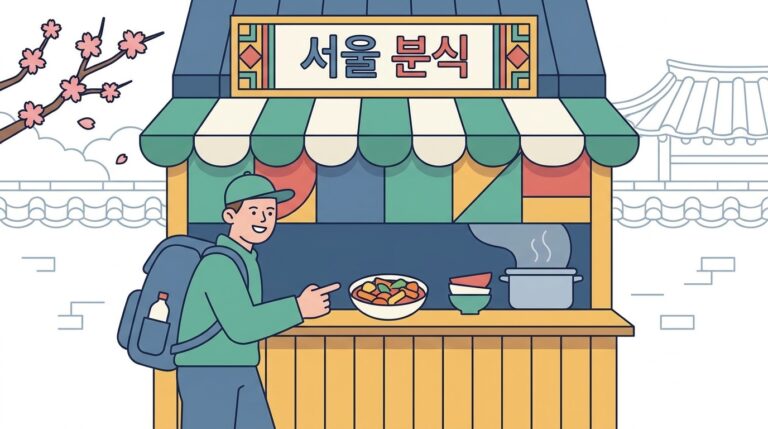
Setting: A vibrant Tteokbokki street food stall in Myeongdong.
Character: Ahjumma (Friendly Stall Owner)
- Turn 1 (You): 안녕하세요! 저기요, 이거 매워요? / Annyeonghaseyo! Jeogiyo, igeo maewoyo? / (Hello! Excuse me, is this spicy?)
🎭 Pointing at Tteokbokki - Turn 2 (Ahjumma): 조금 매워요~ 신라면 정도예요! / Jogeum maewoyo~ Shin Ramyun jeongdo-yeyo! / (It’s a little spicy~ About the level of Shin Ramyun!)
🎭 Smiling kindly - Turn 3 (You): 아, 신라면요? 저는 매운 거 잘 못 먹어요. / A, Shin Ramyun-yo? Jeoneun maewun geo jal mot meogeoyo. / (Ah, Shin Ramyun? I can’t eat spicy food well.)
🎭 Fanning mouth lightly - Turn 4 (Ahjumma): 그래요? 그럼 덜 매운 맛으로 줄까요? / Geuraeyo? Geureom deol maewun maseuro julkkayo? / (Is that so? Then shall I give you a less spicy version?)
🎭 Nodding attentively - Turn 5 (You): 네! 덜 매운 맛 있어요? / Ne! Deol maewun mat issoyo? / (Yes! Do you have a less spicy version?)
🎭 Bright eyes - Turn 6 (Ahjumma): 네, 안 매운 로제 떡볶이도 있어요. / Ne, an maewun roje tteokbokki-do issoyo. / (Yes, we also have non-spicy Cream Rose Tteokbokki.)
🎭 Gesturing to menu - Turn 7 (You): 좋아요! 로제 떡볶이 하나 주세요. / Joh-ayo! Roje tteokbokki hana juseyo. / (Great! One Rose Tteokbokki please.)
🎭 Giving thumbs up - Turn 8 (Ahjumma): 네, 금방 줄게요! / Ne, geumbang julgeyo! / (Yes, coming right up!)
🎭 Scooping dish
🔀 Interactive Choice:
If the Ahjumma says the food is super spicy, what do you say?
* Option A: 안 매운 것 있어요? (An maewun geot issoyo?)
* Option B: 이거 진짜 맛있어요! (Igeo jinmma mas-isseoyo!)
* Option C: 물 주세요. (Mul juseyo.)
- Feedback:
- Option A (BEST): Perfect! You safely pivot to a non-spicy alternative.
- Option B (RISK): You haven’t ordered yet, so complimenting the taste now is out of context!
- Option C (BAD): Asking for water doesn’t solve your ordering dilemma contextually.
Phase 6: 10-Second Emotion Shadowing Drill
[🥺 Worried & Curious]이거 / 매워요? (Igeo / maewoyo?)[🤔 Asking softly]조금 / 매워요? (Jogeum / maewoyo?)[😊 Hopeful]안 매운 것 / 있어요? (An maewun geot / issoyo?)[🙏 Requesting politely]덜 매운 맛으로 / 주세요! (Deol maewun maseuro / juseyo!)
Phase 7: K-Culture Mini Dictionary
- 맵찍이 (Maepjjigi) | Mild-spice eater | Someone who cannot tolerate spicy food at all.
- 맵부심 (Maepbusim) | Spice pride | Pride in being able to eat extremely spicy dishes.
- 덜 매운맛 (Deol maewun-mat) | Less spicy option | Mild flavor setting available in many eateries.
- 신라면 (Shin Ramyun) | Shin Ramyun | The gold standard spicy instant noodles in Korea.
Phase 8: Traveler’s Survival Kit
Top 3 Survival Phrases
- 이거 매워요? (Igeo maewoyo?) – Is this spicy?
- 안 매운 것 주세요. (An maewun geot juseyo.) – Please give me something non-spicy.
- 물 좀 주세요. (Mul jom juseyo.) – Please give me some water.
Editor’s Travel Note
When traveling in Korea, navigate food alleys easily by using the Naver Map App for Korean Food Navigation. Always look for menu keywords like 순한맛 (mild flavor) or 달콤한맛 (sweet flavor) if you want a guaranteed spice-free meal!
Phase 9: One Step Deeper
In Korean food culture, sharing meals is an act of deep connection. Showing concern for someone’s spice tolerance is a form of caring (Jeong). When restaurant staff offer to make your dish deol maewun-mat (less spicy), they are extending genuine warmth and hospitality to you.
💬 Your Turn: What is your personal spice tolerance level? Leave a comment below telling us if you are a Maepjjigi (mild lover) or Maepbusim (spice champion)!
Phase 10: FAQ & Common Mistakes
Q: Can I ask the server to make any dish completely non-spicy?
A: Many dishes like fried rice or tteokbokki can be adjusted, but pre-made stews (jjigae) might have chili paste built into the broth base.
Q: What word should I use if I want zero spice?
A: Ask for 안 매운 맛 (An maewun mat) or 순한 맛 (Sunhan mat – mild version).
Q: What should I drink if my mouth is burning?
A: Drink milk or eat pickled radish (danmuji). Water alone won’t wash away capsaicin easily!
🚨 Common Mistakes TOP 3
- Mistake: Saying “매워요?” without pointing at anything.
- Correct Action: Point directly at the menu item while asking “이거 매워요?”.
- Mistake: Confusing 안 매워요 (It is not spicy) with 안 매운 것 (Non-spicy dish).
- Correct Action: To ask for a non-spicy menu item, say “안 매운 것 있어요?”.
- Mistake: Expecting “not spicy” in Korea to mean zero seasoning.
- Correct Action: Korean food uses garlic and ginger; non-spicy usually means no red hot chili peppers!
Phase 11: Action Mission
- 🥉 Bronze: Say “이거 매워요?” out loud 3 times in front of a mirror.
- 🥈 Silver: Practice pronouncing “안 매운 것 있어요?” using our emotion shadowing drill.
- 🥇 Gold: Visit a local Korean restaurant or order takeaway, and ask the staff if the dish is spicy in Korean!
- 🎮 K-Culture Mission: Watch your favorite Korean drama or variety show and spot someone using the word 매워요 (maewoyo)!
Phase 12: Interactive Quiz Challenge
- Situation Quiz: You are at a restaurant and cannot eat spicy food. What do you ask?
- A) 이거 매워요?
- B) 안 매운 것 있어요?
- C) 더 매운 것 주세요.
- Blank Quiz: 이거 많이 _____? (Is this very spicy?)
- A) 매워요
- B) 예뻐요
- C) 비싸요
- True / False: Shin Ramyun is commonly used as a reference point for spiciness in Korea. (T / F)
Click to reveal answers!
- B) 안 매운 것 있어요? (Do you have non-spicy items?)
- A) 매워요 (maewoyo = spicy)
- True! Shin Ramyun is the universal standard for measuring spice levels in Korea.







