

Renting an Audio Guide at a Korean Museum: A Beginner’s Guide
Phase 1: Empathy & Storytelling
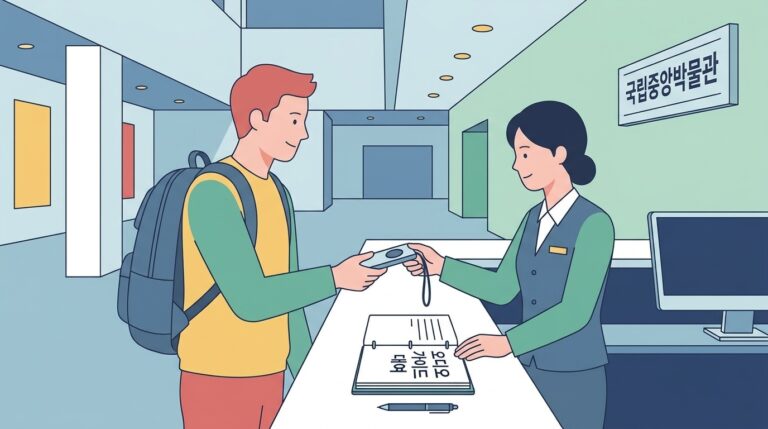
안녕하세요! 매일한글 에디터입니다. (Hello! This is your Daily Hangul Editor.) Imagine walking into the stunning National Museum of Korea in Seoul. The high ceilings and ancient artifacts leave you breathless, but you want to understand the rich history behind each exhibit. You walk up to the information desk, see a line of audio guides, and suddenly freeze. What if you make a mistake? What if you don’t understand the rental fee or deposit requirements? Don’t worry! Renting an audio guide in Korea is super simple once you master a few friendly phrases. Based on real feedback from hundreds of Korean learners, this guide will turn your anxiety into total confidence at any museum or gallery in Korea!
Phase 2: Core Expressions Deep Dive
1. 오디오 가이드 있어요? (O-di-o ga-i-deu it-seo-yo?)
- Pronunciation: [O-dee-oh gah-ee-deu eet-suh-yoh] (Sounds like “Audio guide eat-so-yo?”)
- Meaning: “Do you have an audio guide?”
- K-Culture Moment: You’ll hear this when K-drama protagonists visit sleek art galleries in Gangnam.
- Editor’s Insight: “~있어요?” is your ultimate magic phrase in Korea for asking if something is available!
- Situation Spectrum:
- Casual: 오디오 가이드 있어? ⚠️
- Semi-formal: 오디오 가이드 있어요? ✅
- Formal: 오디오 가이드 있습니까? ✅
- 🤔 Think About It: Why does Korean use the same word (있어요) for both “there is” and “to have”?
2. 영어 가이드로 빌릴 수 있을까요? (Yeong-eo ga-i-deu-ro bil-ril su it-eul-kka-yo?)
- Pronunciation: [Yung-uh gah-ee-deu-roh bil-leel soo eet-eul-kkah-yoh]
- Meaning: “Can I borrow an English guide?”
- K-Culture Moment: Essential when renting device devices at Seoul’s historic palaces or modern art centers.
- Editor’s Insight: Adding “~ㄹ 수 있을까요?” makes your request sound extremely polite and natural.
- Situation Spectrum:
- Casual: 영어 가이드로 빌릴래? 🚫
- Semi-formal: 영어 가이드로 빌릴 수 있을까요? ✅
- Formal: 영어 가이드 대여가 가능합니까? ✅
- 🤔 Think About It: Notice how Korean speakers prefer asking politely as a question rather than demanding a service direct!
3. 신분증이 필요한가요? (Sin-bun-jeung-i pil-yo-han-ga-yo?)
- Pronunciation: [Seen-boon-jeung-ee feel-yoh-hahn-gah-yoh]
- Meaning: “Do I need an ID card?”
- K-Culture Moment: Asked at museum desks when handing over a passport as a rental deposit.
- Editor’s Insight: “신분증” means ID card (passport/driver’s license). Museums often hold your ID while you use the device.
- Situation Spectrum:
- Casual: 신분증 필요해? ⚠️
- Semi-formal: 신분증이 필요한가요? ✅
- Formal: 신분증이 필요합니까? ✅
- 🤔 Think About It: How does security and trust play a role when leaving personal ID items at public institutions in Korea?
Phase 3: Textbook Korean vs. Real Korean
Situation 1: Asking to rent a device
- 📖 Textbook Korean: 오디오 가이드를 대여하고 싶습니다. (I would like to rent an audio guide.)
- 🗣️ Real Korean: 오디오 가이드 빌릴 수 있어요? (Can I rent an audio guide?)
- 💡 Why is it different?: While “대여하다” is formal and written, native speakers in everyday casual interaction prefer the warm, easy verb “빌리다” (to borrow/rent).
Situation 2: Asking about payment
- 📖 Textbook Korean: 얼마를 지불해야 합니까? (How much must I pay?)
- 🗣️ Real Korean: 얼마예요? 카드 돼요? (How much is it? Do you accept cards?)
- 💡 Why is it different?: Korea is virtually cashless! Instead of formal verbs like “지불하다”, simply asking if card payment is okay (“카드 돼요?”) is natural and quick.
Phase 4: K-Culture Deep Dive & Non-verbal Manners
4-1. Nunchi & Gestures
- Two-Handed Courtesy: Always hand over your ID or payment card using both hands (or supporting your right forearm with your left hand). This shows deep respect!
- Polite Eye Contact: Maintain gentle eye contact and nod slightly with a warm smile when speaking to museum staff.
4-2. Culture Code
In Korean culture, museums are highly accessible and tech-forward! Many venues use QR codes or sleek smartphone-like devices. Showing respect to staff by greeting them with “안녕하세요” (Hello) creates an immediate friendly atmosphere.
Phase 5: Real Roleplay Scenario
Setting: The information desk at the National Museum of Korea.
Characters: You (Traveler) & Min-soo (Museum Staff)
- You: 안녕하세요! 오디오 가이드 있어요? 🎭 (Nodding warmly with both hands together)
(An-nyeong-ha-se-yo! O-di-o ga-i-deu it-seo-yo? / Hello! Do you have audio guides?) - Min-soo: 네, 있습니다. 어느 언어로 도와드릴까요?
(Ne, it-seub-ni-da. Eeo-neu eon-eo-ro do-wa-deu-ril-kka-yo? / Yes, we do. Which language would you like?) - You: 영어 가이드로 빌릴 수 있을까요? 🎭 (Pointing politely to the English sign)
(Yeong-eo ga-i-deu-ro bil-ril su it-eul-kka-yo? / Can I rent an English guide?) - Min-soo: 네, 가능합니다. 대여료는 삼천 원입니다.
(Ne, ga-neung-hab-ni-da. Dae-yeo-ryo-neun sam-cheon won-im-ni-da. / Yes. The rental fee is 3,000 KRW.) - You: 신분증이 필요한가요? 🎭 (Holding your wallet gently)
(Sin-bun-jeung-i pil-yo-han-ga-yo? / Do I need an ID card?) - Min-soo: 네, 여권이나 ID 카드를 맡겨주셔야 합니다.
(Ne, yeo-gwon-i-na ID ka-deu-reu mat-gyeo-ju-syeo-ya hab-ni-da. / Yes, please leave your passport or ID card.) - You: 여기 있습니다. 카드로 계산할게요. 🎭 (Handing passport and card with both hands)
(Yeo-gi it-seub-ni-da. Ka-deu-ro gye-san-hal-ge-yo. / Here you go. I will pay by card.) - Min-soo: 감사합니다. 즐거운 관람 되세요!
(Gam-sa-hab-ni-da. Jeul-geo-un gwal-lam doe-se-yo! / Thank you. Enjoy your visit!)
🔀 Interactive Choice Point
What would you say if the staff member hands you the device?
* Option A: 감사! (Gamsah!)
* Option B: 감사합니다! 즐겁게 볼게요. (Gamsahambnida! Jeulgeopge bolgeyo.)
* Option C: 돈 받으세요. (Don badeuseyo.)
- Feedback:
- Option A (Risk): Too casual/short! Sounds rude to staff.
- Option B (Best): Perfect! Polite, warm, and natural.
- Option C (Bad): Unnatural and blunt phrase (“Take the money”).
Phase 6: 10-Second Emotion Shadowing Drill
- [😊 Friendly & Curious] 오디오 가이드 / 있어요? (
O-di-o ga-i-deu / it-seo-yo?) - [🥺 Polite Request] 영어 가이드로 / 빌릴 수 있을까요? (
Yeong-eo ga-i-deu-ro / bil-ril su it-eul-kka-yo?) - [🧐 Gentle Question] 신분증이 / 필요한가요? (
Sin-bun-jeung-i / pil-yo-han-ga-yo?)
Phase 7: K-Culture Mini Dictionary
- 신분증 (Sin-bun-jeung) | Identification (ID) Card | Required for rentals or age verification in Korea.
- 대여료 (Dae-yeo-ryo) | Rental Fee | The cost charged to temporarily borrow items like guides or bikes.
- 관람 (Gwal-lam) | Viewing/Exhibition Tour | Used when visiting museums, art galleries, or shows.
- 반납 (Ban-nab) | Return (of borrowed items) | Returning devices or audio guides back to the desk before leaving.
Phase 8: Traveler’s Survival Kit
Top 3 Survival Phrases
- 이거 어떻게 써요? (I-geo eot-teo-ke sseo-yo?) – How do I use this?
- 반납은 어디서해요? (Ban-nab-eun eo-di-seo hae-yo?) – Where do I return this?
- 한국어 가이드도 있어요? (Han-guk-eo ga-i-deu-do it-seo-yo?) – Do you also have a Korean guide?
Editor’s Travel Note
Before heading to top destinations in Seoul, download the Naver Map app download for real-time indoor museum layout guides and navigation. Most major Korean museums accept credit cards, but keeping your physical passport ready for device rental deposits is a pro tip!
Phase 9: One Step Deeper
In Korea, public services and museums prioritize convenience and trust. When renting devices, leaving an ID is standard practice to maintain mutual trust between guests and institutions. By learning these simple polite expressions, you are engaging in this implicit trust cultural exchange!
💬 Your Turn: What museum in Korea are you most excited to visit? Let us know in the comments below!
Phase 10: FAQ & Common Mistakes
Q: Can I use my foreign credit card to pay for the audio guide rental fee?
A: Yes, almost all major museums in Korea accept foreign credit cards (Visa, Mastercard).
Q: What should I leave as a deposit if I don’t carry my original passport?
A: A driver’s license or official residence card from your home country is usually accepted as an ID deposit!
Q: Do Korean museums offer free smartphone app audio guides?
A: Yes! Many modern galleries offer free downloadable audio apps via QR codes at the entrance desk.
🚨 Common Mistakes TOP 3
- Using Informal Language: Saying “가이드 줘” (Give me a guide). -> Correct Action: Use polite forms ending in “~요” or “~주세요”.
- Forgetting Both Hands: Handing your card with one finger/hand. -> Correct Action: Always hand over items with both hands.
- Walking Away Without Returning: Forgetting to return the device before exiting. -> Correct Action: Look for the “반납 (Return)” desk before leaving.
Phase 11: Action Mission & Engagement
- Bronze Level: Practice saying “오디오 가이드 있어요?” out loud 3 times!
- Silver Level: Record your voice practicing the Phase 6 Shadowing Drill and share it on social media!
- Gold Level: Visit a local museum or simulation and order an audio guide in Korean using full sentences!
🎮 K-Culture Mission: Watch a scene from a K-drama set in an art gallery and spot if you hear “~있어요?” or “감사합니다”!
Phase 12: Interactive Quiz Challenge
Question 1: How do you politely ask if an English audio guide is available?
Click to view Answer & Explanation
Answer: 영어 가이드로 빌릴 수 있을까요?
Explanation: This phrase politely asks “Can I borrow an English guide?” using A2 level honorific forms.
Question 2 (True/False): You should hand your payment card to the museum staff using only one hand.
Click to view Answer & Explanation
Answer: False!
Explanation: In Korean culture, handing items with both hands shows courtesy and respect.







