

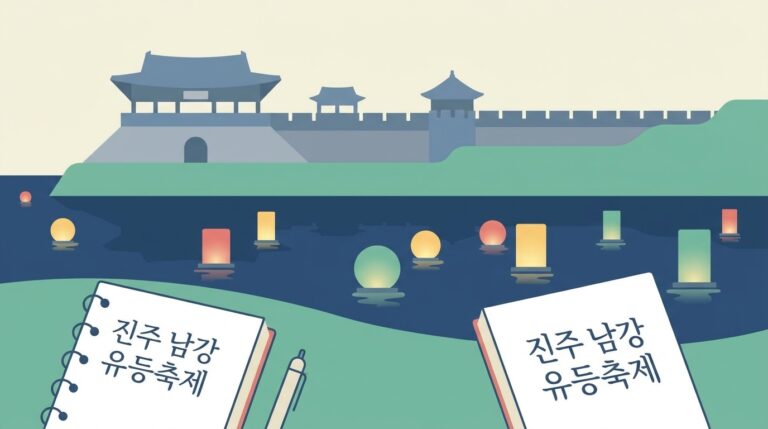
Master the Romance of Jinju Namgang Yudeung Festival: Night View Korean Guide
Phase 1: Empathy & Storytelling
안녕하세요! 매일한글 에디터입니다.
Imagine walking along the tranquil banks of the Namgang River in Jinju under a crisp autumnal night sky. Suddenly, the darkness transforms into a glowing wonderland: thousands of colorful, hand-crafted paper lanterns (yudeung) float effortlessly on the water, echoing the starry sky above. The smell of local street food fills the air, and the gentle murmur of festival-goers creates an unforgettable romantic ambiance.
However, as an intermediate (B2) learner, you might find yourself stuck using basic textbook phrases like “야경이 좋습니다” (The night view is good). While grammatically correct, it fails to convey the sheer awe and emotional depth you are feeling in that moment! You want to express subtle nuances, suggest dual activities like taking a stroll while making a wish, and connect naturally with Korean friends or festival hosts without sounding like an audio recording.
Don’t worry! Based on real feedback from advanced Korean language learners, this guide is designed to elevate your conversational expressive power. By the end of this guide, you will master sophisticated B2-level natural structures, cultural context, and practical night-festival etiquette.
Phase 2: Key Expressions Deep Dive
1. 눈이 부실 정도로 아름답네요
- Pronunciation: [Nuni busil jeongdoro areumdapneyo] (Sounds like “Noon-e boo-shil jeong-do-ro ah-reum-dap-nee-yo”)
- Meaning: Literally “It’s beautiful to the point of being dazzling.”
- K-Culture Moment: Seen in romantic period dramas or modern K-Dramas during breathtaking night illumination scenes when characters gaze over water reflections.
- Editor’s Insight: The pattern
-ㄹ/을 정도로(to the extent/degree that…) elevates your B2 speech from simple descriptions to vivid imagery. - Situation Spectrum: Casual ⚠️ | Semi-formal ✅ | Formal ✅
- 🤔 Think About It: How does Korean connect physical sensory reactions (eyes dazzling) to emotional admiration compared to your native language?
2. 소원을 적어서 띄워 보내요
- Pronunciation: [Sowoneul jeogeoseo ttiweo bonaeyo] (Sounds like “So-won-eul jeo-geo-seo ttee-weo bo-nae-yo”)
- Meaning: “Let me/us write down a wish and float it out.”
- K-Culture Moment: Writing personal wishes on paper strips at Jinju’s festival booths and launching floating lanterns into the Namgang River.
- Editor’s Insight: Combining two actions with
-아서/어서and using the compound verb띄워 보내다(float and send off) creates a natural flow characteristic of intermediate fluency. - Situation Spectrum: Casual ✅ | Semi-formal ✅ | Formal ⚠️
- 🤔 Think About It: What cultural significance does setting light afloat hold in collective Korean traditions of hope and remembrance?
3. 야경도 볼 겸 산책할까요?
- Pronunciation: [Yagyeongdo bol gyeom sanchaekhalkkayo?] (Sounds like “Ya-gyeong-do bol gyeom san-chaek-hal-kka-yo?”)
- Meaning: “Shall we go for a walk while also checking out the night view?”
- K-Culture Moment: Asking a friend or date out for an evening walk along the illuminated bamboo grove path across the river.
- Editor’s Insight: The intermediate grammar
-(으)ㄹ 겸 (해서)expresses carrying out two goals simultaneously. It makes invitations sound gentle and polite rather than forceful. - Situation Spectrum: Casual ✅ | Semi-formal ✅ | Formal ⚠️
- 🤔 Think About It: Why is indirect invitation through dual purpose preferred in soft conversational Korean?
Phase 3: Textbook Korean vs. Real Korean
Situation 1: Expressing awe at the vibrant lantern spectacle
- 📖 Textbook Korean: 야경이 매우 아름답습니다. (The night view is very beautiful.)
- 🗣️ Real Korean: 야경 미쳤는데요? 진짜 대박이에요! (The night view is insane! Seriously amazing!)
- 💡 Why the difference? Modern native speakers at local events use expressive everyday terms like
미쳤다(insane/crazy good) with light polite sentence endings (-는데요) to share genuine excitement with peers.
Situation 2: Waiting in line for the lantern boat (Yudeung-bae)
- 📖 Textbook Korean: 배를 타기 위해 기다리고 있습니다. (I am waiting in order to ride the boat.)
- 🗣️ Real Korean: 유등 배 타려고 줄 서 있는 중이에요. (I’m currently standing in line to ride the lantern boat.)
- 💡 Why the difference? Native speakers favor dynamic purpose endings
-(으)려고and ongoing state expressions-는 중이다over static written structures.
Phase 4: K-Culture Deep Dive & Non-Verbal Manners
4-1. Nunchi & Gestures
- Taking Photos for Others: When approaching visitors on the crowded Jinju bridge to take a picture, maintain a friendly smile and hold the phone with both hands when returning it.
- Navigating Crowds: When passing through dense festival crowds along the riverbanks, slightly lower your shoulder and bow your head slightly while saying “잠시만요” (Excuse me for a moment).
4-2. Cultural Code Analysis
The Jinju Namgang Yudeung Festival originates from the military communications during the 1592 Jinjuseong Fortress battle during the Imjin War, where floating lights were launched to prevent Japanese troops from crossing the river and to send signals to family members outside. Today, it has evolved into a global peace and light celebration, blending historic reverence with modern artistic craftsmanship.
Phase 5: Real Roleplay Scenario
Setting: 8 PM at the Jinju Namgang Wish Lantern Booth.
Character: Minsu (Local Festival Volunteer)
- Minsu: 안녕하세요! 소원등 체험하러 오셨나요?
(Hi! Did you come to experience the wish lantern?)🎭 Smiling warm welcome - Learner: 네! 야경도 볼 겸 소원도 빌려고 왔어요.
(Yes! I came to make a wish while also taking in the night view.)🎭 Enthusiastic node - Minsu: 탁월한 선택이세요! 여기 소원지에 소원을 적으시면 됩니다.
(Excellent choice! You can write your wish on this paper strip.)🎭 Handing paper strip - Learner: 혹시 눈이 부실 정도로 예쁜 등은 어떤 거예요?
(By the way, which lantern is dazzlingly beautiful?)🎭 Pointing gently - Minsu: 저기 연꽃 모양 유등이 물 위에 띄우면 제일 아름다워요.
(That lotus-shaped floating lantern looks most beautiful when set on the water.)🎭 Pointing towards river - Learner: 소원을 적어서 바로 물에 띄워 보내면 되나요?
(Should I write my wish and float it out on the water right away?)🎭 Holding marker pen - Minsu: 네, 안전요원 안내에 따라 강가에서 띄워 주시면 됩니다.
(Yes, just float it from the riverbank following the safety staff’s guide.)🎭 Directing toward bank - Learner: 와, 정말 기대돼요. 감사합니다!
(Wow, I’m really looking forward to it. Thank you!)🎭 Bright smile
🔀 Interactive Decision Point
How do you ask Minsu to take a picture of you launching your wish lantern?
* Choice A: “야, 나 사진 좀 찍어봐.” (Hey, take a picture of me.)
* Choice B: “혹시 소원등 띄우는 모습 사진 한 장 찍어 주실 수 있나요?” (Could you possibly take a photo of me floating the wish lantern?)
* Choice C: “사진 찍어.” (Take photo.)
Feedback:
* Choice A (Risk 🚨): Extremely blunt and impolite to someone you just met!
* Choice B (Best ✅): Polite, accurate, and perfectly suited for B2 conversational level.
* Choice C (Bad ❌): Imperative form that sounds disrespectful.
Phase 6: 10-Second Emotional Shadowing Drill
[😊 Exciting & Awestruck]야경이 / 눈이 부실 정도로 / 진짜 아름답네요!
(Ya-gyeong-i / nu-ni bu-sil jeong-do-ro / jin-jja a-reum-dap-ne-yo!)[🥰 Warm & Hopeful]예쁜 소원지에 / 소원을 적어서 / 띄워 보내요.
(Ye-ppeun so-won-ji-e / so-won-eul jeo-geo-seo / tti-weo bo-nae-yo.)[💬 Gentle Suggestion]바람도 시원한데 / 야경도 볼 겸 / 강변을 산책할까요?
(Ba-ram-do si-won-han-de / ya-gyeong-do bol gyeom / gang-byeon-eul san-chaek-hal-kka-yo?)
Phase 7: K-Culture Mini Dictionary
- 유등 (Yudeung) | Floating Lantern
- Paper lanterns crafted into traditional or modern shapes placed upon water bodies during festivals.
- 남강 (Namgang) | Nam River
- The central historic river flowing through Jinju city, South Gyeongsang Province.
- 소원지 (Sowonji) | Wish Paper Strip
- Paper slips where attendees write personal hopes for health, love, or fortune.
- 야경 (Yagyeong) | Night View
- Scenery illuminated after dark, frequently used in Korean dating language.
Phase 8: Traveler’s Survival Kit
TOP 3 Festival Survival Expressions
- 유등 배 표는 어디서 사나요? (Where can I buy tickets for the lantern boat?)
- Pro Tip: Useful at busy ticket booths along the river walkway.
- 사진 찍기 좋은 명소가 어디예요? (Where is a good spot to take photos?)
- Pro Tip: Locals will point you to the best bridge view or bamboo lighting trail.
- 셔틀버스 탑승장이 어디인가요? (Where is the shuttle bus boarding area?)
- Pro Tip: Jinju operates free public shuttle buses during festival peak hours.
Editor’s Travel Note
- Navigate the festival grounds easily by using 네이버 지도 앱 다운로드 (Naver Map App Download) to search for Jinjuseong Fortress (진주성). Credit cards are accepted at all food stalls and entry booths, but carrying around 10,000 KRW cash for small wish papers is handy!
Phase 9: One Step Deeper
Korean night festivals are far more than visual spectacles; they are spaces of collective healing and shared hope. By writing wishes on physical lanterns released together onto the Namgang River, Koreans celebrate a communal spirit where individual hopes merge into a river of light. Understanding this cultural warmth helps you appreciate why language expressions around festivals focus so heavily on shared experiences (-ㄹ 겸, 함께).
💬 Your Turn: What wish would you write on a floating lantern if you visited Jinju tonight? Share your thoughts in Korean below!
Phase 10: FAQ & Common Mistakes
Q: How do I ask to buy a wish lantern politely at the festival booth?
A: You can say: “소원등 체험 하나 하고 싶은데, 얼마인가요?” (I’d like to try the wish lantern experience, how much is it?)
Q: Can I use “야경 미쳤다” when talking to elderly locals?
A: No, “미쳤다” is casual slang best used with friends or peers. With elders, stick to “야경이 정말 멋지네요!” or “눈이 부실 정도로 아름답네요.”
Q: What is the best way to ask someone to take a photo of me with lanterns?
A: Say: “죄송한데, 유등 배경으로 사진 한 장만 찍어 주실 수 있으세요?” (Excuse me, could you take a photo of me with the lanterns in the background?)
🚨 Common Mistakes TOP 3
- Mistake: Using
눈이 부시다for simple dark settings. -> Correction: Use it specifically when lights or reflections dazzle bright night scenes. - Mistake: Saying
소원을 적다without connectors. -> Correction: Connect smoothly as소원을 적어서 띄우다. - Mistake: Overusing written forms like
아름답습니다in casual chatting. -> Correction: Use B2 conversational forms like아름답네요or멋지네요.
Phase 11: Action Mission & K-Culture Challenge
- 🥉 Bronze: Practice saying “야경도 볼 겸 산책할까요?” aloud 3 times with natural rhythm.
- 🥈 Silver: Post a nighttime picture on SNS with the caption: “눈이 부실 정도로 아름다운 야경!”
- 🥇 Gold: Use
-ㄹ 겸to make a dual-purpose invitation to a Korean-speaking friend this week!
🎮 K-Culture Mission: Watch a clip of a Korean travel vlog covering local night festivals (like Jinju or Suwon) and spot how many times people say “대박” or “미쳤다” when seeing night lights!
Phase 12: Interactive Quiz Challenge
- Fill in the blank: 야경도 ____ 겸 강변을 걸었어요. (I walked along the riverbank while also seeing the night view.)
- A) 보고
- B) 볼
- C) 본
- True or False: The word ‘소원지’ refers to the ticket you buy for the shuttle bus.
- (True / False)
- Situation Check: Which sentence uses the B2 expression for “dazzling beauty” correctly?
- A) 눈이 부실 정도로 아름답네요.
- B) 눈이 부신 아름답습니다.
👉 Click to reveal answers and explanations!
- Answer: B) 볼
- Explanation: The grammar structure requires
-(으)ㄹ 겸, so보 + ㄹ = 볼is correct.
- Explanation: The grammar structure requires
- Answer: False
- Explanation: ‘소원지’ is the strip of paper on which you write your wish.
- Answer: A) 눈이 부실 정도로 아름답네요.
- Explanation:
-ㄹ 정도로correctly modifies the adjective to convey degree.
- Explanation:







