

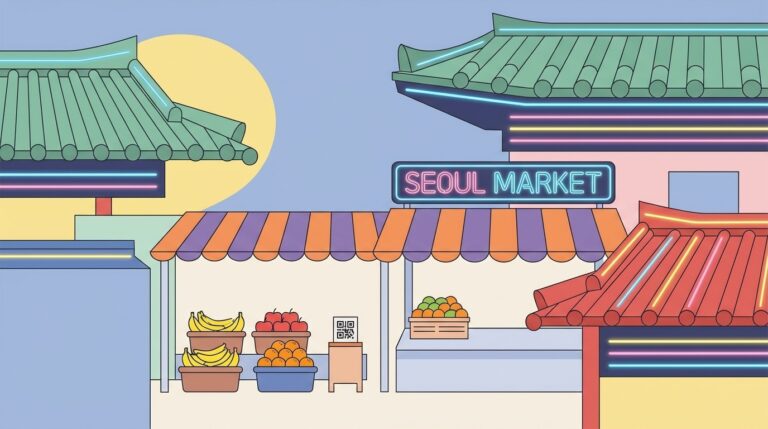
Experience Old Meets New in Korea: How Modernized Traditional Markets Make Shopping Easy and Fun
Phase 1: Empathy & Storytelling Opening
안녕하세요! I’m your Daily Hangul editor, your 10-year resident culture navigator in South Korea! Have you ever stood at a bustling traditional Korean market like Mangwon or Gwangjang Market, surrounded by sizzling tteokbokki and colorful fresh fruit, only to hesitate at the vendor booth because you were unsure if your credit card or mobile payment app would work?
In the past, visiting Korean traditional markets (전통시장) meant carrying wads of cash and relying on basic hand gestures. However, traditional markets across South Korea have undergone a massive modernization transformation! Today, young vendors operate trendy food stalls alongside classic grandmothers (할머니), featuring QR code payments, eco-friendly packaging, and even market-wide app delivery services like Onnuri Delivery. Yet, many intermediate learners still feel stuck using rigid, beginner-level textbook phrases when navigating these modern market conveniences.
Don’t worry! Based on real student feedback and insider market experience, this guide will equip you with B2-level natural Korean expressions. You will navigate modernized markets with total confidence, pay effortlessly via digital wallets, and connect warmly with local merchants!
Phase 2: Core Expressions Deep Dive
1. 모바일 온누리상품권 되나요? (Can I use the Mobile Onnuri Gift Certificate?)
- Pronunciation: [Mo-ba-il On-nu-ri sang-pum-gwon doe-na-yo?] (Sounds like: Mo-by-eel Ahn-noo-ree sang-poom-gwon dway-nah-yo?)
- Meaning: Direct Translation: “Does the mobile Onnuri gift certificate work?” | Nuance: Politely checking if the stall accepts South Korea’s official subsidized market digital voucher.
- K-Culture Moment: Seen frequently in lifestyle vlog videos where modern shoppers scan QR codes at market stalls to get a 10% government discount.
- Editor’s Insight: Modernized traditional markets use the Onnuri voucher system. Asking this demonstrates you understand local Korean consumer culture and savings secrets!
- Situation Spectrum: Casual: 🚫 | Semi-formal: ✅ | Formal: ✅
- 🤔 Think About It: How does government support for small local merchants reflect Korea’s collective economic values?
2. 혹시 근처에 당일 배송 서비스가 있나요? (Is there a same-day delivery service nearby?)
- Pronunciation: [Hok-si geun-cheo-e dang-il bae-song seo-bi-seu-ga in-na-yo?]
- Meaning: Direct Translation: “By any chance, is there a same-day delivery service nearby?” | Nuance: A sophisticated way to ask if the market offers consolidated local delivery for heavy market purchases.
- K-Culture Moment: Used in modern K-dramas when characters buy large amounts of side dishes (반찬) or fresh seafood at traditional markets and ship them straight home.
- Editor’s Insight: 혹시 (by any chance) instantly softens your question, making you sound extremely polite and fluent.
- Situation Spectrum: Casual: ⚠️ | Semi-formal: ✅ | Formal: ✅
- 🤔 Think About It: Why do traditional Korean markets adapt modern e-commerce delivery logistics to compete with hypermarkets?
3. 제로페이나 카드 결제도 지원하나요? (Do you support ZeroPay or card payments as well?)
- Pronunciation: [Je-ro-pei-na ka-deu gyeol-je-do ji-won-ha-na-yo?]
- Meaning: Direct Translation: “Do you support ZeroPay or card payment too?” | Nuance: A fluent B2 expression replacing basic “카드 돼요?” (Is card okay?).
- K-Culture Moment: Common at modern food truck pop-ups inside traditional night markets.
- Editor’s Insight: Using the verb 지원하다 (to support/be compatible with) elevates your speech from basic conversational Korean to professional B2 capability.
- Situation Spectrum: Casual: 🚫 | Semi-formal: ✅ | Formal: ✅
- 🤔 Think About It: How has the rapid shift toward a cashless society altered merchant-customer interactions in Korea?
Phase 3: Textbook Korean vs. Real Native Korean
Situation 1: Asking to pay with a smartphone or credit card
- 📖 Textbook Korean: “카드로 계산해 주세요.” (Please calculate with a card.)
- 🗣️ Real Native Korean: “제로페이나 삼성페이 결제도 가능할까요?” (Is payment via ZeroPay or Samsung Pay possible?)
- 💡 Why is it different? Modernized markets accept various digital payment platforms. Mentioning specific digital wallets shows updated cultural familiarity.
Situation 2: Asking if you can eat food at a modern market lounge
- 📖 Textbook Korean: “여기서 먹을 수 있습니까?” (Can I eat here?)
- 🗣️ Real Native Korean: “혹시 2층 고객 쉼터에서 먹고 가도 돼요?” (Is it okay if I eat at the 2nd-floor customer lounge?)
- 💡 Why is it different? Modern markets now feature renovated customer lounges (고객 쉼터) and dining zones, separating purchasing from dining comfortably.
Phase 4: K-Culture Deep Dive & Non-Verbal Manners
4-1. Nunchi (눈치) & Gestures
When visiting a modernized market booth, look for QR code stands on the counter before asking about cashless payments. Placing your smartphone near the scanner with both hands demonstrates respect (공손함). If a merchant is busy preparing food, point gently to the QR code and nod while saying “QR 결제할게요~” (I’ll pay via QR).
4-2. Cultural Code: Market Modernization (전통시장의 변신)
Traditional markets are no longer just for older generations. Young entrepreneurs (청년상인) are transforming classic markets like Seoul’s Gwangjang and Mangwon markets into hipster spots selling artisanal craft butter, fusion desserts, and craft beer. This blending of historical heritage with digital convenience represents Korea’s fast-paced ppalli-ppalli (빠르빠르) innovation.
Phase 5: Real-Life Roleplay Scenario
Setting: A modern side-dish stall in Mangwon Market run by a friendly young vendor (NPC Min-ho).
- NPC Min-ho: 안녕하세요! 시식해 보세요. 매콤한 양념게장이에요.
(An-nyeong-ha-se-yo! Si-sik-hae bo-se-yo. Mae-kom-han yang-nyeom-ge-jang-i-e-yo.)
(Hello! Try a sample. It’s spicy seasoned raw crab.)
🎭 Action: Offers a sample on a small paper cup with a smile. -
Learner: 와, 진짜 맛있네요! 이거 두 팩 사고 싶은데요.
(Wa, jin-jja mas-it-nae-yo! I-geo du paek sa-go sip-eun-de-yo.)
(Wow, it’s really delicious! I’d like to buy two packs of this.)
🎭 Action: Tastes the sample enthusiastically. -
NPC Min-ho: 감사합니다! 더 필요한 건 없으세요?
(Gam-sa-ham-ni-da! Deoe pi-ryo-han geon eop-seu-se-yo?)
(Thank you! Do you need anything else?)
🎭 Action: Taps the display glass gently. -
Learner: 혹시 무거워서 그러는데, 당일 배송 서비스도 되나요?
(Hok-si mu-geo-wo-seo geu-reo-neun-de, dang-il bae-song seo-bi-seu-do doe-na-yo?)
(Because it’s heavy, do you offer same-day delivery service by any chance?)
🎭 Action: Points to a heavy bag of purchases. -
NPC Min-ho: 네! 시장 고객센터를 통해 근처 호텔까지 배송 가능해요.
(Ne! Si-jang go-gaek-sen-teo-reu tong-hae geun-cheo ho-tel-kka-ji bae-song ga-neung-hae-yo.)
(Yes! Delivery to nearby hotels is available through the market customer center.)
🎭 Action: Points toward the market customer service hub. -
Learner: 다행이네요! 결제는 모바일 온누리상품권으로 할게요.
(Da-haeng-i-ne-yo! Gyeol-je-neun mo-ba-il on-nu-ri-sang-pum-gwon-eu-ro hal-ge-yo.)
(What a relief! I’ll pay using the Mobile Onnuri Gift Certificate.)
🎭 Action: Pulls out smartphone to scan the counter QR code. -
NPC Min-ho: 네, 여기 QR코드 스캔해 주시면 됩니다!
(Ne, yeo-gi QR-ko-deu seu-kyaen-hae ju-si-myeon doem-ni-da!)
(Yes, please scan the QR code right here!)
🎭 Action: Adjusts the QR code stand toward the customer. -
Learner: 완료했어요! 확인해 주세요.
(Wan-ryeo-haess-eo-yo! Hwag-in-hae ju-se-yo.)
(Completed! Please check it.)
🎭 Action: Shows smartphone screen showing confirmation.
🔀 Interactive Branching Choice
How do you handle paying if your phone battery unexpectedly dies right at checkout?
- Choice A: “죄송하지만 현금만 계산할게요.” (Sorry, I’ll pay with cash only.)
- Feedback (Best): Clear and flexible! Traditional markets always welcome cash smoothly.
- Choice B: “배터리가 없어서 그냥 안 살게요.” (I don’t have battery so I won’t buy it.)
- Feedback (Bad): Too abrupt after preparing the item. Might confuse the seller.
- Choice C: “혹시 여기서 핸드폰 충전 좀 할 수 있나요?” (Could I charge my phone here by any chance?)
- Feedback (Risk): Vendor might allow it if not busy, but during peak hours, it could delay other customers.
Phase 6: 10-Second Emotion Shadowing Drill
[😊 Delighted & Enthusiastic]
모바일 / 온누리상품권으로 / 결제할게요!
(Mo-ba-il / On-nu-ri-sang-pum-gwon-eu-ro / gyeol-je-hal-ge-yo!)-
[🥺 Politely Inquiring]
혹시 / 근처 호텔까지 / 당일 배송도 / 가능한가요?
(Hok-si / geun-cheo ho-tel-kka-ji / dang-il bae-song-do / ga-neung-han-ga-yo?) -
[😮 Impressed & Friendly]
전통시장에서 / 제로페이가 / 되니까 / 정말 편하네요!
(Jeon-tong-si-jang-e-seo / Je-ro-pei-ga / doe-ni-kka / jeong-mal pyeon-ha-ne-yo!)
Phase 7: K-Culture Mini Dictionary
- 온누리상품권 (Onnuri Sangpumgwon) | Government Gift Certificate | Official vouchers issued by the South Korean government usable specifically in traditional markets to boost small businesses.
- 청년몰 (Cheongnyeon Mall) | Youth Incubator Market Zone | Modern shopping corridors inside traditional markets run by young creators selling artisanal foods and crafts.
- 제로페이 (ZeroPay) | Direct Mobile Payment Infrastructure | A public mobile payment network widely supported across modernized traditional Korean retail hubs.
- 고객 쉼터 (Gogaek Shimteo) | Customer Lounge Zone | Rest areas in modernized markets where visitors can eat takeaway food, charge devices, and access tourist info.
Phase 8: Traveler’s Survival Kit
Survival Phrases TOP 3
- QR코드 어디에 있어요? (Where is the QR code?) — Pro Tip: Use when paying with mobile wallets at busy stalls.
- 배송 접수는 어디서 해요? (Where do I register for market delivery?) — Pro Tip: Ask when carrying heavy souvenirs.
- 이거 포장해서 쉼터에서 먹어도 되나요? (Can I pack this and eat it at the customer lounge?) — Pro Tip: Perfect for multi-stall food crawls!
Editor’s Travel Note
Before heading to Seoul’s top markets, download the official Naver Map App Download to locate designated market delivery centers and customer lounge facilities easily.
Phase 9: A Step Deeper (Humanities Essay)
Traditional Korean markets have historically represented Jeong (정)—an affectionate, communal bond between people. Modernization hasn’t destroyed this sentiment; instead, digital payment systems and clean customer hubs have preserved traditional market charm while making it accessible to global visitors and younger generations. Language evolves right alongside these physical spaces.
💬 Your Turn: Have you ever used digital vouchers or mobile payments at a local market in Korea? Share your favorite market memory in the comments below!
Phase 10: FAQ & Common Mistakes
Q: Can foreign tourists use mobile Onnuri certificates?
A: Foreign residents with a Korean alien registration card can register easily via mobile banking apps. Short-term travelers can use standard international credit cards at all modernized stalls marked with card reader logos!
Q: Are traditional markets completely cashless now?
A: While most modernized stalls accept cards and mobile payments, carrying 10,000–20,000 KRW in cash is still recommended for smaller pop-up snack carts.
Q: How do I request market delivery?
A: Visit the market’s Central Service Center (고객만족센터). Staff will consolidate purchases from multiple vendors and arrange local courier delivery to your hotel or residence.
🚨 Common Mistakes TOP 3
- Mistake: Saying “카드로 깎아주세요” (Discount it because I’m paying card).
Correction: Discounts in Korea are normally requested when paying cash, not card. Instead say: “현금으로 하면 조금 할인돼요?” - Mistake: Assuming every traditional market stall lacks card terminals.
Correction: Almost all permanent stalls in modernized markets accept cards. Ask politely: “카드 결제도 괜찮나요?” - Mistake: Leaving trash on market stall counters after eating.
Correction: Look for designated waste sorting bins (분리수거함) near market lounges.
Phase 11: Action Mission & Engagement
- Bronze Mission: Practice saying “모바일 결제 가능한가요?” aloud 3 times with natural rhythm.
- Silver Mission: Post a picture of your favorite Korean street food on social media using Korean hashtags like
#전통시장 #망원시장. - Gold Mission: Visit a local Korean market in person or via virtual tour, successfully locate a QR payment banner, and order in Korean!
🎮 K-Culture Mission: Watch a modern Korean travel vlog featuring Mangwon or Tongin Market, and spot 3 real instances where merchants interact using digital screens or QR codes!
Phase 12: Interactive Quiz Challenge
Question 1: Which expression is most natural and polite (B2 level) when asking about mobile payment at a modern market booth?
– A) 현금만 줘요. (Give me cash only.)
– B) 모바일 결제도 지원하나요? (Do you support mobile payment?)
– C) 카드 없어요. (I don’t have a card.)
Question 2 (True/False): Modernized Korean traditional markets offer central customer lounges (고객 쉼터) where you can rest and eat food purchased at stalls.
🔍 Click here to reveal Quiz Answers & Explanations
- Question 1 Answer: B) 모바일 결제도 지원하나요? (Explanation: 지원하다 shows sophisticated intermediate proficiency suitable for modern services.)
- Question 2 Answer: True (Explanation: Modern traditional market renovation projects specifically include customer lounges for visitor convenience.)







