

Navigating Jeong and Ojirap in Korea: Loving Kindness or Unsolicited Advice?
안녕하세요! 매일한글 에디터입니다. (Hello! I’m your lead editor at Daily Hangul.) Have you ever been sitting quietly on a Korean subway or ordering food at a local restaurant, only for an older Korean lady (아주머니) to suddenly fix your jacket collar, slide extra side dishes onto your table, or ask if you have a girlfriend/boyfriend?
At first, your inner alarm bells might ring: “Wait, why is a total stranger asking about my private life or touching my scarf?” In many Western cultures, this boundary-crossing is seen as intrusive. But in Korea, you’ve just stepped into the fuzzy, warm, and sometimes overwhelming gray zone between 정 (Jeong – deep social affection) and 오지랖 (Ojirap – meddlesomeness/nosiness).
Understanding this dynamic is the ultimate unlock key for living or traveling in Korea as an intermediate (B1) learner. When you master how to respond warmly without feeling overwhelmed, your Korean interactions transform from awkward cultural misunderstandings into heartwarming local connections. Based on real feedback from over 500 international learners at Daily Hangul, this guide will equip you with natural, native phrases to navigate Korean affection like a pro!
Phase 2: Core Expressions Deep Dive
1. 괜한 오지랖일 수도 있지만…
- Pronunciation: [Gwaen-han o-ji-rap-il su-do it-ji-man] (Sounds like: gwen-han oh-jee-rap-eel soo-doh eet-jee-mahn)
- Meaning: “It might be unsolicited nosiness, but…” / “I don’t mean to pry, but…”
- K-Culture Moment: You hear this in workplace K-dramas when a sunbae (senior colleague) offers personal life advice over dinner, starting with a humble disclaimer before giving heartfelt guidance.
- Editor’s Insight: Koreans use this phrase to lower their posture before offering help or advice. It acknowledges that they might be crossing personal boundaries, softening the impact while expressing genuine care.
- Situation Spectrum: Casual ⚠️ / Semi-formal ✅ / Formal 🚫
- 🤔 Think About It: Is offering unsolicited advice considered rude in your home country, or can it be seen as a sign of caring about someone’s well-being?
2. 정으로 챙겨주는 거예요
- Pronunciation: [Jeong-eu-ro chaeng-gyeo-ju-neun gwae-yo] (Sounds like: jung-eu-roh chaeng-gyuh-joo-neun goh-yah-yoh)
- Meaning: “I’m taking care of you out of affection (Jeong).”
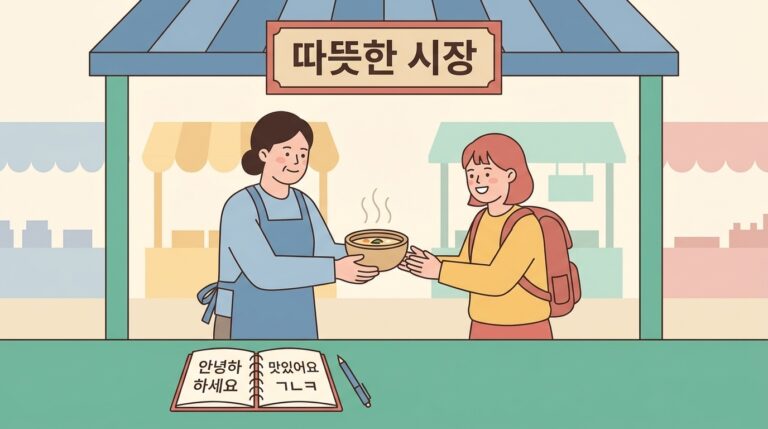
- K-Culture Moment: An elderly owner of a traditional Gukbap (rice soup) restaurant places extra steamed dumplings on your table for free, smiling warmly while saying this phrase.
- Editor’s Insight: The verb 챙기다 (chaeng-gi-da) means to look after, pack, or attend to someone. When combined with 정 (Jeong), it excuses any boundary overstep by framing it as pure warmth and community hospitality.
- Situation Spectrum: Casual ✅ / Semi-formal ✅ / Formal ⚠️
- 🤔 Think About It: How does your culture express affection to strangers without using words?
3. 부담 갖지 말고 편하게 받으세요
- Pronunciation: [Bu-dam gat-ji mal-go pyeon-ha-ge bat-eu-se-yo] (Sounds like: boo-dahm gat-jee mahl-goh pyuhn-hah-geh baht-eu-seh-yoh)
- Meaning: “Please accept it comfortably without feeling burdened.”
- K-Culture Moment: A Korean friend gifts you a box of fresh strawberries or a warm tea, noticing you looked tired, and senses you feel obligated to give something back.
- Editor’s Insight: Korean social etiquette revolves around reciprocity (주고받기). If someone gives you a gift, you feel 부담 (burden/obligation) to return the favor. This phrase explicitly releases you from that obligation!
- Situation Spectrum: Casual ⚠️ / Semi-formal ✅ / Formal ✅
- 🤔 Think About It: Why is clearing emotional debt so important in Korean interpersonal relationships?
Phase 3: Textbook Korean vs. Real Korean
Scenario 1: Accepting Extra Food or Hospitality from an Elder
- 📖 Textbook: 감사합니다. 잘 먹겠습니다. (Gham-sa-ham-ni-da. Jal meok-get-seum-ni-da. – Thank you. I will eat well.)
- 🗣️ Real Korean: 우와, 진짜 감사해요! 이렇게까지 챙겨주시다니 감동이에요. (U-wa, jin-jja gam-sa-hae-yo! I-reoh-ge-kka-ji chaeng-gyeo-ju-si-da-ni gam-dong-i-e-yo. – Wow, thank you so much! I’m so touched that you took care of me like this!)
- 💡 Why the difference? While the textbook response is polite, expressing emotional impact (감동이에요 – I’m touched) acknowledges the elder’s Jeong and validates their intention to care for you.
Scenario 2: Politely Declining Excessive Personal Questions
- 📖 Textbook: 사생활이라 대답할 수 없습니다. (Sa-saeng-hwal-i-ra dae-dap-hal su eop-seum-ni-da. – It is my private life, so I cannot answer.)
- 🗣️ Real Korean: 아, 아직 고민 중이에요! 때가 되면 말씀드릴게요~ (A, a-jik go-min jung-i-e-yo! Ttae-ga dyae-myeon mal-sseum-deu-ril-ge-yo~ – Ah, I’m still thinking about it! I’ll tell you when the time comes~)
- 💡 Why the difference? Directly shutting down a question with standard textbook privacy phrases creates social tension (ssam). Using an open-ended, playful answer maintains harmony while setting a subtle boundary.
Phase 4: K-Culture Deep Dive & Non-Verbal Manners
4-1. Nunchi & Gesture Spectrum
When navigating the fine line between Ojirap and Jeong, your non-verbal cues matter as much as your spoken vocabulary:
* The Soft Bow & Two-Handed Accept: When a local hands you extra side dishes or helps with your bags, receive the item with both hands while giving a slight 15-degree head tilt.
* The Gentle Hand Wave (거절 손짓): If an elderly person tries to give you advice or food you cannot accept, place one hand over your chest and gently wave the other hand palm-out downward, accompanied by a polite smile.
4-2. Cultural Code: The Gukbap Grandma Effect
In Korean media and daily life, the quintessential icon of Jeong is the 욕쟁이 할머니 (Yokjaengi Halmeoni – Cursing Grandma) archetype found in street markets. She might yell at you for not wearing a warm coat in winter (“Why are you dressed so thin?! You’ll catch a cold!”), but simultaneously pours double meat into your soup bowl. In Western eyes, shouting at a stranger about their jacket is Ojirap. In Korea, it is the ultimate manifestation of maternal Jeong.
Phase 5: Real-Life Roleplay Scenario
Setting: A cozy neighborhood traditional market in Mangwon-dong, Seoul. You are sitting at an open-air food stall eating Tteokbokki.
NPC Character: Market Auntie (시장 이모님) – Warm-hearted, chatty, loves giving extra food to international travelers.
- Turn 1 (이모님): [😊 따뜻한 미소를 지으며] 학생, 추운데 따뜻한 어묵 국물 좀 더 줄까?
(Hag-saeng, chu-un-de tta-tteut-han eo-muk guk-mul jom deo jul-kka?)
“Student, it’s cold outside, shall I give you some more warm fishcake broth?” -
Turn 2 (You): [🙏 두 손으로 컵을 모으며] 아, 네! 감사합니다, 이모님.
(A, ne! Gam-sa-ham-ni-da, i-mo-nim.)
“Ah, yes! Thank you, Auntie.” -
Turn 3 (이모님): [🥣 국물을 가득 부어주며] 혼자 한국에서 고생이 많네. 매운 건 잘 먹어?
(Hon-ja han-gug-e-seo go-saeng-i man-ne. Mae-un geon jal meok-eo?)
“It must be hard living alone in Korea. Can you eat spicy food well?” -
Turn 4 (You): [😄 환하게 웃으며] 네, 매운 음식 엄청 좋아해요!
(Ne, mae-un eum-sik eom-cheong jo-a-hae-yo!)
“Yes, I love spicy food so much!” -
Turn 5 (이모님): [🥟 서비스 만두를 접시에 올리며] 그럼 이것도 먹어봐. 정으로 주는 서비스야!
(Geu-reom i-geot-do meok-eo-bwa. Jeong-eu-ro ju-neun seo-bi-seu-ya!)
“Then try this too. It’s service given out of Jeong!” -
Turn 6 (You): [😲 놀라며 감격스러운 표정으로] 우와, 이렇게 많이 주셔도 돼요? 진짜 감동이에요!
(U-wa, i-reoh-ge man-i ju-syeo-do dwae-yo? Jin-jja gam-dong-i-e-yo!)
“Wow, is it okay to give me this much? I’m so genuinely touched!” -
Turn 7 (이모님): [손사래를 치며 웃는다] 부담 갖지 말고 맛있게 먹어! 또 놀러 오고!
(Bu-dam gat-ji mal-go mas-it-ge meok-eo! Tto nol-leo o-go!)
“Don’t feel burdened and enjoy your meal! Come visit again!” -
Turn 8 (You): [😊 정겹게 인사하며] 네, 자주 올게요! 이모님 최고예요!
(Ne, ja-ju ol-ge-yo! I-mo-nim choe-go-ye-yo!)
“Yes, I’ll come often! You are the best, Auntie!”
🔀 Interactive Branching Choice
The Auntie suddenly asks: “근데 왜 아직 결혼 안 했어? 한국 사람 소개시켜 줄까?” (By the way, why aren’t you married yet? Want me to introduce a Korean person to you?) How do you respond?
- Option A: “그런 개인적인 질문은 실례예요.” (That kind of personal question is rude.)
- Option B: “아, 아직 공부(일)에 집중하고 있어서요! 좋은 사람 있으면 말씀드릴게요~” (Ah, I’m focusing on my studies/work right now! If I’m ready, I’ll let you know~)
- Option C: “네! 당장 소개시켜 주세요!” (Yes! Introduce someone right away!)
Feedback:
- Option A (BAD): ❌ Creates an uncomfortable chill in the air. While logically true in Western etiquette, it shuts down the elder’s attempt at bonding.
- Option B (BEST): ✅ Perfect B1 skill! It respects her concern (Jeong), sets a boundary gently, and uses light humor without offending.
- Option C (RISK): ⚠️ Unless you are genuinely looking for an immediate Blind Date (소개팅) arranged by a market stall owner, be prepared for her to pull out her smartphone immediately!
Phase 6: 10-Second Emotion Shadowing Drill
Practice reading these sentences aloud, following the emotional cues and / breath pauses:
[🥺 아쉽고 애교 섞어서]괜한 오지랖일 수도 있지만… / 진짜 걱정돼서 그래요.
(Gwaen-han o-ji-rap-il su-do it-ji-man… / jin-jja geok-jeong-dwae-seo geu-rae-yo.)
“It might be unsolicited nosiness… / but I’m saying this because I’m genuinely worried.”-
[😊 기쁘고 신나게]우와, 이렇게 챙겨주시다니! / 역시 한국의 정이 최고예요!
(U-wa, i-reoh-ge chaeng-gyeo-ju-si-da-ni! / yeok-si han-gug-ui jeong-i choe-go-ye-yo!)
“Wow, taking care of me like this! / Korean Jeong is truly the best!” -
[😌 편안하고 감사하게]부담 갖지 않고 / 맛있게 잘 먹겠습니다!
(Bu-dam gat-ji an-go / mas-it-ge jal meok-get-seum-ni-da!)
“Without feeling burdened, / I will enjoy this meal very much!”
Phase 7: K-Culture Mini Dictionary
- 정 (Jeong) | Deep affection, emotional warmth, and invisible attachment shared between people over time or through shared spaces. Used in daily expressions like “정이 들다” (to grow fond of someone).
- 오지랖 (Ojirap) | Literally ‘the wide front flap of a traditional coat.’ Idiomatically refers to meddling or sticking one’s nose into others’ business. Used as “오지랖이 넓다” (to be over-inquisitive/nosy).
- 눈치 (Nunchi) | The quick emotional perception to gauge others’ feelings and social atmosphere. Crucial when deciding whether someone’s action is loving care or an awkward overstep.
- 덤 (Deom) | Free extra items given by sellers out of market affection. When you buy apples and get two extra for free, that bonus is called ‘덤’.
Phase 8: Traveler’s Survival Kit
TOP 3 Survival Phrases
- 괜찮아요, 신경 쓰지 마세요! (Gwaen-chan-a-yo, sin-gyeong sseu-ji ma-se-yo!)
Pro Tip: Use this with a gentle smile when someone tries to help you with something you’d rather do yourself. - 이거 서비스예요? (I-geo seo-bi-seu-ye-yo?)
Pro Tip: When an extra dish lands on your restaurant table unexpectedly, ask this to verify if it’s free hospitality! - 마음만 감사히 받을게요. (Ma-eum-man gam-sa-hi bat-eul-ge-yo.)
Pro Tip: The ultimate polite rejection phrase. Meaning: “I will gratefully accept your kind heart/intention (even if I decline the item/favor).”
Editor’s Travel Note
When traveling off the beaten path in Korea, navigating small towns requires authentic navigation tools. Make sure to complete your Naver Map App Download before exploring traditional markets where Jeong is most vibrant. Cash is also handy if you want to buy small treats and experience street vendor hospitality firsthand!
Phase 9: One Step Deeper (Humanities Mini-Essay)
Korea was traditionally an agrarian village society where survival depended on mutual aid (품앗이). In this tight-knit community, your neighbor’s business was naturally everyone’s business. Today’s fast-paced urban Korea still retains these subconscious social roots. What Western individualism defines as “privacy infringement” is often viewed in traditional Korean culture as a lack of social warmth if withheld. Recognizing that Ojirap stems from the same root as Jeong allows you to see intrusive questions not as personal attacks, but as clumsy attempts at human connection.
💬 Your Turn: Has a Korean stranger or friend ever shown you unexpected Jeong or Ojirap? Share your favorite or most surprising story in the comments below!
Phase 10: FAQ & Common Mistakes
Q: How can I tell if someone is being genuinely affectionate (정) or just overly nosy (오지랖)?
A: Look at their immediate actions! Jeong is almost always accompanied by giving (food, physical assistance, genuine care), whereas pure Ojirap usually stops at asking intrusive questions or offering unsolicited advice without offering real help.
Q: Is it rude to decline extra free food (덤/서비스) given at a market?
A: It is not rude if you decline politely using 마음만 감사히 받을게요 (I’ll gratefully receive your kind intention) while gesturing that your stomach is full.
Q: Why do older Koreans ask about my age, marital status, or salary right away?
A: In Korean culture, age and social role determine hierarchy and appropriate language register (존댓말 vs 반말). Asking personal questions is often their traditional way of figuring out how to relate to you respectfully and comfortably.
🚨 Common Mistakes TOP 3
- Mistake: Responding with cold silence or a flat “No” when elders offer advice.
- Correct Action: Nod politely and say, “아, 그렇군요! 참고할게요~” (Ah, I see! I’ll keep that in mind~).
- Mistake: Offering money to pay for free side dishes (서비스).
- Correct Action: Do not offer money for free items! Simply offer a energetic verbal thank you: “잘 먹겠습니다!”
- Mistake: Feeling obligated to answer intimate questions truthfully.
- Correct Action: Give vague, playful responses like “글쎄요~ 아직 잘 모르겠어요” (Hmm, I’m not sure yet) to protect your privacy while keeping the vibe light.
Phase 11: Action Mission
- 🥉 Bronze Level: Practice saying “부담 갖지 말고 편하게 받으세요!” out loud 3 times in front of a mirror with a warm facial expression.
- 🥈 Silver Level: Share this blog post on your favorite social media channel with your own definition of Jeong.
- 🥇 Gold Level: Next time you visit a Korean restaurant or cafe, say “정말 친절하게 챙겨주셔서 감사합니다!” to the staff after receiving great service.
🎮 K-Culture Mission: Watch an episode of a slice-of-life K-drama (like Reply 1988 or Hometown Cha-Cha-Cha) and count how many times neighbors give each other food out of Jeong!
Phase 12: Interactive Quiz Challenge
Q1. Situation Judgment: An elderly neighbor tells you that you look pale and hands you a warm herbal drink. What is the most culturally appropriate response?
👉 Click to view Answer & Explanation
Answer: “우와, 제 건강까지 챙겨주시다니 정말 감사합니다! 잘 마실게요.”
Explanation: Acknowledging that they are looking out for your health (챙겨주시다) responds directly to their Jeong with gratitude, creating a warm community connection.
Q2. Fill in the Blank: Complete the native phrase meaning “Please receive it comfortably without feeling burdened.”
“_____ 갖지 말고 편하게 받으세요.”
👉 Click to view Answer & Explanation
Answer: 부담 (Bu-dam)
Explanation: 부담 means burden or emotional pressure. Saying 부담 갖지 마세요 relieves the receiver of reciprocal obligation.
Q3. True or False: In Korean culture, asking unsolicited questions about your romantic life is always done with malice or intent to gossip.
👉 Click to view Answer & Explanation
Answer: False!
Explanation: While it can feel uncomfortable to Westerners, asking personal questions is often an older generation’s traditional social mechanism to show interest and express Jeong toward younger people.







