

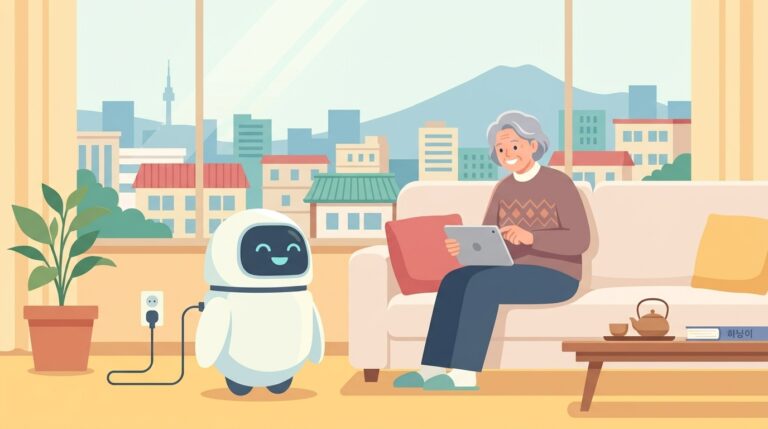
안녕하세요! 매일한글 에디터입니다. Welcome back to another high-level Korean language deep-dive with Daily Hangul!
Korea is officially transitioning into a super-aged society, making the Silver Economy (고령화 비즈니스) and Aging Tech (에이징 테크) two of the hottest, most crucial topics in modern Korean society. Picture this: You are attending a high-level business meeting in Yeouido or presenting a tech proposal to a Korean senior welfare foundation. The board is looking for advanced, culturally nuanced Korean that doesn’t just describe technology—it shows deep respect for Korean social values like hyo (효, filial piety) and emotional rapport (jeong).
If you’ve ever felt that textbook business Korean sounds too robotic or overly direct when discussing eldercare, you are not alone! At the C2 level, precision is everything. Expressing how AI care robots (돌봄 로봇) enhance autonomy while maintaining emotional connection requires mastering subtle stylistic registers and socio-cultural nuances. Drawing from over ten years of coaching global executives and advanced learners, I’ve tailored this guide to help you navigate Korea’s cutting-edge Aging Tech discourse like a true local insider.
1. 정서적 교감을 형성하다 (Jeongseojuk gyogameul hyeongseonghada)
- Pronunciation: [Jeong-seo-jeok gyo-gam-eul hyeong-seong-ha-da] (Sounds like “jung-so-juck pyo-gam-ool hyung-sung-ha-da”)
- Meaning: Literal: “To form emotional communion.” / Actual Nuance: To build genuine emotional rapport or a heartfelt bond, especially between care robots and senior citizens.
- K-Culture Moment: Commonly heard in modern K-Dramas featuring smart homes or documentaries on rural elders bonding with AI companion dolls like ‘Hyodol’.
- Editor’s Insight: In C2-level business, avoid saying “노인과 친해지다” (to get friendly with seniors). “정서적 교감을 형성하다” elevates your discourse to an expert level, highlighting human-centric tech design.
- Situation Spectrum: Casual 🚫 | Semi-formal ⚠️ | Formal ✅
- 🤔 Think About It: How does your native language express the emotional connection between human beings and assistive artificial intelligence?
2. 존엄성을 보장하다 (Joneomseongeul bojanghada)
- Pronunciation: [Jon-eom-seong-eul bo-jang-ha-da] (Think of “zone-um-sung-ool bo-jang-ha-da”)
- Meaning: Literal: “To guarantee dignity.” / Actual Nuance: To preserve an elderly person’s autonomy and self-respect through non-intrusive tech support.
- K-Culture Moment: Used heavily in government policy discussions and high-tech medical expos in Seoul when showcasing smart mobility solutions.
- Editor’s Insight: Korean elder care places extreme value on saving face and maintaining human dignity. Using this phrase demonstrates that your business solution prioritizes human values over pure automation.
- Situation Spectrum: Casual 🚫 | Semi-formal ⚠️ | Formal ✅
- 🤔 Think About It: Why is preserving dignity a core selling point in East Asian senior care tech compared to purely utilitarian solutions?
3. 고령 친화적 인터페이스 (Goryeong chinhwajeok inteopeiseu)
- Pronunciation: [Go-ryeong chin-hwa-jeok in-teo-puei-seu]
- Meaning: Literal: “Age-friendly interface.” / Actual Nuance: UI/UX specifically simplified, enlarged, and emotionally optimized for senior citizens.
- K-Culture Moment: Featured in tech startup pitches proposing simplified voice-activated controls for smart care devices.
- Editor’s Insight: While “쉬운 화면” (easy screen) works in basic speech, “고령 친화적 인터페이스” shows professional domain expertise in tech and silver economy contexts.
- Situation Spectrum: Casual 🚫 | Semi-formal ✅ | Formal ✅
- 🤔 Think About It: How does tech accessibility reflect societal attitudes toward aging in your culture?
📖 교과서 한국어
“이 로봇은 노인의 외로움을 줄여 줍니다.”
(This robot reduces the loneliness of old people.)
🗣️ 진짜 한국어
“본 돌봄 로봇은 어르신과의 정서적 교감을 통해 독거노인의 고독사를 예방하고 일상에 활력을 불어넣습니다.”
(This care robot prevents isolated senior death and infuses vitality into daily life by forming an emotional bond with elders.)
💡 왜 다를까?
At the C2 level, avoid using “노인” (old people) directly when addressing audiences or describing clients; instead, use the honorific “어르신” (esteemed elders). Furthermore, professional discourse replaces simple verbs like “줄여 줍니다” with active, value-added phrasing such as “활력을 불어넣습니다” (infuses vitality).
4-1. Nunchi & Non-Verbal Gestures
When presenting Aging Tech proposals to Korean stakeholders or visiting silver welfare centers, non-verbal cues carry immense weight:
* Two-Handed Demonstration: When showing an app or hand-held care unit to an elder or executive, always hold the device with both hands or support your right elbow with your left hand.
* Warm Body Language: Maintain soft eye contact, bow slightly (15-30 degrees) when addressing senior test-users, and avoid crossing your arms, which can signal distance or arrogance.
4-2. Cultural Code: Filial Piety (효) Meets High Tech
In Korea, caring for parents is historically a sacred family duty (Hyo). However, modern urbanization has created a “Care Gap” (돌봄 공백). Today’s Aging Tech is not seen as a replacement for human family love, but rather as an instrument of modern Hyo that empowers elders to live independently without being a physical burden to their children.
Scenario: You are presenting a smart AI companion robot solution to Director Kim (김 이사님) at a leading Korean Silver Life Foundation.
- You: 이사님, 이번에 선보이는 에이징 테크 솔루션은 어르신의 자립성을 극대화하도록 설계되었습니다. (Director Kim, the aging tech solution we are presenting this time is designed to maximize elders’ independence.)
- 🎭 Action: (Warmly pointing to the pitch slides with an open palm)
- Director Kim: 기존의 단순 음성인식 인형과 어떤 점에서 차별화됩니까? (How does this differentiate itself from existing simple voice-recognition dolls?)
- You: 단순 일방향 응답을 넘어, 어르신과의 정서적 교감을 형성하는 딥러닝 모델을 탑재했습니다. (Beyond simple one-way responses, it features a deep-learning model that forms emotional rapport with elders.)
- 🎭 Action: (Nodding respectfully with a confident, reassuring smile)
- Director Kim: 현장 요양보호사분들의 업무 부담도 줄여줄 수 있을까요? (Can it also reduce the workload of field care workers?)
- You: 네, 돌봄 공백을 메워주는 백업 시스템 역할을 수행하므로 현장 인력의 피로도를 낮춥니다. (Yes, it acts as a backup system that bridges care gaps, reducing the physical fatigue of field staff.)
- Director Kim: 무엇보다 어르신들께서 기기 사용에 거부감을 느끼지 않으셔야 할 텐데요. (Above all, senior citizens shouldn’t feel resistant to using the device.)
- You: 직관적인 고령 친화적 인터페이스를 적용하여 누구나 손쉽게 친숙해지실 수 있습니다. (We applied an intuitive age-friendly interface so anyone can comfortably get used to it.)
- 🎭 Action: (Gently placing hands together to demonstrate harmony)
🔀 Interactive Choice Point
Director Kim asks: “어르신의 개인정보 보호와 존엄성 문제는 어떻게 해결했나요?” (How did you resolve the issue of privacy protection and dignity for elders?)
- Choice A: “보안 기술이 뛰어나서 개인정보 유출 걱정은 전혀 하지 않으셔도 됩니다.” (Best / Executive tone)
- Choice B: “데이터는 자동 삭제되며, 존엄성을 보장하는 비침해적 센서 기술을 채택했습니다.” (Best / C2 Master level)
- Choice C: “어르신들이 기기를 신경 쓰지 않으시면 문제없습니다.” (Bad / Dismissive nuance)
Feedback:
* Choice B (Best): Perfect C2 tone! You addressed dignity (“존엄성 보장”) and utilized technical accuracy (“비침해적 센서”).
* Choice A (Risk): Accurate, but sounds like a basic sales pitch lacking depth.
* Choice C (Bad): Unprofessional and displays a lack of empathy for senior user experience.
Practice these high-impact C2 sentences with emotional dynamics:
[😊 확신에 차서 / Confident & Warm]
“본 로봇은 / 단순한 기기를 넘어 / 어르신의 따뜻한 말벗이 되어 드립니다.”
(Bon robot-eun / dansun-han gigi-reul neomeo / eorreusin-ui ttatteut-han malbeos-i doe-eo deurimnida.)-
[🤝 정중하고 격식 있게 / Formal & Respectful]
“어르신의 존엄성을 보장하며 / 돌봄 공백을 효과적으로 메우겠습니다.”
(Eorreusin-ui joneomseong-eul bojanghamyeo / dolbom gongbaeg-eul hyogwa-jeog-euro me-ugessnida.)
- 실버타운 (Silver Town) | Senior living community offering comprehensive medical, residential, and social facilities.
- 돌봄 공백 (Care Gap) | The shortage or absence of adequate caregiving support for isolated or dependent elders.
- 반려 로봇 (Companion Robot) | AI-driven robotic devices designed to provide friendship, health monitoring, and emergency alerts.
- 디지털 소외 (Digital Alienation) | The marginalization of older adults caused by rapid digitization of daily services.
Top 3 Survival Phrases for Silver Tech Contexts
- “어르신, 불편하신 곳은 없으신가요?” (Eorreusin, bulpyeonhasin goseun eopsuseinga-yo?)
- Pro Tip: Essential greeting when testing equipment with senior users to convey care and respect.
- “음성 크기와 글자 크기를 조절해 드리겠습니다.” (Eumseong keugi-wa geulja keugi-reul jojeol-hae deurigessnida.)
- Pro Tip: Use when demonstrating user accessibility features to senior clients.
- “긴급 상황 시 즉시 보호자에게 알림이 전송됩니다.” (Gingeup sanghwang si jeoksi bohoja-ege allim-i jeonsongdoemnida.)
- Pro Tip: Critical pitch phrase emphasizing safety assurances.
Editor’s Travel & Field Note
When visiting public silver welfare facilities or elder care centers in Seoul, research facility locations using the 네이버 지도 앱 다운로드 to check accessibility and nearby public transport options.
In modern Korean culture, the traditional Confucian concept of filial piety (Hyo) is undergoing a profound transformation. Rather than viewing technological intervention as an evasion of family duty, contemporary Korean society embraces Aging Tech as a collaborative ecosystem. Care robots do not replace human warmth; they sustain human dignity when physical family co-presence is unattainable.
💬 Your Turn: How is Aging Tech viewed in your home country? Is technology embraced as a reliable caregiver, or is there resistance? Share your thought-provoking insights in English or Korean below!
Q: Is it disrespectful to use care robots instead of hiring human caregivers in Korea?
A: Not at all! In modern Korea, care robots are increasingly welcomed as supportive tools that prevent elder isolation and relieve physical caregiving stress, as long as human emotional care remains present.
Q: What is the difference between ‘노인’ and ‘어르신’?
A: ‘노인’ is a neutral, demographic/legal term used in official papers or statistics. ‘어르신’ is a highly respectful honorific term used in direct conversation, business pitches, and public communication to show deep respect.
Q: How do I express UI simplicity for seniors without sounding patronizing?
A: Use terms like ‘고령 친화적 설계’ (age-friendly design) or ‘직관적 인터페이스’ (intuitive interface) rather than ‘쉽게 만든 기능’ (simple made features).
🚨 Common Mistakes Table
- Incorrect: “노인들을 위한 쉬운 기기입니다.”
- Correct Action: Use “어르신을 위한 고령 친화적 기기입니다.”
- Reason: ‘노인’ sounds clinical and cold in live pitches; ‘어르신’ shows social etiquette and maturity.
- Bronze Level: Record yourself reading the 3 core C2 expressions aloud with natural pauses.
- Silver Level: Write a 3-sentence summary of an ideal Aging Tech care robot in Korean and share it on your social platform.
- Gold Level: Engage in a mock presentation pitching a smart care tech solution using the dialogue from Phase 5.
🎮 K-Culture Mission: Watch a documentary episode on Korea’s smart silver towns or search YouTube for ‘돌봄로봇 효돌’ to observe real-life conversational nuances between seniors and AI robots!
1. What is the most respectful term to use when speaking about senior clients in a business pitch?
- A) 노인들
- B) 어르신
- C) 늙은이
Click to view answer & explanation
Correct Answer: B
‘어르신’ is the proper honorific term reflecting C2-level cultural maturity and business protocol.
2. Fill in the blank: “로봇이 어르신과의 _________을(를) 형성합니다.”
- A) 존엄성
- B) 정서적 교감
- C) 디지털 소외
Click to view answer & explanation
Correct Answer: B
‘정서적 교감’ (emotional rapport) completes the statement describing emotional AI bonding.
3. True or False: ‘실버타운’ refers strictly to a government-run nursing home for destitute elders.
Click to view answer & explanation
Correct Answer: False
‘실버타운’ refers to modern senior living residential complexes equipped with premium health, leisure, and living services.






