

안녕하세요! 매일한글 에디터입니다.
Have you ever sat in a Korean cafe or office meeting where nobody explicitly said “no,” yet everyone somehow agreed that the answer was a firm “no”? Or perhaps you noticed someone waving their hand franticly in front of their face, leaving you wondering if they were shooing a fly or declining your coffee offer?
Welcome to C1-level Korean communication, where what remains unspoken speaks infinitely louder than words! Nonverbal communication—from subtle micro-gestures to the intricate art of Nunchi (눈치)—forms over 70% of high-context Korean interactions. In this deep dive, crafted from real feedback by advanced learners and over 10 years of field editing at Daily Hangul, we will decode the implicit body language codes that elevate you from a fluent speaker to a true cultural insider.
Phase 2: Core Expressions Deep Dive
1. 손사래를 치다 (Sonsarae-reul chida)
- Pronunciation: [Son-sa-rae-reul chi-da] (Imagine rapidly fanning away warm air with your open palm facing outward)
- Meaning: Literal: To wave one’s hands outward. | Real Nuance: Firmly yet humbly declining a compliment, gift, or favor to display modesty (Gyemson).
- K-Culture Moment: In K-dramas, when an elder offers a generous allowance or compliment, the protagonist rapidly waves both hands with open palms while gasping lightly.
- Editor’s Insight: This is not anger or rejection; it is high-level Korean etiquette designed to prevent the speaker from appearing boastful or greedy.
- Situation Spectrum: Casual ✅ | Semi-formal ✅ | Formal ⚠️
- 🤔 Think About It: How does your home culture physically express humility when receiving grand praise?
2. 고개를 갸웃거리다 (Gogaereul gyautgeorida)
- Pronunciation: [Go-gae-reul gya-ut-geo-ri-da] (Tilted head posture, shifting side to side like a thoughtful cat)
- Meaning: Literal: To tilt one’s head side to side. | Real Nuance: Expressing non-confrontational doubt, confusion, or gentle disagreement without verbal confrontation.
- K-Culture Moment: A junior project manager listens to a tight deadline in a Seongsu tech office, subtly tilting their head 15 degrees while soft-sighing.
- Editor’s Insight: Tilting your head signals ‘I am processing this critically’ rather than ‘You are wrong,’ softening potential social friction.
- Situation Spectrum: Casual ✅ | Semi-formal ✅ | Formal ⚠️
- 🤔 Think About It: In high-context societies, why is non-verbal hesitation preferred over direct verbal refusal?
3. 눈치를 보다 (Nunchi-reul boda)
- Pronunciation: [Nun-chi-reul bo-da] (Reading the eye-atmosphere and energy rhythm of the room)
- Meaning: Literal: To observe eye vibes. | Real Nuance: Micro-analyzing facial expressions and emotional atmosphere before taking action.
- K-Culture Moment: During a team dinner (Hoesik), colleagues watch the department director’s chopstick pace to gauge the right moment to leave.
- Editor’s Insight: Doing Nunchi is not anxiety—it is active social intelligence and empathetic situational awareness.
- Situation Spectrum: Casual ✅ | Semi-formal ✅ | Formal ✅
- 🤔 Think About It: Is reading the room considered an innate emotional skill or a trained social obligation in your country?
Phase 3: Textbook Korean vs Real Native Korean
Situation 1: Declining compliments or offers
- 📖 교과서 한국어: “아닙니다. 괜찮습니다.” (No, it is okay.)
- 🗣️ 진짜 한국어: [손사래를 치며] “에이, 아닙니다! 제가 해야죠!” ([Waving hands outward] Oh come on, no way! I should be the one doing it!)
- 💡 왜 다를까?: Textbook phrases sound cold and distant. Native Korean uses warm physical gestures alongside energetic exclamations (Ei~) to build interpersonal connection (Jeong).
Situation 2: Expressing disagreement in meetings
- 📖 교과서 한국어: “이해하기 어렵습니다.” (It is hard to understand.)
- 🗣️ 진짜 한국어: [고개를 갸웃거리며] “글쎄요… 조금 애매한데요?” ([Tilting head] Well… it’s a bit ambiguous/tricky, isn’t it?)
- 💡 왜 다를까?: Direct statements like “hard to understand” can sound accusatory. Combining a tilted head with soft hedge words (geulsseyo) cushions the disagreement.
Phase 4: K-Culture Deep Dive & Nonverbal Manners
4-1. High-Context Bows, Eye Contact & Hand Placement
In Korea, physical positioning signals hierarchy and respect:
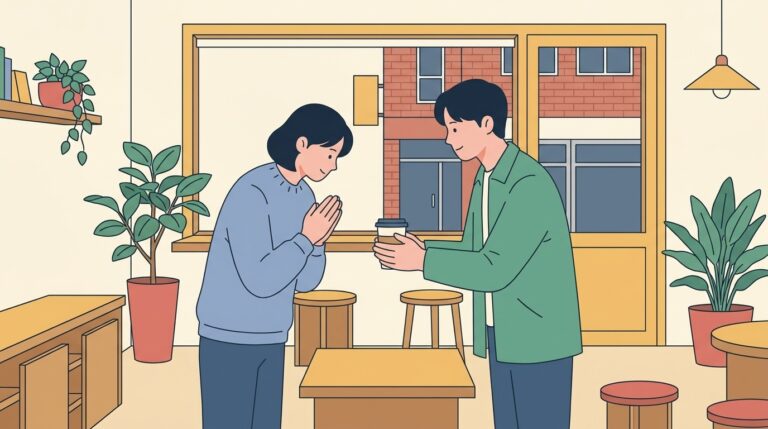
* Two-Handed Rule: When giving or receiving business cards, drinks, or items, always use two hands or support your right wrist/elbow with your left hand.
* Gaze Management: Direct, unblinking eye contact during critique can be perceived as defiance. Dropping your gaze slightly down while keeping your body engaged shows reflective respect.
4-2. Cultural Code Analysis: Business & Drama Moments
Pay attention to business card exchanges (Myeongham) in K-dramas: professionals receive cards with both hands, take three seconds to review the title, and carefully set them on the table rather than immediately slipping them into a back pocket.
Phase 5: Real-life Roleplay Scenario
Setting: A modern creative agency in Seongsu-dong during a project sprint review with Team Leader Min (민 팀장).
- 민 팀장: [안경을 고쳐 쓰며] “이번 신제품 프로모션안, 금요일까지 마무리 가능하겠죠?”
(Min Timjang: [Adjusting glasses] “The new product promotion plan, we can wrap it up by Friday, right?”) - 학습자: [고개를 갸웃거리며] “음… 금요일 말씀이신가요?”
(Learner: [Tilting head slightly] “Um… did you say Friday?”) - 민 팀장: [손가락으로 펜을 만지작거리며] “왜요? 일정에 무슨 문제라도 있나요?”
(Min Timjang: [Fiddling with a pen] “Why? Is there a problem with the schedule?”) - 학습자: [두 손을 모으고] “사실 디자이너 측 피드백이 목요일 저녁에 도착할 예정이라서요.”
(Learner: [Hands clasped together] “To be honest, the design feedback is scheduled to arrive Thursday evening.”) - 민 팀장: [지그시 바라보다가 살짝 고개를 끄덕이며] “아, 그래요? 그럼 월요일 아침까지로 연장해 줄게요.”
(Min Timjang: [Gazing thoughtfully then nodding softly] “Ah, really? Then I’ll extend it until Monday morning.”) - 학습자: [손사래를 치며] “아닙니다! 주말까지 고생하실 필요 없게 월요일 출근 전까지 완료해 두겠습니다!”
(Learner: [Waving hands humbly] “Oh, no! To save you trouble over the weekend, I will have it ready before work on Monday!”) - 민 팀장: [미소를 지으며] “역시 믿음직스럽네요. 잘 부탁해요.”
(Min Timjang: [Smiling] “As expected, very reliable. I’m counting on you.”) - 학습자: [허리를 굽혀 가볍게 인사하며] “네, 감사합니다! 최선을 다하겠습니다.”
(Learner: [Bowing slightly] “Yes, thank you! I will do my best.”)
🔀 Interactive Branching Point
When Team Leader Min pushes an unrealistic Friday deadline, how do you signal your hesitation non-verbally?
* Option A: [Cross arms and sigh loudly] “That deadline is totally impossible.”
* Option B: [Tilt head slightly, hold hands together, softly state the bottleneck]
* Option C: [Nod vigorously and say yes immediately, even if impossible]
Feedback:
* Option A (Bad): Defensive body posture creates aggressive tension in a Korean workplace.
* Option B (Best): C1-level masterstroke! Nonverbal hesitation combined with soft language respects authority while setting practical boundaries.
* Option C (Risk): Over-promising to save face leads to severe loss of trust later.
Phase 6: 10-second Emotion Shadowing Drill
- [😊 감격하며 쑥스러운 듯 – Modest & Flustered]
“에이 / 손사래를 치면서 / 아닙니다! / 제가 더 감사하죠!”
(Ei / sonsarae-reul chimeonseo / anipnida! / jega deo gamsahajo!) -
[🤔 진지하고 신중하게 – Thoughtful & Cautious]
“글쎄요… / [고개를 갸웃] / 조금 더 검토해 봐야 / 할 것 같습니다.”
(Geulsseyo… / [gogae-reul gyaut] / jogeum deo geomtohae bwaya / hal geot gatseumnida.)
Phase 7: K-Culture Mini Dictionary
- 눈치 (Nunchi) | Tactful situational awareness | The ability to gauge group dynamics and unspoken feelings instantly.
- 손사래 (Sonsarae) | Refusal hand gesture | Rapid outward hand fanning used to refuse graciously or brush off praise.
- 표정 관리 (Pyojeong Gwanri) | Facial composure | Maintaining a respectful, balanced facial expression during tense discussions.
- 분위기 파악 (Bunwigi Paak) | Reading the room | Assessing collective mood before speaking up.
Phase 8: Traveler’s Survival Kit
Survival Expressions TOP 3
- [양손으로 받으며] “감사합니다!” (Gamsahamnida! – Receiving coffee/receipts with both hands)
- [가볍게 목례하며] “실례지만…” (Sillyejiman… – Nodding lightly when seeking assistance)
- [손사래 치며] “괜찮습니다!” (Gwaenchansumnida! – Waving hand gently to decline flyers or extra plastic bags)
Editor’s Travel Note
When traveling around Seoul, seamless local navigation is key. Download the 네이버 지도 앱 다운로드 to find local transit rules (e.g., standing on the right side of subway escalators).
Phase 9: A Step Deeper (Reflection)
In Korean society, words form the framework, but body language paints the canvas. Preserving Gibun (기분)—the emotional harmony and dignity of your conversational partner—is paramount. Navigating disagreement through tilted heads, softened eyes, and humble gestures allows for clear boundary-setting without causing loss of face. True fluency lies in communicating through these subtle human frequencies.
💬 Your Turn: What body language cue in your own culture translates completely differently in South Korea? Let’s discuss in the comments below!
Phase 10: FAQ & Common Mistakes
Q: Is direct eye contact considered disrespectful in Korea?
A: Unblinking, intense eye contact with superiors can be interpreted as defensive or aggressive. Maintaining soft eye contact while dropping your gaze slightly when listening shows respectful engagement.
Q: Why do Koreans wave their hand in front of their faces when refusing?
A: This gesture (Sonsarae) visually softens the refusal, signaling humility (“I am unworthy of such praise/favor”) rather than cold rejection.
Q: Is pointing with one finger offensive?
A: Yes, pointing directly at a person with one finger is considered rude. Use an open palm facing upward to indicate people or directions smoothly.
🚨 Common Mistakes
- Mistake 1: Handing money or drinks with one hand to elders. -> Correct Action: Always use two hands or touch your right forearm with your left hand.
- Mistake 2: Beckoning someone with your palm facing UP. -> Correct Action: Turn your palm DOWN and gently flap your fingers (palm up is reserved for calling pets).
- Mistake 3: Crossing arms over your chest while listening to superiors. -> Correct Action: Keep arms relaxed at your sides or loosely folded in front.
Phase 11: Action Mission & Engagement
- 🥉 Bronze Mission: Practice the 손사래 gesture in front of a mirror while saying “에이, 아닙니다!”.
- 🥈 Silver Mission: Record a short reel demonstrating one-handed vs. two-handed beverage handovers.
- 🥇 Gold Mission: Use a non-verbal soft refusal (tilted head + soft hedge) in your next live conversation with a native speaker.
- 🎮 K-Culture Mission: Watch a K-drama scene today and spot at least two instances of 고개를 갸웃거리다!
Phase 12: Interactive Quiz Challenge
- Situation Judgment: A colleague gives you a big compliment on your presentation. What is the most natural non-verbal response?
- A) Look them dead in the eye and say “I know.”
- B) Perform Sonsarae (light hand wave) with a humble smile and say “에이, 아닙니다.”
- C) Turn around and walk away.
Click to reveal answer
Answer: B! Performing Sonsarae demonstrates C1-level cultural modesty and warmth.
-
Fill in the Blank: Observing and reading the unspoken energy of a room before making a move is called ________ (눈치).
Click to reveal answer
Answer: 눈치 (Nunchi).
-
True or False: Beckoning someone with your palm facing upwards is polite in Korea.
Click to reveal answer
Answer: False! Palm facing upwards is used for animals. Turn your palm DOWN when beckoning people.







