

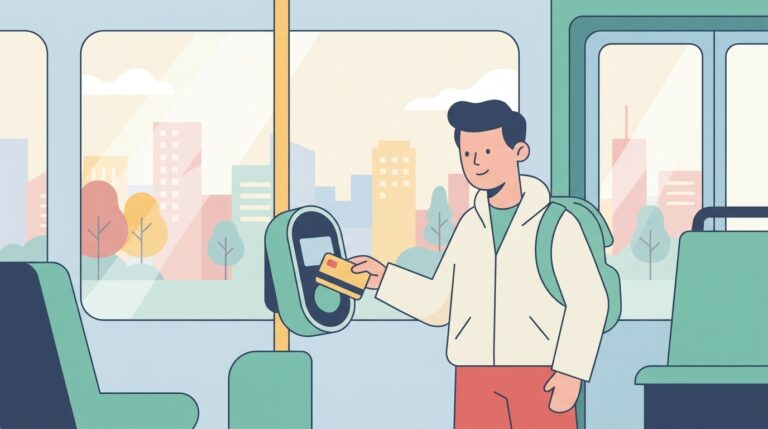
안녕하세요! 매일한글 에디터입니다. Have you ever stepped onto a bright blue or green Seoul bus, tapped your transit card, and heard the card reader chime with a friendly voice saying “Hwan-seung-im-ni-da”? If you felt a momentary freeze wondering if your card was rejected or if you did something wrong, don’t worry! Every traveler in Korea experiences this exact moment. Understanding Korea’s bus transfer system isn’t just about saving money—it’s your ultimate ticket to riding public transit like a true Seoul local. Based on feedback from thousands of beginner learners, this guide will make sure you never panic at the bus card reader again!
Phase 2: Key Expressions Deep Dive
1. 환승입니다 (Hwan-seung-im-ni-da)
- Pronunciation: [Hwan-seung-im-ni-da] (Sounds like “Juan” + “sung” + “im-nee-dah”)
- Meaning: Literal: “It is a transfer.” | Nuance: “Transfer discount applied! You’re good to go.”
- K-Culture Moment: In modern K-Dramas, whenever characters quickly switch from a subway to a bus while heading home, you’ll hear this iconic automated voice chime.
- Editor’s Insight: It is an automated notification from the card reader indicating that your transfer discount was successfully applied.
- Situation Spectrum: Casual (⚠️), Semi-formal (✅), Formal (✅)
- 🤔 Think About It: In many cities, you pay a flat fee per ride regardless of transfers. Why do you think Korea built a seamless discount system between buses and subways?
2. 카드를 대주세요 (Ka-deu-reul dae-ju-se-yo)
- Pronunciation: [Ka-deu-reul dae-ju-se-yo] (Sounds like “Car-doo-reul” + “day-joo-say-yo”)
- Meaning: Literal: “Please touch the card.” | Nuance: “Please tap your card again.”
- K-Culture Moment: When a passenger taps their card too fast and walks away, the bus driver kindly reminds them over the speaker!
- Editor’s Insight: “대다” (dae-da) means to touch or hold close to something. Adding “-주세요” makes it a polite request.
- Situation Spectrum: Casual (🚫), Semi-formal (✅), Formal (✅)
- 🤔 Think About It: Notice how polite public announcements are in Korea, using honorific endings even when giving automated instructions!
3. 내릴 때 찍으세요 (Nae-ril ttae jjeog-eu-se-yo)
- Pronunciation: [Nae-ril ttae jjeog-eu-se-yo] (Sounds like “Neigh-reel” + “ttae” + “jjeok-eu-say-yo”)
- Meaning: Literal: “Tap when getting off.” | Nuance: “Don’t forget to tap out when you exit!”
- K-Culture Moment: A helpful local standing near the exit gently reminding tourists to tap before exiting so they don’t lose their transfer discount.
- Editor’s Insight: “찍다” (jjik-da) literally means to stamp or snap a photo, but in transit slang, it means to “tap/scan” a card!
- Situation Spectrum: Casual (⚠️), Semi-formal (✅), Formal (✅)
- 🤔 Think About It: Korean uses dynamic visual verbs like “찍다” (stamp/tap) for modern electronic actions. How does your language express tapping a card?
Phase 3: Textbook Korean vs. Real Korean
📖 Textbook Korean: “환승 혜택이 적용되었습니다.” (Hwan-seung hye-taeg-i jeog-yong-deo-eoss-seub-ni-da)
🗣️ Real Korean: “환승입니다!” (Hwan-seung-im-ni-da!)
💡 Why different? Automated bus readers use short, concise phrasing so traffic flows quickly during rush hour.
📖 Textbook Korean: “하차하실 때 카드를 단말기에 접촉하십시오.” (Ha-cha-ha-sil ttae ka-deu-reul dan-mal-gi-e jeob-chok-ha-sip-si-o.)
🗣️ Real Korean: “내릴 때 카드 찍으세요!” (Nae-ril ttae ka-deu jjeog-eu-se-yo!)
💡 Why different? Locals prefer the catchy everyday verb “찍다” over formal vocabulary like “접촉” (contact/touch).
Phase 4: K-Culture Deep Dive & Non-verbal Manners
4-1. Nunchi & Gestures
When approaching the exit door, prepare your card in advance. Keep your eye on the scanner. When you tap and hear “Hwan-seung-im-ni-da”, a slight nod with a confident step off the bus shows true local bus etiquette!
4-2. Culture Code Analysis
Korea’s integrated transit system connects subways, city buses, and local neighborhood buses (마을버스). Tapping out within 30 minutes guarantees free or deeply discounted transfers up to 4 times a day!
Phase 5: Real Roleplay Scenario
- Setting: A busy bus stop in Hongdae, Seoul.
- Characters: Alex (Tourist, Beginner) & Bus Reader/Driver (NPC)
-
Turn 1: Alex – 안녕하세요! (An-nyeong-ha-se-yo!) 🎭 [Greeting with a bright smile] (Hello!)
- Turn 2: Driver – 어서 오세요. (E-seo o-se-yo.) 🎭 [Nodding warmly] (Welcome aboard.)
- Turn 3: Reader – 카드를 대주세요. (Ka-deu-reul dae-ju-se-yo.) 🎭 [Chime beeps] (Please touch your card.)
- Turn 4: Alex – (Taps T-money card on reader) 🎭 [Taps card firmly]
- Turn 5: Reader – 환승입니다. (Hwan-seung-im-ni-da.) 🎭 [Cheerful automated chime] (It’s a transfer.)
- Turn 6: Alex – 아, 환승이에요? 감사합니다! (A, hwan-seung-i-e-yo? Gam-sa-ham-ni-da!) 🎭 [Relieved and happy] (Ah, it’s a transfer? Thank you!)
- Turn 7: Driver – 내릴 때도 찍으셔야 해요. (Nae-ril ttae-do jjeog-eu-seo-ya hae-yo.) 🎭 [Friendly advice] (Make sure to tap when getting off, too.)
- Turn 8: Alex – 네, 내릴 때 찍을게요! (Ne, nae-ril ttae jjeog-eul-ge-yo!) 🎭 [Giving a confident thumbs up] (Yes, I will tap when getting off!)
🔀 Interactive Choice Point: What do you do when getting off the bus?
– Choice A: Just walk off without tapping because you paid when boarding.
– Choice B: Tap your card on the rear exit scanner until it beeps.
– Choice C: Hand your card to the bus driver directly.
Feedback:
– Choice A: 🚫 Risk! You will lose your transfer discount and pay a penalty distance fee on your next ride!
– Choice B: ✅ Best! Perfect job! Tapping out registers your journey and secures your transfer discount.
– Choice C: ⚠️ Bad! Drivers don’t scan cards by hand; always use the door reader scanners.
Phase 6: 10-Second Emotion Shadowing Drill
- [😊 Happy & Relieved] 환승입니다! / 감사합니다! (Hwan-seung-im-ni-da! / Gam-sa-ham-ni-da!)
- [💡 Polite & Alert] 내릴 때 / 카드를 / 찍으세요! (Nae-ril ttae / ka-deu-reul / jjeog-eu-se-yo!)
- [👍 Confident] 네, / 내릴 때 / 찍을게요! (Ne, / nae-ril ttae / jjeog-eul-ge-yo!)
Phase 7: K-Culture Mini Dictionary
- 교통카드 (Gyo-tong-ka-deu) | Transportation Card | Reloadable cards like T-money used for buses, subways, and taxis in Korea.
- 환승 (Hwan-seung) | Transfer | Switching transit lines or vehicles within 30 minutes for discounted fares.
- 하차 태그 (Ha-cha tae-geu) | Tap Off | Tapping your card at the exit door when getting off a bus.
- 마을버스 (Ma-eul-beo-seu) | Village Bus | Small green buses that navigate inner neighborhood streets to main transit hubs.
Phase 8: Traveler’s Survival Kit
Top 3 Survival Expressions
- 내릴게요! (Nae-ril-ge-yo!) – “I’m getting off!” (Pro Tip: Shout this politely if the bus exit area is packed!)
- 환승 돼요? (Hwan-seung dwae-yo?) – “Is transfer discount available?”
- 카드가 안 돼요. (Ka-deu-ga an dwae-yo.) – “My card isn’t working.”
Editor’s Travel Note
Before starting your journey in Seoul, check out the Naver Map App Download guide to navigate live bus routes and stop announcements. Always keep your T-money card topped up at convenience stores!
Phase 9: One Step Deeper
Korea’s public transit system is globally renowned for efficiency. The transfer discount system reflects Korea’s commitment to convenient urban mobility for all citizens. By interconnecting subways and buses seamlessly, commuting becomes smooth and economical.
💬 Your Turn: Have you ever used a public transit card in another country? How does it compare to Korea’s transfer system? Share your stories in the comments below!
Phase 10: FAQ & Common Mistakes
Q: What happens if I forget to tap my card when getting off the bus?
A: You will lose your transfer discount and be charged a penalty fare equal to the basic fare distance on your next ride. Always tap out!
Q: How long do I have to make a transfer?
A: You have 30 minutes (extended to 60 minutes between 9 PM and 7 AM) after tapping off the previous vehicle.
Q: Can I get a transfer discount if I take the exact same bus number again?
A: No, transfer discounts do not apply if you re-board the same bus route number immediately after exiting.
🚨 Common Mistakes TOP 3:
1. Tapping twice when boarding: Tap only once per person unless asking the driver for multi-passenger billing.
2. Forgetting to tap out at exit: Leads to penalty distance charges next time.
3. Panicking at “Hwan-seung-im-ni-da”: Remember, it means your discount was successful!
Phase 11: Action Mission
- Bronze Level: Practice saying “환승입니다” out loud 3 times in front of a mirror!
- Silver Level: Record yourself shadowing Phase 6 and tag #DailyHangulBus on social media!
- Gold Level: Use a T-money card on a Korean bus and successfully make a transfer ride!
🎮 K-Culture Mission: Spot a scene in a Korean drama where characters tap off at the exit door and comment the drama name below!
Phase 12: Interactive Quiz Challenge
Q1. What does the automated reader mean when it says “환승입니다”?
Click to see Answer & Explanation
It means “It’s a transfer!” confirming that your transfer discount has been applied successfully.
Q2. Fill in the blank: “내릴 때 카드를 ______” (Tap your card when getting off).
Click to see Answer & Explanation
Answer: 찍으세요 (jjeog-eu-se-yo)
Q3. True or False: You don’t need to tap your card when exiting if you aren’t transferring.
Click to see Answer & Explanation
False! You must always tap out to avoid distance penalty charges on your next ride.







