

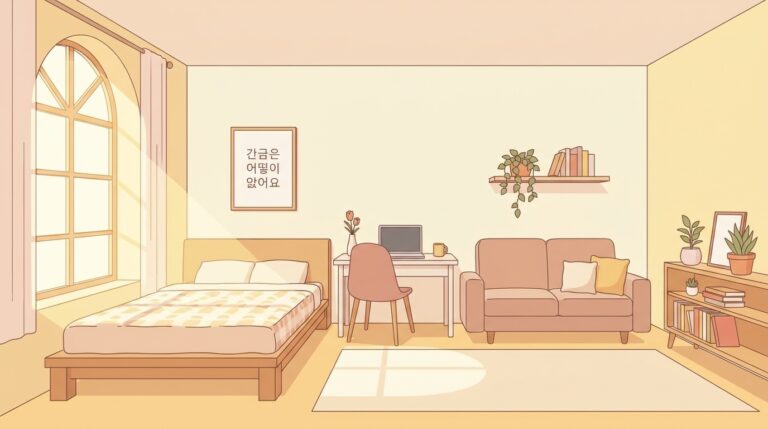
안녕하세요! 매일한글 에디터입니다. Welcome back to another exciting lesson with Daily Hangul!
Have you ever dreamed of moving into a cozy, sunlit won-room (원룸 – studio apartment) in Seoul, just like the characters in your favorite K-Dramas? Or maybe you’re currently rearranging your space and want to share your aesthetic home setup with Korean friends on Instagram? Rearranging furniture is one of the most exciting parts of making a space feel like home. However, when it comes to explaining where each piece should go—whether to a moving assistant, a roommate, or a friend helping you assemble IKEA furniture—it is super easy to get tongue-tied over spatial prepositions and polite request verbs.
Many A2 learners tell us: “I know the words for ‘bed’ and ‘desk’, but how do I naturally tell someone to put the desk against the wall or opposite the TV?” Don’t worry at all! Based on real feedback from our global learner community, we’ve crafted this ultimate guide to help you master furniture layout Korean. By the end of this blog post, you’ll be describing your dream living space with absolute confidence and charm!
1. 침대를 창문 옆에 놓아 주세요. (Chimdae-reul changmun yeope noa juseyo.)
- Pronunciation: Chim-dae-reul chang-mun yeop-e no-ah joo-seh-yo (Think of ‘yeop’ sounding like a quick ‘yup’!)
- Meaning: Direct: “Please place the bed next to the window.” | Nuance: A warm, polite request commonly used when directing helpers or setting up a room.
- K-Culture Moment: You often see this scene in modern Korean interior makeover vlogs on YouTube where creators place a floor mattress right next to a giant window to catch the gentle morning light.
- Editor’s Insight: The pattern
[Location] + 옆에 (yeop-e) + 놓아 주세요 (no-a ju-se-yo)is your absolute go-to for placing items next to something.놓다means ‘to place/put down’. - Situation Spectrum: Casual: ⚠️ | Semi-formal: ✅ | Formal: ✅
- 🤔 Think About It: In English, we say “Put the bed next to the window.” In Korean, the location word (
옆에) comes before the action verb (놓아 주세요). How does this order change how you visualize the room before acting?
2. 소파 맞은편에 TV를 둘 거예요. (Sopa majeunpyeone TV-reul dul geoyeyo.)
- Pronunciation: So-pha ma-jeun-pyeon-e TV-reul dul geo-ye-yo.
- Meaning: Direct: “I’m going to put the TV opposite the sofa.” | Nuance: Expressing your home arrangement plan naturally.
- K-Culture Moment: Setting up the ultimate living room spot for watching K-Dramas with late-night delivery chicken (chimaek)!
- Editor’s Insight:
맞은편(ma-jeun-pyeon) means ‘directly opposite’ or ‘across from’. You can also use건너편(geon-neo-pyeon), but맞은편is especially common for indoor furniture layouts. - Situation Spectrum: Casual: ✅ | Semi-formal: ✅ | Formal: ⚠️
- 🤔 Think About It: Notice how Korean uses
둘 거예요(will put/place). It shows intention while keeping the tone casual and warm.
3. 책상은 벽 쪽에 붙여 주세요. (Chaeksangeun byeok jjoge butyoe juseyo.)
- Pronunciation: Chaek-sang-eun byeok jjok-e boo-chyeo joo-seh-yo.
- Meaning: Direct: “Please push the desk right against the wall.” | Nuance: Requesting furniture to be flush against a surface to maximize floor space.
- K-Culture Moment: Crucial when setting up small studio apartments (won-room) in busy Seoul districts like Hongdae or Gangnam.
- Editor’s Insight:
붙이다literally means ‘to stick’ or ‘attach’, but when talking about furniture,벽에 붙이다means pushing it right up against the wall. - Situation Spectrum: Casual: ⚠️ | Semi-formal: ✅ | Formal: ✅
- 🤔 Think About It: Why is maximizing open floor space so culturally significant in Korean homes? (Hint: Think about floor-sitting culture and ondol floor heating!)
📖 Textbook Korean vs 🗣️ Real Korean
Situation 1: Asking where to place a table
- 📖 Textbook Korean: 의자를 탁자 옆에 두십시오. (Uijareul takja yeope dusipsio.)
- 🗣️ Real Korean: 의자 테이블 옆에 놓아 주세요. (Uija teibeul yeope noa juseyo.)
- 💡 Why the difference? Textbooks often use formal
-하십시오endings and the traditional word탁자. Native speakers in modern homes usually say테이블or식탁(dining table) and use the friendly-해 주세요polite request style.
Situation 2: Asking how to arrange overall furniture
- 📖 Textbook Korean: 가구를 어떻게 배치합니까? (Gagureul eotteokhe baechihamnikka?)
- 🗣️ Real Korean: 가구 어떻게 놓을까요? (Gagu eotteokhe noeulkkayo?)
- 💡 Why the difference?
배치하다sounds like professional logistics or interior designer vocabulary. For daily conversations with friends or family,어떻게 놓을까요?(How shall we place it?) sounds far more natural and inviting.
4-1. Nunchi & Gestures
When directing furniture layout in Korea, avoid pointing with a single index finger directly at people or close to their faces, as it can feel commanding. Instead, use an open palm with fingers together when gesturing toward a spot in the room (e.g., pointing toward the window while saying “창문 옆에”). When asking moving helpers for a favor, a slight soft bow of the head adds instant politeness!
4-2. Culture Code: The Magic of Won-room Living & Ondol
Korean urban housing heavily features the won-room (원룸 – studio) design. Because space is precious, furniture placement revolves around functional zones and ondol (온돌 – underfloor heating). Placing beds and desks near electrical outlets without blocking the warm floor heat flow is an art form! Also, traditional Pungsu-jiri (Korean Feng Shui) suggests avoid placing your bed directly facing the main entrance door for good energy and cozy privacy.
Scene: Rearranging the Living Room with Minjun
Setting: You just moved into a bright studio apartment in Seoul. Your friendly Korean neighbor, Minjun (민준), is helping you unpack.
- Minjun: 침대는 어디에 놓을까요? (Chimdaeneun eodie noeulkkayo?)
- Where shall we place the bed?
- You: 🎭 (Pointing with an open hand toward the window) 창문 옆에 놓아 주세요! (Changmun yeope noa juseyo!)
- Please place it next to the window!
- Minjun: 좋은 위치네요! 그럼 책상은요? (Joeun wichineyo! Geureom chaeksangeun-yo?)
- Great spot! Then what about the desk?
- You: 🎭 (Patting the side wall gently) 책상은 벽 쪽에 붙여 주세요. (Chaeksangeun byeok jjoge butyoe juseyo.)
- Please push the desk right against the wall.
- Minjun: 알겠어요. TV는 소파 맞은편에 둘까요? (Algesseoyo. TV-neun sopa majeunpyeone dulklayo?)
- Got it. Shall we put the TV opposite the sofa?
- You: 🎭 (Nodding happily) 네, 맞아 요! 소파 맞은편이 좋아요. (Ne, majayo! Sopa majeunpyeoni joayo.)
- Yes, that’s right! Opposite the sofa is great.
- Minjun: 이제 가구 배치가 거의 끝났네요! (Ije gagu baechiga geoi kkeunnanneyo!)
- Now the furniture layout is almost finished!
- You: 🎭 (Handing Minjun a cold drink) 도와주셔서 정말 감사합니다! (Dowajusyeoseo jeongmal gamsahamnida!)
- Thank you so much for helping me!
🔀 Interactive Choice: Where will you put the coffee table?
- Option A: 테이블을 소파 위에 놓아 주세요. (Teibeureul sopa wie noa juseyo.)
- Option B: 테이블을 소파 앞에 놓아 주세요. (Teibeureul sopa ape noa juseyo.)
- Option C: 테이블을 소파 밑에 붙여 주세요. (Teibeureul sopa mite butyoe juseyo.)
Feedback:
* Option A (Bad): 소파 위에 means on top of the sofa! Minjun will be confused trying to balance a wooden table on your sofa cushions!
* Option B (Best!): Perfect! 소파 앞에 means in front of the sofa. This is the natural and comfortable spot for a coffee table!
* Option C (Risk): 소파 밑에 means underneath the sofa. Unless it’s a paper-thin rug, it won’t fit under there!
Practice saying these aloud with rich emotional tone! / indicates a brief natural pause.
[😊 Excitement]창문 옆에 / 침대를 놓아 주세요! (Changmun yeope / chimdaereul noa juseyo!)[🤔 Pondering]책상은 / 어디에 놓을까요? (Chaeksangeun / eodie noeulkkayo?)[🎉 Relieved]소파 맞은편이 / 딱 좋아요! (Sopa majeunpyeoni / ttak joayo!)
- 원룸 (Won-rum): Studio apartment. Extremely popular among students and young professionals in Korean cities.
- 가구 배치 (Gagu bae-chi): Furniture layout / arrangement.
- 공간 활용 (Gong-gan hwal-yong): Space utilization / making the most of tight spaces.
- 맞은편 (Ma-jeun-pyeon): Opposite side / across from.
- Top 1:
여기 놓아 주세요.(Yeogi noa juseyo.) – Please put it here. (Super easy survival phrase!) - Top 2:
벽 쪽에 붙여 주세요.(Byeok jjoge butyoe juseyo.) – Please push it against the wall. - Top 3:
조금만 더 오른쪽으로 옮겨 주세요.(Jogeumman deo oreunjjogeuro olmgyeo juseyo.) – Please move it just a bit to the right.
Editor’s Resident Note: Moving or decorating in Korea? Check out our guide on using the [Daangn Market Secondhand App Guide] to buy stylish secondhand Korean furniture near your neighborhood, and download Naver Maps for tracking home delivery drivers directly to your doorstep!
In many Western cultures, personal living spaces are strictly individualized. In Korea, however, home is deeply tied to the concept of ‘우리 집’ (Our Home). Even if you live alone in a small studio, inviting friends over to help rearrange furniture and sharing a meal of delivery Jajangmyeon (black bean noodles) is a traditional rite of passage. Language reflects this warmth—when you ask someone to help place furniture using -해 주세요, you are building Jeong (정 – bond/affection) through mutual helpfulness.
💬 Your Turn: How is your room set up right now? Is your desk next to the window (창문 옆) or against the wall (벽 쪽)? Tell us in Korean in the comments below!
Q: What is the difference between ‘옆에’ (yeop-e) and ‘옆쪽에’ (yeop-jjog-e)?
A: 옆에 strictly means ‘next to’ or ‘beside’. Adding 쪽 (옆쪽에) gives it a broader feel like ‘over on the side direction’. Both work well in everyday speech!
Q: Can I use ‘두다’ instead of ‘놓다’?
A: Yes! Both mean to put/place. 놓다 often implies placing something down on a surface (like putting a lamp on a table), while 두다 has a slight nuance of leaving it there for a while.
Q: How do I say ‘move it a little bit’?
A: You can say 조금만 옮겨 주세요 (Jogeumman olmgyeo juseyo). It’s very polite and helpful when fine-tuning layout positions!
🚨 Common Mistakes TOP 3
- ❌ Saying “소파 위에 TV” when you mean in front of the sofa: Remember,
위means on top. Use앞(in front) or맞은편(opposite)! - ❌ Forgetting the place particle ‘에’: Say
창문 옆에(at the side of window), not just창문 옆 놓아 주세요. - ❌ Overusing military/formal verb endings with friends: Use
-아/어 주세요instead of-두십시오for a modern, friendly tone.
- 🥉 Bronze: Look around your current bedroom right now. Say three items and their location in simple Korean (e.g., “침대 옆에 협탁”).
- 🥈 Silver: Leave a comment below describing your dream room layout using at least two spatial words (
옆에,맞은편에,벽 쪽에). - 🥇 Gold: Watch a Korean Room Tour video on YouTube and spot 3 times the host uses spatial words like
옆,앞, or위!
🎮 K-Culture Mission: Search #방꾸미기 (Room Decorating) or #원룸인테리어 (Studio Interior) on Instagram or YouTube to see real Korean studio layouts in action!
Part 1: Situation Judgment
Q: You want your study desk pushed completely against the wall to make room for yoga. What should you say?
* A) 책상을 벽 위에 올려 주세요.
* B) 책상을 벽 쪽에 붙여 주세요.
* C) 책상을 벽 맞은편에 치워 주세요.
Click to reveal answer
Correct Answer: B! 벽 쪽에 붙여 주세요 means push it against the wall. A means put it on top of the wall, and C means clear it away opposite the wall!
Part 2: Fill in the Blank
Q: Fill in the blank: “소파 ( _____ ) TV를 놓아서 영화를 볼 거예요.” (I will put the TV _____ the sofa to watch movies.)
* Options: ① 맞은편에 / ② 밑에
Click to reveal answer
Correct Answer: ① 맞은편에 (opposite). You watch TV opposite the sofa, not underneath (밑에) it!
Part 3: True / False Culture Quiz
Q: In Korea, ‘원룸’ (Won-room) refers to an apartment with one single big bedroom and three separate living rooms. (True / False)
Click to reveal answer
Correct Answer: False! A won-room (원룸) is an all-in-one studio apartment where the living room, bedroom, and kitchen share one single open space!







