

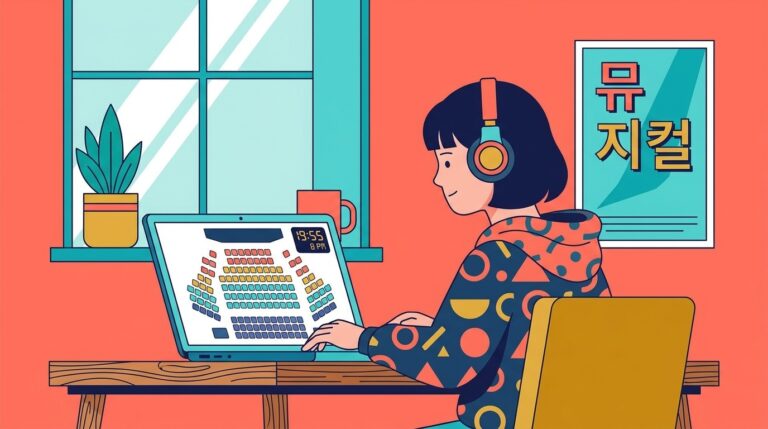
Conquering Korean Ticket Wars: Master Musical Ticketing Slang & Nuances Like a Local
Phase 1: Welcome to the Battlefront of Korean Ticket Sales!
안녕하세요! 매일한글 에디터입니다. (Annyeonghaseyo! I am your Daily Hangul Editor.)
Picture this: It is 7:59:58 PM. You are sitting in front of a high-speed monitor at a local PC Bang, your eyes glued to Navyism server clock down to the millisecond. Your heart pounds. In two seconds, tickets for the hit musical starring your favorite idol or top-tier stage actor go live. At 8:00:00 PM precisely, you hit refresh, select your preferred seat in row A, and click ‘Book’… only for a popping dialog box to shatter your dreams: * 이미 선택된 좌석입니다 (This seat has already been selected).* In less than 0.3 seconds, 3,000 seats are completely sold out.
Welcome to the intense reality of Korean performing arts culture! As a C1-level learner, you likely already know basic booking vocabulary like 예매 (reservation) or 공연 (performance). However, navigating the fierce universe of Korean theatre requires an intimate grasp of hyper-localized slang, socio-cultural instincts, and sophisticated conversational nuances. Today, drawing from years of real-world theatre-going experience and feedback from advanced international theater enthusiasts, I’ll walk you through the subtle art of surviving ‘Piketting’ so you can comfortably snag those coveted front-row seats!
Phase 2: 3 Core Expressions for the Ticketing Elite
1. 피켓팅 (Piketting)
- Pronunciation: [pi-ket-ting] (Sounds like blood + ticketing; ‘Pi’ rhymes with ‘pea’, followed by ‘ket-ting’)
- Meaning: A compound word blending 피 (blood) and 티켓팅 (ticketing). Literally ‘bloody ticketing’, referring to a ticket-buying war that is so brutally competitive it metaphorically draws blood.
- K-Culture Moment: In modern Korean theater culture, attending a musical featuring top musical actors like Cho Seung-woo, Jeon Mi-do, or K-pop stars requires preparing for ‘Piketting’ across platforms like Interpark or Melon Ticket.
- Editor’s Insight: While beginners simply say ‘예매가 너무 어려워요’ (Reserving is too difficult), C1 speakers express the extreme competitiveness with ‘이번 뮤지컬 완전 피켓팅이었어’ (This musical’s ticketing was an absolute bloodbath).
- Situation Spectrum:
- Casual: ✅ | Semi-formal: ✅ | Formal: 🚫
- 🤔 Think About It: How does your home country’s concert culture reflect digital competitiveness compared to Korea’s ultra-fast broadband and PC Bang infrastructure?
2. 이선좌 (Iseonjwa)
- Pronunciation: [i-seon-jwa] (Rhymes with ‘ee-sun-jwah’)
- Meaning: An acronym for ‘이미 선택된 좌석입니다’ (This seat is already selected).
- K-Culture Moment: When trying to pick seats, receiving this pop-up repeatedly causes psychological panic among Korean theatergoers, who instantly refer to the dreaded modal box as ‘이선좌’.
- Editor’s Insight: It is used as a noun representing heartbreak. For example: ‘오늘 이선좌만 10번 봤어’ (I saw the ‘seat already taken’ popup 10 times today).
- Situation Spectrum:
- Casual: ✅ | Semi-formal: ⚠️ | Formal: 🚫
- 🤔 Think About It: Why do fast-paced online acronyms quickly become established emotional expressions among youth communities in South Korea?
3. 취케팅 (Chwiketting)
- Pronunciation: [chwi-ket-ting] (Sounds like ‘chwee’ + ‘ket-ting’)
- Meaning: A portmanteau of 취소 (cancellation) and 티켓팅 (ticketing). It refers to the strategy of staying up late to snatch unpaid canceled tickets that drop into the system overnight.
- K-Culture Moment: Most Korean ticketing platforms release unpaid seats at midnight or 2:00 AM. Theatre fans set alarms specifically to hunt for these seats during ‘Chwiketting’.
- Editor’s Insight: It demonstrates resilience and patience in Korean fan culture. Instead of giving up, advanced speakers say: ‘실패했지만 취케팅 노려봐야지!’ (I failed the initial drop, but I’ll go for the cancellation drop!).
- Situation Spectrum:
- Casual: ✅ | Semi-formal: ✅ | Formal: 🚫
- 🤔 Think About It: How does the phenomenon of ‘Chwiketting’ reflect the Korean cultural mindset of persistent diligence (근성)?
Phase 3: Textbook Korean vs. Real Native Korean
Scenario 1: Describing an extremely competitive ticket booking experience
- 📖 Textbook Korean: 티켓 예매 경쟁이 너무 심해서 좌석을 구하지 못했습니다. (The competition for ticket reservation was too intense, so I could not obtain a seat.)
- 🗣️ Real Native Korean: 오늘 피켓팅 피바다였어! 1초 만에 이선좌 뜨더니 전석 매진되더라. (Today’s ticketing was a total bloodbath! The ‘already taken’ popup showed up in 1 second and the whole show sold out.)
- 💡 Why is it different? C1 native speakers use sensory metaphors like ‘피바다’ (sea of blood) and acronyms like ‘이선좌’ to vividly express the hyper-speed frustration of modern ticketing.
Scenario 2: Asking a friend if they managed to get a seat
- 📖 Textbook Korean: 좋은 기회로 티켓을 확보하는 데 성공하셨습니까? (Did you succeed in securing a ticket through a good opportunity?)
- 🗣️ Real Native Korean: 너 혹시 용병 뛰어줘서 로열석 잡았어? (Did you manage to snag a VIP seat by getting friends to help out as ‘mercenaries’?)
- 💡 Why is it different? ‘용병’ (mercenary) refers to friends enlisted to log in simultaneously to boost your chances. Using localized stage terms like ‘로열석’ (VIP/Royal seat) sounds natural and native.
Phase 4: K-Culture Deep Dive & Non-Verbal Etiquette
4-1. Nunchi & Physical Etiquette in Korean Theatres
Navigating Korean theatrical etiquette (관극 매너) requires subtle social awareness (Nunchi):
* ** 시체관극 (Siche-gwangeuk – Dead Body Viewing Etiquette):** In Korean musical and play fandoms, absolute stillness is expected once the lights go down. Unnecessary head movements, rustling plastic, or leaning forward (시야 방해 / view obstruction) are strictly frowned upon.
* Clapping Timing: Korean audiences show immense respect through synchronized applause at curtain calls, but absolute quiet is maintained during dramatic musical climaxes.
4-2. Cultural Analysis: The PC Bang & Server Clock Phenomenon
To win at ‘Piketting’, Koreans rarely rely on standard home Wi-Fi. They visit high-spec gaming cafes ([PC방]) and open microsecond-accurate server clocks (such as Navyism). This highlights South Korea’s high-tech infrastructure combined with intense collective enthusiasm for performing arts, turning a simple ticket purchase into an organized e-sports event.
Phase 5: Real Roleplay Scenario
Setting: A cozy cafe near Daehangno (Korea’s Broadway district). You are chatting with Min-ji, a veteran musical theater fan (연뮤덕).
- Character: Min-ji (Friendly, super-knowledgeable musical enthusiast)
Dialogue
- Min-ji: 너 다음 주 샤롯데씨어터 뮤지컬 예매 도전한다며? 준비는 잘 돼가? 🎭 (I heard you’re trying to book that musical at Charlotte Theater next week! Are you ready?)
- You (C1 Learner): 그럼! 네이비즘 서버 시계 켜놓고 컴퓨터 앞에 대기할 생각이야. 🎭 (Of course! I plan to keep the Navyism server clock open and wait right in front of my computer.)
- Min-ji: 오, 제법인데? 그런데 거기는 용병 안 구하면 일열 잡기 진짜 힘들어. 🎭 (Oh, impressive! But for that venue, it’s really hard to grab row 1 unless you enlist mercenaries.)
- You: 용병? 친구들한테 동시 접속해 달라고 부탁하는 거 말하는 거지? 🎭 (Mercenaries? You mean asking friends to log in simultaneously?)
- Min-ji: 맞았어! 만약에 정각에 클릭했는데 이선좌 뜨면 어떡할 거야? 🎭 (Exactly! If you click on the dot and get the ‘already taken’ popup, what will you do?)
- You: 당황하지 않고 바로 뒷열 클릭한 다음에, 실패하면 퐁당퐁당 좌석이라도 노려야지. 🎭 (Without panicking, I’ll click the row behind, and if that fails, I’ll aim for staggered seats.)
- Min-ji: 대단하다! 완전히 연뮤덕 다 됐네. 만약 그것도 다 놓치면? 🎭 (Awesome! You’ve become a total theater nerd. What if you miss those too?)
- You: 밤새워서 취케팅 직진해야지! 취소표는 절대 날 배신하지 않아. 🎭 (Then I’ll go straight for midnight cancellation ticketing! Canceled tickets never betray me.)
🔀 Interactive Choice Point
When Min-ji asks what you’ll do if the server crashes at 8:00 PM:
* Option A: 새로고침(F5)을 계속 연타한다. (Keep spamming refresh/F5.)
* Option B: 새로고침하지 않고 대기열 번호가 빠질 때까지 차분히 기다린다. (Do not refresh; wait calmly until the queue number decreases.)
* Option C: 창을 끄고 티켓이 나올 때까지 내일까지 기다린다. (Close the window and wait until tomorrow.)
Feedback:
* Best Choice (Option B): 🏆 Perfect! On Korean booking platforms (like Interpark), hitting F5 resets your waiting queue to the back of 50,000 people. Waiting patiently keeps your spot!
* Risk Choice (Option A): ⚠️ Warning! Hit F5 continuously in Korean ticketing and you’ll end up at the very back of the line.
* Bad Choice (Option C): 🚫 Missed opportunity! The entire show will sell out in minutes; waiting until tomorrow guarantees no tickets.
Phase 6: 10-Second Emotion Shadowing Drill
Practice these high-frequency emotional utterances with native inflection!
[😱 Panicked & Urgent]
어 / 대기순서 만 명이라고? / 이선좌 또 떴어!
(Eo / daegiseunseo man myeong-irago? / Iseonjwa tto tteosseo!)
(What / waiting queue is 10,000? / ‘Already taken’ popped up again!)-
[😎 Confident & Triumphant]
네이비즘 정각 클릭 성공! / 심지어 전진해서 1열 잡았잖아!
(Neibijeum jeong-gak keullik seonggong! / Simjieo jeonjinhaeseo il-yeol jabatjan-a!)
(Successfully clicked right on the second via Navyism! / I even moved up and grabbed row 1!) -
[🥺 Hopeful & Persistent]
오늘 밤 두 시 / 취케팅에서 / 반드시 원가 양도로 성공한다!
(Oneul bam du si / chwiketting-eeseo / bandeusi won-ga yangdoro seonggonghanda!)
(Tonight at 2 AM / during cancellation drop / I will definitely succeed at face-value transfer!)
Phase 7: K-Culture Mini Dictionary
- 연뮤덕 (Yeon-myu-deok) | Theater Fanatic | Short for 연극(play) + 뮤지컬(musical) + 덕후(geek/fan). Refers to passionate theatre lovers who watch the same production multiple times.
- 금손 (Geum-son) | Golden Hands | Someone who has extraordinary luck or dexterity, especially in securing front-row tickets during sales.
- 똥손 (Ttong-son) | Poop Hands | The opposite of Golden Hands; someone who always gets high queue numbers or misclicks.
- 덕극 (Deok-geuk) | Cult-favorite Show | Shows specifically loved by dedicated theatrical fandoms due to complex storylines or stellar cast chemistry.
Phase 8: Traveler’s Survival Kit
Top 3 Survival Expressions
- 현장 수령으로 할게요. (Hyeonjang suryeong-euro halgeyo.)
- Meaning: I will pick up the tickets at the venue box office.
- Pro Tip: Essential for international fans who cannot receive physical mail in Korea.
- 혹시 취소표 남아있나요? (Hoksi chwisopyo nam-a-itnayo?)
- Meaning: Are there any canceled tickets available by any chance?
- Pro Tip: Ask at the box office 1 hour before curtain call for last-minute returned seats.
- 캐스팅 변경 공지 확인하셨어요? (Kaesting byeongyeong gongji hwaginhasyeosseoyo?)
- Meaning: Did you check the casting change announcement?
- Pro Tip: Always verify daily cast schedules before heading to Daehangno.
Editor’s Travel Note
Before heading to performance venues like Blue Square or Sejong Center, make sure to set up your navigation using the 네이버 지도 앱 다운로드 (Naver Map app) rather than Google Maps for accurate subway exit guidance. Always carry physical photo ID (passport) when picking up tickets booked under your name!
Phase 9: One Step Deeper (Cultural Perspective)
In Korean performance culture, ticketing is not merely a transaction; it is a shared ritual of respect and passion. The concept of 원가 양도 (transferring tickets at original face value) among fans shows a deep communal honor code—reselling tickets at inflated scalper prices (프리미엄/플피) is strongly stigmatized within fandom communities. Supporting artists through official booking channels and maintaining exemplary theatre decorum (관극 매너) reflects the collective priority given to harmony and mutual respect in Korean society.
💬 Your Turn: Have you ever experienced high-stakes ticket booking in your country or in Korea? What strategies did you use? Share your war stories in the comments below!
Phase 10: FAQ & Common Mistakes
Q: Can foreign residents buy musical tickets on Korean booking platforms without a Korean phone number?
A: Yes! Major booking platforms such as Interpark, Melon Ticket, and YES24 offer dedicated ‘Global Pages’ where foreign visitors can register using their email and pay via international credit cards. Always double-check if the show is listed on the Global portal.
Q: What time do canceled tickets drop on Korean sites?
A: For Interpark, unpaid seats typically reset and drop around 2:00 AM to 2:15 AM KST. For YES24 and Melon Ticket, cancellation drops usually occur around midnight (00:00 KST).
Q: What should I bring when picking up my pre-booked tickets at the venue?
A: You must present your booking confirmation (printed or digital screenshot with booking number) along with your physical passport or Alien Registration Card (ARC) matching the purchaser’s name.
🚨 Common Mistakes Warning
- Refreshing (F5) during line queues: Resets your server connection. Correct Action: Wait until queue counts down to zero automatically.
- Using auto-translation plugins on seating charts: Can glitch seat maps during payment popups. Correct Action: Keep native Korean interface open during seat selection phase.
- Mistaking theater box office hours: Arriving 10 minutes before showtime risks long lines. Correct Action: Arrive at least 45–60 minutes prior to performance time.
Phase 11: Action Missions
- 🥉 Bronze Level: Practice saying ‘이선좌’ and ‘피켓팅’ out loud 5 times using native intonation.
- 🥈 Silver Level: Visit a Korean ticketing website global portal and practice selecting seats to familiarize yourself with seat layout terms (e.g., VIP석, R석, S석).
- 🥇 Gold Level: Watch a short behind-the-scenes musical clip or actor vlog on YouTube and identify at least two slang terms learned today in the comment section.
🎮 K-Culture Mission: Search for a clip of a Korean musical curtain call (뮤지컬 커튼콜) on social media and comment using native cheer phrases like “오늘 캐스팅 대박이었어요!” (Today’s cast was amazing!).
Phase 12: Interactive Quiz Challenge
Test your C1 Korean ticketing smarts!
- Situation Quiz: You were selecting a front-row seat, but a popup appeared and blocked your transaction. What term describes this seat status?
- A) 취케팅
- B) 이선좌
- C) 용병
- True/False Culture Quiz: In Korean theater culture, eating crunchy snacks or leaning far forward during a musical performance is considered acceptable as long as you are quiet.
- (True / False)
🔍 Click here to check Answer & Explanations!
- Answer: B) 이선좌
- Explanation: ‘이선좌’ stands for ‘이미 선택된 좌석입니다’ (This seat is already selected).
- Answer: False
- Explanation: Both actions violate ‘시체관극’ (dead body viewing etiquette). Leaning forward blocks the sightlines of audience members behind you, and snacks create disruptive noise.







