

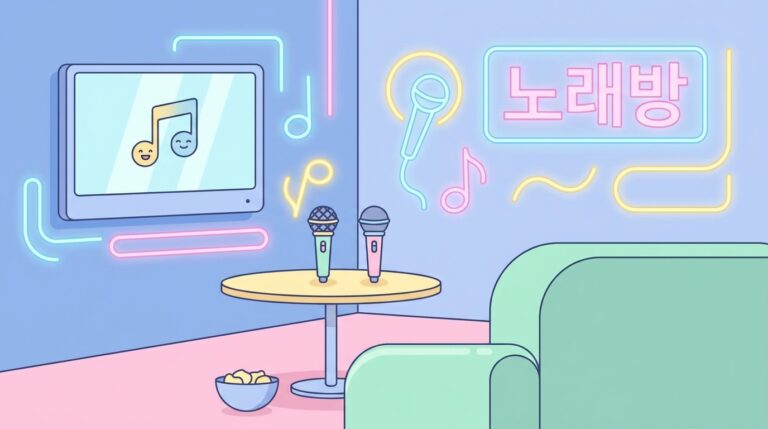
Phase 1: Empathy (Storytelling Opening)
안녕하세요! This is your Daily Hangul editor and your personal Korean culture navigator! Have you ever stepped into a vibrant Korean noraebang (노래방 – karaoke room) with your Korean friends, grabbed the glowing microphone, and felt super excited—only to get completely lost when the K-pop song started playing way too fast? You try to keep up with the beat, but your voice goes off-pitch, your friends are laughing playfully, and you wish you could say, “Hey, the beat is too fast!” or “Can we lower the pitch?”
Don’t worry, you are not alone! Many Korean learners panic when the beat catches them off guard. Today, based on real feedback from hundreds of beginner students, I am going to teach you 3 magical and easy Korean expressions to control the beat and pitch like a true insider. By the end of this lesson, you will handle any karaoke room with absolute confidence!
Phase 2: Core Expressions Deep Dive
1. 박자가 빨라요 (Bakjaga ppallayo)
- Pronunciation: [Bak-ja-ga ppal-la-yo] (Sounds like: bahk-jah-gah ppahl-lah-yoh)
- Meaning: Literal: “The beat is fast.” / Nuance: “The tempo is too fast for me to follow!”
- K-Culture Moment: When an upbeat K-pop song starts and the rhythm jumps unexpectedly faster than you practiced!
- Editor’s Insight: ‘박자’ means beat/tempo, and ‘빨라요’ comes from ‘빠르다’ (to be fast). Use this to tell your friend to slow down the song!
- Situation Spectrum:
- Casual: 박자 너무 빨라! (⚠️ Friends only)
- Semi-formal: 박자가 빨라요. (✅ Polite & safe for everyone)
- Formal: 박자가 빠릅니다. (🚫 Too stiff for karaoke)
- 🤔 Think About It: In your country, do you adjust the music speed during karaoke, or do you just power through it?
2. 음이 너무 높아 (Eumi neomu nopa)
- Pronunciation: [Eum-i neo-mu no-pa] (Sounds like: eum-ee nuh-moo noh-pah)
- Meaning: Literal: “The pitch is too high.” / Nuance: “This key is way too high for my voice!”
- K-Culture Moment: Trying to sing a high note in a ballad song by IU or BTS and instantly realizing your throat can’t reach it.
- Editor’s Insight: ‘음’ refers to musical pitch or note. Combine it with ‘너무’ (too) and ‘높아’ (high) to express singing difficulty.
- Situation Spectrum:
- Casual: 음이 너무 높아! (✅ Perfect for friends)
- Semi-formal: 음이 너무 높은데 요… (⚠️ Adds soft concern)
- Formal: 음이 높습니다. (🚫 Sounds like a textbook)
- 🤔 Think About It: Do you prefer singing high-pitched songs or low-pitched chill songs?
3. 박자 맞춰 주세요 (Bakja matchwo juseyo)
- Pronunciation: [Bak-ja mat-chwo ju-se-yo] (Sounds like: bahk-jah maht-chwo joo-seh-yoh)
- Meaning: Literal: “Please match the beat.” / Nuance: “Please follow the rhythm together with me!”
- K-Culture Moment: When clapping or shaking tambourines together during a group chorus.
- Editor’s Insight: ‘맞춰 주세요’ comes from ‘맞추다’ (to adjust/match) and ‘주세요’ (please give/do). It asks people to sync up with you!
- Situation Spectrum:
- Casual: 박자 좀 맞춰 줘! (⚠️ Close friends)
- Semi-formal: 박자 맞춰 주세요. (✅ Polite standard request)
- Formal: 박자를 맞춰 주시겠습니까? (🚫 Extremely formal)
- 🤔 Think About It: How do music lovers in your hometown cheer each other on during live singing?
Phase 3: Textbook Korean vs. Real Korean
Situation 1: Asking to lower the music pitch
- 📖 Textbook Korean: 노래의 키를 낮춰 주십시오. (Noraeui kireul natchwo jusipsio.) – “Please lower the key of the song.”
- 🗣️ Real Korean: 키 좀 낮춰 줄래? (Ki jom natchwo jullae?) – “Can you lower the key a bit?”
- 💡 Why is it different?: In real Korean karaoke culture, speakers shorten sentences and use ‘키’ (key) directly with soft requests like ‘좀’ (a bit).
Situation 2: Saying the beat is too fast
- 📖 Textbook Korean: 템포가 너무 빠릅니다. (Tempoga neomu ppareumnida.) – “The tempo is very fast.”
- 🗣️ Real Korean: 아, 박자 놓쳤다! (A, bakja notchyeotda!) – “Ah, I missed the beat!”
- 💡 Why is it different?: Korean youngsters express feelings reaction-style immediately rather than describing formal musical facts.
Phase 4: K-Culture Deep Dive & Non-Verbal Manners
4-1. Nunchi (눈치) & Gestures
When the pitch is too high, Korean people wave their hands downward horizontally while making a slightly stressed face. If you want to request a tempo change without stopping the fun, simply tap the remote control button (‘템포’ or ‘키’) while giving a friendly wink or laugh!
4-2. Cultural Code Analysis: Remote Controls & Tambourines
Korean Karaoke rooms feature special remote controls with dedicated keys: ‘키’ (Key pitch) and ‘템포’ (Tempo beat). Korean friends love doing ‘떼창’ (group singalong) and playing the tambourine rhythmically. If someone loses the beat, others cheer louder with tambourines to help them recover!
Phase 5: Real-Life Roleplay Scenario
- Setting: A neon-lit cozy Noraebang in Hongdae, Seoul.
- Character: Minji (Your friendly Korean classmate who loves K-pop).
- Minji: 오늘 무슨 노래 부를 거야? (Oneul museun norae bureul geoya?) – What song are you singing today?
- You: K-pop 노래 부르고 싶어요! (K-pop norae bureugo sipeoyo!) – I want to sing a K-pop song!
- Minji: 와, 좋아! 내가 반주 틀어줄게! (Wa, joa! Naega banju teureojulge!) – 🎭 Hands you the glowing mic eagerly – Wow, awesome! I’ll play the backing track!
- You: (Music starts playing too fast) 어? 박자가 빨라요! (Eo? Bakjaga ppallayo!) – Uh? The beat is fast!
- Minji: 진짜? 키도 맞춰줄까? (Jinja? Kido matchwojulkka?) – 🎭 Grabs the remote control – Really? Should I adjust the key pitch too?
- You: 네, 음이 너무 높아! (Ne, eumi neomu nopa!) – Yes, the pitch is too high!
- Minji: 오케이! 템포 낮추고 키도 내려줄게! (Okei! Tempo natchugo kido naeryeojulge!) – Okay! Lowering tempo and key!
- You: 고마워요! 이제 신나게 불러요! (Gomawoyo! Ije sinnage bulleoyo!) – Thank you! Now let’s sing fun!
🔀 Interactive Branching Choice
Minji asks: “템포 더 낮춰줄까?” (Should I lower tempo more?)
– Option A: 네, 박자 맞춰 주세요! (Yes, please match the beat!)
– Option B: 아니요, 괜찮아요! (No, I am okay!)
– Option C: 노래 꺼 주세요. (Please turn off the song.)
- Feedback:
- Best (Option A): Perfect! It keeps the fun conversation going naturally!
- Bad (Option B): Good, but you might struggle with the fast speed.
- Risk (Option C): Oh no! Turning off the song ruins the karaoke party atmosphere!
Phase 6: 10-Second Emotional Shadowing Drill
- [😊 Cheerful & Energetic]
박자 / 맞춰 / 주세요! (Bakja / matchwo / juseyo!) -
[😅 Flustered & Cute]
아, / 음이 / 너무 / 높아! (A, / eumi / neomu / nopa!) -
[😮 Surprised]
어? / 박자가 / 너무 / 빨라요! (Eo? / Bakjaga / neomu / ppallayo!)
Phase 7: K-Culture Mini Dictionary
- 노래방 (Noraebang) | Karaoke Room | Private singing venue with food, drinks, and lights.
- 키 조절 (Ki Jojeol) | Key Pitch Adjustment | Changing the song’s key higher or lower on the remote.
- 탬버린 (Taembeorin) | Tambourine | Essential percussion instrument used in Korean karaoke to boost excitement.
- 떼창 (Ttechang) | Singalong in Unison | Singing together loudly as a group during high-energy choruses.
Phase 8: Traveler’s Survival Kit
Top 3 Survival Phrases
- 키 내려 주세요. (Ki naeryeojuseyo.) – Please lower the key pitch.
- 템포 줄여 주세요. (Tempo juryeojuseyo.) – Please slow down the tempo.
- 한 곡 더! (Han gok deo!) – One more song!
Pro Tip: The big red button labeled ‘시작’ (Start) and green button labeled ‘취소’ (Cancel) are your best friends on Korean karaoke remotes!
Editor’s Travel Note
Before heading to Hongdae or Gangnam karaoke rooms, make sure to download Naver Map app to find top-rated coin noraebangs nearby. Most coin karaoke places accept credit cards or cash easily at automated kiosks!
Phase 9: One Step Deeper
In Korea, singing at Noraebang is not about vocal perfection; it’s about sharing energy and building community bonds. Adjusting pitch or tempo isn’t seen as bad singing—it shows you know how to enjoy the music comfortably with friends!
💬 Your Turn: What is your go-to K-pop song you’d love to sing at a Korean karaoke room? Tell us in the comments below!
Phase 10: FAQ & Mistake Prevention
Q: Is it rude to change the pitch or tempo of a song in Korea?
A: Not at all! Everyone adjusts the key (‘키’) using the remote to match their voice.
Q: What is the difference between ‘박자’ and ‘템포’?
A: ‘박자’ means beat/rhythm, while ‘템포’ refers directly to song tempo/speed.
Q: How do I ask for extra free time at a traditional Noraebang?
A: You can politely ask the host: “서비스 많이 주세요!” (Please give us lots of service bonus time!).
🚨 Common Mistakes TOP 3
- Mistake: Saying “음악이 빨라요” when referring to beat. -> Correct Action: Say “박자가 빨라요” (The beat is fast).
- Mistake: Using extremely formal verb endings like ‘-습니까’ while singing with friends. -> Correct Action: Use casual ‘-요’ or conversational endings.
- Mistake: Pressing ‘중단’ (Stop) by accident instead of lowering pitch. -> Correct Action: Look for ‘키▼’ button on the remote.
Phase 11: Action Mission & Engagement
- Bronze Mission: Practice saying “음이 너무 높아!” 3 times out loud.
- Silver Mission: Record yourself practicing the Phase 6 shadowing drill and post it on Instagram tagging @DailyHangul!
- Gold Mission: Try singing along to a K-pop song while adjusting playback speed on YouTube!
🎮 K-Culture Mission: Watch a K-drama karaoke scene (like in Reply 1988 or Business Proposal) and spot someone hitting the tambourine!
Phase 12: Interactive Quiz Challenge
- How do you say “The pitch is too high” in Korean?
- A) 박자가 빨라요
- B) 음이 너무 높아
- C) 키 올려 주세요
Click to see Answer & Explanation
Answer: B) 음이 너무 높아
‘음’ means pitch and ‘높아’ means high!
-
True or False: ‘떼창’ means singing quietly alone.
Click to see Answer & Explanation
Answer: False
‘떼창’ means singing along loudly as a group!







