

Phase 1: Empathy & Storytelling
안녕하세요! This is your Daily Hangul Editor!
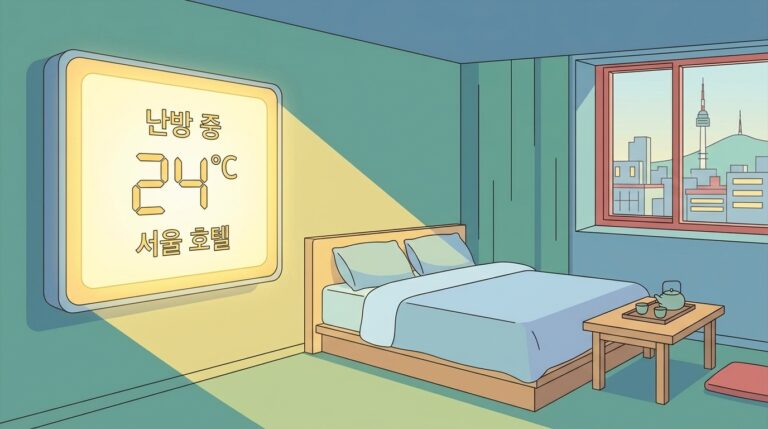
Imagine this: You’ve just spent an amazing full day exploring the bustling streets of Myeongdong and eating delicious street food in Seoul. You return to your cozy hotel room, ready to unwind with your favorite K-Drama. But as you step inside, you realize the room is freezing cold—or perhaps feeling like a hot sauna! You look at the wall controller, but all the buttons are in Korean. You want to call the front desk, but you hesitate because you’re worried about language barriers.
Don’t worry! This is one of the most common challenges travelers face in South Korea. Heating and cooling systems in Korea—especially traditional floor heating called Ondol (온돌)—can be unique and slightly tricky to navigate at first. Based on real learner feedback, mastering just a few simple A2-level Korean phrases can instantly solve this issue and ensure a comfortable, relaxing stay. Let’s make sure you never suffer through a cold night or a overheated room again!
Phase 2: Deep Dive into 3 Core Expressions
1. 방이 너무 추워요. (Bang-i neo-mu chu-wo-yo.)
- Pronunciation: [Bang-ee nuh-moo choo-woh-yoh] (Think of ‘bang’ like a door closing, and ‘chu’ like ‘choose’)
- Meaning: Direct: “The room is too cold.” vs. Actual Nuance: “Could you help me make the room warmer?”
- K-Culture Moment: You often hear guests politely mentioning this at boutique hotels in Hanok (traditional house) stays when the seasonal chill sets in.
- Editor’s Insight: Ending with ~요 (-yo) makes it polite yet natural for front desk staff. You don’t need complicated grammar to get your point across!
- Situation Spectrum: Casual: ⚠️ | Semi-formal: ✅ | Formal: ✅
- 🤔 Think About It: In Korea, expressing discomfort directly is often softened by tone. How does expressing a complaint in your culture differ from Korean politeness?
2. 방이 너무 더워요. (Bang-i neo-mu deo-wo-yo.)
- Pronunciation: [Bang-ee nuh-moo duh-woh-yoh] (Pronounce ‘deo’ like ‘duck’ without the ‘ck’)
- Meaning: Direct: “The room is too hot.” vs. Actual Nuance: “It’s uncomfortable inside, please lower the heat or turn on the air conditioning.”
- K-Culture Moment: Seen frequently in K-Dramas when characters visit modern Seoul apartments or hotels equipped with central heating systems.
- Editor’s Insight: Instead of asking for air conditioning right away, state your state first! Koreans usually respond immediately to your comfort level.
- Situation Spectrum: Casual: ⚠️ | Semi-formal: ✅ | Formal: ✅
- 🤔 Think About It: Why do you think Korean state-oriented statements (e.g., “It is hot”) sound softer than direct command statements (e.g., “Turn on the AC”)?
3. 온도 조절은 어떻게 해요? (On-do jo-jeol-eun eo-tteok-hae-yo?)
- Pronunciation: [Ohn-doh joh-juhl-eun uh-ttuhk-hae-yoh] (Pronounce ‘eo-tteok’ like ‘a-talk’)
- Meaning: Direct: “How do I do temperature control?” vs. Actual Nuance: “Could you explain how to use the room thermostat?”
- K-Culture Moment: Commonly asked at check-in desks when guests receive room key cards with wall panel controls.
- Editor’s Insight: “어떻게 해요?” (How do I do it?) is a magic phrase in Korean for asking how to operate any device!
- Situation Spectrum: Casual: 🚫 | Semi-formal: ✅ | Formal: ✅
- 🤔 Think About It: Asking for instructions empowers you to control your room yourself. Is self-adjusting heat common in your home country’s hotels?
Phase 3: Textbook Korean vs. Real Native Korean
Situation 1: Asking to adjust the heating
- 📖 Textbook Korean: 난방 장치를 조절해 주시겠습니까? (Nan-bang jang-chi-reul jo-jeol-hae ju-si-get-seum-ni-ka?)
- 🗣️ Real Native Korean: 히터 좀 틀어 주시겠어요? (Hi-teo jom teul-eo ju-si-get-eo-yo?)
- 💡 Why is it different? Textbook phrases sound like a formal user manual. Native speakers use lightweight loan words like “히터” (heater) and the versatile verb “틀다” (turn on).
Situation 2: Asking how to turn down the heat
- 📖 Textbook Korean: 온도를 낮추는 방법을 설명해 주십시오. (On-do-reul nat-chu-neun bang-beob-eul seol-myeong-hae ju-sip-si-o.)
- 🗣️ Real Native Korean: 온도 어떻게 줄여요? (On-do eo-tteok-hae jul-yeo-yo?)
- 💡 Why is it different? Shortened, direct verbs like “줄이다” (reduce/turn down) paired with “어떻게” sound friendly and natural in daily service conversations.
Phase 4: K-Culture Deep Dive & Non-verbal Manners
4-1. Nunchi (눈치) & Gestures
When speaking with hotel staff in Korea, maintain soft eye contact and offer a slight head nod (15-degree bow). Holding your hands together at waist height shows respect. If staff visit your room to inspect the wall thermostat, step aside slightly and gesture towards the controller with an open palm—never point with a single finger!
4-2. Cultural Code Analysis: Ondol (온돌) & Central Control
Korean hotels often utilize floor heating (Ondol) or centralized climate systems (중앙 난방). Unlike standard air vents, floor heating warms the room gradually from the ground up. If your floor feels warm, the system is working even if you don’t hear a fan running! Understanding this prevents unnecessary confusion during winter visits.
Phase 5: Real-Life Roleplay Scenario
Setting: Hotel Reception Desk at a stylish boutique hotel in Hongdae. You are talking to Minji, the helpful front desk staff member.
- Turn 1 (Minji): 🎭 Smiling warmly at the counter / 안녕하세요, 손님! 무슨 도움이 필요하신가요? (An-nyeong-ha-se-yo, son-nim! Mu-seun do-um-i pil-yo-ha-sin-ga-yo? – Hello, guest! How can I help you?)
- Turn 2 (You): 🎭 Nodding slightly and holding room key / 저기요, 방이 너무 추워요. (Jeo-gi-yo, bang-i neo-mu chu-wo-yo. – Excuse me, my room is too cold.)
- Turn 3 (Minji): 🎭 Checking computer screen quickly / 아, 그러세요? 몇 호실이세요? (A, geu-reo-se-yo? Myeot ho-sil-i-se-yo? – Oh, really? Which room number are you in?)
- Turn 4 (You): 🎭 Showing key card / 502호예요. 온도는 어떻게 조절해요? (O-baek-i-ho-ye-yo. On-do-neun eo-tteok-hae jo-jeol-hae-yo? – Room 502. How do I control the temperature?)
- Turn 5 (Minji): 🎭 Pointing gently to a sample controller diagram / 벽에 있는 조절기에서 ‘난방’ 버튼을 누르시면 돼요. (Byeok-e in-neun jo-jeol-gi-e-seo ‘nan-bang’ beot-eun-eul nu-reu-si-myeon dwae-yo. – You can press the ‘Heating’ button on the wall thermostat.)
- Turn 6 (You): 🎭 Tapping chin thoughtfully / 히터 좀 더 틀어 주시겠어요? (Hi-teo jom deo teul-eo ju-si-get-eo-yo? – Could you turn up the heater a bit more?)
- Turn 7 (Minji): 🎭 Nodding attentively / 네, 중앙 난방 온도를 바로 올려 드릴게요! (Ne, jung-ang nan-bang on-do-reul ba-ro ol-ryeo deu-ril-ge-yo! – Yes, I’ll raise the central heating temperature right away!)
- Turn 8 (You): 🎭 Bowing head slightly with relief / 감사합니다! 수고하세요. (Gam-sa-ham-ni-da! Su-go-ha-se-yo. – Thank you! Have a good day.)
🔀 Interactive Choice Point
What should you say if the room is still cold after 30 minutes?
* Option A: 방이 아직도 추운데 확인해 주실 수 있나요? (Bang-i a-jik-do chu-un-de hwa-kin-hae ju-sil su in-na-yo?)
* Option B: 왜 히터 안 틀어줘요? (Wae hi-teo an teul-eo-jwo-yo?)
* Option C: 당장 방 바꿔 주세요. (Dang-jang bang ba-kkwo ju-se-yo.)
Feedback:
* Option A (Best Choice): Perfect! Polite, clear, and gives the staff an actionable request without being aggressive.
* Option B (Bad): Sounds overly accusatory (“Why aren’t you turning on the heater?”) and breaks Korean politeness norms.
* Option C (Risk): Too blunt (“Change my room immediately!”). Hotel staff may become defensive.
Phase 6: 10-Second Emotion Shadowing Drill
- Practice matching these emotional rhythm patterns:
[🥺 Seeking Help]저기요… / 방이 / 너무 추워요. (Jeo-gi-yo… / bang-i / neo-mu chu-wo-yo.)[😊 Friendly Query]온도 조절은 / 어떻게 해요? (On-do jo-jeol-eun / eo-tteok-hae-yo?)[🙏 Polite Request]히터 좀 / 틀어 주시겠어요? (Hi-teo jom / teul-eo ju-si-get-eo-yo?)
Phase 7: K-Culture Mini Dictionary
- 난방 (Nan-bang) | Central or space heating system. Crucial word on wall thermostats during autumn and winter.
- 냉방 (Naeng-bang) | Air conditioning / cooling system. Key button during hot Korean summers.
- 올리다 / 내리다 (Ol-ri-da / Nae-ri-da) | Turn up / Turn down (temperature). Used when asking staff to raise or lower heat.
- 에어컨 (E-eo-keon) | Air conditioner. Loan word derived from English, universally understood in Korea.
Phase 8: Traveler’s Survival Kit
Survival Expressions TOP 3
- 에어컨 켜 주세요. (E-eo-keon kyeo ju-se-yo.) – Please turn on the AC.
- 더워요 / 추워요. (Deo-wo-yo / Chu-wo-yo.) – It’s hot / It’s cold.
- 기사님/직원분 불러 주세요. (Gi-sa-nim/Jik-won-bun bul-leo ju-se-yo.) – Please call a technician/staff member.
Editor’s Travel Note
Before traveling, make sure to read our guide on Naver Map Application Setup for Korea Travelers to easily find hotels and amenities. Also, remember that floor heating panels usually have a small red light indicating power—make sure power is turned on before adjusting room levels!
Phase 9: A Step Deeper (Cultural Reflection)
In Korean culture, maintaining personal comfort in shared or hosted spaces is deeply connected to respect for hospitality. Koreans value quick problem-solving through soft communication. By stating your feeling (e.g., “I am cold”) rather than demanding an action, you invite the hotel host into a caring relationship where they take pride in ensuring your warmth and comfort.
💬 Your Turn: Have you ever experienced a unique heating or cooling system while traveling abroad? Share your story in the comments below!
Phase 10: FAQ & Common Mistakes
Q: What does the ‘외출’ (Wae-chul) button on my room thermostat mean?
A: ‘외출’ means ‘Outing’ or ‘Away Mode’. It keeps heating at a low energy-saving baseline while you are outside so the room doesn’t freeze.
Q: Why isn’t the air conditioner turning on in winter?
A: Many Korean hotels use seasonal central switches. During winter months, AC systems are disabled centrally to prevent freezing.
Q: Can I ask the staff to change room temperature in English?
A: Front desk staff in major cities understand English, but using basic Korean phrases ensures immediate clarity and leaves a delightful impression!
🚨 Common Mistakes TOP 3
- Mistake 1: Saying “히터 켜!” (Heater kyeo!) without honorifics. Correct Action: Always add “주세요” (ju-se-yo) -> “히터 켜 주세요.”
- Mistake 2: Confusing ‘난방’ (heating) with ‘냉방’ (cooling) on wall remote control panels. Correct Action: Remember ‘난’ = Warm (Nan-bang), ‘냉’ = Cold (Naeng-bang).
- Mistake 3: Pushing buttons repeatedly when Ondol heating doesn’t warm up instantly. Correct Action: Allow 20-30 minutes for floor heat to conduct through tiles.
Phase 11: Action Mission & Engagement
🎯 Action Mission Steps
- Bronze: Repeat the phrase “방이 너무 추워요” 3 times out loud in front of a mirror.
- Silver: Record your voice saying “온도 조절은 어떻게 해요?” and post it on your Instagram story tagging @DailyHangul!
- Gold: Use one of today’s phrases during your next hotel check-in in South Korea!
🎮 K-Culture Mission
Watch a hotel scene in a popular Korean vlog or drama (like King the Land). See if you can spot heating control panels on the walls or hear characters using polite request forms with hotel staff!
Phase 12: Interactive Quiz Challenge
Test your knowledge before you check into your hotel!
- Situation Quiz: You are sweating in your room in July. What should you say to the front desk?
- Blank Fill: 방이 너무 _____ (cold). -> Choose: 추워요 vs 더워요.
- True/False: ‘난방’ means Air Conditioning.
🔍 Click here to reveal Answers & Explanations!
- Answer: “방이 너무 더워요. 에어컨 좀 켜 주시겠어요?”
- Explanation: Expressing that the room is hot and politely asking for AC is the perfect approach.
- Answer: 추워요 (chu-wo-yo)
- Explanation: ‘추워요’ means cold, while ‘더워요’ means hot.
- Answer: False
- Explanation: ‘난방’ means heating! Cooling is ‘냉방’.
- Explanation: ‘난방’ means heating! Cooling is ‘냉방’.







