

Phase 1: Empathy & Storytelling
안녕하세요! 매일한글 에디터입니다.
Imagine sitting in a high-level macroeconomic summit in Yeouido, Seoul’s Wall Street, or tuning into an intense panel debate on Korean broadcast networks like KBS or TV Chosun. The speakers are fluently dissecting global supply chains, crude oil benchmarks, and geopolitical shifts. Suddenly, someone brings up how the American shale revolution disrupted OPEC’s pricing power. As a C2-level Korean learner, you understand the baseline facts, but do you have the sophisticated Korean terminology to articulate nuanced financial mechanisms—like structural price caps, market share wars, or supply elasticity?
Discussing 에너지 정책 (Energy Policy) and the complex topic of 셰일 가스 혁명이 국제 유가에 미친 영향 (The Impact of the Shale Gas Revolution on International Oil Prices) is the ultimate litmus test for native-like fluency in Korean. Many advanced learners struggle when moving beyond basic conversational Korean into professional economic analysis because Korean geopolitical discourse relies heavily on specialized Sino-Korean vocabulary (한자어) and specific idiomatic frameworks.
In this comprehensive guide, built on real feedback from diplomatic and corporate Korean language learners, you will master the exact expressions, tones, and cultural nuances required to command any discussion on global energy markets like a native analyst!
Phase 2: Core Expressions Deep Dive
1. 파급 효과를 가져오다 (Pageub hyogwareul gajieo-oda)
- Pronunciation: [Pa-geub hyo-gwa-reul ga-ji-eo-o-da] (Sounds like pah-gyub hyo-gwah)
- Meaning: Literally “To bring about a ripple effect”; nuance refers to far-reaching macroeconomic consequences across interconnected markets.
- K-Culture Moment: Frequently heard on Korean business news shows like Syuka World or SBS Current Affairs Debate when explaining how foreign market movements affect the Korean Won.
- Editor’s Insight: While 초급 (beginner) learners say “영향을 주다” (to affect), C2 speakers use “파급 효과를 가져오다” to emphasize the cascading domino effect of policy shifts.
- Situation Spectrum: Casual 🚫 / Semi-formal ⚠️ / Formal ✅
- 🤔 Think About It: Korean financial terms often utilize water imagery (파급 – waves spreading out). How does your native language metaphorically describe economic chain reactions?
2. 유가 하락 압력으로 작용하다 (Yuga harak amnyeogeuro jakyonghada)
- Pronunciation: [Yu-ga ha-rak am-nyeok-eu-ro jak-yong-ha-da]
- Meaning: To act as downward pressure on crude oil prices.
- K-Culture Moment: Used by chief economists on Hankyung TV or KDI economic research briefings when analyzing energy import costs.
- Editor’s Insight: Notice the noun modifier “하락 압력” (downward pressure). Combining financial force metrics with “작용하다” (to act/operate) creates an authoritative tone.
- Situation Spectrum: Casual 🚫 / Semi-formal ⚠️ / Formal ✅
- 🤔 Think About It: Why does formal Korean economics prefer passive-impersonal structures like “작용하다” over direct transitive verbs?
3. 시장 주도권을 다투다 (Sijang judogwoneul datuda)
- Pronunciation: [Si-jang ju-do-gwon-eul da-tu-da]
- Meaning: To vie for market dominance / supremacy.
- K-Culture Moment: Seen in corporate drama dialogue (such as Reborn Rich or Agency) when executives plot market share strategies against global rivals.
- Editor’s Insight: “주도권” consists of 주 (main) + 도 (lead) + 권 (right/power). It signifies the decisive steering wheel of market dynamics.
- Situation Spectrum: Casual ⚠️ / Semi-formal ✅ / Formal ✅
- 🤔 Think About It: How does the concept of 주도권 reflect Korean social views on institutional hierarchy and market power?
Phase 3: Textbook Korean vs. Real Korean
Scenario 1: Describing the drop in oil prices
- 📖 교과서 한국어: 셰일 가스는 유가를 떨어뜨렸습니다. (Shale gas dropped oil prices.)
- 🗣️ 진짜 한국어: 셰일 가스 혁명이 국제 유가에 구조적인 하방 압력을 가했죠. (The shale gas revolution exerted structural downward pressure on global oil prices.)
- 💡 왜 다를까? Textbook Korean uses simple action verbs (떨어뜨리다). Professional real-world Korean uses Sino-Korean abstract nouns (구조적, 하방 압력) to convey analytical precision.
Scenario 2: Analyzing market war strategies
- 📖 교과서 한국어: OPEC과 미국이 경쟁하고 있습니다. (OPEC and the US are competing.)
- 🗣️ 진짜 한국어: OPEC과 미국 셰일업체 간의 치열한 치킨게임이 벌어지고 있어요. (A fierce chicken game is unfolding between OPEC and US shale producers.)
- 💡 왜 다를까? Native Korean commentators frequently integrate global strategic loanwords like “치킨게임” (Chicken game) to emphasize high-stakes economic brinkmanship.
Phase 4: K-Culture Deep Dive & Non-Verbal Manners
4-1. Nunchi & Gestures in Korean Economic Debates
When presenting macroeconomic analysis in a Korean boardroom or seminar:
* Posture of Gravitas: Maintain upright posture with hands neatly clasped on the table when presenting data. Avoid overly aggressive pointing gestures.
* Two-Handed Slide Referral: When gesturing toward presentation slides or economic charts, use an open palm with both hands subtly aligned to show respect to your audience.
* Nunchi (눈치) during Debates: Avoid cutting off senior researchers abruptly. Use softening phrases like “말씀해주신 부분에 덧붙이자면…” (Adding onto what you mentioned…) before presenting a counter-argument.
4-2. Culture Code: Korea’s Sensitivity to Energy Security
Unlike energy-rich nations, South Korea imports over 90% of its energy resources. Therefore, Korean citizens and media view global oil prices (국제 유가) not just as abstract metrics, but as direct drivers of daily consumer prices (물가), electricity bills (전기요금), and trade deficits (무역수지). Showing an understanding of Korea’s energy vulnerability instantly establishes your C2 linguistic and cultural credibility.
Phase 5: Practical Roleplay Scenario
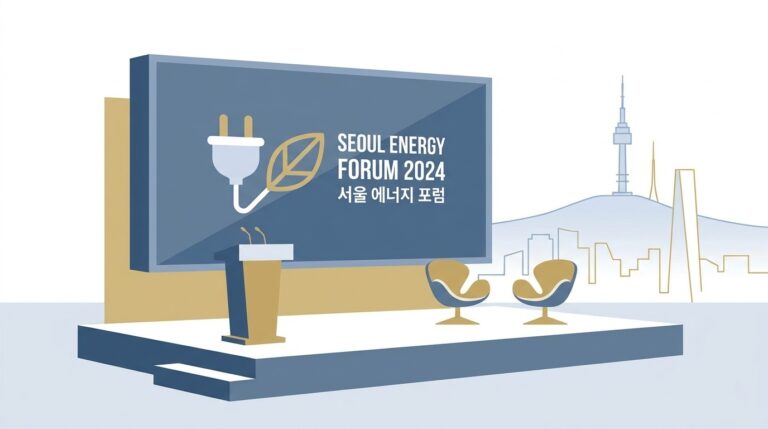
Setting: An international energy policy forum held at COEX, Seoul. You are a senior energy analyst participating in a panel discussion with Dr. Park, a veteran Korean petroleum economist.
Dialogue
- Dr. Park: 기술 혁신으로 인한 미국 셰일 가스의 증산이 국제 에너지 시장을 흔들고 있습니다. (🎭 Looking over charts with a serious expression)
- (The increase in US shale gas production due to technological innovation is shaking the global energy market.)
- You: 맞습니다. 셰일 혁명은 단순한 공급 증가를 넘어 국제 유가에 구조적인 하방 압력을 가하고 있죠. (🎭 Nodding gravely and leaning forward slightly)
- (That’s correct. The shale revolution goes beyond a simple supply increase, exerting structural downward pressure on global oil prices.)
- Dr. Park: 맞아요. 그 결과 OPEC의 시장 점유율 유지 전략과 충돌하면서 가격 변동성이 극대화되었습니다. (🎭 Adjusting glasses)
- (Indeed. As a result, it collided with OPEC’s market share retention strategy, maximizing price volatility.)
- You: 전통적 석유 생산국과 셰일업체 간의 치열한 치킨게임이 파급 효과를 가져온 셈입니다. (🎭 Gesturing with an open palm toward the presentation screen)
- (It means the fierce chicken game between traditional oil producers and shale companies brought about widespread ripple effects.)
- Dr. Park: 그렇다면 이러한 유가 흐름이 한국 경제에는 어떤 시사점을 준다고 보십니까? (🎭 Turning toward you attentively)
- (Then, what implications do you think this trend in oil prices holds for the Korean economy?)
- You: 수입 의존도가 높은 한국으로서는 원가 절감의 기회이자, 동유럽 및 중동 정세의 불확실성에 대비해야 하는 과제를 동시에 안게 되었습니다. (🎭 Speaking calmly with clear diction)
- (For Korea, with its high import dependency, it is both an opportunity for cost reduction and a task to prepare for uncertainties in Eastern Europe and the Middle East.)
- Dr. Park: 아주 명쾌한 분석이십니다. 에너지 안보 차원의 대응책이 시급하겠군요. (🎭 Smiling and approvingly nodding)
- (An exceptionally lucid analysis. Countermeasures at the energy security level must be urgent.)
- You: 네, 지정학적 리스크 완화를 위해 공급망 다변화가 필수적입니다. (🎭 Concluding with a confident nod)
- (Yes, diversifying supply chains is essential to mitigate geopolitical risks.)
🔀 Interactive Choice Point
Dr. Park asks: “미국 셰일 가스의 저렴한 생산 단가가 지속될 경우, 석유 export 국가들의 대응은 어떠할까요?”
- Choice A: “모르겠어요, 그냥 기름값이 떨어지면 좋은 거 아닌가요?”
- Choice B: “생산비용 절감을 추진함과 동시에, 감산 합의를 통해 유가 하단을 지지하려 할 것입니다.”
- Choice C: “셰일가스 회사들을 다 사버리면 됩니다.”
Feedback:
- Choice A (Bad): 🚫 Too casual and lacks depth. Dismisses the macroeconomic inquiry.
- Choice B (Best): ✅ Perfect C2 Korean! Uses precise terms like “감산 합의” (production cut agreement) and “유가 하단 지지” (supporting the oil price floor).
- Choice C (Risk): ⚠️ Unrealistic economic logic. Sounds dismissive in a professional seminar context.
Phase 6: 10-Second Emotion Shadowing Drill
Practice these high-level analytical sentences with the indicated cadence and tone:
[📊 분석적이고 단호하게 / Analytical & Firm]
셰일 혁명은 / 단순한 공급 증가를 넘어 / 국제 유가에 / 구조적 하방 압력을 / 가하고 있습니다.
(Seil hyeongmyeong-eun / dansunhan gonggeub jeonggareul neomeo / gukje yugae / gujojeok habang amnyeogeul / gahago isseumnida.)-
[🔍 신중하고 전문적으로 / Cautious & Professional]
지정학적 리스크에 대비하여 / 에너지 공급망 다변화를 / 조속히 추진해야 합니다.
(Jijeonghakjeok riseukue daebihayeo / eneoji gonggeubmang dabyeonhwareul / josokhi chujinhaeya hamnida.)
Phase 7: K-Culture Mini Dictionary
- 석유파동 (Seokyu Padong) | Oil Shock | Historically used in Korea to reference global oil supply crises that severely impacted national development.
- 에너지 안보 (Eneoji Anbo) | Energy Security | A strategic policy imperative in Korea focused on securing stable, long-term national fuel imports.
- 치킨게임 (Chikin Geim) | Chicken Game / Price War | Commonly used in Korean economic media to describe non-cooperative price-cutting battles between dominant industry players.
- 감산 합의 (Gamsan Habi) | Production Cut Agreement | Standard diplomatic-business term for OPEC+ decisions to reduce crude oil output.
Phase 8: Business Traveler’s Survival Kit
Top 3 Survival Expressions for Seminars & Meetings
- 발표자료를 참고해 주시기 바랍니다.
(Baalpyojaryoreul chamgohae jusigi baramnida.)
-> Please refer to the presentation materials.
Pro Tip: Excellent opening line when presenting economic charts. - Q&A 시간에 추가 논의를 이어가겠습니다.
(Q&A sigane chuga nonuireul ieogagesseumnida.)
-> We will continue further discussion during the Q&A session. - 본 사안은 원자재 가격 변동성에 직결되어 있습니다.
(Bon saaneun wonjajae gageok byeondongseong-e jikgyeol-doe-eo isseumnida.)
-> This matter is directly tied to raw material price volatility.
Editor’s Travel Note
When attending international conventions at COEX (Gangnam) or IFC Mall (Yeouido), rely on native navigation apps. Make sure to complete your 네이버 지도 앱 다운로드 before arriving. For swift transfers across Seoul’s financial district, top up your T-money card at any convenience store.
Phase 9: One Step Deeper (Thought Essay)
Language is a mirror of a nation’s vulnerabilities and ambitions. South Korea’s rapid rise from post-war poverty to an industrial powerhouse occurred despite possessing virtually zero domestic oil reserves. Consequently, Korean economic terminology regarding energy is marked by acute vigilance—words like 안보 (security), 변동성 (volatility), and 상쇄 (offsetting) carry deep weight in policy circles. Understanding how energy prices ripple through Korea’s manufacturing core gives you a profound window into the resilient mindset of Korean society.
💬 Your Turn: How does your home country’s energy landscape shape its macroeconomic vocabulary? Share your thoughts in Korean in the comments below!
Phase 10: FAQ & Common Mistakes
Q: What is the difference between ‘유가’ and ‘기름값’?
A: Both mean oil/fuel prices. However, 유가 (油價) is a Sino-Korean formal term used in economics, news, and official policy (e.g., 국제 유가). 기름값 is a native Korean word used in daily conversation when talking about refueling your car at a gas station.
Q: Can I use ‘치킨게임’ in a formal academic presentation in Korea?
A: Yes! While derived from English, “치킨게임” is an established economic term in Korea frequently used by university professors, news anchors, and policy analysts.
Q: Is ‘셰일 가스’ pronounced the same as in English?
A: It is written as 셰일 가스 and pronounced [Se-il ga-seu]. Be sure to add the final vowel sound [-seu] to 가스!
🚨 Common Mistakes TOP 3
- Mistake: Using “기름값이 내렸다” in a formal economic speech.
- Correct Action: Use “국제 유가가 하락세를 보였다” for professional gravitas.
- Mistake: Confusing “인상” (increase) with “인하” (decrease).
- Correct Action: Memory trick: 상 (上 = Up), 하 (下 = Down). Thus, 유가 인상 = Oil price rise / 유가 인하 = Oil price drop.
- Mistake: Overusing direct English loanwords when standard Sino-Korean policy terms exist.
- Correct Action: Replace “에너지 세큐리티” with “에너지 안보”.
Phase 11: Action Mission
- Bronze Level: Read the Phase 6 Shadowing Drill aloud 3 times, focusing on natural pauses at
/marks. - Silver Level: Write a 2-sentence summary in Korean about how oil prices affect your daily life and post it in the comments.
- Gold Level: Watch a 5-minute clip of a Korean economic news channel (e.g., Hankyung TV) and identify at least two core terms learned today (파급 효과, 하방 압력, 주도권).
🎮 K-Culture Mission: Search YouTube for “슈카월드 셰일가스” (Syuka World Shale Gas) to watch one of Korea’s top financial creators explain this exact topic with humor and charts!
Phase 12: Interactive Quiz Challenge
Quiz 1: Vocabulary Choice
국제 유가가 급락하면서 석유 수출국 간의 시장 ( ) 싸움이 치열해졌다.
1) 주도권
2) 친목
3) 난방비
🔍 정답 및 해설 보기 (Click to expand)
정답: 1) 주도권
* 해설: “시장 주도권” (Market dominance/control) is the correct economic phrase. “친목” means friendship and “난방비” means heating expenses.
Quiz 2: True or False
In formal Korean economic reports, ‘기름값’ is preferred over ‘유가’. (True / False)
🔍 정답 및 해설 보기 (Click to expand)
정답: False
* 해설: ‘유가’ (Sino-Korean) is preferred in formal reports, whereas ‘기름값’ is used in casual daily conversations.







