

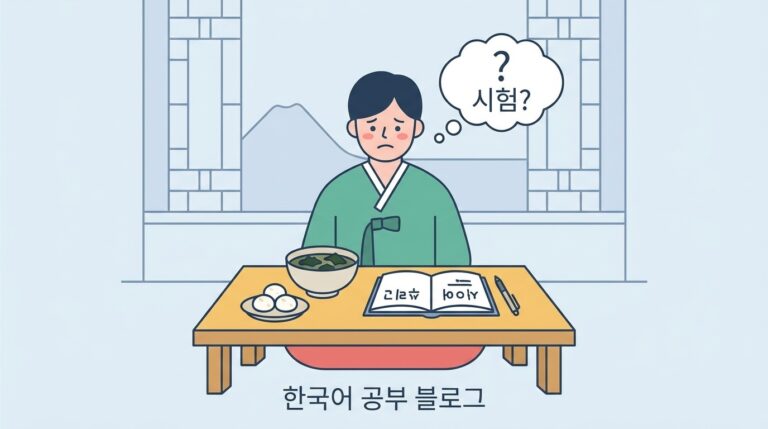
Why You Should NEVER Eat Seaweed Soup Before an Exam in Korea! 🍲❌
Phase 1: Welcome to Daily Hangul! (공감)
안녕하세요! I’m your lead editor at Daily Hangul and your 10-year local culture navigator! Imagine this: It’s the morning of the biggest test of your semester in Seoul. You wake up nervous, and your sweet Korean host mother smiles warmheartedly as she places a steaming bowl of food on the table. But wait! You look down and see dark green slippery seaweed floating in a rich broth—미역국 (Miyeok-guk / Seaweed Soup)! You freeze. You recall a friend warning you, “Whatever you do, don’t eat seaweed soup today! You’ll fail!”
If you’ve ever felt bewildered by Korean exam superstitions or stumbled over how to politely express worries about bad luck in Korean, you are in the right place! Superstitions in Korea aren’t just ancient folklore; they are deeply embedded in daily conversations, modern drama plotlines, and student culture. By understanding the linguistic nuances behind these superstitions, you will not only avoid awkward social faux pas but also level up your intermediate Korean conversational fluency. This guide is crafted from real student feedback to help you navigate cultural nuances like a true insider. Let’s dive in!
Phase 2: Key Expressions Analysis (핵심 표현 3선)
1. 미역국을 먹다 / 미역국을 먹었어요 (Mi-yeok-guk-eul meok-da)
- Pronunciation: [mi-yeok-guk-eul meok-da] (Sounds like “me-yok-goose-eul meok-da”)
- Meaning: Literal: “To eat seaweed soup” / Idiomatic Nuance: To fail an exam or to get rejected/fired.
- K-Culture Moment: In modern K-Dramas, when a character comes home looking gloomy after a job interview, their roommate might ask softly, “또 미역국 먹었어?” (Did you fail/get rejected again?).
- Editor’s Insight: Seaweed is extremely slippery (미끄럽다). In Korean cultural imagery, slipping down means falling or sliding down the ranking list. Hence, eating slippery seaweed before a big day symbolizes “slipping” on your exam!
- Situation Spectrum:
- Casual: ✅ (Frequently used among peers)
- Semi-formal: ✅ (Acceptable when making light jokes with coworkers)
- Formal: 🚫 (Avoid in official academic/business presentations)
- 🤔 Think About It: Does your home country have idioms where eating a specific food or physical sensation is linked metaphorically to bad luck or failure?
2. 엿처럼 딱 붙으세요! (Yeot-cheo-reom ttak bu-teu-se-yo!)
- Pronunciation: [yeot-cheo-reom ttak bu-teu-se-yo] (Sounds like “yut-chuh-reom ttack boo-teu-say-yo”)
- Meaning: Literal: “Stick tightly like sticky taffy!” / Idiomatic Nuance: “May you pass your exam with flying colors!”
- K-Culture Moment: Outside high schools on exam day, junior students chant and hand out 엿 (Yeot – traditional sticky taffy) or 찹쌀떡 (Chapssaltteok – sticky rice cakes) to test-takers so they “stick” to the university list.
- Editor’s Insight: While 미역국 makes you slip, 엿 makes you stick (붙다). The word 붙다 means both “to stick” and “to pass an exam.” It’s a clever double entendre!
- Situation Spectrum:
- Casual: ✅
- Semi-formal: ✅
- Formal: ⚠️ (Better to use “합격을 기원합니다”)
- 🤔 Think About It: Why do you think sticky food culture became such a central ritual during Korea’s intense university entrance exams?
3. 재수없게 왜 그래요? (Jae-su-eop-ge wae geu-rae-yo?)
- Pronunciation: [jae-su-eop-ge wae geu-rae-yo] (Sounds like “jae-soo-up-gae way greh-yo”)
- Meaning: Literal: “Why are you acting without good luck?” / Idiomatic Nuance: “Why are you bringing bad luck?” or “Don’t jinx it!”
- K-Culture Moment: When a friend says, “What if we fail tomorrow’s test?”, you pout and playfully scold them with this expression.
- Editor’s Insight: 재수 (Jaesu) refers to good fortune or luck. Saying someone is 재수없다 can range from playful teasing (“Don’t jinx us!”) to a harsh insult (“That person is unpleasant”). Use it with a soft tone among close friends!
- Situation Spectrum:
- Casual: ✅ (With close friends)
- Semi-formal: ⚠️ (Use cautiously depending on tone)
- Formal: 🚫 (Do not use in formal settings)
- 🤔 Think About It: How do you tell someone in your native language not to bring bad vibes or jinx an important event?
Phase 3: Textbook Korean vs. Real Native Korean (교과서 vs. 진짜 한국어)
Situation 1: Wishing someone luck on a test
- 📖 Textbook Korean: 시험에 합격하기를 바랍니다. (I hope you pass the exam.)
- 🗣️ Real Native Korean: 이번 시험 완전 떡상하자! 딱 붙어라! (Let me super succeed on this test! Stick right to it!)
- 💡 Why the difference?: Natives love dynamic imagery. Using slang like 떡상 (huge success/skyrocketing) combined with sticky food metaphors (붙어라) feels far warmer and more encouraging than stiff textbook phrases.
Situation 2: Expressing fear of failing after making a mistake
- 📖 Textbook Korean: 저는 시험을 망칠까 봐 걱정됩니다. (I am worried that I might ruin the exam.)
- 🗣️ Real Native Korean: 아 어떡해, 나 미역국 먹는 거 아니겠지? (Oh no, what if I end up eating seaweed soup?)
- 💡 Why the difference?: B2 speakers sound natural when replacing direct emotional verbs with metaphoric idiomatic expressions like “eating seaweed soup.”
Phase 4: K-Culture Deep Dive & Non-Verbal Manners
4-1. Nunchi (눈치) & Expressive Gestures
When discussing superstitions in Korea, non-verbal cues carry enormous weight:
* Shaking your legs (다리 떨기): If you shake your leg while waiting for an exam or interview, elderly Koreans or peers might tap your knee gently and say, “다리 떨면 복 나간다” (If you shake your leg, your luck slips away). Avoid leg-shaking in formal or nervous situations!
* Writing names in Red Ink (빨간색 이름): Never write a living person’s name in red ink. Historically associated with deceased individuals in registries, doing this before an exam is seen as severe bad luck.
4-2. Cultural Code: Food and Destiny
Food in Korea isn’t just sustenance; it’s a symbolic vehicle for fate. On birthdays, Koreans must eat 미역국 to honor their mothers and celebrate life. However, on exam day, eating the exact same dish becomes a taboo (금기). This contrast showcases how contextual meaning governs Korean cultural life!
Phase 5: Interactive Roleplay Scenario (실전 롤플레이)
Setting: A university cafeteria in Sinchon, Seoul, the day before the Topik / Midterm Exam. You are sitting with your Korean classmate, Minsu (민수).
- Minsu: 오늘 점심 메뉴에 미역국 나왔는데, 너 미역국 받을 거야?
(They served seaweed soup for lunch today, are you going to get it?) - You: 🎭 (Shaking your head in dramatic panic) 아니! 절대 안 먹어. 내일 시험인데 미역국을 먹으면 어떡해!
(No! Absolutely not eating it. I have an exam tomorrow, what if I eat seaweed soup!) - Minsu: 하하, 너 한국 미역국 미신 알고 있구나? 대박이다!
(Haha, you know about the Korean seaweed soup superstition? That’s awesome!) - You: 🎭 (Smiling proudly) 그럼! 미역처럼 미끄러지면 안 되잖아.
(Of course! I shouldn’t slip like seaweed.) - Minsu: 맞아. 대신 오늘 저녁에 찹쌀떡 먹으러 갈까?
(Right. Instead, shall we go eat sticky rice cakes tonight?) - You: 🎭 (Nodding eagerly) 좋아! 시험에 엿처럼 딱 붙어야지!
(Sounds good! I need to stick tightly like taffy on the exam!) - Minsu: 너 진짜 한국 사람 다 됐네. 그럼 이번 시험 걱정 없겠다!
(You’ve really become fully Korean. Then no worries for this exam!) - You: 🎭 (Winking confidently) 말이라도 고마워. 우리 같이 합격하자!
(Thanks for saying so! Let’s pass together!)
🔀 Interactive Choice Point
Minsu drops his pen during your study session right before the test and says, “아, 펜 떨어졌다… (Ah, my pen fell…)”. How do you respond?
- Choice A: “괜찮아! 펜 떨어진 건 아무 의미 없어. 그냥 다시 주워.”
- Choice B: “어? 떨어졌다니… 너 이번 시험 미역국 먹는 거 아니야? (Laughing loudly)”
- Choice C: “에이, 액땜했다 치자! 본 시험에서는 안 떨어질 거야!”
— Feedback —
* Choice A (Bad): A bit too logical! It shuts down the cultural banter and feels cold.
* Choice B (Risk): Saying someone will fail (“eat seaweed soup”) right after they drop something can make nervous students genuinely upset.
* Choice C (Best – Pro Level!): Perfect! 액땜하다 means “to get minor bad luck out of the way to avoid bigger disaster.” Encouraging and culturally authentic!
Phase 6: 10-Second Emotional Shadowing Drill
[🥺 Worried & Playful]
아 / 어떡해… / 내일 시험인데 / 미역국 먹으면 / 안 되는데! /
(Ah / what do I do… / I have an exam tomorrow / I shouldn’t eat seaweed soup!)-
[😊 Encouraging & Energetic]
걱정 마! / 이번 시험에 / 엿처럼 / 딱 / 붙을 거야! /
(Don’t worry! / On this test / like sticky taffy / tightly / you will stick!)
Phase 7: K-Culture Mini Dictionary
- 액땜 (Aek-ttaem) | Bad luck preventive cushion | Experiencing a small inconvenience (e.g., missing a bus) before an important event, viewed positively as taking the hit for bigger misfortunes.
- 징크스 (Jing-keu-seu) | Jinx | Frequently used in Korean daily life (e.g., “나는 시험 날 빨간 옷 입으면 징크스 있어” = I have a jinx if I wear red on exam day).
- 합격 부적 (Hap-gyeok bu-jeok) | Passing amulet | Yellow paper talismans or modern phone wallpapers designed to bring good score vibes.
- 눈치챙겨 (Nun-chi-chaeng-gyeo) | Read the room / Pick up cues | A slang phrase telling someone to pay attention to social harmony and unspoken rules.
Phase 8: Traveler’s Survival Kit
Top 3 Survival Phrases
- “휴지 좀 주시겠어요?” (Hyu-ji jom ju-si-get-eo-yo?)
- Meaning: Could you give me some toilet paper / tissue?
- Pro Tip: Giving toilet paper (휴지) as a housewarming gift symbolizes things unraveling smoothly (풀리다), just like rolling out toilet paper!
- “시험 잘 보세요!” (Si-heom jal bo-se-yo!)
- Meaning: Good luck on your test!
- Pro Tip: The standard polite way to wish any test-taker well.
- “대박 나세요!” (Dae-bak na-se-yo!)
- Meaning: Wish you giant success / Hit the jackpot!
- Pro Tip: Great for encouraging friends or small business owners.
Editor’s Travel Note
When traveling or studying in Korea, navigation apps are essential. KakaoMap and Naver Map work far better than Google Maps. Make sure to check out the Naver Map App Download before heading to your examination center or cozy Korean study cafes!
Phase 9: A Step Deeper (한 발 더 깊이)
In Western cultures, superstitions often focus on luck regarding mystical elements (like black cats or 777). However, Korean superstitions are deeply tied to linguistic wordplay (언어유희) and community solidarity. When Korean parents give students sticky rice cakes or avoid seaweed soup, it’s not just irrational fear—it is a tangible expression of communal empathy (정, Jeong). It is a way for society to say, “We acknowledge your hard work, and we want to remove every possible negative symbol from your path.”
💬 Your Turn: What is the most unique exam superstition in your native culture? Do you eat or avoid specific foods before a test? Leave a comment below and share your story with the Daily Hangul community!
Phase 10: FAQ & Common Mistakes
Q: Can I eat seaweed soup on my Korean friend’s birthday if they have a test that week?
A: Birthdays strictly require 미역국! The birthday tradition of honoring mothers overrides exam superstitions. However, on the actual morning of the exam, it is best to avoid serving it.
Q: Is it rude to give chocolate or coffee as an exam gift?
A: Not at all! Modern Koreans frequently send KakaoTalk gift coupons for Godiva chocolates, Starbucks coffee, or energy drinks along with sticky rice cakes.
Q: Are there other foods to avoid before exams besides seaweed soup?
A: Yes! Anything slippery or soft, such as 죽 (Juk – Rice Porridge), is sometimes avoided because 죽 쒔다 is slang for ruining something or messing up.
🚨 Common Mistakes TOP 3
- Mistake: Writing good luck notes to friends in red ink.
- Correct Action: Use blue or black ink! Red ink carries negative funeral connotations.
- Mistake: Using formal dictionary verbs like “시험에서 떨어졌습니다” when making jokes with close peers.
- Correct Action: Use metaphorical idioms like “미역국 먹었어요” for natural native rhythm.
- Mistake: Shaking your legs nervously next to older adults while waiting in line.
- Correct Action: Keep posture steady so you don’t trigger the “shaking off good luck” superstition!
Phase 11: Action Mission & K-Culture Mission
- 🥉 Bronze Mission: Speak the expression “미역국 먹지 마세요!” out loud 3 times with playful emotion.
- 🥈 Silver Mission: Write a short Korean comment below using the word 액땜.
- 🥇 Gold Mission: Watch a K-Drama or Korean vlog episode about school life and spot when students give each other 엿 or 찹쌀떡!
🎮 K-Culture Mission: Next time you listen to K-Pop or watch a drama, listen closely for phrases like “딱 붙어라” or “죽 쒔어”. You’ll be amazed at how often these food idioms pop up!
Phase 12: Interactive Quiz Challenge
Q1. What does the Korean phrase “나 이번 시험에서 미역국 먹었어” mean in reality?
a) I ate delicious food during my test break.
b) I passed the exam with top scores.
c) I failed or slipped up on the exam.
d) I celebrated my birthday during the test.
🔍 Click to reveal Answer & Explanation
Correct Answer: c) I failed or slipped up on the exam.
Explanation: Seaweed (미역) is slippery, symbolizing slipping down the rankings or failing an exam.
Q2. True or False: Writing a friend’s name in red ink on a good luck card before an exam is a sweet Korean gesture.
🔍 Click to reveal Answer & Explanation
Correct Answer: False
Explanation: Red ink is traditionally associated with deceased individuals. Always use blue, black, or warm colors when writing names!
Q3. Fill in the blank: Before an exam, Korean students give each other ________ (sticky taffy) to help them “stick” to the passing list.
🔍 Click to reveal Answer & Explanation
Correct Answer: 엿 (Yeot)
Explanation: Sticky foods like 엿 or 찹쌀떡 symbolize sticking to the exam list and passing successfully!







