

Phase 1: 공감 (Empathy & Storytelling)
안녕하세요! 매일한글 에디터입니다. 👋
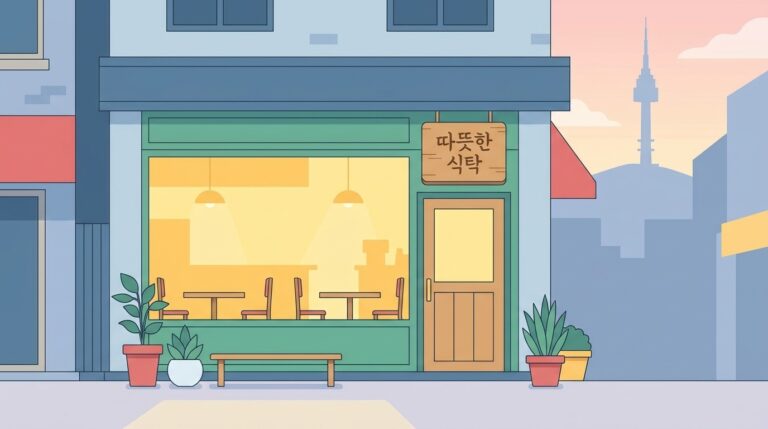
Have you ever walked through the trendy streets of Seongsu-dong or Hongdae, your stomach rumbling with excitement to try that legendary spicy galbijjim (braised short ribs) you saw on Instagram? You reach the restaurant, smell the incredible aromas, reach for the door handle—and suddenly stop. The lights inside are dimmed, the staff are sitting together sharing a meal, and a neat acrylic sign hanging on the door reads: “Break Time: 15:00 – 17:00”.
That sinking feeling in your stomach is a right of passage for anyone exploring the food scene in modern Korea! Mid-afternoon break times are almost universal across popular Korean eateries to give hardworking staff a rest and time to prep fresh dinner ingredients.
In this lesson, you’ll master the exact expressions needed to navigate Korean restaurant break times effortlessly. No more hungry disappointment—just smooth, confident conversations that will make restaurant staff smile and treat you like a local foodie insider!
Phase 2: 핵심 표현 3선 심층 분석 (Core Expressions)
1. 지금 브레이크 타임인가요? (Jigeum beureikeu taim-ingayo?)
- Pronunciation: [Ji-geum beu-re-i-keu ta-im-in-ga-yo?] (Sounds like: “jee-geum break-time-in-gah-yo?”)
- Meaning: Direct: Is it break time now? | Nuance: Excuse me, are you currently closed for your afternoon break?
- K-Culture Moment: You see this classic scene in K-dramas where hungry main characters run up to a restaurant right as the owner flips the door sign from Open to Break Time.
- Editor’s Insight: Adding “~인가요?” at the end softens your question compared to a blunt “이에요?”. It sounds naturally polite and considerate.
- Situation Spectrum: Casual ⚠️ | Semi-formal ✅ | Formal ✅
- 🤔 Think About It: How does your home country handle afternoon restaurant prep, and why do you think Koreans use the English phrase “break time” directly?
2. 몇 시부터 브레이크 타임이에요? (Myeot sibuteo beureikeu taim-ieyo?)
- Pronunciation: [Myeot si-bu-teo beu-re-i-keu ta-im-i-e-yo?] (Sounds like: “myot shee-boo-teo break-time-ee-eh-yo?”)
- Meaning: Direct: From what time is break time? | Nuance: What time does your break time start?
- K-Culture Moment: Foodie vloggers in Seoul checking restaurant times on their phones before mapping out their food tour route.
- Editor’s Insight: “부터” means “from”. Combining it with “몇 시” (what time) creates the ultimate time-management phrase for hungry travelers!
- Situation Spectrum: Casual ⚠️ | Semi-formal ✅ | Formal ✅
- 🤔 Think About It: In fast-paced Korean dining culture, timing your meal between peak hours is key to avoiding long waiting lines!
3. 라스트 오더 몇 시예요? (Laseuteu odeeo myeot si-yeyo?)
- Pronunciation: [Ra-seu-teu o-deo myeot si-ye-yo?] (Sounds like: “lah-seu-teu oh-deo myot shee-yeh-yo?”)
- Meaning: Direct: What time is last order? | Nuance: Until what time can I place my food order before the kitchen closes?
- K-Culture Moment: Arriving at a famous tteokbokki spot at 2:15 PM when break time starts at 3:00 PM. You need to know if the kitchen is still accepting orders!
- Editor’s Insight: Korean restaurants usually set Last Order (L.O.) about 30 to 45 minutes before break time actually begins.
- Situation Spectrum: Casual ✅ | Semi-formal ✅ | Formal ✅
- 🤔 Think About It: Koreans love blending handy English culinary loanwords with polite Korean sentence endings.
Phase 3: 교과서 한국어 vs 진짜 한국어 (Textbook vs Real Korean)
Situation 1: Asking if you can enter right now
- 📖 교과서 한국어: 영업 시간이 어떻게 되나요? (Eo-myeop si-gan-i eo-tteoh-ge doe-na-yo?)
- 🗣️ 진짜 한국어: 지금 주문 돼요? (Ji-geum ju-mun dwae-yo?)
- 💡 왜 다를까? While textbooks teach general inquiries about operating hours, real Koreans on a lunch crunch ask directly if the kitchen is currently accepting orders.
Situation 2: Checking last order time
- 📖 교과서 한국어: 마지막 주문은 언제까지 입니까? (Ma-ji-mak ju-mun-eun eon-je-kka-ji im-ni-ka?)
- 🗣️ 진짜 한국어: 라스트 오더 몇 시예요? (Ra-seu-teu o-deo myeot si-ye-yo?)
- 💡 왜 다를까? Modern Korean food establishments almost universally use the loanword “라스트 오더” (Last Order) written on signs and menus.
Phase 4: K-Culture 딥다이브 & 비언어적 매너 (Culture & Etiquette)
4-1. 눈치 (Nunchi) & Non-Verbal Gestures
When walking up to a restaurant near 2:30 PM – 3:00 PM, use your Nunchi (cultural awareness):
* If staff members make an “X” shape with their arms or point to their watch while tilting their head with an apologetic smile, that is the international Korean sign for “We are on break time!”
* Simply bow your head slightly, say “아, 네! 감사해요!” (Ah, yes! Thank you!), and gracefully exit.
4-2. Cultural Code: Why Break Time Matters in Korea
Break time in Korea is not laziness—it is a mark of culinary quality! Restaurants use 3:00 PM to 5:00 PM to boil fresh broths, hand-roll dumplings, and eat a balanced meal together (Sik-sa). Respecting break times shows you understand and honor authentic Korean food culture.
Phase 5: 실전 롤플레이 시나리오 (Interactive Roleplay)
Scenario: You arrive at a popular handmade noodle shop in Ikseon-dong at 2:20 PM. Break time starts at 3:00 PM.
- Traveler (You): 🎭 (Peeking through the door with a friendly smile) 저기요, 지금 식사 돼요? (Jeo-gi-yo, ji-geum sik-sa dwae-yo? / Excuse me, can we eat now?)
- Staff: 🎭 (Checking watch politely) 아, 저희 3시부터 브레이크 타임이에요. (A, jeo-hui se-si-bu-teo beu-re-i-keu ta-im-i-e-yo. / Ah, our break time starts at 3 o’clock.)
- Traveler (You): 🎭 (Nodding understandingly) 아, 정말요? 그럼 라스트 오더는 몇 시예요? (A, jeong-mal-yo? Geu-reom ra-seu-teu o-deo-neun myeot si-ye-yo? / Ah, really? Then when is the last order?)
- Staff: 🎭 (Pointing to menu) 2시 30분까지예요! 10분 남았어요. (I-si sam-sip-bun-kka-ji-ye-yo! Sip-bun na-mas-seo-yo. / It’s until 2:30! You have 10 minutes left.)
- Traveler (You): 🎭 (Relieved) 아, 다행이다! 빨리 주문할게요. (A, da-haeng-i-da! Ppal-ri ju-mun-hal-ge-yo. / Ah, what a relief! I’ll order quickly.)
- Staff: 🎭 (Guiding to a table) 네, 편하신 자리에 앉으세요! (Ne, pyeon-ha-sin ja-ri-e an-jeu-se-yo. / Yes, please take any comfortable seat!)
- Traveler (You): 🎭 (Taking a seat) 감사합니다! 물은 셀프인가요? (Gam-sa-ham-ni-da! Mu-reun sel-peu-in-ga-yo? / Thank you! Is water self-service?)
- Staff: 🎭 (Smiling) 네, 정수기 이용해 주세요! (Ne, jeong-su-gi i-yong-hae ju-se-yo! / Yes, please use the water dispenser!)
🔀 인터랙티브 분기점 (Decision Point)
It is 2:28 PM, and you have 2 minutes left before Last Order. What do you say?
- Option A: “천천히 고르고 주문할게요.” (I’ll take my time choosing and order.)
- ❌ Bad Choice: Staff need to submit orders to the kitchen before 2:30 PM sharp! Taking too long might mean missing out.
- Option B: “대표 메뉴로 빨리 주문할게요!” (I’ll order your signature dish right away!)
- ✅ Best Choice: Efficient, respectful of their time, and guarantees you get the best meal!
- Option C: “지금 브레이크 타임 안 하면 안 돼요?” (Can’t you just skip break time today?)
- 🚨 Risk Choice: Rude and culturally inappropriate. Always respect restaurant operating schedules!
Phase 6: 10초 감정 섀도잉 드릴 (Shadowing Drill)
Practice speaking these sentences with natural rhythm and emotional expression!
[😊 Polite & Inquisitive]저기요 / 지금 / 주문 돼요? (Jeo-gi-yo / ji-geum / ju-mun dwae-yo?)[🥺 Urgent & Hopeful]라스트 오더 / 몇 시예요? (Ra-seu-teu o-deo / myeot si-ye-yo?)[😌 Relieved & Cheerful]아 다행이다 / 빨리 / 주문할게요! (A da-haeng-i-da / ppal-ri / ju-mun-hal-ge-yo!)
Phase 7: K-Culture 미니 사전 (Mini Dictionary)
- 브레이크 타임 (Beureikeu Taim) | Break Time | Mid-afternoon staff rest and kitchen prep hours (typically 15:00 – 17:00).
- 라스트 오더 (Laseuteu Odeeo) | Last Order | The final cut-off time for food orders before break time or closing.
- 재료 소진 (Jaeryo Sojin) | Sold Out Ingredients | Kitchen closed early because prepped fresh ingredients ran out.
- 웨이팅 (Weiting) | Waiting List | Queueing system at popular restaurants, often managed via digital kiosks.
Phase 8: 여행자를 위한 생존 키트 (Travel Survival Kit)
TOP 3 Survival Phrases
- 몇 시에 다시 열어요? (Myeot si-e da-si yeor-eo-yo?) – What time do you reopen?
- 포장은 돼요? (Po-jang-eun dwae-yo?) – Is takeout available?
- 대기 팀 얼마나 있어요? (Dae-gi tim eol-ma-na is-seo-yo?) – How many waiting teams are ahead?
Editor’s Travel Note 💡
Don’t get caught off guard! Before taking a long subway ride to a viral eatery, always use the 네이버 지도 앱 다운로드 (Naver Map App Download) to verify live break time hours and real-time announcements.
Phase 9: 한 발 더 깊이 (Cultural Insight)
In modern urban Korea, break times reflect a growing cultural commitment to work-life balance (Warabal) and high culinary standards. While older night-market style stalls operate continuously, modern Korean diners respect break time as a guarantee that their dinner will feature freshly prepared broths and veggies.
💬 Your Turn: Have you ever experienced break time surprises while traveling in Korea or eating out in your home town? Share your story in the comments below!
Phase 10: FAQ & 오해 방지 (FAQ & Common Mistakes)
Q: Do Korean restaurants have break times on weekends too?
A: Yes! Many popular places keep break times on Saturdays and Sundays. Always check Naver Maps before heading out.
Q: What should I do if a sign says “재료 소진시 조기 마감”?
A: This means “Closed early once ingredients run out.” Even if break time hasn’t officially started, orders are closed for that session.
Q: Can I sit inside and wait while staff are on break time?
A: Generally no. Staff use the dining floor to rest and eat their own staff meals (Bap), so guests are asked to return when break time ends.
🚨 Common Mistakes Top 3
- Mistake: Arriving 5 minutes before break time expecting full menu service.
- Correct Action: Aim to arrive at least 45 minutes before break time starts.
- Mistake: Confusing Break Time start with Last Order time.
- Correct Action: Always ask specifically for “라스트 오더”.
- Mistake: Entering loudly while staff are eating together.
- Correct Action: Gently ask from the doorway: “혹시 지금 브레이크 타임인가요?”.
Phase 11: 액션 미션 & 참여 유도 (Action Mission)
- 🥉 Bronze: Say “라스트 오더 몇 시예요?” out loud 3 times with confidence!
- 🥈 Silver: Save your favorite Korean restaurant on Naver Maps and check their break time hours.
- 🥇 Gold: Next time you visit a Korean restaurant, ask the staff in Korean about their last order time!
🎮 K-Culture Mission: Watch a Korean street food vlog or K-drama this week, spot a restaurant door sign, and identify if it shows break time hours!
Phase 12: 인터랙티브 퀴즈 챌린지 (Quiz Challenge)
Q1. What does “라스트 오더” mean in Korean dining?
Click to view answer & explanation
Answer: It means Last Order—the cut-off time when the kitchen stops accepting food orders before break time or closing.
Q2. Fill in the blank: “몇 시____ 브레이크 타임이에요?” (From what time is break time?)
Click to view answer & explanation
Answer: 부터 (bu-teo). The full sentence is: “몇 시부터 브레이크 타임이에요?”.
Q3. True or False: If a restaurant break time starts at 3:00 PM, you can order food at 2:55 PM.
Click to view answer & explanation
Answer: False! Kitchens usually close for Last Order around 2:15 PM or 2:30 PM to finish cooking before 3:00 PM.







