

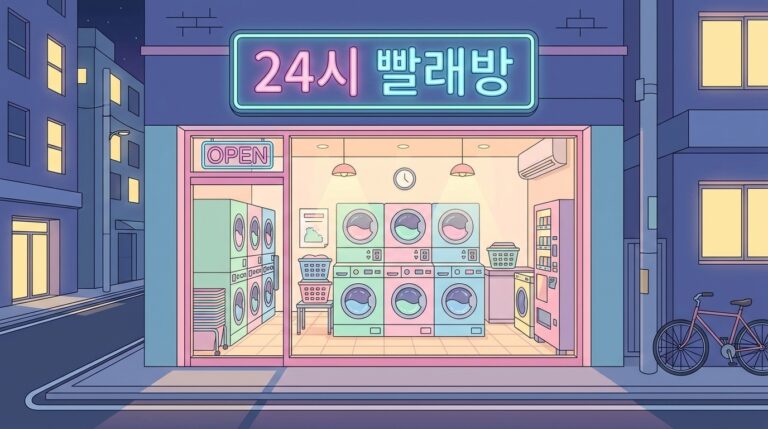
안녕하세요! I am your lead editor and Korean culture navigator at Daily Hangul. Have you ever walked into a sleek, neon-lit 24-hour self-service laundromat (코인빨래방) in Seoul, waited for your laundry cycle to finish, and suddenly frozen when it was time to take your clothes out? Maybe the machine is locked, or maybe someone left their dried clothes inside the machine you desperately need! Dealing with shared public spaces in a foreign language can be intimidating. But don’t worry—I’m here as your Korean best friend to guide you through every step. By mastering these simple A2-level Korean phrases for getting your laundry out smoothly, you will feel like a confident local, practice great Korean etiquette (눈치), and handle any laundromat situation with ease!
Phase 2: Core Expression Deep Dive
1. 빨래 다 됐어요? (Pbal-lae da dwae-sseo-yo?)
- Pronunciation: [Pbal-lae da dwae-sseo-yo] (Sounds like: Pbal-leh dah dway-suh-yo)
- Meaning: Literal: “Is the laundry all done?” / Real Nuance: “Is this machine finished?” or “Are you done with your laundry?”
- K-Culture Moment: Seen in K-dramas when two characters meet late at night in a neighborhood laundromat and break the ice.
- Editor’s Insight: The word 되다 (to become/be done) is used everywhere in daily Korean when an action or process is completed.
- Situation Spectrum: Casual ✅ / Semi-formal ✅ / Formal ⚠️
- 🤔 Think About It: Why do you think Korean uses the passive verb 되다 (to be done) instead of “Did the machine finish?”
2. 이것 좀 꺼내도 될까요? (I-geot jom kkeo-nae-do doel-kka-yo?)
- Pronunciation: [I-geot jom kkeo-nae-do doel-kka-yo] (Sounds like: Ee-geot jom kkuh-nae-doh dwel-kkah-yo)
- Meaning: “May I take this out?”
- K-Culture Moment: Asking politely when someone’s laundry has been sitting inside a dryer that you need to use.
- Editor’s Insight: Adding 좀 (a little/please) softens the request instantly and makes you sound super polite!
- Situation Spectrum: Casual ⚠️ / Semi-formal ✅ / Formal ✅
- 🤔 Think About It: How does asking for permission (-도 될까요?) reflect Korean politeness and care for personal boundaries?
3. 빨래 바구니에 담아둘게요. (Pbal-lae ba-gu-ni-e dam-a-dul-ge-yo.)
- Pronunciation: [Pbal-lae ba-gu-ni-e dam-a-dul-ge-yo] (Sounds like: Pbal-leh bah-goo-nee-eh dah-mah-dool-geh-yo)
- Meaning: “I will put the laundry in the basket for you.”
- K-Culture Moment: Assuring someone that you are carefully placing their dried clothes into a clean laundromat basket without mixing them up.
- Editor’s Insight: The pattern -아/어 둘게요 means “I will do it and leave it in that state for you,” showing helpful consideration.
- Situation Spectrum: Casual ✅ / Semi-formal ✅ / Formal ⚠️
- 🤔 Think About It: What does leaving clothes neatly in a shared basket say about modern Korean public courtesy?
Phase 3: Textbook Korean vs. Real Korean
Situation 1: Asking if the washer is finished
- 📖 Textbook Korean: 세탁이 완료되었습니까? (Se-tak-i wan-ryeo-doe-eoss-seub-ni-kka?) – Is the washing completed?
- 🗣️ Real Korean: 빨래 다 됐어요? (Pbal-lae da dwae-sseo-yo?) – Is the laundry done?
- 💡 Why is it different? Locals prefer friendly, simple action verbs like 되다 over formal Sino-Korean noun phrases like 세탁 완료.
Situation 2: Taking clothes out of the machine
- 📖 Textbook Korean: 세탁물을 회수하십시오. (Se-tak-mul-eul hoe-su-ha-sip-si-o.) – Please retrieve laundry.
- 🗣️ Real Korean: 빨래 꺼내시면 돼요! (Pbal-lae kkeo-nae-si-myeon dwae-yo!) – You can just take the laundry out!
- 💡 Why is it different? Written signs use formal instructions, but spoken Korean uses soft recommendations with -시면 돼요.
Phase 4: K-Culture Deep Dive & Manner Guide
4-1. Nunchi & Gestures
When taking your laundry out or moving someone else’s left laundry, always maintain good 눈치 (Nunchi – situational awareness):
* Eye Contact & Nod: Give a slight 15-degree head bow when making eye contact with another customer.
* Pointing: Gently gesture toward the dryer with an open palm rather than pointing with one finger.
* Basket Etiquette: Use the provided plastic carts (빨래 카트) to move clothes directly from dryer to folding table.
4-2. Laundromat Culture in Korea
Modern Korean laundromats (코인빨래방) are warm, clean micro-sanctuaries. Many feature arcade games, capsule coffee machines, high-speed Wi-Fi, and cozy seats. Taking care not to leave clothes inside machines once done is considered standard public etiquette so everyone can enjoy a smooth visit.
Phase 5: Real-Life Roleplay Scenario
Setting: A cozy 24-hour coin laundromat in Hongdae. You need to use Dryer No. 2, but the cycle finished and the clothes are still inside. Min-ju is sitting nearby checking her phone.
- Turn 1 (You): 저기요, 혹시 이 건조기 빨래 다 됐나요?
(Jeo-gi-yo, hok-si i geon-jo-gi pbal-lae da dwae-sseo-yo?)
[Excuse me, is the laundry in this dryer finished by any chance?]
🎭 Action: Point gently to Dryer No. 2 with a polite smile. - Turn 2 (Min-ju): 아, 네! 제 건데 벌써 끝났네요.
(A, ne! Je geon-de beol-sseo kkeut-nan-ne-yo.)
[Ah, yes! It’s mine, it already finished.]
🎭 Action: Stands up quickly and reaches for her basket. - Turn 3 (You): 제가 꺼내드릴까요?
(Je-ga kkeo-nae-deu-ril-kka-yo?)
[Shall I help you take it out?]
🎭 Action: Hold the machine door open for her. - Turn 4 (Min-ju): 아니에요! 제가 금방 꺼낼게요. 감사해요!
(A-ni-e-yo! Je-ga geum-bang kkeo-nael-ge-yo. Gam-sa-hae-yo!)
[No, that’s okay! I’ll take it out right away. Thank you!]
🎭 Action: Smiles warmly and pulls her clothes into the basket. - Turn 5 (You): 천천히 하세요. 바구니 여기 있어요.
(Cheon-cheon-hi ha-se-yo. Ba-gu-ni yeo-gi iss-eo-yo.)
[Take your time. The basket is right here.]
🎭 Action: Pushes a laundry cart closer to her. - Turn 6 (Min-ju): 와, 정말 친절하시네요! 이제 다 꺼냈어요.
(Wa, jeong-mal chin-jeol-ha-si-ne-yo! I-je da kkeo-nae-sseo-yo.)
[Wow, you are so kind! I’ve taken everything out now.]
🎭 Action: Moves her basket to the folding table. - Turn 7 (You): 감사합니다. 이제 제 빨래 넣을게요.
(Gam-sa-hab-ni-da. I-je je pbal-lae neo-heul-ge-yo.)
[Thank you. I’ll put my laundry in now.]
🎭 Action: Loads your wet clothes into Dryer No. 2. - Turn 8 (Min-ju): 네, 좋은 하루 보내세요!
(Ne, jo-eun ha-ru bo-nae-se-yo!)
[Yes, have a wonderful day!]
🎭 Action: Waves slightly as she goes to fold her laundry.
🔀 Interactive Choice Point
What would you say if the owner of the clothes isn’t around and the dryer has been sitting finished for 20 minutes?
- Option A: (Quietly move clothes to basket) 빨래 바구니에 담아둘게요.
- Result: BEST! 🌟 Respectful, clean, and perfectly acceptable laundromat etiquette.
- Option B: (Shout out loud) 누구 빨래예요? 빨리 꺼내세요!
- Result: BAD! 🚫 Too loud and confrontational for Korean public spaces.
- Option C: (Throw clothes on the floor and use dryer) 내 순서예요.
- Result: RISK! ⚠️ Highly rude and will cause severe conflict.
Phase 6: 10-Second Emotion Shadowing Drill
Practice saying these lines out loud with feeling!
[😊 Friendly & Polite]저기요 / 혹시 / 빨래 다 됐나요?
(Jeo-gi-yo / hok-si / pbal-lae da dwae-sseo-yo?)[🥺 Apologetic & Gentle]이것 좀 / 꺼내도 될까요?
(I-geot jom / kkeo-nae-do doel-kka-yo?)[👍 Warm & Helpful]바구니에 / 예쁘게 / 담아둘게요!
(Ba-gu-ni-e / ye-ppeu-ge / dam-a-dul-ge-yo!)
Phase 7: K-Culture Mini Dictionary
- 코인빨래방 (Koin-pbal-lae-bang): Self-service laundromat (literally coin wash room).
- 세탁기 (Se-tak-gi): Washing machine.
- 건조기 (Geon-jo-gi): Clothes dryer.
- 빨래 바구니 (Pbal-lae ba-gu-ni): Laundry basket/cart provided for public use.
Phase 8: Traveler’s Survival Kit
Top 3 Survival Phrases
- 이거 다 됐어요? (I-geo da dwae-sseo-yo?) – Is this done?
- 문 어떻게 열어요? (Mun eot-teo-ke yeol-ae-yo?) – How do I open the door?
- 동전 어디서 바꿔요? (Dong-jeon eo-di-seo ba-kkwo-yo?) – Where can I exchange coins?
Editor’s Travel Note
Looking for a 24-hour coin laundromat nearby? Download and search on the Naver Map App using the search term 코인빨래방 to locate nearest clean laundromats with coin changers and air conditioning!
Phase 9: One Step Deeper
In Korean society, shared convenience spaces rely heavily on 남에게 피해 주지 않기 (not causing inconvenience to others). When taking your laundry out promptly, you show respect for the next person’s time. This subtle awareness creates a comfortable environment where everyone can enjoy clean clothes hassle-free.
💬 Your Turn: Have you ever used a self-service laundromat in Korea? Tell us your experience in the comments below!
Phase 10: FAQ & Common Mistakes
Q: What if a machine door won’t open after the cycle ends?
A: Check the digital screen! Some machines have an automatic safety lock that takes 1-2 minutes to unlock after stopping. Look for the red lock icon to turn off.
Q: Is it okay to move someone else’s laundry if no machine is available?
A: Yes! If a dryer has finished and been sitting idle, place the clothes carefully into a clean laundry basket (빨래 바구니) nearby.
Q: How do I say “Where is the laundry detergent?”
A: Ask: 세제 어디에 있어요? (Se-je eo-di-e iss-eo-yo?).
🚨 Common Mistakes TOP 3
- Mistake: Pulling the door forcefully while locked. -> Correct Action: Wait for the click sound (딸깍) or press the stop/unlock button.
- Mistake: Leaving wet laundry in washers for hours. -> Correct Action: Set a timer on your phone for 30 minutes.
- Mistake: Mixing detergent into dryers. -> Correct Action: Only put dryer sheets (건조기 종이 섬유유연제) in the dryer!
Phase 11: Action Mission
- Bronze Mission: Practice saying 빨래 다 됐어요? 3 times out loud.
- Silver Mission: Leave a comment below using the pattern -도 될까요? (May I…?).
- Gold Mission: Visit a local laundromat in Korea and successfully retrieve your clothes using Korean!
🎮 K-Culture Mission: Watch a modern urban Korean drama scene set in a coin laundromat and spot the laundry carts!
Phase 12: Interactive Quiz Challenge
Q1. How do you politely ask if a washing machine is finished?
- A) 세탁기 사세요!
- B) 빨래 다 됐어요?
- C) 빨래 버리세요!
🔍 Click to view Answer & Explanation
Correct Answer: B) 빨래 다 됐어요?
Explanation: 다 됐어요? means “Is it all done?” and is the most natural way to ask if laundry is finished.
Q2. True or False: It is considered rude to place finished unattended laundry into a laundry basket at a coin laundromat.
🔍 Click to view Answer & Explanation
Correct Answer: False!
Explanation: Moving finished laundry into a designated clean basket so others can use the machine is normal and helpful etiquette in Korea.







