

Phase 1: Mind Your Hands! The Unspoken Rules of Korean Hand Gestures
안녕하세요! I’m your lead editor at Daily Hangul. Have you ever tried waving someone over in Korea, only to see them freeze with a look of utter confusion or mild offense? Imagine this: You’re sitting at a cozy cafe in Hongdae with your new Korean acquaintance. You want to call them over after picking up your drinks, so you raise your hand with your palm facing UP and curl your fingers—the standard ‘come here’ gesture back home. Suddenly, the atmosphere turns awkward. Why? In Korea, waving with your palm facing up is reserved exclusively for calling pets or young animals! Doing it to a person can make them feel like they are being beckoned like a dog.
Non-verbal etiquette in Korea is deeply rooted in respect, hierarchy, and context. As a B2 learner, mastering the spoken language is fantastic, but navigating these subtle cultural body signals is what truly elevates you from a student to a culturally fluent insider. Based on feedback from hundreds of international learners who’ve navigated these exact social bumps, this guide will help you decode Korean hand gestures so you can express warmth, respect, and politeness without saying a single wrong move!
Phase 2: Key Expressions Breakdown
1. 손짓하다 (Sonjithada)
- Pronunciation: [Son-jit-ha-da] (Sounds like ‘son’ + ‘jeat’ + ‘ha-da’)
- Meaning: To gesture / To beckon with one’s hand.
- K-Culture Moment: Seen frequently in K-Dramas when a boss subtly gestures for a subordinate to step into an office, or when a friend waves excitedly across the street.
- Editor’s Insight: While ‘손짓’ refers to any hand movement, using it as a verb ‘손짓하다’ describes intentional non-verbal communication.
- Situation Spectrum: Casual ✅ | Semi-formal ✅ | Formal ⚠️
- 🤔 Think About It: How does your culture view hand gestures during formal conversations compared to Korea’s preference for calm, composed body posture?
2. 손을 내밀다 (Soneul Naemilda)
- Pronunciation: [Son-eul nae-mil-da] (Sounds like ‘son-eul’ + ‘nay-meal-da’)
- Meaning: To reach out a hand / To offer a hand.
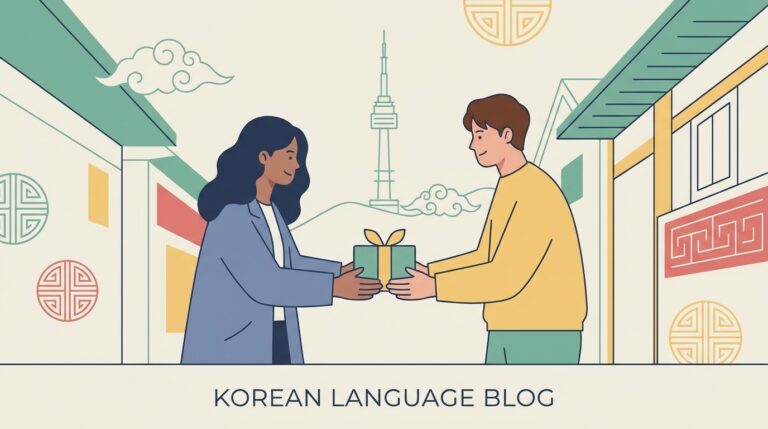
- K-Culture Moment: In business dramas, when a CEO extends a hand for a handshake, lower-ranked employees gently support their own right elbow with their left hand.
- Editor’s Insight: This phrase isn’t just physical; it metaphorically means offering help or seeking reconciliation.
- Situation Spectrum: Casual ✅ | Semi-formal ✅ | Formal ✅
- 🤔 Think About It: Does your native culture use two hands during physical greetings, or is one hand always standard?
3. 두 손으로 받다 (Du Soneuro Batda)
- Pronunciation: [Doo son-eu-ro bat-da] (Sounds like ‘do’ + ‘son-oo-ro’ + ‘baht-da’)
- Meaning: To receive with both hands.
- K-Culture Moment: When receiving a gift or a glass of water from an elder during a holiday gathering like Chuseok.
- Editor’s Insight: Receiving items with two hands signals that the item—and the person giving it—holds your full attention and respect.
- Situation Spectrum: Casual ⚠️ | Semi-formal ✅ | Formal ✅
- 🤔 Think About It: Why do you think physical contact with two hands communicates respect across East Asian cultures?
Phase 3: Textbook Korean vs. Real Korean
Situation 1: Calling someone over politely
- 📖 Textbook Korean: 저쪽으로 오십시오. (Jeojjogeuro osipsio. – Please move over there.)
- 🗣️ Real Korean: 이쪽으로 오세요~ (with palm facing down gesture) (Ijjogeuro oseyeo~ – Come this way~)
- 💡 Why is it different? The formal textbook phrase can sound like an airport announcement. In real life, combining a warm ‘이쪽으로 오세요’ with a palm-down fluttering motion feels welcoming and natural.
Situation 2: Polishing a business interaction
- 📖 Textbook Korean: 명함을 드리겠습니다. (Myeonghameul deurigessseumnida. – I will give you my business card.)
- 🗣️ Real Korean: 제 명함입니다. (handed over with both hands) (Je myeongham-imnida. – This is my business card.)
- 💡 Why is it different? Stating the action (‘giving’) is unnecessary. Native speakers let the respectful two-handed gesture do the talking while keeping the phrase concise.
Phase 4: K-Culture Deep Dive & Non-Verbal Etiquette
4-1. Nunchi (눈치) & Gestural Nuance
In Korea, Nunchi (the art of gauging social dynamics) extends directly to your hands:
1. The Beckoning Wave: Always keep your palm facing DOWN, gently flapping your fingers toward yourself. Never use palm-up finger curling.
2. The Two-Hand Rule: When giving or receiving money, credit cards, or drinks, use both hands. If one hand is busy, support your right wrist or forearm with your left hand.
3. Pointing: Avoid pointing directly at people with a single index finger. Instead, open your hand with the palm slightly up and indicate direction with your entire hand.
4-2. Cultural Code: The ‘Wrist Support’ in K-Dramas
Watch any corporate scene in a modern K-Drama. When a younger associate pours a drink for a senior director, you’ll notice their left hand resting gently near their right inner elbow or chest. This subtle gesture originated from ancient Hanbok traditions where long sleeves needed to be held back to keep them clean—and it evolved into an enduring symbol of deference.
Phase 5: Interactive Roleplay Scenario
Setting: A sleek tea house in Insadong. You are meeting Min-soo, a senior colleague, to discuss a joint project.
- Turn 1 (Min-soo): 안녕하세요! 오시는 길 힘들지 않으셨어요? (Hello! Was your trip here okay?)
- Turn 2 (You): 🎭 Smiling, lowering head slightly 네, 괜찮았습니다! 선배님도 잘 지내셨어요? (Yes, I was fine! How have you been, Sunbae-nim?)
- Turn 3 (Min-soo): 그럼요. 자, 여기 따뜻한 차 한 잔 마셔요. 🎭 Pours tea for you
- Turn 4 (You): 🎭 Holding your cup with both hands to receive the tea 감사합니다. 잘 마시겠습니다! (Thank you. I will enjoy it!)
- Turn 5 (Min-soo): 아, 그리고 지난번 요청하신 자료입니다. 🎭 Hands over a folder
- Turn 6 (You): 🎭 Reaching out both hands 정말 감사합니다, 잘 보겠습니다! (Thank you so much, I will read it carefully!)
- Turn 7 (Min-soo): 내일 미팅 때 다른 팀원들도 부를까요? (Should I call the other team members for tomorrow’s meeting?)
- Turn 8 (You): 네! 🎭 Gesture choice point below
🔀 Interactive Choice Point: How do you gesture to suggest calling the team members over?
* Option A: Raise your index finger and curl it towards yourself while saying ‘네, 불러주세요.’
* Option B: Wave your hand with palm facing up and say ‘네, 오라고 해주세요.’
* Option C: Extend your hand palm down, gently waving fingers inward while saying ‘네, 이쪽으로 오시라고 해주시면 좋겠습니다.’
Feedback:
* ❌ Option A (BAD): Curling an index finger is considered dismissive or overly demanding in Korea.
* ⚠️ Option B (RISK): Palm-up waving is meant for animals/pets; doing this in a professional context creates friction.
* ✅ Option C (BEST): Perfect! Palm down with polite phrasing demonstrates polished B2-level cultural fluency.
Phase 6: 10-Second Emotion Shadowing Drill
Practice reading these out loud, observing the rhythmic pauses (/) and emotional cues:
[😊 Welcoming & Gentle]
아, 안녕하세요! / 이쪽으로 / 오세요~
(A, an-nyeong-ha-se-yo! / I-jjog-eu-ro / o-se-yo~)-
[🙇 Respectful & Humble]
제가 / 두 손으로 / 받겠습니다! / 감사합니다.
(Je-ga / du son-eu-ro / bat-geess-seum-ni-da! / Gam-sa-ham-ni-da.) -
[🤝 Polite Professionalism]
여기 / 제 명함입니다. / 잘 부탁드립니다!
(Yeo-gi / je myeong-ham-im-ni-da. / Jal bu-tak-deu-rim-ni-da!)
Phase 7: K-Culture Mini Dictionary
- 손짓 (Sonjit) | Hand Gesture | Refers to manual non-verbal cues. Used often when discussing manners or non-verbal communication.
- 두 손 매너 (Du Son Maeneor) | Two-Hand Etiquette | The habit of using both hands when handing items to elders or colleagues.
- 목례 (Mokrye) | Nod Bow | A slight bow of the head used when greeting acquaintances while making hand gestures.
- 눈치 (Nunchi) | Social Tact | The ability to read non-verbal cues and body language instantly in social settings.
Phase 8: Survival Kit for Travelers
Top 3 Hand-Gesture Survival Phrases
- 저기요~ (Jeogiyo~) – Excuse me! (Raise one hand politely at shoulder level with flat palm facing forward to call restaurant staff).
- 두 손으로 드릴게요. (Du soneuro deurilgeyo.) – I’ll give it to you with both hands. (Polite phrase when making payments or handing cards).
- 괜찮습니다! (Gwaenchanhsumnida!) – It’s okay / No thank you. (Waving a flat hand gently back and forth in front of your chest).
Editor’s Travel Note: When traveling around Seoul, downloading navigation tools like the Naver Map App Download is essential. When asking locals for directions, remember to point toward your destination using an open hand rather than a single finger!
Phase 9: One Step Deeper
Korean hand gestures are not mere physical habits; they are physical expressions of Jondeat-mal (honorific culture). Just as spoken language adjusts level of respect based on hierarchy, body movements mirror that exact hierarchy. When you hold your arm with your left hand while passing a item, you are physically minimizing personal comfort to prioritize the recipient’s honor.
💬 Your Turn: Has a non-verbal gesture in Korea ever surprised you? Share your experience in the comments below!
Phase 10: FAQ & Common Mistakes
Q: Is it rude to shake hands with one hand in Korea?
A: Shaking hands with one hand isn’t strictly rude among peers, but with seniors or business partners, using your left hand to support your right forearm elevates your politeness significantly.
Q: How do I call a taxi using hand gestures?
A: Keep your arm low (chest level or lower) and extend your hand with palm facing DOWN, patting the air gently. Avoid waving palm-up high above your head.
Q: Can I use the ‘V’ sign in photos?
A: Yes! The ‘V’ sign (Peace sign) is universal and extremely common in casual Korean photos.
🚨 Common Mistakes TOP 3
- Mistake: Beckoning someone with palm facing up.
Correct Action: Flip your hand over so the palm faces down and gently wave fingers towards yourself. - Mistake: Handing over a credit card with one finger pinching it.
Correct Action: Hold the card with both hands or support your right wrist with your left hand. - Mistake: Pointing directly at an elder’s face/chest.
Correct Action: Direct your open palm gently toward the person.
Phase 11: Action Missions
- Bronze Mission: Practice the palm-down beckoning gesture 3 times in front of a mirror while saying ‘이쪽으로 오세요’.
- Silver Mission: Next time you buy something at a store, hand your credit card over using both hands!
- Gold Mission: Spot 3 non-verbal gestures in your favorite K-Drama scene and note down how the characters use their hands during greetings.
🎮 K-Culture Mission: Watch an episode of a Korean variety show and comment below every time a celebrity uses two hands to hand over an item!
Phase 12: Interactive Quiz Challenge
1. Situation Judgment
You are paying for coffee at a cafe in Gangnam. What is the most culturally polite way to hand your card to the clerk?
* A) Toss it lightly on the counter.
* B) Hold it with one hand while looking at your phone.
* C) Hand it over using both hands while offering a slight nod.
🔍 Click to view Answer & Explanation
Answer: C
Explanation: Handing items over with both hands accompanied by a slight nod (Mokrye) demonstrates excellent Korean social etiquette.
2. Fill-in-the-blank
When beckoning someone politely in Korean, your palm should face __________.
🔍 Click to view Answer & Explanation
Answer: DOWN (아래)
Explanation: Palm-down gestures show respect to humans, whereas palm-up beckoning is reserved for animals.
3. True / False
Statement: Pointing at someone with a single index finger is considered warm and friendly in formal Korean meetings.
🔍 Click to view Answer & Explanation
Answer: FALSE
Explanation: Pointing with one finger can feel aggressive. Using an open palm is the polite standard.







