

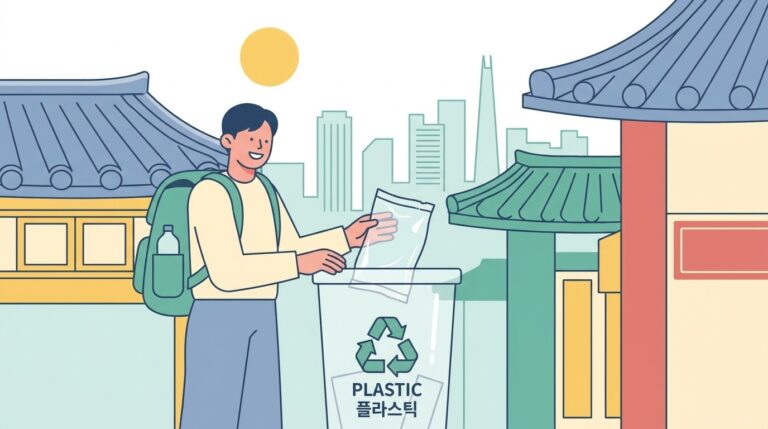
Phase 1: Empathy (Story-driven Opening)
안녕하세요! I’m your Daily Hangul editor and best friend in Korea! Have you ever stood in front of an apartment recycling station in Seoul, holding a crinkly plastic snack bag in one hand and a clear sauce pouch in the other, feeling completely frozen? You look left and see an elderly neighbor smoothly tossing plastic bags into a clear mesh container. You look right, and there are bins for paper, glass, and plastic bottles—but where on earth does this soft vinyl packaging go?
Recycling in Korea is world-class, but it can feel like a high-stakes puzzle when you first arrive. One of the biggest points of confusion for foreign residents and travelers is separating vinyl wrappers (비닐) from hard plastics. Did you know that dirty plastic wrappers can ruin an entire batch of recycling? Learning how to say and spot vinyl recycling phrases will save you from awkward neighbor glances and potential municipal fines. Based on feedback from hundreds of global learners living in Korea, mastering these simple A2-level phrases will turn you into a confident, neighborhood-savvy Korean resident in no time!
Phase 2: Core Expressions Deep Dive
1. 비닐은 따로 모아 주세요 (Binireun ttaro moa juseyo)
- Pronunciation: [Bi-nil-eun tta-ro mo-a ju-se-yo] (Sounds like: Bee-neel-eun tah-ro mo-ah joo-say-yo)
- Meaning: “Please collect vinyl wrappers separately.”
- K-Culture Moment: You will hear this phrase spoken by apartment security guards (아저씨) or neighbors when sorting trash on designated morning recycling days.
- Editor’s Insight: In Korean, the word ‘비닐’ (binil) originates from ‘vinyl’, but it refers broadly to almost all flexible plastic wraps, snack bags, and plastic carrier bags.
- Situation Spectrum: Casual ⚠️ / Semi-formal ✅ / Formal ✅
- 🤔 Think About It: Does your home country separate hard plastic bottles from soft plastic snack wrappers? How does separating soft film waste reflect Korea’s high-density urban living?
2. 깨끗이 씻어서 버려요 (Kkaekkeusi ssiseoseo beoryeoyo)
- Pronunciation: [Kkae-kkeut-i ssi-seo-seo beo-ryeo-yo] (Sounds like: Kkae-kkeut-ee she-seh-seh beo-ryeo-yo)
- Meaning: “Wash it clean and throw it away.”
- K-Culture Moment: A helpful roommate or neighbor reminding you that food residue on a ramyeon bag must be rinsed off before recycling.
- Editor’s Insight: Korean recycling guidelines require flexible plastics to be clean and dry. If red tteokbokki sauce won’t wash off, it goes to regular trash instead!
- Situation Spectrum: Casual ✅ / Semi-formal ✅ / Formal ⚠️
- 🤔 Think About It: Why does cleanliness matter so much in recycling? In Korean culture, taking care of community waste shows respect for the shared space.
3. 이 딱지 있어요? (I ttakji isseoyo?)
- Pronunciation: [I ttak-ji is-seo-yo?] (Sounds like: Ee ttak-jee ees-seh-yo?)
- Meaning: “Does it have this label/mark?”
- K-Culture Moment: Pointing to the small triangular recycling mark (재활용 마크) printed on the back of packaging to check if it’s recyclable vinyl.
- Editor’s Insight: While ‘표시’ (pyosi) is the formal word for mark, locals often casually call small printed signs or stickers ‘딱지’ (ttakji).
- Situation Spectrum: Casual ✅ / Semi-formal ✅ / Formal 🚫
- 🤔 Think About It: How easy is it to spot recycling symbols on products in your country compared to Korea’s standardized symbol system?
Phase 3: Textbook Korean vs. Real Korean
Situation 1: Asking where to place plastic wrappers
- 📖 Textbook Korean: 비닐류를 어디에 배출해야 합니까? (Binirryureul eodie baechulhaeya hamnikka?)
- 🗣️ Real Korean: 비닐은 어디에 버려요? (Binireun eodie beoryeoyo?)
- 💡 Why the difference? Textbook phrases use formal municipal vocabulary like ‘배출하다’ (to discharge/dispose), whereas real Koreans use the simple verb ‘버리다’ (to throw away) in everyday conversations.
Situation 2: Explaining that wrappers must be clean
- 📖 Textbook Korean: 이물질을 제거한 후 분리수거 하십시오. (Imuljireul jegeohan hu bunrisugeo hasipsio.)
- 🗣️ Real Korean: 깨끗이 씻어서 버려야 돼요. (Kkaekkeusi ssiseoseo beoryeoya dwaeyo.)
- 💡 Why the difference? Official instructional posters use Sino-Korean terms like ‘이물질’ (foreign substances), but everyday speakers use easy action verbs like ‘씻다’ (to wash).
Phase 4: K-Culture Deep Dive & Non-verbal Manners
4-1. Nunchi & Gestures
When recycling in Korea, Nunchi (눈치 – social awareness) is key! If you are unsure whether a wrapper is recyclable:
1. Tilt your head slightly and hold up the bag: Show the neighbor or building supervisor the item with both hands.
2. Look for the small symbol: Point at the back corner of the packet where the small square icon says ‘비닐류’ (Vinyl).
3. Flatten and fold: Always compress plastic bags and wrappers so they don’t blow away in the wind.
4-2. Cultural Code: The Instant Ramyeon Wrapper Rule
Korea consumes more instant ramyeon per capita than almost anywhere else! After cooking delicious Shin Ramyun, what do you do with the oily wrapper and seasoning sachets? If you rinse the outer bag with water to remove red soup splashes, it goes into the 비닐 (Vinyl) bin. However, if the sauce packet is permanently stained or dirty, it must go into the 종량제 봉투 (General Food/General Waste Bag). Keeping this distinction shows true mastery of Korean street etiquette!
Phase 5: Real-Life Roleplay Scenario
Setting: Recycling station outside a Seoul apartment building on a Tuesday morning.
NPC: Mr. Park (박 아저씨), the friendly apartment building supervisor wearing a high-vis vest.
- Turn 1 (Mr. Park): 안녕하세요! 분리수거 하러 오셨어요? (Hello! Came to do recycling?)
- Turn 2 (Learner): 🎭 Holding a bundle of snack bags 네, 안녕하세요! 비닐은 어디에 버려요? (Yes, hello! Where do I throw away vinyl?)
- Turn 3 (Mr. Park): 비닐은 저기 투명한 자루에 모아 주세요. (Please collect vinyl over there in that transparent mesh bag.)
- Turn 4 (Learner): 🎭 Checking a dirty wrapper 아, 여기요? 그런데 이 과자 봉지는 좀 더러워요. (Ah, here? But this snack bag is a bit dirty.)
- Turn 5 (Mr. Park): 더러운 건 물로 깨끗이 씻어서 버려요. 안 씻기면 일반 쓰레기예요. (Wash dirty ones clean with water before throwing. If it won’t wash off, it’s general trash.)
- Turn 6 (Learner): 🎭 Nodding cheerfully 아하! 씻어서 버려야 되는군요. 감사합니다! (Aha! It has to be washed and thrown away. Thank you!)
- Turn 7 (Mr. Park): 허허, 맞아요. 딱지 확인하고 버리면 쉬워요! (Haha, that’s right. Check the label and throw it away, then it’s easy!)
- Turn 8 (Learner): 🎭 Giving a small bow 네! 오늘도 좋은 하루 되세요! (Yes! Have a nice day today too!)
🔀 Interactive Choice Point
Mr. Park notices a food-stained sauce pouch in your hand. What do you say?
- Option A: “이것도 비닐에 그냥 버릴게요!” (I will just throw this in vinyl too!)
- Option B: “이건 더러우니까 일반 쓰레기봉투에 버릴게요.” (Since this is dirty, I’ll throw it in the general waste bag.)
- Option C: “비닐 안 버려요!” (I won’t throw away vinyl!)
Feedback:
* Option A (Risk): 🚫 Throwing dirty items in vinyl recycling ruins the batch! Mr. Park will stop you.
* Option B (Best): ✅ Perfect! You recognized that unwashable vinyl belongs in general waste.
* Option C (Bad): ⚠️ Irrelevant answer that breaks the flow of conversation.
Phase 6: 10-Second Emotion Shadowing Drill
Practice reading these out loud with appropriate pauses (/) and natural voice emotion:
[😊 Friendly & Polite]비닐은 / 어디에 / 버려요? (Bi-nil-eun / eo-di-e / beo-ryeo-yo?)[💡 Realization]아! / 깨끗이 / 씻어서 / 버려야 돼요! (A! / Kkae-kkeut-i / ssi-seo-seo / beo-ryeo-ya dwaeyo!)[❓ Curious]이 과자 봉지에도 / 재활용 마크가 / 있어요? (I gwa-ja bong-ji-e-do / jae-hwa-ryong ma-keu-ga / is-seo-yo?)
Phase 7: K-Culture Mini Dictionary
- 비닐 (Binil) | Plastic Film / Soft Packaging | Refers to flexible plastic wraps, food pouches, bubble wrap, and grocery bags.
- 분리수거 (Bunrisugeo) | Waste Sorting / Recycling | The system and act of sorting trash into designated categories in Korea.
- 종량제 봉투 (Jongryangje Bongtu) | Pay-per-trash Standard Bag | Official government-mandated trash bags purchased at convenience stores for non-recyclable waste.
- 재활용 마크 (Jaehwaryong Makeu) | Recycling Symbol | The printed logo indicating whether an item is paper, glass, plastic, or vinyl.
Phase 8: Traveler’s Survival Kit
Top 3 Survival Phrases
- 비닐봉지 필요 없어요. (Binilbongji piryo eopseoyo.) – “I don’t need a plastic bag.”
- 이거 재활용 돼요? (Igeo jaehwaryong dwaeyo?) – “Is this recyclable?”
- 일반 쓰레기 어디예요? (Ilban sseuregi eodiyeyo?) – “Where is the general waste?”
Editor’s Travel Note
When traveling in Korea, public trash cans are rare on street sidewalks! If you are carrying empty plastic packaging from street food, open the Naver Map app interactive guide to find nearby subway stations or convenience stores, which often have sorted recycling stations inside or near the entrance.
Phase 9: One Step Deeper (Reflection)
Korea’s strict waste sorting rules reflect a deeply ingrained community culture (우리 – Woori culture). Because cities like Seoul are densely populated, proper recycling directly impacts the cleanliness of shared residential spaces. When you take a few seconds to rinse a plastic packaging bag before throwing it away, you are showing care for the residential workers and community members who manage your building daily.
💬 Your Turn: How does recycling work in your home country? Have you ever felt confused by garbage rules while traveling abroad? Leave a comment below and share your experience!
Phase 10: FAQ & Common Mistakes
Q: Can I recycle clear plastic wrap used for food delivery?
A: Yes, but only if it is completely clean and dry! If it is stained with greasy food or sauce that cannot be washed off, dispose of it in the general waste bag (종량제 봉투).
Q: What about bubble wrap (뽁뽁이) from online shopping packages?
A: Bubble wrap is classified as vinyl (비닐류)! Pop the bubbles if possible, fold it neatly, and place it in the vinyl recycling bin.
Q: Is sticker tape on cardboard boxes considered vinyl?
A: Plastic tape must be peeled off from cardboard boxes before recycling! Tape goes into general waste, while the clean cardboard box goes into paper recycling.
🚨 Common Mistakes Board
- Mistake 1: Tossing dirty sauce pouches into the vinyl bin.
Correct Action: Wash with water first; if food stains remain, put it in general waste. - Mistake 2: Putting hard plastic toys into the soft vinyl bin.
Correct Action: Hard plastic belongs in the hard plastic (플라스틱) bin, not soft vinyl (비닐). - Mistake 3: Leaving paper receipts inside plastic wrappers.
Correct Action: Separate all paper items from plastic bags before sorting.
Phase 11: Action Mission
- 🥉 Bronze Mission: Look at 3 food packages in your kitchen today and locate the ‘비닐류’ recycling mark on the back.
- 🥈 Silver Mission: Practice saying “비닐은 따로 모아 주세요” 3 times out loud in front of a mirror with correct intonation.
- 🥇 Gold Mission: Successfully sort your soft plastic wrappers into a separate clear bag before taking out your trash this week!
🎮 K-Culture Mission: Next time you watch a Korean vlog or K-Drama scene set in an apartment complex, spot the outdoor recycling bins and identify the colorful vinyl recycling containers!
Phase 12: Interactive Quiz Challenge
Question 1 (Situation Judgment)
You just ate a cup of instant ramyeon. The outer plastic cover is clean, but the tiny soup packet inside is covered in thick oil that won’t wash off. Where should the tiny soup packet go?
🔍 Click to view the Answer & Explanation
Answer: It goes into the General Waste Bag (종량제 봉투)!
Explanation: Unwashable, dirty plastic pouches cannot be recycled into clean vinyl material. Throwing greasy items into vinyl recycling pollutes the whole recycling bin.
Question 2 (Fill in the Blank)
Complete the sentence: “비닐은 물로 ______ 씻어서 버려야 돼요.”
* A) 비싸게
* B) 깨끗이
* C) 크게
🔍 Click to view the Answer & Explanation
Answer: B) 깨끗이 (Kkaekkeusi – cleanly)
Explanation: “비닐은 물로 깨끗이 씻어서 버려야 돼요” means “Vinyl must be washed clean with water before throwing away.”
Question 3 (True or False Cultural Quiz)
True or False: All types of plastic, whether soft snack bags or hard water bottles, go into the exact same bin in Korea.
🔍 Click to view the Answer & Explanation
Answer: FALSE!
Explanation: Soft flexible wrappers go to 비닐 (Vinyl), while hard plastic bottles go to 플라스틱 (Plastic) or clear PET bins.







