

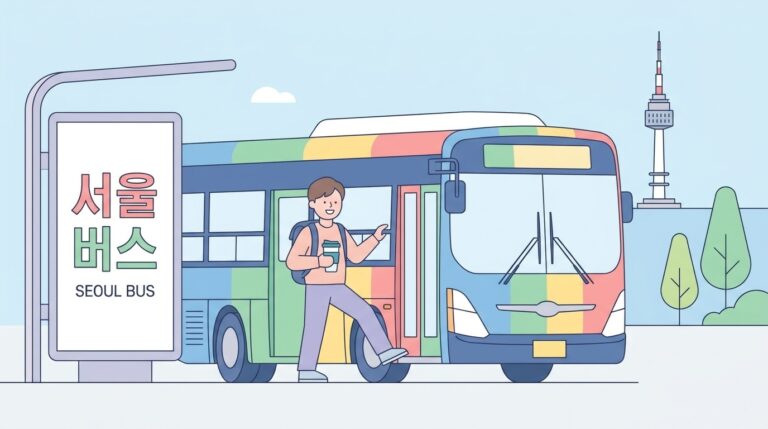
안녕하세요! 매일한글 에디터입니다. Have you ever stepped onto a bus in Seoul holding a delicious iced Americano, only for the driver to wave their hand sternly and say “No entry”? You are certainly not alone! Many visitors are surprised to learn about South Korea’s strict public transit rules regarding open food and beverages. In 2018, Seoul officially banned open containers of food and drinks on city buses to keep rides clean, comfortable, and safe for everyone. As your trusty 10-year local guide, I have seen many intermediate learners get flustered by this sudden interaction. Understanding these rules and mastering the right expressions won’t just save you from awkward moments—it will make you feel like a savvy local who truly respects Korean civic etiquette. Based on feedback from hundreds of our learners at Daily Hangul, we have compiled this ultimate practical guide. Let’s master Seoul bus etiquette together!
1. 음료 가지고 타시면 안 돼요 (Eumryo gajigo tasimyeon an dwaeyo)
- Pronunciation: [Eum-ryo ga-ji-go ta-si-myeon an dwae-yo] (Sounds like “Eum-ryo” with a soft ‘r’ + “gah-jee-go”)
- Meaning: Literal: You cannot board with a drink. / Nuance: Soft yet firm reminder that open beverages are prohibited on board.
- K-Culture Moment: In modern K-dramas, you often see characters rushing to catch a bus, only to be stopped right at the door when holding a cup of boba tea.
- Editor’s Insight: The driver uses the respectful honorific suffix ‘-시-‘ (-si-) to remain polite while firmly enforcing a mandatory safety rule.
- Situation Spectrum: Casual (🚫) / Semi-formal (✅) / Formal (✅)
- 🤔 Think About It: Why do you think Korean public transport prioritizes collective cleanliness over individual convenience during rush hours?
2. 마시고 타거나 버리고 타세요 (Masigo tageona beorigo taseyo)
- Pronunciation: [Ma-si-go ta-geo-na beori-go ta-se-yo] (Sounds like “Mah-see-go tah-geoh-nah”)
- Meaning: Literal: Drink it before boarding or throw it away before boarding. / Nuance: Practical choices offered by transit staff when you hold an open drink.
- K-Culture Moment: A helpful bystander at a busy Gangnam bus stop pointing out the recycling bin next to the shelter.
- Editor’s Insight: The grammatical connector ‘-거나’ (-geona) presents clear alternatives without sounding overly blunt.
- Situation Spectrum: Casual (✅) / Semi-formal (✅) / Formal (⚠️)
- 🤔 Think About It: How are direct public choices communicated in public etiquette rules in your home country?
3. 밀폐된 용기는 괜찮아요 (Milpyaedoen yong-gi-neun gwaenchana-yo)
- Pronunciation: [Mil-pyae-doen yong-gi-neun gwaen-cha-na-yo] (Sounds like “Meel-pyae-doen yong-gee-neun gwen-chah-nah-yo”)
- Meaning: Literal: Sealed containers are fine. / Nuance: Clarifying that unopened bottles, thermos tumblers, or securely packaged food are completely allowed.
- K-Culture Moment: A traveler showing a sealed stainless steel tumbler to a bus driver and receiving a friendly, welcoming nod.
- Editor’s Insight: ‘밀폐된’ (sealed) is the crucial adjective that distinguishes permitted drinks from forbidden open plastic cups!
- Situation Spectrum: Casual (✅) / Semi-formal (✅) / Formal (✅)
- 🤔 Think About It: How does knowing specific key vocabulary boost your confidence when exploring a foreign city?
📖 교과서 한국어: 음식물을 가지고 탑승하지 마십시오. (Eumsigmureul gajigo tapseunghaji masipsio.)
🗣️ 진짜 한국어: 버스에 음식 들고 타면 안 돼요. (Beoseue eumsik deulgo tamyeon an dwaeyo.)
💡 왜 다를까? Textbook Korean uses formal written notices found on poster boards, whereas native speakers rely on direct conversational forms with ‘-면 안 돼요’ in daily interactions.
📖 교과서 한국어: 테이크아웃 컵을 버려 주십시오. (Teikeua-ut keobeul beoryeo jusipsio.)
🗣️ 진짜 한국어: 이 커피 다 마시고 타야 돼요. (I keopi da masigo taya dwaeyo.)
💡 왜 다를까? Real-life spoken Korean focuses on immediate practical actions that need to be completed before stepping onto the bus.
4-1. 눈치 (Nunchi) & Non-Verbal Gestures:
When boarding a Seoul bus with a drink in hand, pay close attention to the driver’s eyes. If they make slight eye contact and raise an open palm or gently shake an index finger side-to-side, that is instant non-verbal ‘Nunchi’ telling you to step back. Keep your posture respectful, smile lightly, and point toward a bin or step back to finish your drink.
4-2. Culture Code Analysis:
In Korea’s dense urban environment, public transit moves millions of commuters daily. Cleanliness and preventing spills on sudden stops are considered essential social duties. This reflects the Korean social mindset of ‘더불어 사는 사회’ (a society where we live together harmoniously).
[Setting: A sunny afternoon at a bustling bus stop in Hongdae. Character: Driver Kim, a friendly bus driver.]
1. Driver Kim: “손님, 그 테이크아웃 커피는 들고 타시면 안 됩니다.” (Sonnim, geu teikeua-ut keopineun deulgo tasimyeon an doemnida.) 🎭 [Raising a hand gently to stop you]
2. Learner: “아, 정말요? 뚜껑이 닫혀 있는데요?” (A, jeongmarlyo? Ttukkeong-i dachyeo inneundeyo?) 🎭 [Looking confused and pointing to the cup lid]
3. Driver Kim: “플라스틱 컵은 일회용이라 쏟아질 수 있어서 안 돼요.” (Peurasteik keobeun ilhoeyong-ira ssodajil su isseoseo an dwaeyo.) 🎭 [Shaking head gently]
4. Learner: “아, 그렇군요! 그럼 다 마시고 다음 버스를 탈게요.” (A, geureokgunyo! Geureom da masigo da-eum beoseureul talgeyo.) 🎭 [Smiling apologetically and stepping back]
5. Driver Kim: “네, 죄송하지만 규칙이라서요. 다음 버스는 5분 뒤에 와요.” (Ne, joesonghajiman gyuchigiraseoyo. Da-eum beoseuneun obun dwie wa-yo.) 🎭 [Nodding warmly]
6. Learner: “네, 감사합니다! 쓰레기통은 어디에 있나요?” (Ne, gamsahamnida! Sseuregitong-eun eodie innayo?) 🎭 [Looking around the shelter]
7. Driver Kim: “정류장 바로 오른쪽에 분리수거함이 있어요.” (Jeongryujang baro oreunjjoge bunrisugeohami isseoyo.) 🎭 [Pointing to the side of the bus stop]
8. Learner: “알겠습니다. 좋은 하루 보내세요!” (Algetseumnida. Joeun haru bonaeseyo!) 🎭 [Bowing lightly with a polite smile]
🔀 Interactive Choice: What do you do when holding a takeout coffee at the bus door?
* Option A: Step back immediately, say “죄송합니다” (Sorry), finish your drink, and take the next bus.
* Option B: Hide the cup inside your coat and board quickly without saying a word.
* Option C: Argue that the lid is secure and demand to board.
Feedback:
* Option A [BEST]: Excellent Nunchi! You respected transit safety and showed great Korean manners.
* Option B [RISK]: Dangerous! If it spills during a sudden stop, it causes embarrassment and inconvenience.
* Option C [BAD]: Avoid this! Drivers must follow regulations strictly; arguing delays the bus schedule.
- [😊 Bright & Understanding] 아 / 그렇군요! / 다 마시고 / 탈게요. (A / geureokgunyo! / Da masigo / talgeyo.)
- [🥺 Apologetic & Respectful] 죄송합니다, / 음식을 / 들고 타면 / 안 되는지 / 몰랐어요. (Joesonghamnida, / eumsigeul / deulgo tamyeon / an doeneunji / mollasseoyo.)
- [❓ Curious & Polite] 혹시 / 텀블러는 / 가지고 타도 / 괜찮나요? (Hoksi / teombeulleoneun / gajigo tado / gwaenchan nayo?)
- 음료 반입 금지 (Eumryo ban-ip geumji) | No Drinks Allowed | Found on official warning stickers inside public buses and subways.
- 테이크아웃 컵 (Teikeua-ut keop) | Disposable Takeout Cup | Targeted under transit safety regulations due to spill risks.
- 텀블러 (Teombeulleo) | Reusable Tumbler/Thermos | Permitted on buses if securely sealed and leak-proof.
- 정류장 (Jeongryujang) | Bus Stop | The location where recycling bins are provided for beverage disposal.
Survival TOP 3:
1. 이거 가지고 타도 돼요? (Igeo gajigo tado dwaeyo?) – [Ei-geo gah-jee-go tah-do dwae-yo?] – Pro Tip: Ask while showing your container to the driver.
2. 다 마시고 탈게요. (Da masigo talgeyo.) – [Dah mah-see-go tahl-geh-yo.] – Pro Tip: Say this with a reassuring nod when stepping back.
3. 쓰레기통이 어디 있어요? (Sseuregitong-i eodi isseoyo?) – [Sseu-reh-gee-tong-ee uh-dee eet-seh-yo?] – Pro Tip: Useful when locating disposal bins at the shelter.
Editor’s Travel Note:
Before heading out in Seoul, make sure to read our detailed Naver Map App Download Guide to track real-time bus arrival minutes so you know exactly how long you have to finish your beverage!
In Korea, public transit is viewed as a shared communal sanctuary. Banning open beverages reflects a deep cultural priority placed on mutual respect and clean public spaces. By following these rules smoothly, you actively participate in making daily urban life pleasant for everyone.
💬 Your Turn: Have you ever encountered unexpected transit etiquette rules while traveling? Tell us your experience in the comments below!
Q: Are sealed bottled drinks allowed on Seoul buses?
A: Yes! Beverages in plastic bottles with securely screwed caps or sealed thermos tumblers are completely allowed.
Q: Can I eat small snacks like candy or gum on the subway?
A: Subways are less strict than buses regarding tiny non-messy snacks, but consuming smelly or messy food is strongly discouraged.
Q: What should I do if there is no trash bin at the bus stop?
A: You should carry your cup until you find a designated recycling bin near a convenience store or subway station.
🚨 Common Mistakes TOP 3:
1. Mistake: Believing a plastic lid on a disposable cup counts as “sealed”. Correct Action: Finish or dispose of plastic takeout cups before entering the bus.
2. Mistake: Hiding open beverages inside an open canvas bag. Correct Action: Place unsealed food items in a completely closed, leak-proof container.
3. Mistake: Leaving empty coffee cups on bus stop benches. Correct Action: Dispose of waste properly in designated recycling bins.
Action Mission 3 Steps:
* Bronze Level: Practice saying “다 마시고 탈게요” out loud 3 times.
* Silver Level: Take a picture of your reusable sealed tumbler and share it online!
* Gold Level: Board a Seoul bus smoothly showing your sealed tumbler to the driver with a warm greeting.
🎮 K-Culture Mission: Watch a scene from a modern K-drama at a bus stop and spot whether characters are carrying takeout coffee cups!
Q1. Which drink container IS allowed on a Seoul city bus?
A) Open plastic iced latte cup
B) Fully screwed water bottle
C) Open bubble tea with straw
Click to view Answer & Explanation
Correct Answer: B! Fully closed water bottles with screw caps are permitted because they will not spill if the bus stops suddenly.
Q2. Complete the sentence: “다 ______ 탈게요.” (I will drink it all and then board.)
A) 버리고 (beorigo)
B) 마시고 (masigo)
C) 사고 (sago)
Click to view Answer & Explanation
Correct Answer: B (마시고)! ‘마시고’ means ‘drink and…’.
Q3. True or False: You are allowed to eat fast food like french fries on Seoul buses as long as you are careful.
Click to view Answer & Explanation
Correct Answer: False! Unsealed hot food is strictly prohibited on buses to prevent odors and spills.







