

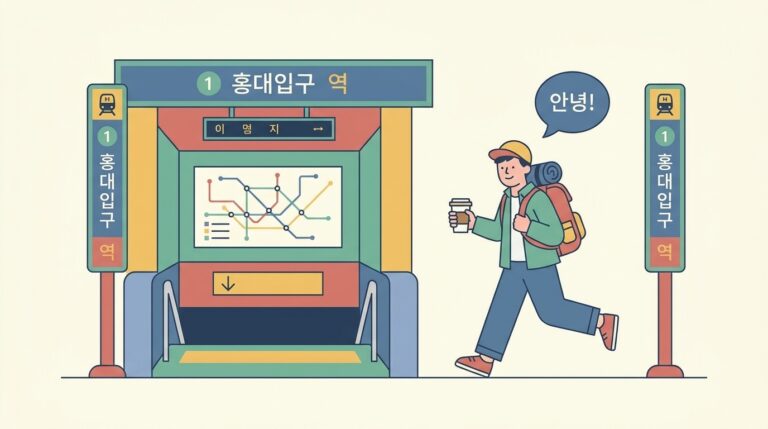
안녕하세요! 매일한글 에디터입니다. Have you ever been stuck in a crowded subway station in Hongdae or trapped in sudden Seoul traffic while your Korean friend is waiting for you at a cozy cafe? Your heart races, your palms sweat, and you reach for your phone thinking, ‘Oh no, how do I explain this in Korean without sounding rude?’ Running late happens to everyone, but in Korea—where punctuality and consideration for others’ time are deeply valued—knowing how to send a quick, polite text can completely save your day! Many beginner Korean learners freeze because textbook phrases feel too formal or robotic when you just need to text a quick update. Don’t worry, your trusty Korean best friend and Daily Hangul tutor is right here to rescue you. In this beginner-friendly guide based on real student feedback and everyday K-Drama scenarios, you’ll learn natural, cute, and polite ways to say ‘I think I’ll be late’ in Korean. By the end of this lesson, you’ll feel confident handling any late arrival like a true local!
Phase 2: Core Expressions Deep Dive
1. 조금 늦을 것 같아요 (Jo-geum neu-jeul geot ga-ta-yo)
- Pronunciation: [Jo-geum neu-jeul geot ga-ta-yo] (Sounds like: “Cho-geum nuh-jeul got gah-tah-yo”)
- Meaning: Literal: “It seems I will be a little late.” / Real Nuance: “I’m running a bit late, sorry!”
- K-Culture Moment: A K-Drama character texting their date while stuck in traffic inside a Seoul taxi.
- Editor’s Insight: Adding ‘것 같아요’ (it seems like) softens your statement, making it sound polite and humble rather than blunt.
- Situation Spectrum: Casual ⚠️ / Semi-formal ✅ / Formal ✅
- 🤔 Think About It: Why do Koreans soften direct statements using “it seems like”? How does your culture handle running late?
2. 먼저 먹고 있어요 (Meon-jeo meok-go i-sseo-yo)
- Pronunciation: [Meon-jeo meok-go i-sseo-yo] (Sounds like: “Muhn-juh meok-go ee-ssuh-yo”)
- Meaning: Literal: “Please be eating first.” / Real Nuance: “Go ahead and start eating without me!”
- K-Culture Moment: Texting your friends at a K-BBQ spot so they don’t starve waiting for you.
- Editor’s Insight: This shows extreme thoughtfulness (Bae-ryeo) in Korean culture—putting others’ hunger before your lateness.
- Situation Spectrum: Casual ✅ / Semi-formal ✅ / Formal ⚠️
- 🤔 Think About It: In your country, is it polite or impolite to eat before everyone arrives?
3. 천천히 오세요 (Cheon-cheon-hi o-se-yo)
- Pronunciation: [Cheon-cheon-hi o-se-yo] (Sounds like: “Chuhn-chuhn-hee oh-seh-yo”)
- Meaning: Literal: “Please come slowly.” / Real Nuance: “Take your time, no rush!”
- K-Culture Moment: Receiving a heartwarming message from a Korean friend when you apologize for being late.
- Editor’s Insight: The ultimate reassurance phrase! It tells the other person safety comes first, so don’t rush or stress.
- Situation Spectrum: Casual ⚠️ / Semi-formal ✅ / Formal ✅
- 🤔 Think About It: How does hearing “take your time” make you feel when you are stressing out?
Phase 3: Textbook Korean vs Real Korean
Situation 1: Apologizing for lateness
📖 교과서 한국어: 저는 늦을 것입니다. 죄송합니다. (Jeo-neun neu-jeul geos-im-ni-da. Joe-song-ham-ni-da.)
🗣️ 진짜 한국어: 미안해요! 조금 늦을 것 같아요. (Mi-an-hae-yo! Jo-geum neu-jeul geot ga-ta-yo.)
💡 왜 다를까?: Textbook Korean uses overly rigid future tense. Real Koreans use polite, soft expressions in daily chat.
Situation 2: Telling someone not to rush
📖 교과서 한국어: 서두르지 마십시오. (Seo-du-reu-ji ma-sip-si-o.)
🗣️ 진짜 한국어: 조심히, 천천히 오세요! (Jo-shim-hi, cheon-cheon-hi o-se-yo!)
💡 왜 다를까?: “서두르지 마십시오” sounds like an official safety warning sign at a subway construction site! “천천히 오세요” is warm, natural, and caring.
Phase 4: K-Culture Deep Dive & Non-verbal Manners
4-1. 눈치 (Nunchi) & Gestures
When you finally meet your friend after running late, body language matters! Lower your head slightly, place your right hand gently near your chest with an apologetic smile, and bow lightly while saying “정말 미안해요!” (Jeong-mal mi-an-hae-yo!). This non-verbal gesture shows sincerity and immediate respect.
4-2. Culture Code Analysis
Korea is famous for its fast-paced lifestyle (“Pali-pali” culture), but consideration (“Baeryeo”) is equally vital. Notifying someone the exact minute you realize you are late demonstrates high Nunchi (social awareness) and preserves trust in friendships.
Phase 5: Real Roleplay Scenario
Setting: Meeting your friend Minji at a trendy cafe in Seongsu-dong.
- Minji: 어디예요? 거의 다 왔어요? (Eodi-ye-yo? Geoeui da wa-sseo-yo?) [Where are you? Almost here?] 🎭 Looking at her watch nervously
- You: 민지 씨, 정말 미안해요! 조금 늦을 것 같아요. (Minji-ssi, jeong-mal mi-an-hae-yo! Jo-geum neu-jeul geot ga-ta-yo.) [Minji, I’m so sorry! I think I’ll be a little late.] 🎭 Texting hurriedly while on the subway
- Minji: 괜찮아요! 얼마나 걸려요? (Gwaen-chan-a-yo! Eol-ma-na geol-ryeo-yo?) [It’s okay! How long will it take?] 🎭 Smiling warmly
- You: 약 15분 정도 늦을 것 같아요. (Yak sip-o-bun jeong-do neu-jeul geot ga-ta-yo.) [I think I’ll be about 15 minutes late.] 🎭 Checking navigation screen
- Minji: 괜찮아요! 카페에 먼저 들어가 있을게요. (Gwaen-chan-a-yo! Ka-pe-e meon-jeo deu-reo-ga i-sseul-ge-yo.) [No problem! I’ll go inside the cafe first.] 🎭 Walking inside the cafe
- You: 네! 음료 먼저 주문해서 드세요. (Ne! Eum-ryo meon-jeo ju-mun-hae-seo deu-se-yo.) [Yes! Please order a drink for yourself first.] 🎭 Fast walking out of subway exit
- Minji: 네, 알겠어요! 조심히 오세요. (Ne, al-ges-seo-yo! Jo-shim-hi o-se-yo.) [Okay, got it! Come safely.] 🎭 Waving from window seat
- You: 금방 갈게요! 고마워요. (Geum-bang gal-ge-yo! Go-ma-wo-yo.) [I’ll be right there! Thank you.] 🎭 Running toward cafe with smile
🔀 Interactive Choice
What should you do when you are 10 minutes late?
* Option A: Send a quick text with “조금 늦을 것 같아요”. -> Best! Perfect etiquette and high social skills.
* Option B: Don’t text and run fast to surprise them. -> Bad! Makes your friend worry and wait in frustration.
* Option C: Send a cold text saying “늦어요”. -> Risk! Sounds abrupt and unpolite without an apology.
Phase 6: 10-Second Emotion Shadowing Drill
- [🥺 Apologetic & Soft] 미안해요! / 조금 늦을 것 같아요. (Mi-an-hae-yo! / Jo-geum neu-jeul geot ga-ta-yo.)
- [🥰 Warm & Caring] 괜찮아요! / 천천히 오세요. (Gwaen-chan-a-yo! / Cheon-cheon-hi o-se-yo.)
- [🏃♂️ Rushed & Honest] 차가 막혀서 / 10분 늦어요! (Cha-ga mak-hyeo-seo / sip-bun neu-jeo-yo!)
Phase 7: K-Culture Mini Dictionary
- 약속 (Yak-sok) | Promise / Appointment | Used for all social meetings and casual coffee plans.
- 지각 (Ji-gak) | Lateness | Commonly used for school, work, or formal meetings.
- 배려 (Bae-ryeo) | Consideration | The core Korean cultural mindset of being thoughtful towards others.
- 정체 (Jeong-che) | Traffic congestion | The ultimate excuse when caught in Seoul city traffic.
Phase 8: Traveler’s Survival Kit
Top 3 Survival Phrases
- 길을 잃었어요. (Gil-eul ir-eos-seo-yo.) – I am lost.
- 지하철을 놓쳤어요. (Ji-ha-cheol-eul no-chyeos-seo-yo.) – I missed the subway.
- 곧 도착해요. (Got do-chak-hae-yo.) – I will arrive soon.
Editor’s Travel Note
When navigating Seoul transit, download and check the Naver Map App Download to track real-time bus and subway arrivals so you can update your friends instantly!
Phase 9: One Step Deeper
In Korea, time is a shared social bridge. Being late isn’t viewed merely as a minor inconvenience, but as taking away someone else’s precious personal time. However, Koreans are remarkably forgiving if you communicate early and thoughtfully. Showing consideration (배려) turns an unexpected delay into a moment of deeper connection.
💬 Your Turn: Have you ever been late for a meeting with a friend in Korea? How did you text them? Share your story in the comments below!
Phase 10: FAQ & Common Mistakes
Q: What should I say if I’m late because I missed the subway?
A: You can say “지하철을 놓쳐서 조금 늦을 것 같아요” (I missed the subway so I think I’ll be a little late).
Q: Is it better to call or text when running late in Korea?
A: Sending a quick text via KakaoTalk is preferred so the waiting person can reply comfortably without loud phone ringing in public.
Q: What is the polite phrase to say when I finally arrive?
A: Say “기다리게 해서 죄송합니다!” (Sorry for making you wait!) with a gentle bow.
🚨 Common Mistakes
- Saying “늦어요” bluntly -> Correct Action: Always use “조금 늦을 것 같아요” to sound polite and soft.
- Not giving an estimated time -> Correct Action: Include time like “10분 정도” (about 10 minutes).
- Forgetting to thank them -> Correct Action: Always end with “기다려줘서 고마워요” (Thanks for waiting!).
Phase 11: Action Mission
- Bronze: Practice saying “조금 늦을 것 같아요” out loud 3 times today.
- Silver: Write a fake late-notice text message in Korean and share it on social media.
- Gold: Next time a friend tells you they’re running late, reply with “천천히 오세요!”.
- 🎮 K-Culture Mission: Watch your favorite K-drama and spot how characters text when meeting up!
Phase 12: Interactive Quiz Challenge
-
How do you softly say “I think I’ll be a little late” in Korean?
Click to reveal Answer & Explanation
Answer: 조금 늦을 것 같아요. (Adding 것 같아요 softens the sentence politely!)
-
True or False: Texting before you arrive late is highly appreciated in Korea.
Click to reveal Answer & Explanation
Answer: True! It shows consideration (배려) and high Nunchi.
-
Fill in the blank: “Take your time!” -> _____ 오세요.
Click to reveal Answer & Explanation
Answer: 천천히 (Cheon-cheon-hi means slowly or unhurriedly).







