

안녕하세요! 매일한글 에디터입니다.
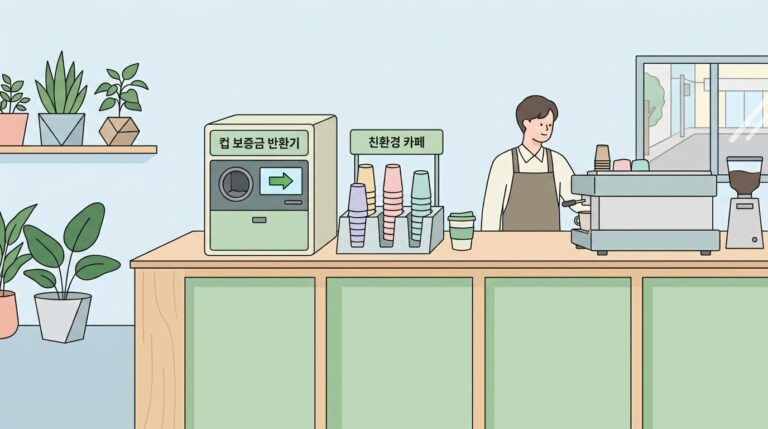
Imagine walking into a vibrant cafe in Jeju or Sejong, ordering your favorite iced Americano, and noticing an extra 300 KRW added to your bill. When you finish your drink, you see a sleek machine near the entrance with people scanning barcodes on their empty plastic cups. If you felt a momentary wave of confusion or hesitated because you didn’t know how to return your cup or ask about the deposit in Korean, you are definitely not alone! Many intermediate Korean learners master cafe orders like “아이돌 스타일 아메리카노 주세요” but stumble when facing real-world eco-policy interactions. This guide is crafted specifically from real learner feedback to give you absolute confidence when navigating Korea’s Plastic Cup Deposit System (플라스틱 컵 보증금 제도).
Phase 2: Core Expressions Deep Dive
1. 보증금 환불받을 수 있나요? (Bo-jeung-geum hwan-bul-bat-eul su in-na-yo?)
- Pronunciation: [Bo-jeung-geum hwan-bool-baht-eul soo een-nah-yo?] (Rhythm tip: Think of ‘Bo-jeung’ like the beat in ‘boat-zoom’)
- Meaning: Literal: “Can I receive a deposit refund?” / Nuance: “Is it possible to return this cup here to get my deposit back?”
- K-Culture Moment: You will hear this frequently at participating cafe counters when returning takeout cups in pilot regions like Jeju Island.
- Editor’s Insight: Note the noun 보증금 (deposit) and verb 환불받다 (to get a refund). At a B2 level, combining them naturally shows high linguistic fluidity.
- Situation Spectrum: Casual ⚠️ | Semi-formal ✅ | Formal ✅
- 🤔 Think About It: How does your home country incentivize recycling compared to Korea’s instant cash/app refund system?
2. 바코드 스캔해 주세요 (Ba-ko-deu seu-kyaen-hae ju-se-yo)
- Pronunciation: [Bah-koh-deu seu-can-hae joo-seh-yo] (Sounds like ‘Bar-code scan-hae ju-se-yo’)
- Meaning: Literal: “Please scan the barcode.” / Nuance: “Could you scan the eco-sticker barcode on my cup?”
- K-Culture Moment: Used when the automated kiosk machine is busy and you hand your cleaned cup directly to the barista.
- Editor’s Insight: Korean eco-cups feature a special serialized sticker. Without scanning it, the refund processing cannot complete.
- Situation Spectrum: Casual ⚠️ | Semi-formal ✅ | Formal ✅
- 🤔 Think About It: Notice how loan words like ‘barcode’ blend seamlessly into Korean grammar via ‘-해 주세요’.
3. 깨끗이 씻어서 반납해야 돼요 (Ggae-kkeut-i ssis-eo-seo ban-nap-hae-ya dwae-yo)
- Pronunciation: [Ggeh-ggeut-ee sshee-seh-seo bahn-nahp-hae-yah dwae-yo]
- Meaning: Literal: “You have to wash it clean and return it.” / Nuance: “Make sure to rinse out any leftover liquid before returning the cup.”
- K-Culture Moment: Baristas gently informing customers about cup return guidelines to ensure smooth recycling.
- Editor’s Insight: Expressing obligation with ‘-해야 돼요’ is essential at B2 level for explaining rules and social norms politely.
- Situation Spectrum: Casual ✅ | Semi-formal ✅ | Formal ✅
- 🤔 Think About It: Why is clean separation (분리배출) so strongly emphasized in Korean urban community life?
Phase 3: Textbook Korean vs. Real Korean
Situation 1: Asking if a cup can be returned
* 📖 Textbook Korean: 이 컵을 여기에 반납하는 것이 가능합니까?
* 🗣️ Real Korean: 이 컵 여기서 반납돼요?
* 💡 Why the difference? Native speakers shorten long passive structures into quick topic-oriented phrasing during busy café rush hours.
Situation 2: Asking where to throw away ice and liquid
* 📖 Textbook Korean: 잔여 음료수는 어디에 버려야 합니까?
* 🗣️ Real Korean: 남은 음료는 어디에 버려요?
* 💡 Why the difference? ‘남은 음료’ is much more natural and conversational than the formal ‘잔여 음료수’.
Phase 4: K-Culture Deep Dive & Non-Verbal Manners
4-1. Nunchi & Gestures
When returning a cup in Korea, proper 눈치 (Nunchi – social awareness) means preparing your cup beforehand. Remove the straw, pour out remaining ice into the designated liquid disposal sink (음료 버리는 곳), and present the sticker barcode facing the staff or kiosk scanner. Handing over a dirty cup with leftover boba or whipped cream is considered bad etiquette!
4-2. Culture Code: Zero-Waste K-Travel
Eco-conscious travel is trending heavily among young Koreans. From K-Pop idols wearing upcycled stage outfits to eco-friendly café hopping along the Jeju coastal road, participating in the cup deposit system makes you feel less like a tourist and more like a responsible local resident.
Phase 5: Real-Life Roleplay Scenario
Setting: A cozy cafe in Jeju City. NPC Barista: Min-soo (helpful, fast-paced).
- Min-soo: 주문하신 아이스 아메리카노 나왔습니다! (Your iced Americano is ready!)
- Learner (You): 🎭 Taking the cup with two hands 아, 감사합니다. 저 혹시 컵 보증금 포함된 건가요? (Ah, thank you. By any chance, is the cup deposit included?)
- Min-soo: 네, 300원 포함되어 있어요. 다 드시고 반납하시면 돌려드려요. (Yes, 300 won is included. If you finish and return it, we return it to you.)
- Learner (You): 🎭 Pointing to the machine near the door 아하! 저기 있는 기계에서 반납하면 돼요? (Aha! Can I return it at that machine over there?)
- Min-soo: 네, 라벨 바코드 스캔하시고 컵 넣으시면 돼요. (Yes, scan the label barcode and put the cup in.)
- Learner (You): 🎭 Looking at the cup 음료가 조금 남았는데 그냥 넣어도 되나요? (There is a little drink left, can I just put it in?)
- Min-soo: 아, 남은 음료는 옆에 퇴수구에 버려주세요! (Ah, please pour leftover drinks in the liquid sink next to it!)
- Learner (You): 🎭 Nodding gratefully 아, 알겠습니다. 깨끗이 씻어서 반납할게요! (Ah, I understand. I will wash it clean and return it!)
🔀 Interactive Choice Point
What will you say when you hand the cup back if the auto-kiosk is offline?
- Option A: 컵 환불해주세요. (Refund the cup.)
- Option B: 기계가 안 되는데, 여기서 컵 보증금 환불받을 수 있나요? (The machine isn’t working, can I get my cup deposit refunded here?)
- Option C: 이 컵 버려주세요. (Throw this cup away.)
Feedback:
* Best (Option B): Excellent B2 complexity! Polite, accurate context explanation, and clear expression.
* Risk (Option A): grammatically okay, but can sound overly blunt without softer sentence endings.
* Bad (Option C): You miss out on your 300 won refund and ask staff to waste a recyclable deposit cup!
Phase 6: 10-Second Emotion Shadowing Drill
[😊 Friendly & Curious]저기요, / 이 컵 / 여기서 반납돼요? (Jeo-gi-yo, / i cup / yeo-gi-seo ban-nap-dwae-yo?)[🥺 Polite request]남은 음료는 / 어디에 버리면 될까요? (Nam-eun eum-ryo-neun / eo-di-e beo-ri-myeon doel-kka-yo?)[💡 Confident understanding]아, / 바코드를 스캔하면 / 보증금이 들어오는군요! (A, / ba-ko-deu-reul seu-kyaen-ha-myeon / bo-jeung-geum-i deu-reo-o-neun-gun-yo!)
Phase 7: K-Culture Mini Dictionary
- 보증금 (Bo-jeung-geum) | Deposit | Money paid upfront returned upon returning an item (cups, apartments, rental bikes).
- 자원순환 (Ja-won-sun-hwan) | Resource Circulation | Key public policy term seen on public recycling kiosks and eco campaigns.
- 퇴수구 (Toe-su-gu) | Liquid Disposal Sink | Special sink at Korean cafes specifically for leftover liquid and ice.
- 분리배출 (Bun-ri-bae-chul) | Sorting Waste | The practice of separating recyclables by material type (plastic, paper, vinyl).
Phase 8: Traveler’s Survival Kit
Survival Top 3
- 영수증 주세용! (Receipt please!): Essential if your refund goes to a barcode on paper.
- 보증금 앱으로 받을게요. (I’ll receive deposit via app.): Used when scanning mobile apps like COSMO.
- 빨대는 어디에 버려요? (Where do I throw away the straw?): Straws go to general waste (일반쓰레기).
Editor’s Travel Note
Before traveling to pilot regions like Jeju, make sure to read the 자원순환보증금 앱 모바일 가이드 to link your Korean bank account or mobile wallet for instant automated 300 won refunds straight to your phone!
Phase 9: One Step Deeper
Korea’s rapid adoption of technology in public eco-policies reflects its strong civic responsibility and high digital integration. The cup deposit system isn’t just about 300 won; it represents community trust and shared effort toward sustainability. Participating in this system gives you a genuine glimpse into modern Korean citizenship.
💬 Your Turn: Has your town implemented plastic cup deposit schemes? How would you explain your local recycling habits in Korean? Share below!
Phase 10: FAQ & Common Mistakes
Q: Can I return a cup bought at Cafe A to Cafe B?
A: Yes! As long as both cafes participate in the national Disposable Cup Deposit System, cross-brand returns are fully supported.
Q: What if I lost the barcode sticker on the cup?
A: Unfortunately, the barcode sticker is required to verify the 300 won deposit payment. Handle your cup carefully so it doesn’t peel off!
Q: Do I get cash or app points back?
A: Both options are available. You can receive cash directly from staff or automatic digital transfers via the official app.
🚨 Common Mistakes
- Mistake: Throwing the whole cup with ice into plastic bins.
- Correct Action: Separate liquid into the 퇴수구, straw into 일반쓰레기, and clean cup into the return machine.
- Mistake: Saying “컵 버려주세요” expecting a refund.
- Correct Action: Say “보증금 환불해 주세요” specifically.
- Mistake: Attempting to return dirty cups with leftover cream.
- Correct Action: Lightly rinse or wipe the inside before returning.
Phase 11: Action Mission
- 🥉 Bronze: Say “보증금 환불받을 수 있나요?” out loud 3 times using emotional shadowing.
- 🥈 Silver: Snap a picture of a Korean cafe return kiosk and label the word 퇴수구 on your Instagram story.
- 🥇 Gold: Successfully return a plastic cup at a Korean cafe and receive your 300 KRW refund independently!
🎮 K-Culture Mission: Watch a recent Korean vlog set in Jeju and spot how vloggers handle their takeout cups at eco-friendly cafes!
Phase 12: Interactive Quiz Challenge
-
Situation Quiz: What should you do before scanning your cup at the return kiosk?
Click to view answer
Empty all liquid and ice into the designated disposal sink (퇴수구) and make sure the barcode sticker is intact!
-
Fill in the blank: 남은 음료는 어디에 ( _____ ) 돼요?
Click to view answer
버리면 (Grammar point: -으면 돼요 – ‘It is fine if you throw away…’)
-
True or False: The 300 won deposit is an optional tip for baristas.
Click to view answer
False! It is a mandatory recyclable cup deposit that is 100% refunded when you return the clean cup.







