

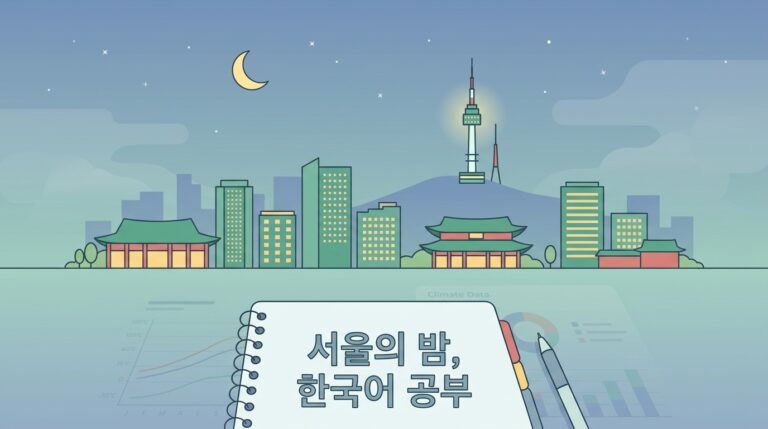
Phase 1: Empathy – When Seoul Nights Don’t Cool Down
안녕하세요! Welcome back to Daily Hangul! As your senior editor and cultural navigator, I want to take you to a muggy midnight in Seoul during mid-August. Imagine sitting outside a 24-hour convenience store in Hongdae. The clock strikes 1:00 AM, yet the ambient temperature hovers relentlessly at 27°C (80.6°F) with high humidity. You hold an ice cup filled with pouch coffee, listening to the hum of outdoor air conditioning units blasting throughout the metropolis. On the news ticker above the street, headline banners flash with terrifying metrics: “열대야 연속 20일째” (20th consecutive tropical night) and “기후 적응 대책 긴급 점검” (Emergency review of climate adaptation measures).
At the C2 level, your goal in Korean is no longer just ordering cold noodles or remarking that it is simply “hot.” You are stepping into high-level sociopolitical discourse, environmental policy analysis, and nuanced urban commentary. When discussing heatwaves and climate resilience with native Korean colleagues, researchers, or neighbors, expressing sophisticated concern requires precision, contextual empathy, and native rhetorical elegance. Mastering these advanced terms will elevate you from a fluent speaker to a compelling voice in contemporary Korean societal debates.
Phase 2: Deep Dive into 3 Core Advanced Expressions
1. 열대야 현상이 심화되다 (Yeoldaeya hyeonsang-i simhwadoeda)
- Pronunciation: [Yeol-dae-ya hyeon-sang-i sim-hwa-doe-da] (Sounds like “Yol-dae-yah hyun-sang-ee sim-hwa-doe-da”)
- Meaning: Literally “Tropical night phenomenon deepens/intensifies.” Nuanced meaning: The worsening trend of nocturnal heatwaves where overnight temperatures fail to drop below 25°C.
- K-Culture Moment: Commonly heard on news broadcasts like KBS News 9 or featured in documentary specials investigating urban heat island effects in Seoul.
- Editor’s Insight: 심화되다 (to intensify) is a quintessential C2 academic verb. Rather than using simple verbs like 심해지다, using 심화되다 conveys structural and progressive environmental severity.
- Situation Spectrum: Casual 🚫 | Semi-formal ⚠️ | Formal ✅
- 🤔 Think About It: How does your native language distinguish between simple nighttime heat and a systemic socio-environmental phenomenon like 열대야?
2. 기후 적응 인프라를 구축하다 (Gihu jeok-eung inpeura-reul guchukhada)
- Pronunciation: [Gi-hu jeog-eung in-peu-ra-reul gu-chug-ha-da] (Sounds like “Kee-hoo jug-eung in-fra-rul goo-chook-ha-da”)
- Meaning: Literally “To construct climate adaptation infrastructure.” Nuanced meaning: Proactively building urban systems (like cooling centers, permeable pavement, and green roofs) to survive climate change.
- K-Culture Moment: Used in Seoul City Hall policy briefings, urban planning debates on TV program Sisa Journal, and ESG corporate policy reports.
- Editor’s Insight: 구축하다 implies systematic, large-scale structural establishment. It moves the conversation from individual endurance to state-level administrative responsibility.
- Situation Spectrum: Casual 🚫 | Semi-formal ⚠️ | Formal ✅
- 🤔 Think About It: In Korean culture, collective responsibility (공공성) often frames government initiative as an ethical duty. How does this shape environmental terminology?
3. 온열 질환 취약 계층을 보호하다 (Onyeol jil-hwan chwi-yak gye-chyeong-eul bohohada)
- Pronunciation: [On-yeol jil-hwan chwi-yag gye-chyeong-eul bo-ho-ha-da] (Sounds like “On-yol jeel-hwan chwee-yahk gyeh-chung-ul bo-ho-ha-da”)
- Meaning: Literally “To protect heat-related illness vulnerable populations.” Nuanced meaning: Safeguarding elderly or low-income residents disproportionately affected by heatwaves.
- K-Culture Moment: Frequently highlighted in welfare-focused Korean dramas or civic news segments focusing on jjokbang-chon (tiny room housing units) during extreme summers.
- Editor’s Insight: 취약 계층 (vulnerable social strata) is a key policy term. Combining it with 온열 질환 (heat-induced illnesses) demonstrates high-level socio-humanistic empathy in professional discussions.
- Situation Spectrum: Casual 🚫 | Semi-formal ⚠️ | Formal ✅
- 🤔 Think About It: How does modern Korean welfare rhetoric balance technological climate adaptation with human safety nets?
Phase 3: Textbook Korean vs Real Native C2 Korean
Situation 1: Expressing concern over worsening nocturnal heatwaves
- 📖 Textbook Korean: 날씨가 밤에도 너무 뜨거워서 잠을 잘 수 없어요. (The weather is too hot even at night, so I cannot sleep.)
- 🗣️ Real Native C2 Korean: 연일 계속되는 열대야로 인해 밤잠을 설치는 날이 부쩍 늘었네요. (With the relentless stretch of tropical nights, sleepless nights have increased noticeably.)
- 💡 Why the Difference? While the textbook version states a personal physical issue, C2 natives frame it using noun-modifying clauses (연일 계속되는) and evocative vocabulary (밤잠을 설치다 – to toss and turn all night).
Situation 2: Discussing urban environmental solutions in a meeting
- 📖 Textbook Korean: 정부가 여름을 위해 더 좋은 대책을 만들어야 합니다. (The government must make better measures for summer.)
- 🗣️ Real Native C2 Korean: 지자체 차원에서 기후 적응 대책을 선제적으로 강구할 필요가 있습니다. (Municipal authorities need to preemptively devise climate adaptation strategies.)
- 💡 Why the Difference? C2 native policy discourse favors precise Sino-Korean vocabulary (선제적 – preemptive, 강구하다 – to devise/seek solution) over basic native verbs.
Phase 4: K-Culture Deep Dive & Non-verbal Manners
4-1. Nunchi & Gestures: Environmental Empathy
When discussing public vulnerability during extreme weather in Korea, facial expressions must reflect serious 공감 (empathy). Nod slowly while listening to policy proposals. Avoid casual dismissive gestures like waving your hand dismissively (손사래). When mentioning vulnerable demographics (취약 계층), maintain steady eye contact and lower your voice pitch slightly to convey respect and civic solemnity.
4-2. Cultural Code: The Evolution of Pungnyeon to Gihu Wigi
Traditionally, Korean agricultural heritage viewed summer heat through seasonal health customs such as Samgyeotang consumption during Sambok (the three hottest dog days). However, modern Korean media and public sentiment have shifted from viewing summer as a temporary seasonal hardship to framing it as 기후 위기 (climate crisis). In urban centers like Seoul, public cooling centers (무더위 쉼터) inside community service centers (동주민센터) reflect how public policy adapts traditional communal welfare into emergency climate resilience systems.
Phase 5: Interactive Roleplay Scenario
Setting: A policy panel discussion at a Seoul Urban Sustainability Forum.
Characters:
* Min-woo (민우): Urban Planning Director at Seoul Metropolitan Government.
* You (학습자): Visiting Senior Climate Policy Analyst.
Dialogue Script
- Min-woo: “이번 여름은 예년과 달리 열대야 일수가 경신되어 시민들의 불편이 극에 달하고 있습니다.” (🎭 Expression serious, adjusting his glasses)
(This summer, unlike previous years, the record for tropical night days has been broken, reaching extreme discomfort for citizens.) - You: “맞습니다. 단순한 계절적 현상을 넘어 기후 변화의 직격탄을 맞고 있는 것으로 보입니다.” (🎭 Nodding gravely with hands folded)
(Indeed. Beyond a simple seasonal phenomenon, it appears we are hit directly by climate change.) - You: “특히 도심 열섬 현상과 맞물려 열대야 현상이 심화되는 점이 우려스럽습니다.” (🎭 Gesturing toward the slide presentation)
(I am particularly concerned that the tropical night phenomenon is intensifying in tandem with the urban heat island effect.) - Min-woo: “동감합니다. 이에 따라 서울시도 맞춤형 기후 적응 대책을 수립하고 있습니다.” (🎭 Looking intently at you with approval)
(I agree. Consequently, Seoul City is establishing tailored climate adaptation measures.) - You: “바람길 숲 조성이나 친환경 보도블록 확충 같은 인프라 구축이 시급해 보입니다.” (🎭 Speaking in a calm, confident tone)
(Constructing infrastructure like wind-path forests and eco-friendly permeable paving seems urgent.) - Min-woo: “지적해주신 대로, 예산 편성을 통해 선제적 대응 체계를 마련하고자 합니다.” (🎭 Writing notes on his document)
(As you pointed out, we aim to establish a preemptive response system through budget allocation.) - You: “무엇보다 온열 질환 취약 계층을 위한 실효성 있는 지원책이 병행되어야 할 것입니다.” (🎭 Maintaining steady, compassionate eye contact)
(Above all, effective support measures for populations vulnerable to heat illness must be implemented concurrently.) - Min-woo: “깊이 있는 제언에 감사드립니다. 정책 실행 과정에 적극 반영하겠습니다.” (🎭 Offering a respectful bow)
(Thank you for your profound insight. We will actively reflect it in our policy execution.)
Interactive Branching Decision Point
How do you follow up on Min-woo’s final remark?
- Choice A: “네, 수고하세요.” (Casual exit)
- Choice B: “지속 가능한 도시 환경 조성을 위해 지속적으로 협력할 수 있기를 기대합니다.” (Formal strategic partnership request)
- Choice C: “에어컨이나 더 틀어주면 좋겠네요.” (Overly casual humor about air conditioning)
Feedback:
* Best Choice (Choice B): Perfect! It maintains formal C2 professional etiquette and reinforces strategic, diplomatic collaboration.
* Bad Choice (Choice A): Too blunt and dismissive for a formal policy forum.
* Risk Choice (Choice C): Undermines the gravity of the environmental discussion and lacks professional polish.
Phase 6: 10-Second Emotion Shadowing Drill
Practice these high-level sentences with authentic pitch dynamics and emotional inflection.
[🧐 Serious & Analytical]
연일 계속되는 열대야는 / 단순한 불편을 넘어 / 국가적 기후 위기의 방증입니다.
(Yeon-il gyesok-doe-neun yeoldaeya-neun / dansun-han bulpyeon-eul neom-eo / gukgajeok gihu wigi-ui bangjeung-imnida.)-
[🏛️ Formal & Authoritative]
기후 적응 인프라 구축은 / 더 이상 미룰 수 없는 / 시대적 과제입니다.
(Gihu jeok-eung inpeura guchuk-eun / deo isang mirul su eomneun / sidaejeok gwaje-imnida.) -
[🥺 Empathetic & Compassionate]
온열 질환 취약 계층을 위한 / 복지 안전망을 / 한층 강화해야 합니다.
(Onyeol jil-hwan chwi-yak gye-chyeong-eul wi-han / bokji anjeonmang-eul / hancheong ganghwahaeya hamnida.)
Phase 7: K-Culture Mini Dictionary
- 열섬 현상 (Yeolseom Hyeonsang) | Urban Heat Island Effect | The phenomenon where urban concrete structures retain heat, preventing nighttime cooling.
- 폭염 특보 (Pogyeom Teokbo) | Heatwave Warning/Advisory | Official meteorological alerts issued when heat index values reach dangerous levels for consecutive days.
- 무더위 쉼터 (Mudeowi Swimteo) | Beat-the-Heat Shelter | Designated air-conditioned public spaces (libraries, community centers) open to all citizens.
- 기후 위기 대응 (Gihu Wigi Dae-eung) | Climate Crisis Response | Administrative and civic actions aimed at mitigating and adapting to systemic climate change.
Phase 8: Traveler Survival Kit
Survival Expressions TOP 3
- 무더위 쉼터가 어디에 있나요? (Mudeowi swimteo-ga eodie innayo?)
Pro Tip: Use this during hot summer urban walks if you need an air-conditioned public safe haven. - 폭염 경보가 발령되었나요? (Pogyeom gyeongbo-ga balryeong-doe-eonna-yo?)
Pro Tip: Useful when asking hotel staff or tour guides about safety advisories during extreme heat. - 온열 질환 예방 수칙을 확인하세요. (Onyeol jil-hwan yebang suchik-eul hwag-inhaseyo.)
Pro Tip: Read safety posters in subway stations to stay updated on hydrations and heat warnings.
Editor’s Travel Note
When traveling in Korea during extreme heat events, check real-time meteorological advisories via the official KMA Weather Information Portal or monitor civic emergency notifications via safety apps. Stay hydrated and locate emergency cooling zones near major subway hubs.
Phase 9: A Step Deeper – Humanities & Society Essay
In modern Korea, the rise in tropical nights (열대야) is no longer viewed merely as summer discomfort; it has become a litmus test for social solidarity and urban governance. The term 기후 적응 (climate adaptation) highlights a cultural shift from individual stoicism to structural civic care. Korean society increasingly demands that environmental safety be treated as a fundamental human right, protecting every citizen regardless of socioeconomic standing.
💬 Your Turn: How does your home country handle extreme summer heat in urban planning? Share your thoughts in Korean in the comments below!
Phase 10: FAQ & Common Mistakes
Q: What is the difference between 열대야 and 폭염?
A: 폭염 refers to daytime heatwaves characterized by extremely high maximum temperatures, whereas 열대야 specifically refers to nighttime heat where temperatures remain at or above 25°C overnight.
Q: Is 기후 적응 the same as 기후 변화 완화?
A: No. 기후 변화 완화 (climate mitigation) focuses on reducing greenhouse gas emissions, while 기후 적응 (climate adaptation) focuses on adjusting urban infrastructure and public health systems to survive inevitable climate impacts.
Q: Can I use 심화되다 for positive situations?
A: No. 심화되다 (to intensify/worsen) is exclusively used for negative, problematic, or complex phenomena such as crisis, conflict, or environmental damage.
🚨 Common Mistakes TOP 3
- Using casual adjectives in formal policy context: Saying “날씨가 너무 나빠요” instead of “기후 위기가 심화되고 있습니다.” Correct Action: Replace simple physical descriptions with socio-systemic terminology.
- Confusing 적응 (Adaptation) with 적응하다 in formal noun compounds: Saying 기후 적응하는 대책 instead of the standard official phrase 기후 적응 대책.
- Mishandling honorifics in corporate/policy settings: Omitting official passive/formal ending verbs like 강구하다 or 구축되다 during presentation summaries.
Phase 11: Action Mission & Engagement
- Bronze Level: Read Phase 6 shadowing sentences aloud three times using correct emotional inflection.
- Silver Level: Write a 2-sentence commentary on Korean heatwaves using the phrase 열대야 현상 and post it on your social media.
- Gold Level: Engage in a formal discussion with a native speaker or language tutor about climate adaptation policies in Seoul using 기후 적응 인프라.
🎮 K-Culture Mission: Watch a recent news report on Korean broadcast networks (KBS, YTN, SBS) regarding summer weather and count how many times 열대야 and 취약 계층 are mentioned!
Phase 12: Interactive Quiz Challenge
Question 1: Fill in the blank
지자체는 폭염에 대비해 온열 질환 ________ 계층을 위한 긴급 지원책을 마련했습니다.
(A) 취약 (B) 강력 (C) 신속
Click to reveal Answer & Explanation
Correct Answer: (A) 취약
Explanation: 취약 계층 (vulnerable social groups) is the correct socio-policy compound term.
Question 2: True or False
열대야 refers to daytime heatwaves above 35°C.
Click to reveal Answer & Explanation
Correct Answer: False
Explanation: 열대야 specifically refers to overnight heat (tropical nights) where temperatures stay above 25°C.






