

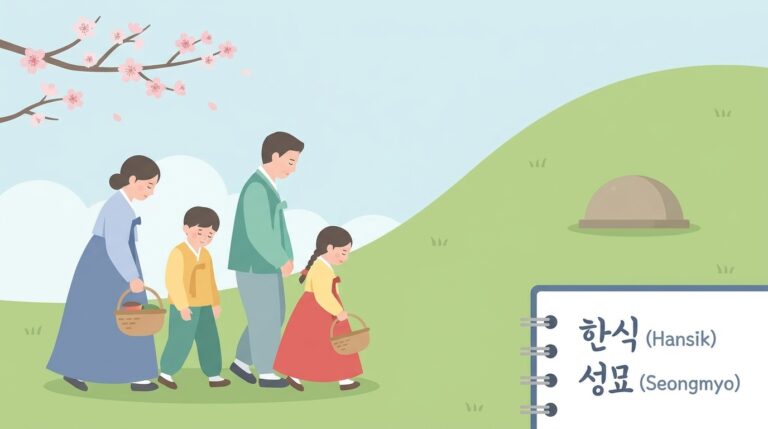
Navigating Hansik and Seongmyo Like a Native: The Nuances of Korean Ancestral Rites and Cold Food Day
Phase 1: Empathy (Storytelling Opening)
안녕하세요! 매일한글 에디터입니다.
Picture yourself walking up a sun-dappled pine forest hill in early April. You are accompanying your Korean partner’s family on Hansik (한식), one of Korea’s traditional seasonal holidays. You see them carrying wooden baskets filled with seasonal dishes, fruit, and rice wine to visit their ancestral graves (Seongmyo, 성묘). While you know basic politeness, the intricate social etiquette, high-register honorifics, and cultural reverence leave you wondering how to participate smoothly without causing awkwardness.
Many advanced Korean learners hit a wall when transitioning from everyday conversational speech to socio-cultural contexts like seasonal rites (Sesi Pungsok, 세시 풍속). Knowing how to offer condolences or participate in ancestral grave care requires an understanding of nuanced vocabulary and honorific structures that generic textbooks rarely cover.
In this C1-level guide, built upon real feedback from advanced learners and native cultural expertise, you will master the specialized vocabulary, non-verbal manners, and high-level expressions needed to navigate Hansik and Seongmyo traditions with confidence and elegance.
Phase 2: Deep Dive into 3 Core Expressions
1. 조상님께 차례를 지내다
- Pronunciation: [Jo-sang-nim-kke cha-rye-reul ji-nae-da] (Think: “Jo-sang-neem-kkeh cha-ryeh-reul jee-nae-dah”)
- Meaning: Direct translation: “To perform a ritual service for ancestors.” Actual nuance: To honor forebears through a structured seasonal rite (Charye), expressing familial gratitude and historical continuity.
- K-Culture Moment: In family drama series, you often see multi-generational families gathering at an ancestral home or gravesite on Hansik or Chuseok, arranging ritual offerings according to historical protocols.
- Editor’s Insight: Notice the honorific particle -께 (-kke) instead of -에게 (-ege), alongside the respectful title 조상님 (ancestors). Utilizing these markers demonstrates sophisticated C1 mastery of social hierarchy and veneration.
- Situation Spectrum:
- Casual: 🚫
- Semi-formal: ⚠️
- Formal: ✅
- 🤔 Think About It: How does honoring past generations in your culture compare to the structured protocol of Korean Charye?
2. 성묘를 가다 / 떼를 입히다
- Pronunciation: [Seong-myo-reul ga-da / Tte-reul ip-hi-da] (Think: “Seong-myo-reul gah-dah / Tteh-reul eep-hee-dah”)
- Meaning: Direct translation: “To go visit ancestral graves / To re-turf the grass mound.” Actual nuance: Performing dutiful physical care for ancestral burial mounds as an expression of filial love.
- K-Culture Moment: Scenes where family members pull weeds (Bacho) and carefully lay fresh turf (Tte) onto grave mounds eroded by winter rain.
- Editor’s Insight: Hansik literally means “Cold Food Day,” but its central physical activity is grave maintenance (Seongmyo). Using expressions like “떼를 입히다” elevates your language from basic Korean to native-level cultural fluency.
- Situation Spectrum:
- Casual: ⚠️
- Semi-formal: ✅
- Formal: ✅
- 🤔 Think About It: Why do physical acts of maintenance hold such deep emotional significance in Korean familial duty?
3. 음복을 하다
- Pronunciation: [Eum-bo-geul ha-da] (Think: “Oom-bo-geul ha-dah”)
- Meaning: Direct translation: “To partake in ritual food.” Actual nuance: Sharing ceremonial food and liquor blessed by ancestors after completing the rite, symbolizing community and receipt of ancestral blessings.
- K-Culture Moment: After bowing rituals at the hillside grave, family members sit together on a picnic mat to share rice wine and seasonal dishes.
- Editor’s Insight: Substituting generic verbs like 식사하다 (to eat) with 음복하다 in ceremonial contexts instantly marks you as a culturally refined speaker.
- Situation Spectrum:
- Casual: 🚫
- Semi-formal: ✅
- Formal: ✅
- 🤔 Think About It: Is there a ritual in your native culture where shared food serves as a bridge between memory and modern celebration?
Phase 3: Textbook Korean vs. Real Native Korean
Scenario 1: Describing a visit to ancestral graves
- 📖 교과서 한국어: “조상님의 묘지를 정리하고 음식도 나누어 먹었습니다.”
(We cleaned the ancestors’ graves and shared food.) - 🗣️ 진짜 한국어: “한식이라 가족들이랑 성묘 가서 벌초하고 음복까지 깔끔하게 마치고 왔어요.”
(Since it’s Hansik, I went to the ancestral grave with my family, weeded the site, and finished off with shared ritual food.) - 💡 왜 다를까?: Native speakers use precise compound terms (성묘, 벌초, 음복) and fluid conversational connectors (-아서/어서, 까지) rather than plain, listed sentences.
Scenario 2: Expressing formal respect during a ritual
- 📖 교과서 한국어: “격식을 갖추어 인사를 드리겠습니다.”
(I will greet you with formality.) - 🗣️ 진짜 한국어: “정식으로 절 올리고 마음을 전달해 드렸습니다.”
(I offered formal deep bows and conveyed my heartfelt sincerity.) - 💡 왜 다를까?: Native Koreans use idiomatic collocations like 절을 올리다 (to offer deep bows) rather than generic phrases like “인사하다” when referring to sacred ancestral rites.
Phase 4: K-Culture Deep-Dive & Non-Verbal Etiquette
4-1. Nunchi & Gestures during Seongmyo
- Bowing Posture (Keun-jeol): At grave sites during ceremonial rites, men place their left hand over their right hand before lowering into a bow, while women place their right hand over their left hand. Keep your movements slow and deliberate.
- Eye Contact & Demeanor: Maintain a quiet, reflective tone. Avoid bright, flashy outdoor wear; muted or neutral clothing shows respect for the solemnity of the occasion.
4-2. Cultural Code Analysis
Historically, Hansik originates from the ancient custom of prohibition of fire (Geum-hwa), prompting people to consume pre-prepared cold food (Cold Food Day). Over centuries, it merged with spring grave maintenance customs. In contemporary Korea, Hansik represents a harmonious bridge between seasonal nature cycles and generational reverence.
Phase 5: Interactive Roleplay Scenario
Setting: You are visiting an ancestral grave site in Gangwon-do during Hansik alongside your spouse’s grandfather (Haraboji).
Dialogue (8 Turns)
- Haraboji: “오느라 고생 많았다. 한식인데 묘소 둘러보고 잡초부터 좀 솎아낼까?”
(Onura gosaeng manatda. Hansik-inde myoso duller-bogo japcho-buteo jom sok-a-nael-kka?)
“Thank you for making the long trip. Since it’s Hansik, shall we inspect the grave and weed the area?” - Learner:
🎭 [Politely bowing slightly with hands folded]“네, 할아버님. 제초 도구는 제가 챙겼으니 편히 지시해 주세요.”
(Ne, harabeonim. Jecho doguneun jega chaenggyeotseuni pyeoni jisihae juseyo.)
“Yes, Grandfather. I brought the weeding tools, so please instruct me as needed.” - Haraboji: “허허, 아주 야무지구나. 봉분 주변에 떼가 좀 파인 곳이 있구나.”
(Heo-heo, a-ju ya-mu-ji-gu-na. Bong-bun ju-byeon-e tte-ga jom pa-in got-i it-gu-na.)
“Haha, you are very thoughtful. It seems the turf around the burial mound is a bit eroded.” - Learner:
🎭 [Showing attentive posture]“보수할 잔디를 준비해 두었습니다. 제가 깔끔하게 떼를 입혀 보겠습니다.”
(Bosu-hal jandi-reul junbihae dueotseumnida. Jega kkal-kkeum-ha-ge tte-reul ip-hyeo bo-get-seumnida.)
“I have fresh turf prepared for repairs. I will neatly re-turf the eroded spots.” - Haraboji: “고맙다. 정성스레 손질했으니 이제 차례를 올려보자꾸나.”
(Gomatda. Jeongseongsereu sonjilhaetseuni ije charye-reul ollyeobojakkuna.)
“Thank you. Now that we have cared for the mound with heartfelt dedication, let us perform the rite.” - Learner:
🎭 [Respectfully stepping forward to assist]“상차림을 도와드리겠습니다. 과일과 술은 어디에 올려놓을까요?”
(Sang-cha-rim-eul do-wa-deu-ri-get-seumnida. Gwa-il-gwa sul-eun eo-di-e ol-ryeo-no-eul-kka-yo?)
“I will assist with arranging the ritual table. Where should I place the fruit and rice wine?” - Haraboji: “홍동백서에 맞춰 배치하고, 나란히 두 번 절을 올리자.”
(Hong-dong-baek-seo-e mat-chwo bae-chi-ha-go, na-ran-hi du beon jeol-eul ol-li-ja.)
“Place red fruits to the east and white ones to the west, and then let us bow deeply twice side by side.” - Learner:
🎭 [Lowering body respectfully for deep bow]“경건한 마음으로 절을 올리고, 조상님의 덕을 기리겠습니다.”
(Gyeong-geon-han ma-eum-eu-ro jeol-eul ol-li-go, jo-sang-nim-ui deok-eul gi-ri-get-seumnida.)
“With a reverent heart, I offer deep bows and honor the virtues of our ancestors.”
🔀 Interactive Choice Point
How would you respond if Haraboji asks you to pour the ceremonial rice wine (Jeong-jong)?
* Option A: Pour it quickly with one hand to be efficient. (Bad)
* Option B: Hold the bottle with your right hand while supporting your right wrist with your left hand, pouring reverently. (Best)
* Option C: Ask if you can drink your cup first before serving the ancestors. (Risk)
Feedback:
* Option A (Bad): Using one hand when serving elders or ritual spirits breaks formal Korean decorum.
* Option B (Best): Excellent! Supporting your wrist/forearm shows the highest level of respect during ceremonial pouring.
* Option C (Risk): Intercepting ritual wine before offerings are made violates fundamental etiquette (Charye structure).
Phase 6: 10-Second Emotional Shadowing Drill
- Drill 1:
[😊 정중하고 경건하게 / Respectfully and Reverently]
“조상님의 덕을 기리며 / 마음을 담아 / 절을 올리겠습니다.”
(Jo-sang-nim-ui deok-eul gi-ri-myeo / ma-eum-eul dam-a / jeol-eul ol-li-get-seumnida.) -
Drill 2:
[🥺 정성스럽고 진지하게 / Sincerity and Solemnity]
“한식을 맞아 / 봉분에 떼를 다시 입히고 / 잔을 올려드립니다.”
(Han-sik-eul ma-ja / bong-bun-e tte-reul da-si ip-hi-go / jan-eul ol-ryeo-deu-rim-nida.)
Phase 7: K-Culture Mini Dictionary
- 한식 (Hansik) | Cold Food Day | One of Korea’s four major traditional seasonal holidays (105th day after Winter Solstice), dedicated to grave visits and eating cold dishes.
- 성묘 (Seongmyo) | Ancestral Grave Visit | The act of visiting family burial sites to pay respects and maintain grave grounds.
- 봉분 (Bongbun) | Burial Mound | The rounded earthen mound characteristic of traditional Korean graves.
- 음복 (Eumbok) | Sacred Ritual Meal | The practice of sharing food and liquor offered during ancestral rites to partake in ancestral blessings.
Phase 8: Traveler’s Survival Kit
Top 3 Survival Phrases
- 성묘 가는 길을 도와주실 수 있나요?
(Seongmyo ganeun gireul dowajusil su innayo?)
“Could you help me find the route to the ancestral graveyard?” - 차례 음식 배치는 어떻게 하면 될까요?
(Charye eumsik baechineun eotteokge hamyeon doellkayo?)
“How should we arrange the ceremonial dishes on the table?” - 음복을 같이 나누어도 괜찮을까요?
(Eumbok-eul gachi nanueodo gwaenchanheuljjo?)
“May I join in sharing the ritual food?”
Editor’s Travel Note
When traveling to rural ancestral burial sites during seasonal holidays, navigation can be tricky. Use the 네이버 지도 앱 다운로드 to pinpoint rural paths accurately. For holiday travel booking across Korean provinces, reserve train tickets early via the 코레일탑 승차권 예매.
Phase 9: “One Step Deeper” (Reflective Essay)
In contemporary Korean society, customs like Hansik and Seongmyo transcend mere ritualism; they serve as an anchor for familial lineage and emotional continuity. Cating for physical mounds (Bongbun) and sharing food (Eumbok) reinforces communal responsibility across generations. Through these practices, language acts as a carrier of Hyo (filial piety) and ancestral memory.
💬 Your Turn: Does your native culture have a specific day set aside to visit and care for family grave sites? Share your thoughts and stories in the comments below!
Phase 10: FAQ & Common Mistakes
Q: What is the main difference between Hansik and Chuseok ancestral visits?
A: While Chuseok celebrates the autumn harvest with new crops, Hansik occurs in early spring and focuses heavily on grave maintenance—such as re-turfing (떼 입히기) and clearing winter debris—alongside eating cold food symbolically.
Q: Do modern Koreans still eat strictly cold food on Hansik?
A: Today, the cold food tradition is largely symbolic. Families honor the spirit of Hansik by visiting graves and eating pre-prepared meals during Eumbok, but warm meals are commonly enjoyed afterward.
Q: How many times should you bow during Seongmyo?
A: Traditionally, two full deep bows (Keun-jeol) are offered to deceased ancestors, followed by a slight standing bow (Ban-jeol).
🚨 Common Mistakes
- Bowing once instead of twice: Bowing once is reserved for living elders; deceased ancestors receive two full deep bows.
- Wearing flashy or overly casual sports clothes: Dress in understated, neat attire suitable for respectful outdoor maintenance.
- Eating ritual dishes before bowing: Always complete the formal bowing offerings (Charye) before enjoying Eumbok.
Phase 11: Action Mission & Engagement
- Bronze: Practice pronouncing “조상님께 절을 올리다” aloud 3 times with proper emotional inflection.
- Silver: Write a sentence using 음복 or 성묘 and post it in the comments below.
- Gold: Discuss Korean seasonal traditions with a native Korean speaker using advanced vocabulary from this guide.
- 🎮 K-Culture Mission: Watch a family scene in a Korean drama (e.g., Reply 1988) and identify hand placement during ancestral bowing scenes!
Phase 12: Interactive Quiz Challenge
Quiz 1 (Fill-in-the-Blank)
성묘를 마친 후 조상님께 올렸던 음식과 술을 나누어 먹는 전통을 ( )(이)라고 합니다.
Click to view Answer & Explanation
Answer: 음복 (Eumbok)
Explanation: Eumbok refers specifically to consuming the ceremonial food and drink blessed through ancestral offerings.
Quiz 2 (True / False)
During ancestral grave visits (Seongmyo), you should bow once to honor deceased ancestors.
Click to view Answer & Explanation
Answer: False
Explanation: Traditional protocol dictates offering two full deep bows (Keun-jeol) for deceased ancestors, whereas living elders receive one bow.






