

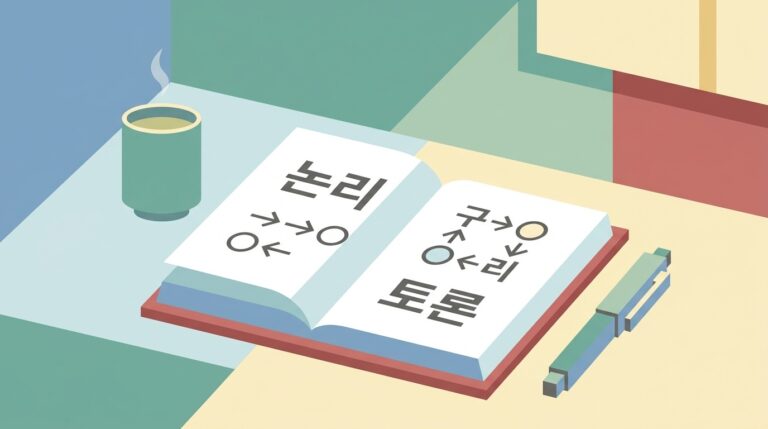
Phase 1: Empathy (스토리 몰입형 오프닝)
안녕하세요! 매일한글 에디터입니다.
Have you ever watched a Korean current-affairs talk show or listened to an intellectual Korean podcast like Alssulsinjap (알쓸신잡) and felt completely lost when discussions shifted from simple facts to complex logical analysis? Imagine this scenario: You are sipping a iced Americano with your Korean colleagues at a café in Seongsu-dong. Someone confidently points out a viral trend, claiming, “Did you know that iced coffee consumption and air conditioner sales both spike in July? Drinking iced coffee must be causing people to buy air conditioners!” You instantly recognize this classic logical flaw—confusing mere correlation with direct causation—but when you try to articulate this in sophisticated Korean, your mind goes blank.
At the C2 level, expressiveness isn’t just about vocabulary size; it’s about nuance, critical agility, and effortlessly pointing out logical fallacies without sounding confrontational. Based on real feedback from advanced learners who struggle in academic and business settings, this guide equips you with the native expressions and cultural finesse needed to navigate logical skepticism in Korean smoothly.
Phase 2: 핵심 표현 3선 심층 분석
1. 상관관계와 인과관계를 혼동하다
- Pronunciation: [Sang-gwan-gwan-gye-wa In-gwa-gwan-gye-reul Hon-dong-ha-da] (Think of ‘Sang-gwan’ like ‘sun-one’ and ‘In-gwa’ like ‘in-qua’)
- Meaning: Literally “To confuse correlation and causation.” Nuance: Used to politely yet precisely call out a flawed analytical premise.
- K-Culture Moment: Frequently heard on Korean news debates (JTBC Newsroom) or podcast roundtables when critique panel members analyze socioeconomic statistics.
- Editor’s Insight: Combining 두 개념을 (two concepts) with 혼동하다 explicitly highlights cognitive error in formal contexts.
- Situation Spectrum: Casual 🚫 | Semi-formal ⚠️ | Formal ✅
- 🤔 Think About It: In your native culture, do people point out logical fallacies directly in public conversations, or do they use indirect language similar to the Korean preference for harmony?
2. 착시 현상에 불과하다
- Pronunciation: [Chak-si Hyeon-sang-e Bul-gwa-ha-da] (Pronounce ‘Chak-si’ smoothly like ‘chalk-see’)
- Meaning: Directly: “It is nothing more than an optical illusion.” Nuance: Metaphorically used to state that a statistical trend or superficial outcome is misleading.
- K-Culture Moment: Popular in tech startup pitch meetings in Gangnam when reviewing vanity metrics that don’t reflect actual revenue growth.
- Editor’s Insight: The ending ‘~에 불과하다’ adds a strong authoritative tone, dismissing superficial evidence.
- Situation Spectrum: Casual ⚠️ | Semi-formal ✅ | Formal ✅
- 🤔 Think About It: How does visual imagery (like ‘optical illusion’) help soften a sharp intellectual critique in Korean business settings?
3. 성급한 일반화의 오류
- Pronunciation: [Seong-geup-han Il-ban-hwa-ui O-ryu] (Rhyme ‘Seong-geup’ with ‘song-goop’)
- Meaning: “The fallacy of hasty generalization.” Nuance: Calling out an assertion based on an insufficient sample size or single anecdote.
- K-Culture Moment: Seen in viral online community debates (e.g., Blind, Nate Pann) when users counter broad stereotyping about generational traits.
- Editor’s Insight: While formal, advanced speakers casually shorten this in spoken debates to “그건 성급한 일반화예요” (That’s a hasty generalization).
- Situation Spectrum: Casual ⚠️ | Semi-formal ✅ | Formal ✅
- 🤔 Think About It: How do online forums in your country handle broad generalizations compared to Korean online communities?
Phase 3: 교과서 한국어 vs 진짜 한국어
Situation 1: Correcting an flawed data argument in a strategy meeting
- 📖 교과서 한국어: 이것은 두 사실 사이의 상관관계일 뿐이며 인과관계가 아닙니다. (This is merely a correlation between two facts, not causation.)
- 🗣️ 진짜 한국어: 둘 사이에 상관관계는 있어 보이는데, 진짜 인과관계인지는 따져봐야 해요. (There seems to be a correlation between the two, but we need to check if it’s actual causation.)
- 💡 왜 다를까? Native C2 speakers soften absolute assertions by using ‘-어 보이다’ (seems to be) and ‘따져보다’ (to closely examine), maintaining group harmony while raising critical doubts.
Situation 2: Dismissing a clickbait news article about consumer habits
- 📖 교과서 한국어: 이 기사의 통계는 잘못된 결론을 유도합니다. (The statistics in this article induce a wrong conclusion.)
- 🗣️ 진짜 한국어: 이거 전형적인 상관관계랑 인과관계를 헷갈린 뉴스네요. (This is a classic news article confusing correlation with causation.)
- 💡 왜 다를까? In casual intellectual exchanges, native speakers use ‘헷갈리다’ rather than ‘혼동하다’ and frame the issue as a ‘전형적인’ (classic/typical) mistake.
Phase 4: K-Culture 딥다이브 & 비언어적 매너
4-1. 눈치(Nunchi) & Gestures
When calling out logical fallacies in Korea, direct bluntness can come across as aggressive. Employ subtle body language: tilt your head slightly with a thoughtful tilt (약간 고개를 갸우뚱하며), lower your voice pitch slightly, and open with an acknowledging nod before delivering your critique. Using open hands instead of pointing fingers is essential to show respect.
4-2. Cultural Code Analysis: The Age of ‘Fact-Checking’ in K-Media
Korean broadcasting has embraced intellectual infographics and deep-dive panels (such as Alssulsinjap or Eojjeoda Eorun). Audiences value intellectual rigor combined with humility. Expressions like “뇌피셜” (unverified personal opinion) versus “팩트” (verified fact) have crossed over from youth slang to mainstream media, showcasing a societal movement toward scientific skepticism.
Phase 5: 실전 롤플레이 시나리오
Characters:
* Min-jun (민준): Senior Data Analyst at a Seoul tech firm.
* You (학습자): Guest Strategy Consultant.
Dialogue:
1. Min-jun: 이번 데이터 보면, 서초구 매장 매출이 늘 때 App 사용 시간도 같이 늘었어요. App 업데이트가 매출을 올린 게 확실해요!
(Min-jun: Looking at this data, app usage time grew right when Seocho branch sales increased. The app update definitely caused the sales boost!)
2. You: 🎭 (고개를 살짝 갸우뚱하며 손짓을 가볍게 한다) 민준 님, 두 수치가 동시에 오른 건 맞지만 상관관계와 인과관계를 혼동했을 수 있어요.
(You: (Tilting head slightly with a light gesture) Min-jun, while both numbers rose simultaneously, we might be confusing correlation with causation.)
3. Min-jun: 네? 둘 다 같이 증가했으니 인과관계 아닌가요?
(Min-jun: Huh? Since both increased together, isn’t it causation?)
4. You: 🎭 (차분하고 미소를 지으며) 여름 프로모션 기간과 겹쳐서 생긴 착시 현상에 불과할 수도 있거든요.
(You: (Calmly with a slight smile) It might just be an optical illusion caused by overlapping with the summer promotion period.)
5. Min-jun: 아, 여름 프로모션 요인을 생각을 못 했네요.
(Min-jun: Ah, I didn’t think about the summer promotion factor.)
6. You: 맞아요. 프로모션이라는 제3의 변수를 고려하지 않으면 성급한 일반화의 오류에 빠질 수 있어요.
(You: Exactly. If we don’t consider the third variable of promotions, we might fall into the fallacy of hasty generalization.)
7. Min-jun: 듣고 보니 그렇네요. 변수를 통제하고 다시 분석해 보겠습니다!
(Min-jun: Hearing you say that, it makes sense. I’ll control the variables and analyze it again!)
8. You: 🎭 (밝게 웃으며) 네, 통제 변수 설정해서 다시 보면 훨씬 명확해질 거예요!
(You: (Smiling brightly) Yes, setting control variables will make it much clearer!)
🔀 Interactive Branching Choice:
How would you respond if Min-jun pushes back, saying “매출 증가는 확실하잖아요!” (But the sales increase is certain!):
* Option A: “제 말이 맞으니까 제 말대로 다시 분석하세요.” (I’m right, so re-analyze it my way.)
* Option B: “맞아요, 매출은 늘었죠! 다만 그 원인이 앱인지 프로모션인지 검증해보자는 뜻이에요.” (True, sales increased! I just mean let’s verify whether the cause was the app or the promotion.)
* Option C: “그런 식으로 분석하시면 데이터 왜곡입니다.” (Analyzing it that way is data distortion.)
Feedback:
* Option A (Bad): Too authoritative and damages workplace harmony. 🚫
* Option B (Best): Validates the colleague’s observation first (‘맞아요’), then clarifies the analytical nuance smoothly. ✅
* Option C (Risk): Intellectually correct but risks provoking unnecessary conflict. ⚠️
Phase 6: 10초 감정 섀도잉 드릴
Practice these lines focusing on natural pauses (/) and emotional tone:
- [😊 Polite & Analytical]
두 데이터 사이에 / 상관관계는 있어 보이지만 / 인과관계로 보긴 힘들어요.
(Doo dae-i-teo sa-i-e / sang-gwan-gwan-gye-neun is-seo bo-i-ji-man / in-gwa-gwan-gye-ro bo-gin him-deu-reo-yo.) -
[🤔 Thoughtful & Gentle Warning]
단순한 계절적 영향으로 인한 / 착시 현상일 수도 있어요.
(Dan-sun-han gye-jeol-jeok yeong-hyang-eu-ro in-han / chak-si hyeon-sang-il su-do is-seo-yo.) -
[💡 Clear & Convincing Summary]
제3의 변수를 놓치면 / 성급한 일반화의 오류에 빠지기 쉽습니다.
(Je-sam-ui byeon-su-reul not-chi-myeon / seong-geup-han il-ban-hwa-ui o-ryu-e ppa-ji-gi swip-seub-ni-da.)
Phase 7: K-Culture 미니 사전 (핵심 키워드 4개)
- 인과관계 (In-gwa-gwan-gye) | Causality | Used in formal, academic, and professional environments to denote direct cause-and-effect relationships.
- 착시 현상 (Chak-si Hyeon-sang) | Illusion/Misleading trend | Originally visual illusion, now widely used in business analytics to describe misleading graphs or numbers.
- 뇌피셜 (Noe-pi-syual) | Personal Unverified Claim | Slang blending ‘Brain’ (뇌) and ‘Official’ (오피셜). Describes claims lacking empirical evidence.
- 변수 통제 (Byeon-su Tong-je) | Variable Control | Essential term in Korean scientific reasoning and business hypothesis testing.
Phase 8: 여행자를 위한 생존 키트
Survival Expressions TOP 3:
- 이거 팩트체크 된 건가요? (Is this fact-checked?) — Handy when evaluating viral local travel tips.
- 근거가 약간 부족한 것 같아요. (The evidence seems a bit lacking.) — Polite way to show skepticism in guided tours or presentations.
- 상황에 따라 다를 수 있어요. (It could depend on the situation.) — Great phrase to avoid hasty generalizations when discussing local cultural differences.
Editor’s Travel Note:
When traveling or living in Korea, don’t rely on unverified online forum recommendations for subway detours or restaurant queues. Use trusted native applications. For navigation, check real-time traffic data via Naver Map app download to ensure you get accurate route causality rather than outdated online rumors!
Phase 9: “한 발 더 깊이” (생각 질문)
In Korean culture, maintaining social cohesion (Jeong and Nunchi) historically prioritized harmony over public debate. However, modern Korea’s rapid technological advancement has fueled a vibrant culture of scientific skepticism and data-driven logic. Expressing critical thinking in Korean requires a delicate balance: honoring your conversation partner’s effort while precisely isolating analytical flaws. Mastering this distinction elevates you from a fluent speaker to a sophisticated intellectual communicator in Korea.
💬 Your Turn: Have you ever encountered a common Korean myth or viral claim that confused correlation with causation? Share your thoughts in the comments below!
Phase 10: FAQ & 오해 방지 (FAQ Schema)
Q: Is ‘상관관계’ only used in scientific contexts?
A: While it originates in statistics, C2 speakers frequently use it in casual intellectual debates, media analysis, and corporate strategy discussions.
Q: How can I critique someone’s logic without offending them in Korean?
A: Always start with an acknowledging phrase like “좋은 지적이십니다만…” (That’s a good point, but…) or “말씀하신 취지는 이해하지만…” (I understand your intention, but…).
Q: What is the difference between ‘오류’ and ‘실수’?
A: ‘실수’ refers to a mistake or slip-up in action, while ‘오류’ refers to a logical fallacy, systematic error, or flaw in reasoning.
🚨 Common Mistakes Warning Board:
- ❌ Wrong: 상관관계와 인과관계를 틀렸어요.
✅ Correct: 상관관계와 인과관계를 혼동했어요. (Use ‘혼동하다’ when confusing two concepts, not ‘틀리다’.) - ❌ Wrong: 이것은 인과가 없다.
✅ Correct: 둘 사이에 인과관계가 없습니다. (Use full noun ‘인과관계’ in professional settings.) - ❌ Wrong: 성급한 일반화의 실수.
✅ Correct: 성급한 일반화의 오류. (Logical fallacies strictly take ‘오류’.)
Phase 11: 액션 미션 & 참여 유도
- 🥉 Bronze Mission: Read the 3 core expressions aloud 3 times using the Shadowing Drill pauses.
- 🥈 Silver Mission: Write a 2-sentence comment below pointing out a logical fallacy using “상관관계” and “인과관계”.
- 🥇 Gold Mission: Watch a Korean news commentary or documentary this week and spot at least one usage of data analysis vocabulary!
- 🎮 K-Culture Mission: Find a scene in a K-drama workplace scene (like Search: WWW or Misaeng) where characters debate strategy and post the quote in our discussion board!
Phase 12: 인터랙티브 퀴즈 챌린지
Question 1 (Situation Judgment):
Which phrase is best suited when pointing out that a sudden spike in ice cream sales during summer doesn’t cause heatwaves?
A) 성급한 일반화의 오류
B) 상관관계와 인과관계의 혼동
C) 뇌피셜의 형성
See Answer & Explanation
Correct Answer: B. Pointing out that two simultaneous summer occurrences are linked together as cause and effect is a classic case of confusing correlation with causation (상관관계와 인과관계의 혼동).
Question 2 (Fill-in-the-blank):
제3의 변수를 고려하지 않은 결론은 단순한 (________) 현상에 불과할 수 있습니다.
See Answer & Explanation
Correct Answer: 착시 (Optical illusion/Misleading trend).
Question 3 (True or False):
In Korea, calling out a logical error directly without softening phrases is considered bad etiquette even in business settings. (True/False)
See Answer & Explanation
Correct Answer: True. Utilizing hedge phrases like “~어 보입니다” or acknowledging gestures helps preserve rapport while exercising critical skepticism.







