

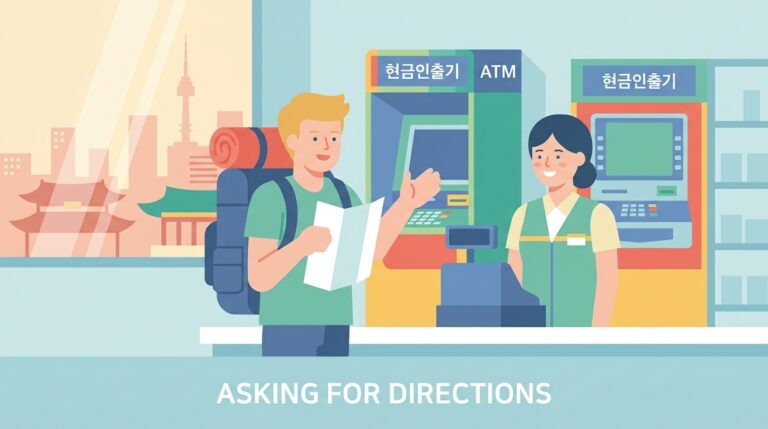
Don’t Get Stranded in Seoul: How to Ask for an ATM in Korean Like a Native
안녕하세요! I’m your Daily Hangul editor, your friendly neighborhood cultural navigator! Today, we are solving one of the most real-world, heart-racing travel situations: finding an ATM when you urgently need cash in Korea.
Phase 1: Empathy (Story-Driven Opening)
Imagine this: You’ve just arrived in the vibrant streets of Hongdae. The air is filled with the mouth-watering aroma of spicy Tteokbokki and crispy Hotteok. You walk up to a legendary street vendor, order your food, and reach for your phone to pay via card. Suddenly, the street vendor kindly smiles and says, “현금만 돼요” (Cash only!).
Your heart drops just a little bit. You have your foreign debit card, but where on earth is the nearest ATM? You look around, see bustling stores and bright signs, but you aren’t sure how to ask local residents without sounding like a textbook robot.
Don’t panic! Finding cash in Korea is actually super easy once you know a single key phrase. Based on feedback from hundreds of our beginner learners at Daily Hangul, mastering basic bank and ATM phrases builds immediate confidence. Let’s make sure you never get stuck cash-less again!
Phase 2: Core Expressions (Deep Dive)
1. ATM이 어디에 있어요? (ATM-i eodi-e isseoyo?)
- Pronunciation: ATM-ee audio-eh ees-seh-yo? (Think of the English letters “A-T-M”, followed by “ee” + “audio” without the ‘o’ + “ees-seh-yo”).
- Meaning: “Where is the ATM?”
- K-Culture Moment: Asking a staff member inside a 24-hour convenience store like CU, GS25, or Seven-Eleven.
- Editor’s Insight: This is your #1 golden phrase. It is polite, simple, and perfectly understood by anyone in Korea.
- Situation Spectrum: Casual ⚠️ | Semi-formal ✅ | Formal ✅
- 🤔 Think About It: Notice how Koreans use the English acronym “ATM” directly! Korean incorporates many loanwords, making your learning journey much smoother.
2. 근처에 은행 있어요? (Geuncheo-e eunhaeng isseoyo?)
- Pronunciation: Geun-chuh-eh oon-haeng ees-seh-yo? (“Geun” sounds like gun, “eunhaeng” sounds like oon-haeng).
- Meaning: “Is there a bank nearby?”
- K-Culture Moment: Searching for major bank branches (like KB Kookmin, Hana, or Shinhan) to find ATMs that accept international cards.
- Editor’s Insight: Convenience store ATMs sometimes only support domestic Korean cards. If your card gets rejected, ask for a real “은행” (Bank).
- Situation Spectrum: Casual ⚠️ | Semi-formal ✅ | Formal ✅
- 🤔 Think About It: Why ask for a bank? Major Korean bank branches almost always house a “Global ATM” booth inside!
3. 현금지급기 어디예요? (Hyeongeum-jigeupgi eodi-yeyo?)
- Pronunciation: Hyeon-geum jee-geup-gee eh-dee-yeh-yo?
- Meaning: “Where is the cash dispenser / ATM?”
- K-Culture Moment: Reading official directional signs inside subway stations or large shopping complexes like COEX Mall.
- Editor’s Insight: “현금지급기” is the formal Korean term for cash machine. You will see it written on signs everywhere!
- Situation Spectrum: Casual 🚫 | Semi-formal ✅ | Formal ✅
- 🤔 Think About It: “현금” (Hyeongeum) means cash, and “지급” (Jigeup) means provision/payment. Korean words often build up like Lego blocks!
Phase 3: Textbook Korean vs. Real Native Korean
Situation 1: Asking where the cash machine is
* 📖 Textbook Korean: “실례지만, 가장 가까운 자동 현금 입출금기가 어디에 있습니까?” (Excuse me, where is the nearest automated cash deposit and withdrawal machine?)
* 🗣️ Real Native Korean: “저기요, 근처에 ATM 있어요?” (Excuse me, is there an ATM nearby?)
* 💡 Why is it different? Nobody uses long technical terms like “자동 현금 입출금기” in casual spoken conversation. “ATM 있어요?” is short, natural, and friendly!
Situation 2: Explaining why you need an ATM
* 📖 Textbook Korean: “저는 현금을 인출하고 싶습니다.” (I would like to withdraw cash.)
* 🗣️ Real Native Korean: “돈 좀 뽑으려고요.” (I need to pull out some cash.)
* 💡 Why is it different? Native Koreans use the verb “뽑다” (to draw/pull out) instead of the formal verb “인출하다” (to withdraw) when talking about cash.
Phase 4: K-Culture Deep Dive & Non-Verbal Manners
4-1. Nunchi (눈치) & Body Gestures
When approaching a clerk or passerby in Korea:
1. The Gentle Bow: Start with a light head nod and say “저기요…” (Jeogiyo… / Excuse me…).
2. The Card/Wallet Tap: Slightly hold up your wallet or bank card while asking. Visual context helps instantly!
3. Two-Hand Manners: When handing your card to a bank clerk, always hold it with both hands or support your right wrist with your left hand as a sign of respect.
4-2. Culture Code: The “Global ATM” Secret
In K-Dramas, you often see characters tapping cards anywhere. Korea is largely a cashless society! However, for foreign travelers, not every ATM accepts overseas Visa/Mastercard cards. Look specifically for the “Global ATM” (글로벌 ATM) logo on the machine, or select the “Foreign Card” (해외 카드) button on screen before inserting your card.
Phase 5: Real-World Roleplay Scenario
Setting: A bright CU Convenience Store near Ewha Womans University.
Characters: You (Traveler) & Minjun (Store Clerk)
- You: 저기요, 죄송한데요… 🎭 (Holding wallet, looking slightly confused)
(Jeogiyo, joesonghandeyo… / Excuse me, I’m sorry to bother you…) - Minjun: 네! 무엇을 도와드릴까요? 🎭 (Smiling warmly behind the counter)
(Ne! Mueoseul dowadeureilkayo? / Yes! How can I help you?) - You: 근처에 ATM이 어디에 있어요? 🎭 (Pointing towards the street outside)
(Geuncheo-e ATM-i eodi-e isseoyo? / Where is an ATM nearby?) - Minjun: 아, 매장 안쪽 오른쪽에 하나 있어요! 🎭 (Pointing to the back corner of the store)
(A, maejang anjjok oreunjjoke hana isseoyo! / Ah, there’s one right inside at the back right!) - You: 해외 카드로 돈 뽑을 수 있어요? 🎭 (Showing your overseas Visa card)
(Hae-oe kadeu-ro don pobeul su isseoyo? / Can I withdraw cash with an overseas card?) - Minjun: 그럼요! 화면에서 ‘Global’ 버튼 누르시면 돼요. 🎭 (Giving a thumbs up)
(Geureomyo! Hwamen-eseo ‘Global’ beoteun nureusimyeon dwaeyo. / Of course! Just press the ‘Global’ button on the screen.) - You: 아, 정말 감사합니다! 🎭 (Bowing head lightly with a relieved smile)
(A, jeongmal gamsahamdani! / Ah, thank you so much!) - Minjun: 별말씀을요. 좋은 여행 되세요! 🎭 (Waving hand politely)
(Byeolmalsseumeul-yo. Joeun yeohaeng doeseo-yo! / You’re welcome. Have a great trip!)
🔀 Interactive Branching Choice
What would you say if you couldn’t find the Global button on the ATM screen?
* Choice A: “이거 해외 카드 안 돼요?” (Does this foreign card not work here?)
* Choice B: “돈 주세요!” (Give me money!)
* Choice C: (Silently leave the store and cry.)
Feedback:
* Choice A (Best): Super natural! The clerk will gladly come over and help you select the language menu.
* Choice B (Bad/Risk): Yikes! That sounds like a robbery! Avoid saying this at all costs.
* Choice C (Risk): Don’t give up! Korean store clerks are famous for being helpful to travelers.
Phase 6: 10-Second Emotion Shadowing Drill
Practice saying these sentences with feeling! Follow the / pause markers:
- [😊 Friendly & Polite]
저기요, / ATM 어디에 / 있어요?
(Jeo-gi-yo, / A-T-M eo-di-e / is-seo-yo?) -
[🥺 Urgent & Curious]
해외 카드로 / 돈 뽑을 수 / 있어요?
(Hae-oe ka-deu-ro / don pobeul su / is-seo-yo?)
Phase 7: K-Culture Mini Dictionary
- 편의점 (Pyeon-ui-jeom) | Convenience Store | The lifesaver 24/7 store chain (CU, GS25, Seven-Eleven) found every 50 meters in Seoul.
- 현금 (Hyeon-geum) | Cash | Essential paper currency for traditional markets, street food, and purchasing T-Money transit cards.
- 글로벌 ATM (Geullobeol ATM) | International Card ATM | Cash machines specifically equipped to process foreign Visa, Mastercard, Cirrus, or UnionPay transactions.
- 카카오맵 (KakaoMap) | Navigation App | One of the top navigation apps in Korea alongside Naver Map to locate nearby bank branches quickly.
Phase 8: Traveler’s Survival Kit
Top 3 Survival Phrases
- 이 카드 돼요? (I kadeu dwaeyo?) – Does this card work?
- 수수료 얼마예요? (Susuryo eolmayeyo?) – How much is the transaction fee?
- 영수증 주세요. (Yeongsujeung juseyo.) – Please give me a receipt.
💡 Editor’s Travel Note
Before wandering the streets, open your phone and search for cash points using the Naver Map App Download. Simply type “글로벌 ATM” or “은행” in the search bar to get real-time walking directions to the closest machine!
Phase 9: One Step Deeper (Cultural Insights)
Korea is one of the most credit-card-dense societies in the world. You can buy a single $1 stick of gum with a credit card! Because of this, ATMs are no longer just inside bank buildings; they are embedded inside convenience stores, subway stations, and bus terminals.
However, traditional food stalls (Pojangmacha) and underground shopping centers often prefer cash or direct bank transfers. Knowing how to grab cash on the fly bridges the gap between modern digital Korea and its charming traditional roots!
💬 Your Turn: Have you ever struggled to find an ATM while traveling abroad? What did you do? Tell us in the comments below!
Phase 10: FAQ & Common Mistakes
Q: Will my foreign bank card work in any Korean ATM?
A: Not all ATMs process international cards. Look specifically for machines labeled “Global ATM” or visit major bank branches like KB Kookmin, Shinhan, or Hana Bank during business hours (9:00 AM – 4:00 PM).
Q: What is the most natural way for beginners to ask for ATM location?
A: Stick to “ATM 어디 있어요?” (ATM eodi isseoyo?). It is simple, polite, and universally understood by everyone.
Q: Can I buy a T-Money transport card with a credit card at convenience stores?
A: No! Transport card purchases and top-ups strictly require cash (현금). That’s why locating an ATM is your first priority after arriving!
🚨 Common Mistakes Alert
- Mistake: Using super formal textbook words like “자동현금입출금기” out loud.
- Correct Action: Keep it simple with “ATM” or “은행” (Bank).
- Mistake: Inserting your foreign card without selecting the language/Global menu first.
- Correct Action: Tap “Foreign Card” or “Global ATM” on the screen before inserting your card.
- Mistake: Expecting ATMs inside quiet residential alleys to accept foreign cards.
- Correct Action: Head to major subway stations or convenience stores along main streets.
Phase 11: Action Mission & Community Challenge
- 🥉 Bronze Mission: Practice saying “ATM 어디 있어요?” out loud 3 times in front of your mirror.
- 🥈 Silver Mission: Post a picture of your favorite Korean snack on Instagram and tag #DailyHangul with the Korean word #현금!
- 🥇 Gold Mission: On your next trip to Korea, successfully ask a store clerk for the ATM location using today’s target phrase!
🎮 K-Culture Mission: Next time you watch a K-Drama episode, try to spot a convenience store sign in the background and see if you can spot the ATM sign near the window!
Phase 12: Interactive Quiz Challenge
Test your knowledge before you go!
Q1. What is the most natural phrase to ask where an ATM is?
* A) 돈 주세요.
* B) ATM 어디 있어요?
* C) 은행이 뭐예요?
Q2. What button should you press on a Korean ATM screen when using an overseas credit card?
* A) 국내 카드 (Domestic Card)
* B) Global / 해외 카드 (Foreign Card)
* C) 통장 정리 (Passbook Update)
Q3. True or False: You can top up your Korean T-Money transport card using an overseas credit card.
* A) True
* B) False
👉 Click here to check the Answers & Explanations!
- Q1 Answer: B) ATM 어디 있어요? (Clear, polite, and natural for beginners!)
- Q2 Answer: B) Global / 해외 카드 (Selecting this opens the international transaction network).
- Q3 Answer: B) False (T-Money card top-ups require cash, making ATMs essential!)
Happy learning with Daily Hangul! See you in the next unit!







