

Phase 1: Empathy & Storytelling Opening
안녕하세요! 매일한글 에디터입니다. (Hello! This is your Daily Hangul lead editor.) If you have ever spent a long, exhausting evening in a small Seoul studio apartment—what locals call a wonroom (원룸)—staring blankly into an empty fridge after an 11-hour shift, you know the specific existential dread of solo living (jachwi, 자취). You want something warm, deeply satisfying, and authentically Korean, but you lack both the energy and the desire to wash three different pans.
Enter the humble microwave (jeonjareinji, 전자레인지), the unsung hero of Korean youth culture. In contemporary Korea, microwave cooking for one is no longer just about heating up bland frozen dumplings; it is a sophisticated culinary subculture fueled by ingenious hacks, hyper-specific vocabulary, and rich flavor balancing.
In this advanced C2 module, we are elevating your language mastery beyond basic recipe instructions. Based on authentic feedback from seasoned expatriates and Korean culinary enthusiasts, you will master the refined pragmatics, subtle sensory idioms, and culturally embedded nuance required to discuss lightning-fast solo cuisine like a born-and-bred Seoulite.
Phase 2: Deep Dive into Core Expressions
1. 뚝딱 해치우다 (Ttuk-ttak hae-chi-u-da)
- Pronunciation: [Ttuk-ttak hae-chi-u-da] (Sounds like the quick rhythmic double-tap of a wooden mallet: stick-stack-done!)
- Meaning: Literally “To whip up and devour/finish off effortlessly in a flash.”
- K-Culture Moment: Seen constantly on YouTube vlogs titled “자취생 5분 계란찜 뚝딱 해치우기” (Whipping up 5-minute steamed eggs in a flash for solo dwellers).
- Editor’s Insight: Combining the sensory sound effect ttuk-ttak (mimicking rapid craftwork) with haechiiuda (to clear out/finish off), this phrase communicates supreme efficiency and self-sufficiency. It implies both speedy preparation and hearty consumption.
- Situation Spectrum: Casual ✅ | Semi-formal ⚠️ | Formal 🚫
- 소리 비유 (Sound Analogy): Imagine snapping your fingers twice in rapid succession—that brisk snappy rhythm is the exact mental tempo of ttuk-ttak.
- Thinking About It: How does your native language express the balance between extreme speed and culinary satisfaction without sounding rushed or careless?
2. 풍미를 두 배로 살리다 (Pung-mi-reul du bae-ro sal-li-da)
- Pronunciation: [Pung-mi-reul doo bae-ro sal-li-da] (Smooth, rolling delivery emphasizing the word ‘sal-li-da’ like breathing life into something)
- Meaning: To amplify or revitalize the depth of aroma and flavor twofold.
- K-Culture Moment: Culinary shows like Delicious Rendezvous where chefs use a splash of sesame oil or toasted seaweed right after microwaving to elevate a simple meal.
- Editor’s Insight: While mat means basic taste, pungmi (풍미) refers to culinary complexity, bouquet, and mouthfeel. Sallida literally means “to rescue” or “bring to life.” Thus, you are saving a quick microwave dish from flat boredom.
- Situation Spectrum: Casual ✅ | Semi-formal ✅ | Formal ✅
- Thinking About It: Why do you think Korean culinary commentary distinguishes so sharply between simple taste (mat) and systemic flavor depth (pungmi)?
3. 간을 딱 맞추다 (Gan-eul ttak mat-chu-da)
- Pronunciation: [Gan-eul ttak mat-choo-da] (The word ‘ttak’ should be pronounced with a crisp, sharp glottal stop)
- Meaning: To achieve perfect seasoning equilibrium without needing a single additional drop of soy sauce or pinch of salt.
- K-Culture Moment: K-Drama scenes where roommates sample a quick microwave soup and nod approvingly: “간이 딱 맞네!” (The seasoning is spot on!).
- Editor’s Insight: Gan is the holistic Korean concept of salinity and overall balance. Ttak is an adverb denoting absolute precision. Saying gan-eul ttak matchuda demonstrates high-level culinary intuition.
- Situation Spectrum: Casual ✅ | Semi-formal ✅ | Formal ⚠️
- Thinking About It: In your culture, is precise seasoning viewed as a scientific measurement or an intuitive sensory art?
Phase 3: Textbook Korean vs. Real Native Korean
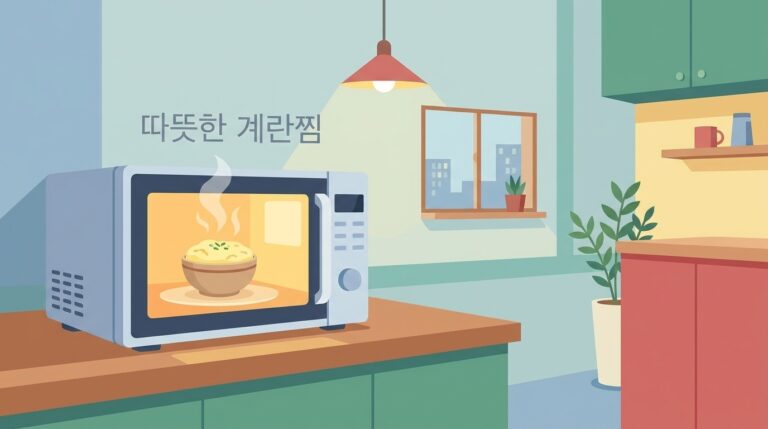
Scenario 1: Describing a fast microwave egg soufflé (계란찜)
- 📖 Textbook Korean: 전자레인지로 계란찜을 매우 빠르게 만들 수 있습니다.
(Jeonjareinjiro gyeranjjimeul maeu ppareuge mandeul su isseumnida.) - 🗣️ Real Native Korean: 전자레인지 하나만 있으면 계란찜 5분 만에 뚝딱 완성이죠!
(Jeonjareinji hanaman isseumyeon gyeranjjim o-bun mane ttuk-ttak wanseong-ijyo!) - 💡 Why the difference? C2 native speakers rarely use dry adverbs like maeu ppareuge. Instead, they employ rhythmic idiomatic structures like ttuk-ttak wanseong to convey conversational flair and ease.
Scenario 2: Adding topping to microwaved spicy ramen hack
- 📖 Textbook Korean: 치즈를 넣으면 매운 맛이 감소하여 더 맛이 좋아집니다.
(Chijeureul neoeumyeon maeun masi gamsohayeo deo masi jojimnida.) - 🗣️ Real Native Korean: 모짜렐라 치즈 한 장 얹어주면 자극적인 매운맛은 잡고 풍미는 싹 올라가요.
(Mojjarella chijeu han jang eonjeojumyeon jageukjeog-in maeunmaseun japgo pungmireun ssak ollagayo.) - 💡 Why the difference? Native Koreans use tactile verbs like japda (to catch/bridle heat) and sensory adverbs like ssak (cleanly/entirely) to describe sophisticated dynamic changes in flavor.
Phase 4: K-Culture Deep Dive & Non-Verbal Manners
4-1. Nunchi & Microwave Etiquette in Shared Korean Living
When cooking microwave meals in shared environments—such as a student goshiwon, co-living space, or shared company pantry—Nunchi (눈치, social tact) is paramount.
* Steam vent awareness: Always leave a slit in the plastic wrap or use a microwave-safe cover (jeonjareinji deopgae). Exploding food in a shared microwave is considered a major breach of social harmony.
* Aroma consideration: Strongly aromatic ingredients like fermented kimchi (mook-eun-ji) or dried squid require subtle self-awareness. It is polite to open a window slightly or offer a self-deprecating chuckle: “냄새가 좀 자극적이죠? 죄송해요!” (The aroma is a bit strong, isn’t it? My apologies!).
4-2. Cultural Code: The Evolution of
Frequently Asked Questions (FAQ)
Q: What does "뚝딱 해치우다 (Ttuk-ttak hae-chi-u-da)" mean in Korean and how do you pronounce it?
A: In Korean, "뚝딱 해치우다 (Ttuk-ttak hae-chi-u-da)" is pronounced [Ttuk-ttak hae-chi-u-da] and means: Literally "To whip up and devour/finish off effortlessly in a flash."
Q: What does "풍미를 두 배로 살리다 (Pung-mi-reul du bae-ro sal-li-da)" mean in Korean and how do you pronounce it?
A: In Korean, "풍미를 두 배로 살리다 (Pung-mi-reul du bae-ro sal-li-da)" is pronounced [Pung-mi-reul doo bae-ro sal-li-da] and means: To amplify or revitalize the depth of aroma and flavor twofold.
Q: What does "간을 딱 맞추다 (Gan-eul ttak mat-chu-da)" mean in Korean and how do you pronounce it?
A: In Korean, "간을 딱 맞추다 (Gan-eul ttak mat-chu-da)" is pronounced [Gan-eul ttak mat-choo-da] and means: To achieve perfect seasoning equilibrium without needing a single additional drop of soy sauce or pinch of salt.






