

Phase 1: Empathy (Warm Welcome!)
안녕하세요! I’m your Daily Hangul editor and favorite Korean study buddy! Welcome back to our fun Korean taste adventure.
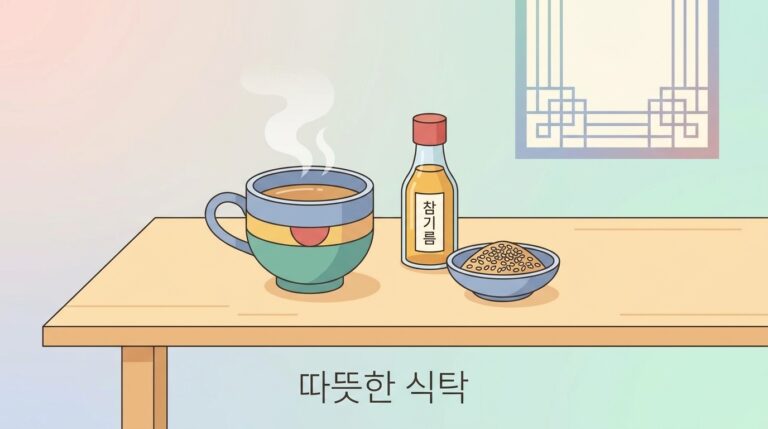
Picture this: You are sitting in a cozy restaurant in Seoul, enjoying a hot bowl of Bibimbap. The server pours a few drops of fresh sesame oil (참기름) right on top. Suddenly, a rich, warm, nutty aroma fills the room. You take a bite and think, “Wow, this isn’t just salty or sweet. It’s so rich and toasted! How do I say this in Korean?”
If you have ever struggled to describe that delicious nutty flavor of sesame oil, roasted barley tea (보리차), or roasted seeds in Korean, you are not alone! Many beginner learners try to say “delicious” (맛있어요), but Koreans have a special word dedicated entirely to this warm, toasted flavor profile: 고소해요 (Goso-haeyo).
Mastering this single word will immediately elevate your Korean food chat from basic to native-level! Today, we will break it down into easy, fun steps designed especially for absolute beginners (A1 level).
Phase 2: Core Expressions Deep Dive
1. 고소해요 (Goso-haeyo)
- Pronunciation: [go-so-hae-yo] (Think: “Go-So-Hey-Yo”)
- Meaning: Direct translation: “It is nutty / savory / toasted.” (Refers to the cozy, rich taste of nuts, sesame, butter, or toasted grains).
- K-Culture Moment: You hear this all the time on Korean food vlogs when influencers taste fresh toasted sesame oil or Korean fried chicken with roasted seeds.
- Editor’s Insight: While English uses “nutty” only for nuts, in Korean, 고소해요 applies to sesame oil, cheese, buttered corn, and even crisp rice crust (누룽지)!
- Situation Spectrum: Casual ✅ / Semi-formal ✅ / Formal ✅
- 🤔 Think About It: Does your native language have a specific word just for toasted and nutty flavors, or do you combine multiple words?
2. 고소한 냄새 (Gosohan naemse)
- Pronunciation: [go-so-han naem-se] (Sounds like: “Go-so-han Naim-seh”)
- Meaning: “A nutty / toasted smell.”
- K-Culture Moment: Walking past a traditional bakery or a sesame oil press shop (방앗간) in a local market.
- Editor’s Insight: Use this when your nose catches that wonderful toasted scent before you even take a bite!
- Situation Spectrum: Casual ✅ / Semi-formal ✅ / Formal ✅
- 🤔 Think About It: How does smelling freshly toasted sesame affect your appetite compared to sweet cake?
3. 정말 고소해요! (Jeongmal goso-haeyo!)
- Pronunciation: [jeong-mal go-so-hae-yo] (Sounds like: “Chung-mal Go-So-Hey-Yo”)
- Meaning: “It is really nutty/savory!”
- K-Culture Moment: Saying thanks to a Korean friend or chef who served you delicious homemade Korean dishes.
- Editor’s Insight: Adding 정말 (Jeongmal – Really) makes your compliment sound much warmer and genuinely appreciative.
- Situation Spectrum: Casual ✅ / Semi-formal ✅ / Formal ✅
- 🤔 Think About It: Complimenting specific food flavors is a great way to bond in Korean dining culture!
Phase 3: Textbook Korean vs. Real Native Korean
Situation 1: Tasting warm barley tea (보리차)
- 📖 Textbook Korean: 이 차가 맛있습니다. (I cha-ga mas-it-seum-ni-da.) – “This tea is delicious.”
- 🗣️ Real Native Korean: 와, 이 차 정말 고소해요! (Wa, i cha jeong-mal go-so-hae-yo!) – “Wow, this tea is so cozy and nutty!”
- 💡 Why is it different? Native speakers love expressing exact flavor notes! Using 고소해요 shows you truly appreciate traditional Korean grain tea.
Situation 2: Smelling sesame oil in Bibimbap
- 📖 Textbook Korean: 냄새가 좋습니다. (Naem-se-ga jot-seum-ni-da.) – “The smell is good.”
- 🗣️ Real Native Korean: 고소한 냄새가 나요! (Go-so-han naem-se-ga na-yo!) – “It smells so delightfully nutty!”
- 💡 Why is it different? 냄새가 나요 means “a scent comes out/arises.” Combining it with 고소한 paints a vivid sensory picture.
Phase 4: K-Culture Deep Dive & Non-verbal Manners
4-1. Nunchi & Gestures
When saying “고소해요!” at a restaurant:
1. Gently cup your hands around your tea cup or food bowl to show appreciation.
2. Nod your head twice while smiling pleasantly as you take your first sip or bite.
3. Making eye contact with the host while saying “정말 고소해요!” brings an instant warm smile to their face.
4-2. Cultural Code: The Magic of Sesame Oil (참기름)
In Korea, fresh sesame oil (참기름) is considered liquidated gold! Traditional markets still feature 방앗간 (mill shops) where whole sesame seeds are freshly toasted and pressed. It adds that iconic 고소한 맛 (nutty flavor) to almost every Korean side dish (반찬).
Phase 5: Real-life Roleplay Scenario
Setting: A cozy traditional Korean restaurant in Seoul. You are chatting with the friendly restaurant auntie (이모님 – Imonim).
- Turn 1 (이모님): 손님, 따뜻한 보리차 드세요. (Son-nim, tta-tteut-han bo-ri-cha deu-se-yo.)
- “Guest, please enjoy some warm barley tea.”
- Turn 2 (You): 🎭 [Takes a gentle sip and smiles] 감사합니다! (Kam-sa-ham-ni-da!)
- “Thank you!”
- Turn 3 (You): 와, 이 차 정말 고소해요! (Wa, i cha jeong-mal go-so-hae-yo!)
- “Wow, this tea is really nutty and cozy!”
- Turn 4 (이모님): 🎭 [Smiles warmly] 맞죠? 직접 볶은 보리예요. (Mat-jjo? Jik-jeop bok-eun bo-ri-ye-yo.)
- “Right? These are barley grains we roasted ourselves.”
- Turn 5 (이모님): 비빔밥도 나왔어요. 참기름 넣었어요! (Bi-bim-bbap-do na-wat-eo-yo. Cham-gi-reum neo-at-eo-yo!)
- “Your Bibimbap is here too. I added sesame oil!”
- Turn 6 (You): 🎭 [Leans in and smells the bowl] 냄새가 정말 좋아요! (Naem-se-ga jeong-mal jo-a-yo!)
- “The smell is really good!”
- Turn 7 (You): 고소한 냄새가 나요. (Go-so-han naem-se-ga na-yo.)
- “It smells so delightfully nutty.”
- Turn 8 (이모님): 맛있게 드세요! (Mas-it-ge deu-se-yo!)
- “Enjoy your meal!”
🔀 Interactive Choice Point
The server asks: “참기름 더 드릴까요?” (Should I give you more sesame oil?) How do you respond?
- Option A: 네, 더 주세요! 고소해서 좋아요. (Yes, please give me more! I love it because it’s nutty.)
- Option B: 아니요, 매워요. (No, it’s spicy.)
- Option C: 맛없어요. (It is not delicious.)
🔍 Click to see feedback on your choice!
- Option A (BEST ✅): Perfect! You correctly identified that sesame oil is nutty (고소해요) and politely asked for more.
- Option B (BAD ❌): Sesame oil isn’t spicy (매워요), so this might confuse the host!
- Option C (RISK 🚫): Oh no! Saying food is 맛없어요 (not tasty) can hurt the chef’s feelings.
Phase 6: 10-Second Emotional Shadowing Drill
Practice saying these lines with natural pauses (/) and real emotion!
[😊 Happy & Excited]- 와 / 정말 / 고소해요!
- (Wa / jeong-mal / go-so-hae-yo!)
[😋 Delighted & Hungry]- 음~ / 고소한 냄새가 / 나요!
- (Eum~ / go-so-han naem-se-ga / na-yo!)
[🥺 Polite & Impressed]- 이 차가 / 참 / 고소하네요!
- (I cha-ga / cham / go-so-ha-ne-yo!)
Phase 7: K-Culture Mini Dictionary
- 참기름 (Chamgireum) | Sesame Oil | The ultimate source of 고소한 맛 in Korean home cooking.
- 보리차 (Boricha) | Roasted Barley Tea | The default cozy welcome drink served in many traditional Korean homes and eateries.
- 고소하다 (Gosohada) | To be nutty/savory | The dictionary form of the verb describing warm, toasted flavor profiles.
- 누룽지 (Nurungji) | Scorched Rice Crust | Crispy rice crust formed at the bottom of a hot stone pot, famous for its crisp 고소한 taste.
Phase 8: Traveler’s Survival Kit
TOP 3 Emergency Food Expressions
- 고소해요. (Go-so-hae-yo) – It’s nutty/savory.
- 참기름 주세요. (Cham-gi-reum ju-se-yo) – Please give me sesame oil.
- 이거 무슨 맛이에요? (I-geo mu-seun mas-i-e-yo?) – What flavor is this?
Editor’s Travel Note
Before heading out to explore local street foods or traditional markets in Seoul, make sure to install the Naver Map app download guide on your phone. Naver Map will help you find authentic sesame oil mills (방앗간) and traditional tea houses without getting lost!
Phase 9: One Step Deeper
In Korean food culture, flavor is deeply tied to emotional warmth and nostalgia. Words like 고소해요 do not just describe a physical taste bud reaction—they evoke memories of family meals, freshly cooked rice, and warm tea on a rainy afternoon. By learning sensory words like 고소해요, you are stepping beyond literal translation and entering the warm heart of Korean home life.
💬 Your Turn: What is your favorite food in your home country that could be described as 고소해요 (nutty, toasted, or buttery)? Tell us in the comments below!
Phase 10: FAQ & Common Mistakes
Q: Can I use 고소해요 for sweet foods like chocolate or candy?
A: Generally, no! Chocolate is 달콤해요 (sweet). 고소해요 is specifically for toasted grains, nuts, seeds, butter, cheese, or roasted tea.
Q: Is 고소하다 a verb or an adjective?
A: In Korean grammar, it is a descriptive verb (adjective) meaning “to be nutty/savory/toasted.”
Q: What is the difference between 고소해요 and 맛있어요?
A: 맛있어요 means “delicious” in general. 고소해요 describes a specific type of deliciousness—nutty, rich, and toasted!
🚨 Common Mistakes TOP 3
- Mistake: Calling spicy fried chicken 고소해요.
- Correct Action: Use 매워요 (spicy) for chili heat, and save 고소해요 for sesame or nuts.
- Mistake: Pronouncing it as “Go-so-hi-yo”.
- Correct Action: Keep the ending crisp: [go-so-hae-yo].
- Mistake: Using 고소해요 only for tree nuts.
- Correct Action: Remember it works for sesame oil, buttered corn, and toasted rice tea too!
Phase 11: Action Missions
- 🥉 Bronze Mission: Say “고소해요!” out loud three times while looking in the mirror.
- 🥈 Silver Mission: Snap a photo of your next coffee, nuts, or roasted tea, and post it on Instagram with the caption: “정말 고소해요! #DailyHangul”
- 🥇 Gold Mission: Visit a local Korean restaurant, order Bibimbap or barley tea, and tell the server “고소해요!”
🎮 K-Culture Mission: Watch your favorite Korean drama tonight and listen carefully during a dining scene. See if you can spot someone saying 고소하다 or 참기름!
Phase 12: Interactive Quiz Challenge
Question 1: Fill in the blank
When drinking roasted barley tea (보리차), you can say: “이 차 정말 ______!”
* A) 매워요
* B) 고소해요
* C) 차가워요
💡 Click to reveal the answer and explanation!
Correct Answer: B) 고소해요
Explanation: Roasted barley tea is famous for its warm, nutty (고소해요) flavor!
Question 2: True or False?
In Korea, sesame oil (참기름) is a primary source of 고소한 맛 (nutty flavor).
* A) True
* B) False
💡 Click to reveal the answer and explanation!
Correct Answer: A) True
Explanation: Fresh sesame oil is the classic example of 고소한 맛 in Korean cuisine!







