

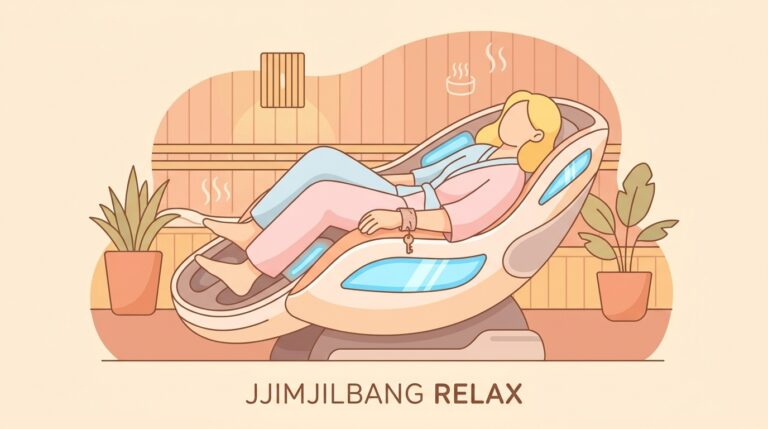
Master the Korean Jjimjilbang: How to Use the Massage Chair Like a Native
Phase 1: Welcome to the Spa! (Empathetic Opening)
안녕하세요! (Annyeonghaseyo!) Editor here from Daily Hangul—your trusted cultural navigator and Korean language buddy!
Imagine this: You’ve just walked into a luxurious Korean bathhouse (Jjimjilbang). You’re wearing the comfy uniform, holding a cool cup of sweet rice drink (sikhye), and you spot a row of high-tech, futuristic massage chairs (anma uija). Your muscles are aching from exploring Seoul all day, so you sit down, eager for relief. But suddenly, confusion sets in! The control screen is entirely in Korean, the machine isn’t starting, and you’re wondering, “Do I swipe my electronic keyband here, or do I need cash? How do I tell someone the pressure is too strong?”
Don’t panic! Many intermediate learners feel overwhelmed by practical, real-life technology in Korea. Sitting helpless on a massage chair while other patrons effortlessly tap their keybands is a classic expat rite of passage. But learning these everyday phrases will give you instant confidence, making your spa trip 100% stress-free and super relaxing. Based on real feedback from our community members, this guide gives you the exact phrases, cultural etiquette, and tech tips you need!
Phase 2: Core Expressions Deep Dive
1. 이거 어떻게 써요? (Igeo eotteokke sseoyo?)
- Pronunciation: [ee-geo uh-ttuh-keh ssuh-yo?] (Sounds like ‘E-go uh-tuck-kay sew-yo?’)
- Meaning: Literal: “How do I use this?” | Nuance: A natural, polite way to ask for quick operational help.
- K-Culture Moment: Commonly heard in Korean variety shows like I Live Alone when someone encounters a complex home gadget or gym gear.
- Editor’s Insight: ‘써요’ comes from ‘쓰다’ (to use). In spoken Korean, native speakers drop formal markers and say ‘이거 어떻게 써요?’ instead of complex dictionary verbs.
- Situation Spectrum: Casual ✅ | Semi-formal ✅ | Formal ⚠️
- 🤔 Think About It: In your culture, would you ask a stranger nearby for help with a machine, or look for an official staff member first?
2. 이거 키밴드로 찍으면 돼요? (Igeo kiban-deuro jjigeumyeon dwaeyo?)
- Pronunciation: [ee-geo key-band-ro jjee-geum-yeon dwae-yo?]
- Meaning: Literal: “Can I tap this with my keyband?” | Nuance: Asking if the cashless keyband sensor works for this amenity.
- K-Culture Moment: Seen in travel vlogs where visitors navigate Korean cashless spas and water parks.
- Editor’s Insight: The verb ‘찍다’ literally means ‘to stamp’ or ‘to take a photo’, but colloquially it means ‘to tap/scan’ an electronic card or band!
- Situation Spectrum: Casual ✅ | Semi-formal ✅ | Formal ⚠️
- 🤔 Think About It: Why do you think Korean Jjimjilbangs created the all-in-one keyband payment system?
3. 너무 세서 강도 좀 줄이고 싶어요 (Neomu seseo gangdo jom jul-igo sipeoyo)
- Pronunciation: [nuh-moo seh-suh gahng-do jom jool-ee-go she-poh-yo]
- Meaning: Literal: “It’s too strong, so I want to lower the intensity.” | Nuance: Expressing discomfort politely to staff or asking how to adjust settings.
- K-Culture Moment: Used in hilarious K-drama scenes where characters pretend to be tough while enduring intense massage rollers!
- Editor’s Insight: ‘좀’ (a little) soft-touches your request, preventing you from sounding overly complaining or aggressive.
- Situation Spectrum: Casual ✅ | Semi-formal ✅ | Formal ✅
- 🤔 Think About It: Korean culture values politeness through mitigating words like ‘좀’. How does your language soften direct requests?
Phase 3: Textbook Korean vs. Real Native Korean
Situation 1: Asking how to operate the massage chair
- 📖 Textbook Korean: 이것을 어떻게 작동합니까? (Igeoseul eotteokke jakdonghamnikka?)
- 🗣️ Real Native Korean: 이거 어떻게 켜요? (Igeo eotteokke kyeoyo? – How do I turn this on?)
- 💡 Why the difference?: ‘작동하다’ (to operate) sounds like a user manual. Natives simply use ‘켜다’ (to turn on) or ‘쓰다’ (to use) in daily conversation.
Situation 2: Saying the massage is too rough
- 📖 Textbook Korean: 압력이 너무 강하여 아픕니다. (Apmyeogi neomu ganghayeo apeumnida.)
- 🗣️ Real Native Korean: 아, 이거 너무 세요! (A, igeo neomu seyo! – Ah, this is too strong!)
- 💡 Why the difference?: ‘압력’ (pressure) is overly technical. Natives use ‘세다’ (to be strong/intense) to describe physical massage power.
Phase 4: K-Culture Deep Dive & Etiquette
4-1. Nunchi & Non-Verbal Gestures
When approaching a massage chair, use Nunchi (눈치 – social awareness). Check if someone left their personal belongings (like a towel or water bottle) on the chair—this is the Korean unspoken way of reserving a spot for a few minutes while in the restroom. If you need help from a spa worker, make eye contact, offer a mild head bow, and tap your keyband gently toward the sensor while tilting your head slightly to ask a question.
4-2. Spa Culture Code
In Korea, Jjimjilbangs are community relaxation hubs. You pay for everything—drinks, food, massage chairs, and arcade games—using your assigned keyband (키밴드) number. You never carry physical cash or credit cards inside the bath area. All expenses are paid at the front desk when you check out!
Phase 5: Real-Life Roleplay Scenario
Setting: You are sitting on a sleek massage chair in a cozy Jjimjilbang lounge. The screen is flashing red. A helpful staff member (Ajumma/Ajusshi) walks past.
- Turn 1 (Staff): 손님, 무슨 문제 있으세요? (Sonnim, museun munje isseuseyo?) – [🎭 Looking at you with a friendly, inquiring smile] (Customer, is there a problem?)
- Turn 2 (You): 저기요, 이거 어떻게 켜요? (Jeogiyo, igeo eotteokke kyeoyo?) – [🎭 Pointing at the touch screen shyly] (Excuse me, how do I turn this on?)
- Turn 3 (Staff): 아, 화면에서 ‘시작’ 누르시고 키밴드 대시면 돼요. (A, hwamyeon-eseo ‘sijak’ nureusigo kiban-deu daesimyeon dwaeyo.) – [🎭 Tapping the sensor board gently] (Ah, press ‘Start’ on the screen and tap your keyband.)
- Turn 4 (You): 아하! 키밴드로 찍으면 되는군요. (Aha! Kiban-deuro jjigeumyeon doeneungunyo.) – [🎭 Nodding enthusiastically] (Aha! So I just tap it with the keyband.)
- Turn 5 (Staff): 네, 한 번에 2,000원이에요. 20분 동안 작동합니다. (Ne, han beone i-cheon-won-ieyo. i-sip-bun dong-an jakdonghamnida.) – [🎭 Showing two fingers] (Yes, it’s 2,000 won per session. It runs for 20 minutes.)
- Turn 6 (You): 혹시 강도 조절은 어떻게 해요? (Hoksi gangdo jojeoreun eotteokke haeyo?) – [🎭 Tilting head curiously] (By any chance, how do I adjust the intensity?)
- Turn 7 (Staff): 리모컨 오른쪽에 ‘강약’ 버튼 있으니까 누르세요. (Rimocon oreunjoge ‘gang-yak’ beoteun isseunikka nureuseyo.) – [🎭 Pointing to side panel] (There’s a ‘Strong/Weak’ button on the right of the remote, press that.)
- Turn 8 (You): 감사합니다! 잘 쓸게요. (Gamsahamnida! Jal sseulgeyo.) – [🎭 Smiling warmly and relaxing back] (Thank you! I’ll enjoy it.)
🔀 Interactive Branching Choice
What would you do if the massage chair starts shaking too violently?
- Option A: Say “이거 너무 세요! 멈춰주세요!” (This is too strong! Please stop it!)
- Option B: Sit silently and endure the pain until the 20 minutes are up.
- Option C: Yell loudly at the staff for bringing a dangerous machine.
Feedback:
* Option A [BEST]: Perfect! Expressing discomfort clearly and politely is key to safety and comfort.
* Option B [BAD]: Oh no! Korean massages can be quite intense. Enduring pain might bruise your muscles!
* Option C [RISK]: Yelling disrupts the quiet, peaceful atmosphere (Nunchi) of the Jjimjilbang.
Phase 6: 10-Second Emotion Shadowing Drill
Practice saying these lines out loud with exact rhythm and feeling! ( / = short pause)
[😊 Asking politely and curiously]
저기요 / 이거 / 어떻게 켜요? (Jeogiyo / igeo / eotteokke kyeoyo?)-
[💡 Realizing with excitement]
아하! / 키밴드로 / 찍으면 돼요? (Aha! / kiban-deuro / jjigeumyeon dwaeyo?) -
[🥺 Slightly overwhelmed / Asking for relief]
우와, / 너무 세요! / 강도 좀 / 줄여주세요. (Uwa, / neomu seyo! / gangdo jom / juryeojuseyo.)
Phase 7: K-Culture Mini Dictionary
- 찜질방 (Jjimjilbang) | Noun: Korean dry sauna bathhouse featuring heated rooms, communal lounging areas, and bath facilities.
- 키밴드 (Keyband) | Noun: An electronic wristband key that unlocks your locker and acts as a digital wallet inside the spa.
- 안마 의자 (Anma Uija) | Noun: Electric massage chair available in public lounge spaces.
- 식혜 (Sikhye) | Noun: Traditional sweet Korean rice beverage served ice-cold in large plastic bottles at spas.
Phase 8: Traveler’s Survival Kit
Top 3 Survival Phrases
- 이거 사용 가능해요? (Igeo sayong ganeunghaeyo?) – Is this available for use?
- 고장 났어요. (Gojang nasseoyo.) – It’s broken / not working.
- 충전 어디서 해요? (Chungjeon eodiseo haeyo?) – Where can I charge my device?
Editor’s Travel Note
Before heading to top Seoul spas like Dragon Hill Spa or Aquafield, make sure to read the Naver Map App Download and Usage Guide to find local Jjimjilbang reviews and operating hours. Keep in mind that massage chairs usually require a minimum 2,000~3,000 KRW balance scanned onto your keyband!
Phase 9: One Step Deeper (Cultural Thought)
In Korea, relaxation is deeply tied to shared community spaces. Unlike Western spa cultures where privacy and quiet isolation are paramount, the Jjimjilbang is a collective living room where families, friends, and strangers chill together, watch TV, and share massage chairs side-by-side. Trying a massage chair in a Jjimjilbang isn’t just about relieving fatigue—it’s about stepping into the shared rhythm of Korean daily life.
💬 Your Turn: Have you ever tried a high-tech massage chair before? How does relaxation culture in your country compare to Korea’s Jjimjilbang? Leave a comment below!
Phase 10: FAQ & Common Mistakes
Q: Can I pay cash directly into the massage chair?
A: Almost never in modern Korean Jjimjilbangs. Cash is usually locked in your main locker. You must use your electronic keyband to tap the chair’s sensor panel.
Q: What if the keyband sensor doesn’t beep when I touch it?
A: Hold the electronic chip part of the keyband firmly flat against the center of the sensor area for 1-2 seconds until you hear a chime sound.
Q: Is there a time limit per scan?
A: Yes! One keyband scan typically provides 15 to 20 minutes of operation. If you want more, you must tap your keyband again after the cycle ends.
🚨 Common Mistakes TOP 3
- Mistake: Trying to use the massage chair with wet clothes or swimwear.
- Correct Action: Put on the dry cotton Jjimjilbang clothes (찜질복) provided at check-in before entering the lounge area.
- Mistake: Forgetting to remove shoes/slippers.
- Correct Action: Jjimjilbang lounges are strictly barefoot zones. Leave your footwear in your locker!
- Mistake: Pressing emergency buttons without asking.
- Correct Action: Use the remote’s simple ‘강/약’ (Strong/Weak) controls or ask staff politely using 이거 좀 도와주세요 (Please help me with this).
Phase 11: Action Missions
- 🥉 Bronze Level: Read the 3 Core Expressions aloud 5 times until natural.
- 🥈 Silver Level: Record a voice note saying “이거 어떻게 써요?” and share it on your Instagram/SNS learning log!
- 🥇 Gold Level: Visit a Korean spa on your next trip and successfully operate a massage chair using keyband payment!
- 🎮 K-Culture Mission: Watch a scene from your favorite K-Drama where characters wear towel sheep heads (양머리) in a spa and listen for the word 찜질방!
Phase 12: Interactive Quiz Challenge
Quiz 1: Scenario Judgment
You sat on a massage chair, but it won’t start. What is the most natural thing to say to a nearby employee?
– A) 이것을 신속히 고치십시오!
– B) 저기요, 이거 어떻게 켜요?
– C) 왜 안 돼요?
🔍 Click to view Answer & Explanation
Correct Answer: B
Explanation: ‘저기요, 이거 어떻게 켜요?’ is the most natural, polite, and practical daily Korean phrase to request help with electronic devices.
Quiz 2: Fill-in-the-Blank
Complete the phrase to say: “Can I tap this with my keyband?”
“이거 키밴드로 ______ 돼요?”
🔍 Click to view Answer & Explanation
Correct Answer: 찍으면
Explanation: ‘찍다’ (jjikda) is used colloquially when scanning or tapping RFID keybands, transportation cards, and payment chips.
Quiz 3: True / False Culture Quiz
True or False: In a Korean Jjimjilbang lounge, you should carry paper cash in your pocket to pay for massage chairs.
🔍 Click to view Answer & Explanation
Correct Answer: FALSE
Explanation: Modern Jjimjilbangs use cashless electronic keybands. All purchases are settled at the front counter when you leave the facility.







