

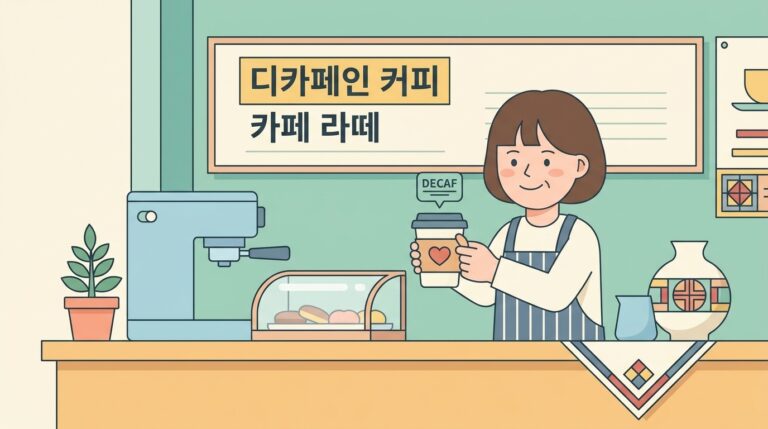
Phase 1: Empathy & Storytelling
안녕하세요! I’m your Daily Hangul editor. If you have spent even a single week in Korea, you already know that this country runs on coffee. From the iconic ‘Eol-juk-a’ (iced Americano even if I freeze to death) lifestyle to late-night study sessions at aesthetic cafes in Seongsu, caffeine is practically the blood type of modern Korea.
However, there comes a point where those three cups of Iced Americano a day catch up with you. Your hands start trembling during a team meeting, your heart pounds frantically while trying to study, or you find yourself staring at the ceiling at 3 AM. When you want to tell your Korean colleagues, “I need to cut down on caffeine,” or ask a barista, “Could you make this decaf or cut the espresso shots?” standard textbook phrases can feel stiff and overly formal.
In this lesson, based on real feedback from intermediate learners living in Seoul, you will master natural, native-level Korean expressions to manage your caffeine intake gracefully without missing out on cafe culture.
Phase 2: 3 Key Expressions Deep Dive
1. 가슴이 두근거려요 (Gaseumi dugeungeoryeoyo)
- Pronunciation: [Ga-seum-i du-geun-geo-ryeo-yo] (Think of ‘du-geun’ sounding like the rhythmic thumping sound of a heartbeat ‘thump-thump’)
- Meaning: Literal: “My chest is throbbing.” / Actual Nuance: “My heart is pounding / fluttering (due to caffeine or nervousness).”
- K-Culture Moment: You are sitting in a cozy Hongdae cafe with friends, and after taking two gulps of a triple-shot cold brew, you hold your chest and say this with a light dramatic sigh.
- Editor’s Insight: ‘두근거리다’ is an mimetic word describing a heartbeat. Using this expression sounds far more natural and emotional than using scientific terms like ‘심장 박동수가 증가했다’ (heart rate increased).
- Situation Spectrum: Casual ✅ | Semi-formal ✅ | Formal ⚠️
- 🤔 Think About It: How does your native language describe physical sensations caused by caffeine compared to emotional heartbeats?
2. 카페인에 민감해요 (Kapeine mingamhaeyo)
- Pronunciation: [Ka-pe-in-e min-gam-hae-yo] (Pronounce ‘ka-pe-in’ smoothly like ‘kah-peh-een’)
- Meaning: Literal: “I am sensitive to caffeine.” / Actual Nuance: “I can’t handle caffeine well / Caffeine affects me strongly.”
- K-Culture Moment: When a coworker offers to buy coffee for the whole team at 4 PM, you decline politely by giving this clear, polite reason.
- Editor’s Insight: This phrase uses the Sino-Korean word ‘민감’ (sensitive). It’s very polite and clearly sets a personal boundary without making anyone feel awkward about ordering coffee.
- Situation Spectrum: Casual ✅ | Semi-formal ✅ | Formal ✅
- 🤔 Think About It: Is declining a drink offer straightforward in your culture, or do you also use indirect explanations like sensitivity?
3. 디카페인으로 변경해 주세요 (Dikapaeineuro byeongyeonghae juseyo)
- Pronunciation: [Di-ka-pae-in-eu-ro byeon-gyeong-hae ju-se-yo]
- Meaning: Literal: “Please change it to decaf.” / Actual Nuance: “Could you make that decaf, please?”
- K-Culture Moment: At the counter of Mega Coffee or Compose Coffee, replacing your usual drink order smoothly at the kiosk or directly to the barista.
- Editor’s Insight: The particle ‘~으로/로’ marks the direction of change. Combining it with ‘변경하다’ (to change/modify) shows confident intermediate Korean skill.
- Situation Spectrum: Casual ⚠️ | Semi-formal ✅ | Formal ✅
- 🤔 Think About It: Why has decaf become so popular in fast-paced Korean urban life recently?
Phase 3: Textbook Korean vs. Real Korean
Situation 1: Asking to reduce espresso shots at a cafe
- 📖 Textbook Korean: 커피 원액을 적게 넣어 주십시오. (Keopi wonaegeul jeokge neo-eo ju-sip-si-o.) – “Please put less coffee extract.”
- 🗣️ Real Korean: 샷 반만 넣어 주시겠어요? / 연하게해 주세요. (Shat ban-man neo-eo ju-si-get-eo-yo? / Yeon-ha-ge hae ju-se-yo.) – “Could you put just half a shot? / Please make it weak.”
- 💡 Why it differs: Koreans rarely say ‘coffee extract’ (원액). Instead, they use loan words like ‘샷’ (shot) or descriptive adjectives like ‘연하게’ (weakly/diluted).
Situation 2: Declining coffee late in the evening
- 📖 Textbook Korean: 밤에 잠을 잘 수 없기 때문에 커피를 마시지 않겠습니다. (Bame jameul jal su eopgi ttaemune keopireul masiji ankeosseumnida.)
- 🗣️ Real Korean: 저 지금 커피 마시면 잠 못 자요. (Jeo ji-geum keo-pi ma-si-myeon jam mot ja-yo.)
- 💡 Why it differs: Spoken Korean prefers direct cause-and-effect structure using conditional ~면 (if) rather than stiff formal grammar like ~때문에 (because of).
Phase 4: K-Culture Deep Dive & Non-Verbal Manners
4-1. Nunchi & Gestures
When mentioning caffeine sensitivity in Korea, gently place your right hand over your left chest and make a light fluttery motion with your fingers while smiling. When asking the barista for custom adjustments, hold both hands together at waist level—this shows respect and keeps the vibe friendly.
4-2. Culture Code: Korea’s Decaf Revolution
Korea is infamous for its ultra-fast coffee consumption, but health consciousness is rising fast among young professionals. Major franchises like Starbucks Korea, Twosome Place, and Paul Bassett now offer high-quality decaf (디카페인) beans. Ordering decaf is no longer seen as fussy; it’s recognized as smart self-care.
Phase 5: Interactive Roleplay Scenario
Setting: Afternoon cafe run with Korean coworker Minji (민지) at a cozy cafe near the office.
- 민지: 에디터 씨, 피곤한데 커피 한잔할래요? 제가 살게요! (Editor, you look tired. Want to grab a coffee? My treat!)
- Learner: 🎭 (Smiles and places hand gently over heart) 고마워요, 민지 씨! 그런데 저 요즘 카페인을 좀 줄이고 있어요. (Thank you, Minji! But I’m trying to cut down on caffeine these days.)
- 민지: 아, 정말요? 왜요? 무슨 일 있어요? (Ah, really? Why? Is something wrong?)
- Learner: 🎭 (Laughs gently) 커피를 많이 마시면 가슴이 두근거려서요. (Because my heart pounds when I drink too much coffee.)
- 민지: 아이구, 그럼 안 되죠! 여기 디카페인 메뉴도 있나 볼까요? (Oh no, then you shouldn’t! Shall we see if they have decaf here?)
- Learner: 🎭 (Nods happily) 네! 디카페인으로 변경할 수 있으면 좋겠어요. (Yes! It would be great if I can switch it to decaf.)
- 민지: 다행히 되네요! 디카페인 라떼로 주문해 드릴게요. (Luckily they do! I’ll order a decaf latte for you.)
- Learner: 🎭 (Bows slightly with two hands together) 정말 감사합니다, 민지 씨! (Thank you so much, Minji!)
🔀 Interactive Choice Point
Minji asks: “커피 대신 따뜻한 녹차(Green Tea) 드실래요?”
* Option A: “좋아요! 녹차는 카페인이 전혀 없죠?” (Great! Green tea has no caffeine at all, right?)
* Option B: “감사하지만 녹차에도 카페인이 있어서, 차라리 허브티나 디카페인이 나을 것 같아요!” (Thank you, but green tea has caffeine too, so herbal tea or decaf would be better!)
* Option C: “싫어요. 그냥 물 마실게요.” (No. I’ll just drink water.)
Feedback:
* Option A (Risk): Factually incorrect! Green tea contains caffeine, which might still trigger side effects.
* Option B (BEST): Polite, accurate, and shows clear B2-level communication skill.
* Option C (Bad): Too blunt and ruins the warm mood of Minji’s treat.
Phase 6: 10-Second Emotional Shadowing Drill
[🥺 Slightly worried]저 / 요즘 / 카페인에 너무 민감해졌어요. / (Jeo / yo-jeum / ka-pe-in-e neo-mu min-gam-hae-jyeoss-eo-yo.)[😊 Relieved]다행히 / 디카페인으로 / 변경 가능하대요! / (Da-haeng-hi / di-ka-pae-in-eu-ro / byeon-gyeong ga-neung-hae-dae-yo!)[☕ Friendly]연하게 / 한 샷만 / 넣어 주시겠어요? / (Yeon-ha-ge / han shat-man / neo-eo ju-si-get-eo-yo?)
Phase 7: K-Culture Mini Dictionary
- 얼죽아 (Eol-juk-a) | Noun | Abbreviation for “얼어 죽어도 아메리카노” (Iced Americano even if I freeze to death). Used playfully to describe iced coffee lovers.
- 디카페인 (Di-ka-pae-in) | Noun | Decaf. Used universally across all Korean cafes.
- 연하게 (Yeon-ha-ge) | Adverb | Weakly / Lightly. Used when requesting fewer shots or more milk/water.
- 카페인 찌듦 (Ka-pae-in jji-deum) | Slang | Being completely soaked/overloaded in caffeine from overwork.
Phase 8: Traveler’s Survival Kit
Top 3 Survival Phrases
- 디카페인 돼요? (Di-ka-pae-in dwae-yo?) – Is decaf available?
- 샷 반만 넣어 주세요. (Shat ban-man neo-eo ju-se-yo.) – Please add only half a shot.
- 밤이라서 디카페인으로 할게요. (Bam-i-ra-seo di-ka-pae-in-eu-ro hal-ge-yo.) – Since it’s night time, I’ll go with decaf.
Editor’s Travel Note
When searching for specialty cafes offering premium decaf beans near your stay, download Naver Map App directly or use KakaoMap to search the keyword ‘디카페인 카페’ (decaf cafe) for real-time customer reviews.
Phase 9: One Step Deeper (Reflective Essay)
In Korea, offering coffee is often less about caffeine itself and more about sharing time and building relationships (‘정’ – Jeong). Refusing coffee flatly can sometimes feel like declining the conversation itself. By knowing how to order decaf or ask for diluted shots, you respect both your physical health and the warm social ritual of Korean office life.
💬 Your Turn: Have you ever felt caffeine jitters in Korea? How do you usually customize your drink? Tell us in the comments below!
Phase 10: FAQ & Common Mistakes
Q: Can I find decaf options in cheap street coffee chains in Korea?
A: Yes! Low-cost chains like Paik’s Coffee (빽다방), Mega Coffee, and Compose Coffee now widely offer decaf espresso modifications for a small extra charge (usually +500 KRW).
Q: Is herbal tea always caffeine-free in Korean cafes?
A: Most herbal teas like Chamomile (카모마일) and Peppermint (페퍼민트) are caffeine-free, but watch out for Green Tea (녹차) and Milk Tea (밀크티) which contain caffeine.
Q: How do I say “no caffeine” in Korean?
A: You can say “카페인 없는 음료 있나요?” (Do you have drinks without caffeine?).
🚨 Common Mistakes Alert
- Mistake 1: Saying “노 카페인” (No caffeine) instead of “디카페인” (Decaf). While understood, ‘디카페인’ is standard.
- Mistake 2: Saying “커피 약하게” instead of “연하게”. Correct action: Use ‘연하게 해 주세요’.
- Mistake 3: Assuming cold brew has less caffeine. In Korea, cold brew often has higher caffeine content than regular Americanos!
Phase 11: Action Mission
- 🥉 Bronze Mission: Practice saying “디카페인으로 변경해 주세요” 3 times out loud.
- 🥈 Silver Mission: Write a comment below sharing your favorite non-caffeinated Korean drink.
- 🥇 Gold Mission: Visit a local Korean cafe or use a ordering app to customize a drink with decaf or ‘연하게’.
🎮 K-Culture Mission: Watch a Korean vlog on YouTube and spot when creators order decaf or talk about caffeine side effects!
Phase 12: Interactive Quiz Challenge
Q1. What does ‘연하게해 주세요’ mean at a cafe?
1) Please make it hot.
2) Please make it weak (fewer shots).
3) Please add extra sugar.
See Answer & Explanation
Correct Answer: 2) Please make it weak.
‘연하다’ means light or diluted in flavor.
Q2. Fill in the blank: “커피를 마시면 가슴이 ________.” (My heart pounds when I drink coffee.)
1) 두근거려요
2) 깨끗해요
3) 조용해요
See Answer & Explanation
Correct Answer: 1) 두근거려요
‘두근거려요’ describes heart pounding or throbbing.
Q3. True or False: Green tea (녹차) in Korea is completely caffeine-free.
See Answer & Explanation
Correct Answer: False!
Green tea naturally contains caffeine, so opt for herbal tea like Chamomile if you need zero caffeine.







