

Phase 1: Empathy & Story Opening
Hello! I’m your Daily Hangul editor.
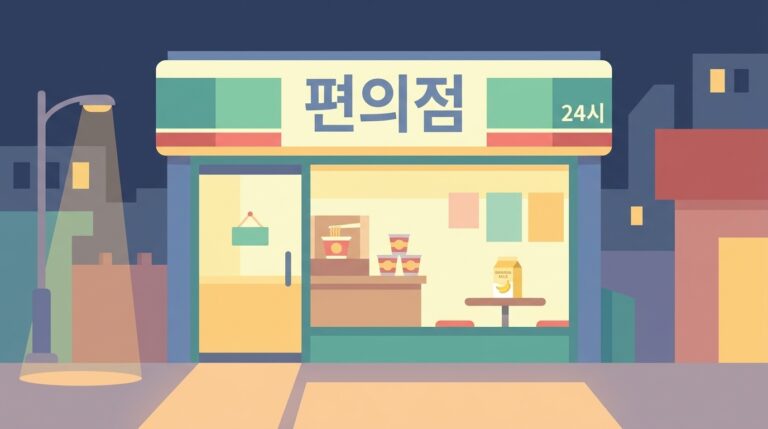
Imagine this: It’s 11:30 PM in Seoul. You’ve been walking around Hongdae or Myeongdong all evening, and your stomach starts rumbling. You step into a bright, welcoming GS25 or CU convenience store. The air smells of rich cup ramen broth, sweet banana milk, and warm toasted sandwiches. You pick up two cup ramens with a brightly colored sticker that says “2+1”, but you hesitate. Can I pick a different flavor for the third one? How do I ask if I can drain the hot water here? Should I pay for a plastic bag?
If you’ve ever felt a moment of panic at a Korean convenience store counter late at night, you are not alone! Many B1 intermediate learners know standard vocabulary, but get tongue-tied when faced with rapid-fire clerk questions or local store etiquette.
This guide is crafted from real learner experiences and feedback. By the end of this post, you’ll master the exact phrases, hidden promo rules, and cultural body language needed to raid any Korean convenience store like a seasoned local!
Phase 2: Core Expressions Deep Dive
1. 이거 2플러스1이에요? (Igeo i-plus-one-ieyo?)
- Pronunciation: [ee-geo ee-plus-won-ee-eyo?] (Sounds like “Ego” + “E-plus-one” + “ee-yo”)
- Meaning: “Is this buy 2 get 1 free?”
- K-Culture Moment: In K-Dramas, broke university students during midterms always search for the green and yellow “2+1” discount tags on ramen shelves.
- Editor’s Insight: Note that Koreans read “2+1” as 이플러스원 (i-plus-one using Sino-Korean numbers), never as “two plus one”. You can also ask “다른 맛으로 섞어도 돼요?” (Can I mix with a different flavor?).
- Situation Spectrum: Casual ✅ | Semi-formal ✅ | Formal ⚠️
- 🤔 Think About It: Why do Korean convenience stores favor multi-buy promos (2+1, 1+1) over simple percentage price cuts?
2. 국물 좀 버려도 돼요? (Gungmul jom beoryeodo dwaeyo?)
- Pronunciation: [Goong-mool jom beo-ryeo-do dwae-yo?]
- Meaning: “Can I drain the soup broth here?”
- K-Culture Moment: Eating dry or spicy stir-fry noodles like Buldak or Chapaguri inside the store requires draining the boiling water into a designated sink counter.
- Editor’s Insight: Korean stores have a specialized sink next to the hot water dispenser marked 국물 버리는 곳 (broth disposal). Asking politely before using it shows high cultural awareness.
- Situation Spectrum: Casual ✅ | Semi-formal ✅ | Formal ✅
- 🤔 Think About It: How does dedicated recycling and waste disposal inside small stores reflect broader Korean social responsibilities?
3. 괜찮아요, 그냥 갈게요. (Gwaenchanayo, geunyang galgeyo.)
- Pronunciation: [Gwaen-cha-na-yo, geu-nyang gal-ge-yo]
- Meaning: “It’s okay, I’ll just take it as is (without a bag).”
- K-Culture Moment: When the clerk asks “봉투 필요하세요?” (Do you need a bag?), locals who bought just 2-3 items routinely reply with this while tucking snacks into their jacket pockets or backpack.
- Editor’s Insight: Plastic bags cost around 20-50 KRW by law in Korea. Saying “그냥 갈게요” (literally: I will just go) sounds much more natural than saying “봉투 없어도 돼요”.
- Situation Spectrum: Casual ✅ | Semi-formal ✅ | Formal ✅
- 🤔 Think About It: What everyday phrase in your native language directly translates to carrying items without a bag?
Phase 3: Textbook Korean vs. Real Korean
Situation 1: Paying at the Counter
- 📖 Textbook Korean: 이것을 계산해 주십시오. (Igeoseul gyesanhae jusipseo. – Please calculate this.)
- 🗣️ Real Korean: 이것도 같이 계산해 주세요! (Igeodo gachi gyesanhae juseyo! – Please scan this together too!)
- 💡 Why different? Koreans rarely use super-formal imperatives like ~주십시오 in stores. Adding 같이 (together) smoothly groups your snacks and drinks into one payment.
Situation 2: Heating Food
- 📖 Textbook Korean: 이것을 전자레인지에 데워 주시겠습니까? (Igeoseul jeonjareinjie deoweo jusigessneumnika?)
- 🗣️ Real Korean: 이거 데워 먹어야 돼요? (Igeo deoweo meogeoya dwaeyo? – Do I need to heat this up to eat it?)
- 💡 Why different? In Korean convenience stores, heating food is usually self-service using public microwaves. Asking if it needs heating is the practical native approach.
Phase 4: K-Culture Deep Dive & Non-verbal Manners
4-1. Nunchi & Gestures
- The Two-Handed Hand-off: Always hand over your credit card or cash using both hands or with your right hand supported by your left forearm/elbow. Doing it single-handed can look dismissive.
- Nodding Etiquette: When entering or leaving, a slight 15-degree head nod accompanied by “수고하세요~” (Keep up the good work!) makes you instantly beloved by night-shift staff.
4-2. Culture Code Analysis: Convenience Store Gastronomy (편창고)
In Korea, convenience stores are full dining spaces equipped with hot water, microwave lines, and eating counters. Creating custom snack combinations—like mixing Mark Meal (떡볶이 + spaghetti + cheese) or adding string cheese to spicy cup ramen—is a celebrated food subculture featured constantly on YouTube and K-Variety shows.
Phase 5: Real-Life Roleplay Scenario
Setting: 12:00 AM at a bustling CU Store near Hongik University Station.
Characters: You (Hungry Traveler) & Minji (Friendly Night-Shift Part-Timer)
- Minji: 어서 오세요! 찾으시는 거 있으세요? (Eoseo oseyeo! Chajeusineun geo isseuseyo?)
- [🎭 Smiling, scanning incoming items] “Welcome! Looking for anything specific?”
- You: 안녕하세요! 저… 이거 2플러스1 맞아요? (Annyeonghaseyo! Jeo… igo i-plus-one majayeo?)
- [🎭 Pointing at two different ramen cups hesitantely] “Hello! Uh… is this buy 2 get 1 free?”
- You: 다른 맛으로 하나 더 가져와도 돼요? (Dareun maseuro hana deo gajeowa-do dwaeyo?)
- [🎭 Holding up a spicy flavor and a mild flavor] “Can I get one more in a different flavor?”
- Minji: 네, 행사 상품 라벨 붙은 거면 섞어서 가져오셔도 돼요! (Ne, haengsa sangpum rabel buteun geomyeon seokkeoseo gajeoosyeodo dwaeyo!)
- [🎭 Nodding, pointing toward the shelf] “Yes, as long as it has the promo tag, you can mix and match!”
- You: 아, 감사해요! 이것도 같이 계산해 주세요. (A, gamsahaeyo! Igeodo gachi gyesanhae juseyo.)
- [🎭 Placing a banana milk and chopsticks on the counter] “Ah, thank you! Please scan this together too.”
- Minji: 봉투 필요하세요? 100원 추가돼요. (Bongtu piryohaseyo? Baek-won chugadwaeyo.)
- [🎭 Holding a plastic bag ready] “Do you need a bag? It’s an extra 100 won.”
- You: 괜찮아요, 그냥 갈게요! 혹시 뜨거운 물 어디서 받아요? (Gwaenchanayo, geunyang galgeyo! Hoksi tteugeowun mul eodiseo badayeo?)
- [🎭 Shrugging cheerfully, gesturing to backpack] “It’s fine, I’ll just carry it! By the way, where can I get hot water?”
- Minji: 문 옆 핫스테이션 이용하시면 돼요! 수고하세요~ (Mun yeop hot-station iyonghasimyeon dwaeyo! Sugohaseyo~)
- [🎭 Pointing toward the hot water dispenser near the window] “You can use the hot station next to the door! Have a great night!”
🔀 Interactive Choice Point
The clerk asks if you want your lunchbox heated, but there is a long line behind you! What do you do?
* Option A: “아뇨, 제가 직접 데울게요!” (No, I’ll heat it myself!)
* Option B: “네, 데워 주실 때까지 여기서 기다릴게요.” (Yes, I’ll stand right here and wait for you to do it.)
* Option C: Say nothing and just point at the microwave.
- Result Feedback:
- Option A [BEST]: Perfect! In Korean convenience stores, self-service heating is expected during busy hours. It shows great nunchi!
- Option B [BAD]: While polite, it slows down the queue and puts unnecessary pressure on the lone night clerk.
- Option C [RISK]: Silence without a gesture might come across as rude or indifferent.
Phase 6: 10-Second Emotion Shadowing Drill
Practice reading these out loud with appropriate emotional inflection!
- [😊 Exciting & Upbeat]
이거 / 2플러스1 맞아요? / 하나 더 가져올게요!
(Igeo / i-plus-one majayeo? / Hana deo gajeoolgeyo!) -
[🥺 Polite & Inquiring]
저기요, / 국물 좀 / 버려도 돼요?
(Jeogiyo, / gungmul jom / beoryeodo dwaeyo?) -
[😎 Cool & Casual]
봉투는 됐어요, / 그냥 갈게요!
(Bongtuneun dwaesseoyo, / geunyang galgeyo!)
Phase 7: K-Culture Mini Dictionary
- 야식 (Yasik) | Late-night Snack | Eating food late at night, a deeply cherished social habit in South Korea’s night-owl lifestyle.
- 행사상품 (Haengsa-sangpum) | Promotional Items | Products marked with 1+1, 2+1, or special gift tag deals.
- 삼각김밥 (Samgak-gimbap) | Triangle Rice Ball | Cheap, satisfying seaweed-wrapped rice balls filled with tuna mayo, spicy pork, or bulgogi.
- 폐기 (Pyegi) | Expired / Pulled Stock | Items past their strict shelf-life hour. Convenience store part-timers famously eat these during breaks!
Phase 8: Traveler’s Survival Kit
TOP 3 Survival Phrases
- 젓가락 챙겨주세요. (Jeotgarak chaenggyeojuseyo.) – Please give me wooden chopsticks.
- 영수증은 버려주세요. (Yeongsujeungeun beoryeojuseyo.) – Please toss the receipt.
- 교통카드 충전해 주세요. (Gyotong-kadeu chungjeonhae juseyo.) – Please top up my transit card.
Editor’s Travel Note
- Navigation Tip: Check store locations using the Naver Map application download page before heading out at night.
- Payment Tip: Most stores accept international credit cards, but topping up your physical transportation card requires cash KRW banknotes at the counter!
Phase 9: “One Step Deeper” (Cultural Reflection)
South Korea’s low crime rate and vibrant 24-hour infrastructure have turned the neighborhood convenience store into more than just a retail shop—it is a community sanctuary. Whether it is a stressed high school student eating ramen at 1 AM or salary workers sharing a quick beer outside, these lit signs offer warmth and safety in urban nights.
💬 Your Turn: What is your go-to late-night comfort food when you visit a store in your country vs. Korea? Tell us in the comments below!
Phase 10: FAQ & Common Mistakes
Q: Can I mix different brands under a 2+1 promotion?
A: Generally no, but you CAN mix different flavors of the same brand and price range (e.g., Shin Ramyun Red and Shin Ramyun Black if marked under the same promo tag).
Q: Is hot water free at Korean convenience stores?
A: Yes! Hot water dispensers are free to use for instant products purchased inside the store.
Q: Can I sit and eat inside every store?
A: Most medium-to-large stores have window counter seats (야외 테이블 or indoor bar), but very small neighborhood shops may not. Look for microwave and stool setups near the window.
🚨 Common Mistakes TOP 3
- Mistake: Throwing leftover noodle soup into the regular trash bin.
- Correct Action: Drain liquids in the dedicated 국물 버리는 곳 sink first, then discard empty containers in the plastic/paper bin.
- Mistake: Pronouncing 2+1 as “Two plus One”.
- Correct Action: Say “이플러스원” (I-plus-one) using Sino-Korean numbers.
- Mistake: Handing over payment cards with one finger/hand.
- Correct Action: Use both hands or rest your left hand on your right wrist as a gesture of polite respect.
Phase 11: Action Mission
- 🥉 Bronze Mission: Practice saying “괜찮아요, 그냥 갈게요!” 3 times out loud in front of a mirror.
- 🥈 Silver Mission: Spot a 2+1 promotion tag in a K-drama or Korean vlog and screenshot it.
- 🥇 Gold Mission: Enter a local Korean grocery or store and order/pay entirely using the expressions learned today!
🎮 K-Culture Mission: Watch a video of Mark Meal (마크정식) on YouTube and write down three convenience store ingredients used in Korean!
Phase 12: Interactive Quiz Challenge
1. Scenario Question
You want to buy two cup ramens and get one free. What phrase should you ask the cashier?
* A) 이거 2플러스1이에요?
* B) 이거 할인해 주세요.
* C) 이거 얼망예요?
Click to reveal answer & explanation
Correct Answer: A
Explanation: Option A (이거 2플러스1이에요?) asks specifically if the item qualifies for the Buy 2 Get 1 promotion.
2. Fill-in-the-Blank
“When declining a plastic bag, say: ‘괜찮아요, ______ 갈게요!'”
* A) 빨리 (ppalli)
* B) 그냥 (geunyang)
* C) 혼자 (honja)
Click to reveal answer & explanation
Correct Answer: B
Explanation: 그냥 means ‘just/as is’. 그냥 갈게요 translates to “I will just go (without a bag)”.
3. True or False
Hot water inside Korean convenience stores costs 500 KRW extra.
* [ ] True
* [ ] False
Click to reveal answer & explanation
Correct Answer: False
Explanation: Hot water and microwave usage are completely free for items purchased at the store!







