

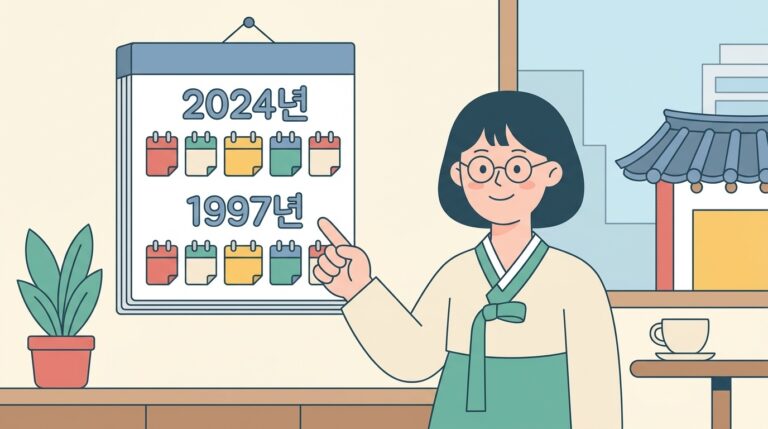
Master Reading Years in Korean: The Ultimate A2 Guide
Phase 1: Empathy & Storytelling Opening
안녕하세요! 매일한글 에디터입니다.
Imagine this: You are watching your favorite K-Drama, and a romantic flashback scene pops up with text on the screen: 1997년. Or you are chatting with a Korean friend who asks, “몇 년생이에요?” (What year were you born?). You know the numbers in Korean, but suddenly your mind goes blank. Should you say “일구구칠”? Or break it down into thousands?
Reading years in Korean is one of the biggest hurdles for A2 learners because Korean uses Sino-Korean numbers for dates, and the compound words can sound like a tongue twister! But don’t worry. Based on feedback from hundreds of our learners at Daily Hangul, we have broken down the exact formula. By the end of this guide, you will effortlessly read any year from 1990 to 2025 in Korean and sound just like a local friend!
Phase 2: Core Expressions Deep Dive
1. 이천이십사년 (Year 2024)
- Pronunciation: [I-cheon-i-sip-sa-nyeon] (Sounds like: Ee-cheon-ee-ship-sah-nyuhn)
- Meaning: Year 2024 (Literally: Two-Thousand Two-Ten Four Year)
- K-Culture Moment: You hear this at the start of every end-of-year K-Pop award show like MAMA or MMA!
- Editor’s Insight: To read years, simply break down the digits into standard mathematical thousands, hundreds, tens, and units using Sino-Korean numbers (일, 이, 삼, 사…), then add 년 (nyeon / year) at the end.
- Situation Spectrum: Casual ✅ | Semi-formal ✅ | Formal ✅
- 🤔 Think About It: In English, you split years into two pairs (20-24). In Korean, you say the full number (2000 + 20 + 4). Which system feels more logical to you?
2. 천구백구십칠년 (Year 1997)
- Pronunciation: [Cheon-gu-baek-gu-sip-chil-nyeon] (Sounds like: Chuhn-goo-baek-goo-ship-cheel-nyuhn)
- Meaning: Year 1997
- K-Culture Moment: Famous in K-Dramas like Reply 1997 or when referring to the legendary K-Pop ’97 liners (like BTS’s Jungkook and Cha Eun-woo).
- Editor’s Insight: Notice that for 1,000, Koreans usually say 천 (cheon) instead of 일천 (il-cheon). Leaving out the initial “1” makes your speech sound much more natural!
- Situation Spectrum: Casual ✅ | Semi-formal ✅ | Formal ✅
- 🤔 Think About It: Why do you think birth years form such strong social bonds among people in Korea?
3. 몇 년도 (Which Year / What Year)
- Pronunciation: [Myeon-nyeon-do] (Sounds like: Myuhn-nyuhn-doh)
- Meaning: What year / Which calendar year
- K-Culture Moment: Asked when inquiring about movie release dates or university enrollment years.
- Editor’s Insight: Due to Korean sound change rules (nasalization), 몇 년 [myeot-nyeon] is pronounced as [면년 / myeon-nyeon]. The ‘ㄷ’ sound in ‘몇’ softens into an ‘ㄴ’ sound before ‘년’.
- Situation Spectrum: Casual ✅ | Semi-formal ✅ | Formal ✅
- 🤔 Think About It: How does changing sounds to make pronunciation smoother exist in your native language?
Phase 3: Textbook Korean vs. Real Korean
Situation 1: Stating Your Birth Year
- 📖 Textbook: “저는 이천이년에 태어났어요.” (I was born in the year 2002.)
- 🗣️ Real Korean: “저 공이년생이에요!” (I’m an ’02-liner!)
- 💡 Why the difference?: In daily casual conversations, Koreans shorten birth years by taking the last two digits and replacing ‘0’ with ‘공 (gong)’. Then they add ‘년생 (born year)’. It’s quick, friendly, and super natural!
Situation 2: Asking Which Year a Drama Came Out
- 📖 Textbook: “이 드라마는 몇 년도에 나왔습니까?” (In which year was this drama released?)
- 🗣️ Real Korean: “이 드라마 몇 년도 거예요?” (Which year is this drama from?)
- 💡 Why the difference?: Real speech drops formal particles like ‘-에’ and uses ‘거’ (thing/one) to keep the flow relaxed and conversational.
Phase 4: K-Culture Deep Dive & Non-verbal Manners
4-1. Gestures & Eye Contact
When stating your birth year or age in Korea, subtle body language matters. If you are stating your birth year to someone older, make slight eye contact, smile, and bow your head very lightly. Avoid using hand gestures to count numbers in front of elders, as stating numbers cleanly with proper eye contact shows sincerity and respect.
4-2. Culture Code: The ‘N-Line’ Bonding (년생 Culture)
In Korea, learning someone’s birth year isn’t just a fact—it determines social dynamics! People born in the same year are 동갑 (dong-gap / same age) and can instantly drop formal speech to become close friends. That’s why K-Pop idols born in the same year, like the ’97 line or ’00 line, form famous celebrity friendship squads!
Phase 5: Real-Life Roleplay Scenario
Setting: You are at a K-Pop poster gallery with your Korean friend, Minho (민호).
- Turn 1 (Minho): “이 BTS 포스터 좀 봐! 완전 추억이다. 너 BTS 몇 년도에 데뷔했는지 알아?”
(Look at this BTS poster! Such memories. Do you know what year BTS debuted?) - Turn 2 (You): 🎭 Smiling casually “글쎄요… 이천십삼년 맞죠?”
(Well… it’s 2013, right?) - Turn 3 (Minho): “정답! 이천십삼년 6월이야. 그럼 너는 몇 년생이야?”
(Correct! June 2013. Then what year were you born?) - Turn 4 (You): 🎭 Thinking for a second “저는 이천사년생이에요.”
(I was born in 2004.) - Turn 5 (Minho): “아, 진짜? 그럼 공사년생이네! 완전 어리다!”
(Oh, really? So you’re an ’04-liner! You’re so young!) - Turn 6 (You): 🎭 Laughing “민호 씨는 몇 년도 학번이에요?”
(Which university class year are you, Minho?) - Turn 7 (Minho): “나? 나는 이공학번! 이천이십년도에 입학했어.”
(Me? I’m class of ’20! I entered in 2020.) - Turn 8 (You): 🎭 Nodding “아, 이천이십년! 이제 기억했어요!”
(Ah, 2020! Now I understand!)
🔀 Interactive Choice Point
Minho asks you: “너는 몇 년도에 한국에 처음 왔어?” (Which year did you first come to Korea?)
- Option A: “이천이십삼년요!”
- Option B: “이천이십삼 년에 왔어요.”
- Option C: “이공이삼 왔어요.”
Feedback:
- Best Choice (Option B): Perfect! Clear Sino-Korean number with correct particle ‘-에’ and polite verb ending.
- Good Choice (Option A): Accurate year number, polite ‘요’, though missing the full sentence structure.
- Risk Choice (Option C): Unnatural! While digit-by-digit reading works for phone numbers, full years require full numbers like ‘이천이십삼년’.
Phase 6: 10-Second Emotion Shadowing Drill
Practice reading these out loud with emotion! Pay attention to the / pause marks.
[😊 Proud & Confident]저는 / 이천이년생이에요! (I am born in 2002!)[🤔 Curious & Intrigued]이 영화 / 몇 년도 거예요? (Which year is this movie from?)[🎉 Excited & Happy]이천이십오년에 / 한국에서 만나요! (Let’s meet in Korea in 2025!)
Phase 7: K-Culture Mini Dictionary
- 년도 (Nyeon-do) | Calendar Year / Academic Year | Used when specifying a particular year (e.g., 2024년도).
- 생년월일 (Saeng-nyeon-wol-il) | Date of Birth | Official form term for Birth Year-Month-Day.
- 학번 (Hak-beon) | University Student ID / Year of Entry | Class year based on admission (e.g., 20학번 = Class of ’20).
- 공공년생 (Gong-gong-nyeon-saeng) | ’00-Liner | Refers to someone born in the year 2000.
Phase 8: Traveler’s Survival Kit
Top 3 Survival Expressions
- 몇 년생이에요? [Myeon-nyeon-saeng-i-e-yo?] – What year were you born?
- 이천이십사년 신상이에요? [I-cheon-i-sip-sa-nyeon sin-sang-i-e-yo?] – Is this a 2024 new release item?
- 몇 년도 건물이에요? [Myeon-nyeon-do geon-mul-i-e-yo?] – Which year was this building built?
Editor’s Travel Note
When visiting historical places in Seoul like Gyeongbokgung Palace, checking building dates adds so much depth! You can search details directly using the 네이버 지도 앱 다운로드 to find historic sites and their foundation years in Korean.
Phase 9: One Step Deeper (Thoughtful Essay)
In many Western cultures, asking someone’s birth year right after meeting might feel overly personal. However, in Korea, knowing the birth year helps people establish proper honorifics, respectful titles, and comfortable social boundaries. It is not about discrimination; it is about finding your place in the harmony of the social circle. Understanding year numbers opens the door to genuine connection with Koreans.
💬 Your Turn: What year were you born? Try writing your birth year in Korean in the comments below! (e.g., “저는 천구백구십구년생이에요!”)
Phase 10: FAQ & Common Mistakes
Q: Do I use Native Korean numbers or Sino-Korean numbers for years?
A: Always use Sino-Korean numbers (일, 이, 삼, 사…) for years, months, and days. Native Korean numbers (하나, 둘, 셋…) are used for counting hours or general items!
Q: How do I pronounce 2000년?
A: Read it as 이천년 [I-cheon-nyeon]. Do not read each zero individually!
Q: Is ‘몇 년’ pronounced as ‘Myeot nyeon’?
A: No! Because of sound nasalization, the ‘ㄷ’ sound at the end of ‘몇’ changes to an ‘ㄴ’ sound when followed by ‘년’, making it sound like [면년 / Myeon-nyeon].
🚨 Common Mistakes Alert!
- Mistake: Saying 스물두 년 for 22 years or year 2022.
- Correct Action: Use Sino-Korean numbers! Say 이십이년.
- Mistake: Pronouncing 1995 as 일구구오 년 in formal conversation.
- Correct Action: Say the full thousands unit: 천구백구십오년.
- Mistake: Writing dates without ‘년’.
- Correct Action: Always attach 년 directly after the digits or Sino-Korean words (e.g., 2024년).
Phase 11: Action Mission & Engagement
🎯 Action Mission
- Bronze: Read today’s year (2024년) out loud 5 times using proper Sino-Korean numbers.
- Silver: Write your birth year in Korean on a sticky note and post it on your study desk.
- Gold: Post a comment below stating your favorite K-Pop idol’s debut year in Korean!
🎮 K-Culture Mission
Find your favorite K-Drama on Netflix and check its release year. Say the year out loud in Korean before starting the episode!
Phase 12: Interactive Quiz Challenge
Quiz 1: How do you read 1998년 in Korean?
1) 일구구팔년
2) 천구백구십팔년
3) 만구백구십팔년
🔍 Click to reveal Answer & Explanation
Answer: 2) 천구백구십팔년
* Explanation: 1,000 = 천, 900 = 구백, 90 = 구십, 8 = 팔 + 년. Put them together to get 천구백구십팔년!
Quiz 2: Fill in the blank
“저는 2005년에 태어났어요. 저는 [ ]년생이에요.”
1) 공오
2) 이오
3) 이천오
🔍 Click to reveal Answer & Explanation
Answer: 1) 공오
* Explanation: In casual speech, birth years like ’05 are shortened to ‘공오년생’.
Quiz 3: True or False?
In Korean, Native Korean numbers (하나, 둘, 셋) are used to read years.
🔍 Click to reveal Answer & Explanation
Answer: False
* Explanation: Years, months, and dates always use Sino-Korean numbers (일, 이, 삼…).







