

Phase 1: Empathy & Storytelling
안녕하세요! 매일한글 에디터입니다. (Hello! This is your Daily Hangul editor.)
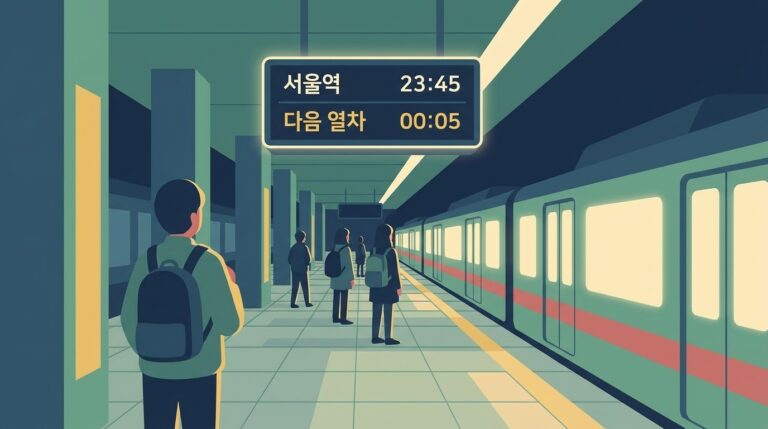
Picture this: You just spent an incredible evening with friends in Hongdae. You enjoyed delicious Korean BBQ, sang your heart out at a noraebang (노래방), and lost track of time. Suddenly, someone glances at their watch and gasps, “막차! (Makcha!)” Everyone grabs their coats and starts sprinting toward the subway station.
If you have ever traveled in Korea or watched modern K-dramas, this midnight scramble feels all too familiar. Public transportation in South Korea is world-class, clean, and punctual—but when midnight approaches, the race against the last train begins. Trying to figure out if you can catch the last bus or subway in a foreign language can be incredibly nerve-wracking. Will you get stuck taking an expensive taxi, or worse, miss your ride completely?
Don’t worry! Today, we are going to master practical Korean phrases for checking last train and bus schedules so you can navigate Korean nightlife like a confident local. Based on feedback from hundreds of intermediate learners, this guide covers real spoken expressions, subtle cultural nuances, and real-life scenarios to keep you moving safely.
Phase 2: Core Expressions Deep Dive
1. 막차 몇 시에 있어요? (Makcha myeot sie issoyo?)
- Pronunciation: [Mak-cha myeot si-e it-seo-yo?] (Sounds like: mahkt-chah myut shee-eh it-seh-yoh)
- Meaning: Literal: “What time is the last vehicle?” | Natural: “What time is the last train/bus?”
- K-Culture Moment: Seen in almost every K-drama slice-of-life scene where coworkers gather for dinner after work and need to head home before midnight.
- Editor’s Insight: “막차” (mak-cha) combines “막” (last/final) and “차” (vehicle/train/bus). You can use this versatile word for both subway trains and buses!
- Situation Spectrum:
- Casual: 막차 몇 시야? (⚠️ Friends/younger people)
- Semi-formal: 막차 몇 시에 있어요? (✅ Polite standard)
- Formal: 막차가 몇 시에 있습니까? (🚫 Too rigid for casual street situations)
- 🤔 Think About It: In many Western cities, late-night transit runs 24/7 or tapers off slowly. Why do you think Korean urban life revolves so dramatically around the precise moment of “막차”?
2. 이거 막차예요? (Igeo makchayeyo?)
- Pronunciation: [I-geo mak-cha-ye-yo?] (Sounds like: ee-geoh mahkt-chah-yeh-yoh)
- Meaning: Literal: “Is this the last vehicle?” | Natural: “Is this the last train/bus?”
- K-Culture Moment: Said breathlessly to a station worker or fellow passenger as you jump onto a platform just as the train doors hover open.
- Editor’s Insight: Use this when you are standing on the platform or stepping onto a bus and need immediate confirmation before the doors close.
- Situation Spectrum:
- Casual: 이거 막차야? (⚠️ Friends)
- Semi-formal: 이거 막차예요? (✅ Perfect for strangers/station staff)
- Formal: 이것이 막차입니까? (🚫 Sounds like a textbook robotic line)
- 🤔 Think About It: Notice how Korean uses simple demonstrative pronouns like “이거” (this) to make urgent questions fast and direct. How does your native language shorten urgent questions?
3. 막차 놓치면 어떡해요? (Makcha notchimyeon eotteokhaeyo?)
- Pronunciation: [Mak-cha not-chi-myeon eo-tteo-kae-yo?] (Sounds like: mahkt-chah not-chee-myun uh-tteoh-kae-yoh)
- Meaning: Literal: “If I miss the last train, what do I do?” | Natural: “What should I do if I miss the last train?”
- K-Culture Moment: Said jokingly (or nervously) at a dinner gathering when your Korean host tries to pour you another glass of tea or drink late at night.
- Editor’s Insight: “놓치다” means “to miss (a ride/opportunity)”. Combining it with “-면 어떡해요” expresses worry or asks for an alternative solution.
- Situation Spectrum:
- Casual: 막차 놓치면 어떡해? (⚠️ Close peers)
- Semi-formal: 막차 놓치면 어떡해요? (✅ Natural & empathetic)
- Formal: 막차를 놓치면 어떻게 합니까? (🚫 Rarely used in spoken English-Korean exchanges)
- 🤔 Think About It: How does asking for advice in emergency situations reflect the helpful, community-oriented mindset in Korean culture?
Phase 3: Textbook Korean vs. Real Native Korean
Situation 1: Asking when the last train leaves
- 📖 Textbook Korean: 마지막 지하철은 몇 시에 출발합니까? (Majimak jihacheoreun myeot sie chulbalhamnika?)
- 🗣️ Real Native Korean: 막차 몇 시예요? (Makcha myeot siyeyo?)
- 💡 Why the Difference? Native speakers drop redundant words like “지하철” (subway) when context is clear and shorten “마지막 차” to the compound word “막차”.
Situation 2: Asking if the service has stopped
- 📖 Textbook Korean: 지금 운행이 종료되었습니까? (Jigeum unhaengi jongryodeoessumnika?)
- 🗣️ Real Native Korean: 아직 막차 안 끊겼죠? (Ajik makcha an kkeunkeyotjyo?)
- 💡 Why the Difference? Koreans naturally use the dynamic verb “끊기다” (to be cut off) to describe transit routes stopping for the night.
Phase 4: K-Culture Deep Dive & Non-verbal Manners
4-1. Nunchi (눈치) & Body Language
When asking station staff or bus drivers about the last train under time pressure:
* Slight Head Nod: Bring your head down slightly in a quick bow while making eye contact.
* Hand Gesture: Slightly open your palm facing upward when asking your question—it looks polite without slowing down your interaction.
* Nunchi Tip: If you see the digital signs at subway turnstiles flashing red or displaying empty lines, read the room (눈치)! It means services are ending fast.
4-2. Cultural Code: The Midnight Rush Culture
In South Korea, social gatherings often go into multiple rounds called 1차 (first round), 2차 (second round), and 3차 (third round). Because taxi demand surges around midnight, catching the
Frequently Asked Questions (FAQ)
Q: What does "막차 몇 시에 있어요? (Makcha myeot sie issoyo?)" mean in Korean and how do you pronounce it?
A: In Korean, "막차 몇 시에 있어요? (Makcha myeot sie issoyo?)" is pronounced [Mak-cha myeot si-e it-seo-yo?] and means: Literal: "What time is the last vehicle?" | Natural: "What time is the last train/bus?"
Q: What does "이거 막차예요? (Igeo makchayeyo?)" mean in Korean and how do you pronounce it?
A: In Korean, "이거 막차예요? (Igeo makchayeyo?)" is pronounced [I-geo mak-cha-ye-yo?] and means: Literal: "Is this the last vehicle?" | Natural: "Is this the last train/bus?"
Q: What does "막차 놓치면 어떡해요? (Makcha notchimyeon eotteokhaeyo?)" mean in Korean and how do you pronounce it?
A: In Korean, "막차 놓치면 어떡해요? (Makcha notchimyeon eotteokhaeyo?)" is pronounced [Mak-cha not-chi-myeon eo-tteo-kae-yo?] and means: Literal: "If I miss the last train, what do I do?" | Natural: "What should I do if I miss the last train?"







