

Phase 1: Empathy & Storytelling Opening
안녕하세요! (Annyeonghaseyo!) I’m your Daily Hangul editor, your friendly 10-year local culture navigator!
Have you ever stood in front of a Korean convenience store clerk or met your Korean friend’s parents and froze for a microsecond? Your head starts spinning: “Should I bow? How low do I bend? Do I make eye contact, or look at the floor? Should I bow and speak at the exact same time?”
If you’ve ever felt awkward bowing in Korea, you are not alone! Many language learners learn words like “안녕하세요” from textbooks, but when it comes to combining speech with physical etiquette, it suddenly feels like a high-stakes dance routine. You might wonder if a quick head nod makes you look rude, or if a deep 90-degree waist bow makes you look like you’re in a historical period drama!
Don’t worry! Today, we’re going to break down the exact art of Korean bowing (인사 – Insa). Based on real student experiences and daily native life in Seoul, this guide will turn your awkward wobble into smooth, natural, and respectful Korean greeting confidence!
Phase 2: Deep Dive into 3 Key Expressions
1. 안녕하세요 (Annyeong-ha-se-yo)
- Pronunciation: [An-nyeong-ha-se-yo] (Sounds like: Ahnn-yung-hah-say-yo)
- Meaning: Literal: “Are you in peace?” / Actual: “Hello! / Good day!”
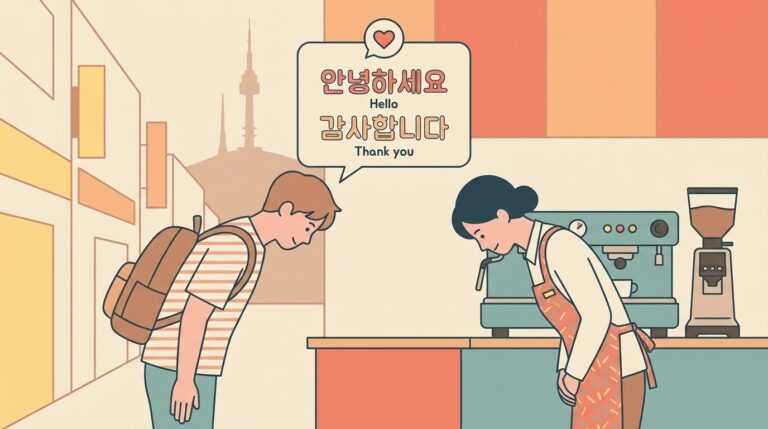
- K-Culture Moment: Every time a character enters a cafe or meets a coworker in a K-drama, they tilt their upper body forward about 15 to 30 degrees and say this with a warm smile.
- Editor’s Insight: This is your ultimate Swiss Army knife phrase. Paired with a gentle 15-degree bow, it instantly makes you appear polite and warm.
- Situation Spectrum: Casual 🚫 | Semi-formal ✅ | Formal ✅
- 🤔 Think About It: In English, we ask “How are you?”. In Korean, asking if someone is “in peace” shows how deeply harmony and safety are valued in social connections. How does your language express peaceful wishes?
2. 감사합니다 (Gam-sa-ham-ni-da)
- Pronunciation: [Gam-sa-ham-ni-da] (Sounds like: Kahm-sah-hahm-nee-dah)
- Meaning: Literal: “I do gratitude.” / Actual: “Thank you very much.”
- K-Culture Moment: When receiving your iced Americano at a Seoul coffee shop, you make light eye contact, take the cup with two hands, and give a short 15-degree bow while saying this.
- Editor’s Insight: In Korea, saying thank you is almost always accompanied by a physical nod or micro-bow. Doing both shows sincere appreciation!
- Situation Spectrum: Casual ⚠️ | Semi-formal ✅ | Formal ✅
- 🤔 Think About It: Why do you think adding a physical gesture like a bow strengthens the feeling of gratitude compared to words alone?
3. 안녕히 계세요 (An-nyeong-hi gye-se-yo)
- Pronunciation: [An-nyeong-hi gye-se-yo] (Sounds like: Ahn-yung-hee gyeh-say-yo)
- Meaning: Literal: “Please stay in peace.” / Actual: “Goodbye (to someone staying).”
- K-Culture Moment: Leaving a cozy restaurant or hotel reception desk after checking out.
- Editor’s Insight: Remember: if you are leaving and the other person is staying, use “계세요” (gyese-yo). Bow lightly as you turn toward the door!
- Situation Spectrum: Casual 🚫 | Semi-formal ✅ | Formal ✅
- 🤔 Think About It: Korean distinguishes between leaving someone who stays vs. leaving someone who is also leaving. What does this tell you about Korean spatial awareness?
Phase 3: Textbook Korean vs Real-World Korean
Situation 1: Entering a Neighborhood Bakery or Cafe
- 📖 Textbook Korean: 안녕하십니까? (Annyeong-haseimnika? – Very formal/military tone)
- 🗣️ Real Korean: 안녕하세요~! (Annyeong-haseyo~! – Upbeat tone with a smooth 15° head-and-shoulder bow)
- 💡 Why the difference? “안녕하십니까?” is great for news anchors or formal business presentations, but in daily life, an upbeat “안녕하세요!” makes you feel approachable and friendly!
Situation 2: Expressing Gratitude in Daily Life
- 📖 Textbook Korean: 대단히 감사합니다. (Daedan-hi gamsahamnida. – Extremely formal)
- 🗣️ Real Korean: 감사합니다! (Gamsahamnida! – Friendly, accompanied by a polite mini-bow)
- 💡 Why the difference? Overly rigid formal phrases can create emotional distance in daily casual interactions.
Phase 4: K-Culture Deep Dive & Non-verbal Manners
4-1. Nunchi (눈치) & Gestures: Bowing Angles Masterclass
- 15° Bow (Casual/Daily): Perfect for shopkeepers, neighbors, or acquaintances. Lower your eyes slightly, tilt from the waist/neck smoothly.
- 30° Bow (Respectful Standard): Used when meeting elders, bosses, or new acquaintances. Hands neatly placed at your sides or folded in front.
- 45° Bow (Deep Respect): Reserved for formal ceremonies, deep apologies, or meeting high-profile elders.
* Pro Tip on Eye Contact: Do NOT keep eye contact while bending down! Lower your gaze naturally as your torso bends. Looking straight into someone’s eyes while bowing can feel aggressive.
4-2. Cultural Code Analysis: The K-Pop & K-Drama Bow
Notice how idol groups bow 90 degrees when backstage, or how K-drama characters bow slightly even when talking on the phone! Bowing is so deeply ingrained that Koreans often nod and bow unconsciously while holding a mobile phone. Try it—it’s surprisingly fun!
Phase 5: Practical Roleplay Scenario
Setting: A cozy neighborhood cafe in Hongdae. You are meeting Minjun (민준), a friendly Korean language partner, for the first time.
- Turn 1 (Minjun): 안녕하세요! XX 씨 맞으시죠? 반가워요!
(Annyeonghaseyo! XX ssi majeosijo? Bangaweoyo!)
Translation: Hello! You are XX, right? Nice to meet you!
(🎭 Action: Minjun smiles brightly and bows 30 degrees with hands together.) -
Turn 2 (You): 안녕하세요, 민준 씨! 만나서 반가워요.
(Annyeonghaseyo, Minjun ssi! Mannaseo bangaweoyo.)
Translation: Hello, Minjun! Nice to meet you too.
(🎭 Action: Bow your head and shoulders about 30 degrees while smiling.) -
Turn 3 (Minjun): 카페에는 잘 찾아오셨어요?
(Kape-eneun jal chaja-osyeosseoyo?)
Translation: Did you find the cafe okay?
(🎭 Action: Gestures toward the seating area politely.) -
Turn 4 (You): 네, 네이버 지도 덕분에 금방 찾았어요.
(Ne, Naever Jido deokbune geumbang chajas-seoyo.)
Translation: Yes, thanks to Naver Map I found it quickly.
(🎭 Action: Nod lightly with a smile.) -
Turn 5 (Minjun): 다행이네요! 제가 커피 사드릴게요. 뭐 드실래요?
(Dahaeng-ineyo! Jega keopi sadeurilgeyo. Mwo deusillaeyo?)
Translation: Glad to hear! I’ll buy you coffee. What would you like to drink?
(🎭 Action: Points pleasantly to the menu counter.) -
Turn 6 (You): 정말요? 감사해서 어쩌죠? 저는 아이스 아메리카노로 할게요!
(Jeongmalyo? Gamsaheseo eojjeojo? Jeoneun aiseu americano-ro halgeyo!)
Translation: Really? You’re so kind! I’ll have an iced Americano please!
(🎭 Action: Slightly bow your shoulders and offer a warm expression of thanks.) -
Turn 7 (Minjun): 좋아요! 잠시만 기다려주세요.
(Jo-a-yo! Jamsiman gidaryeojuseyo.)
Translation: Great! Please wait just a moment.
(🎭 Action: Head to the counter with a slight nod.) -
Turn 8 (You): 네, 감사합니다!
(Ne, gamsahamnida!)
Translation: Yes, thank you!
(🎭 Action: Give a quick 15-degree bow as he steps up to order.)
🔀 Interactive Branching Point
Minjun hands you your coffee cup. What do you do?
* Option A: Grab the cup with one hand, wave your other hand fast, and say “고마워!” (Gomawo!)
* Option B: Receive the cup with both hands, bow your head 15 degrees, and say “감사합니다!” (Gamsahamnida!)
* Option C: Maintain intense eye contact, do not bend your upper body, and say “수고하세요!” (Sugohaseyo!)
Feedback:
* Option A (Risk 🚨): Using casual language (“고마워”) on your first meeting might sound overly blunt or disrespectful.
* Option B (Best Choice ⭐): Perfect! Using two hands to receive items and bowing slightly displays maximum Korean politeness!
* Option C (Bad ❌): Eye-locking without bowing can feel stiff or awkward in Korean cultural contexts.
Phase 6: 10-Second Emotion Shadowing Drill
Practice these aloud while paying attention to the pause slashes (/) and emotional cues!
[😊 Warm and Friendly]안녕하세요! / 반가워요!
(Annyeong-ha-se-yo! / Ban-ga-weo-yo!)[🙇 Polite and Grateful]정말 / 감사합니다!
(Jeong-mal / Gam-sa-ham-ni-da!)[👋 Gentle Farewell]안녕히 / 계세요!
(An-nyeong-hi / Gye-se-yo!)
Phase 7: K-Culture Mini Dictionary
- 인사 (Insa) | Greeting / Bowing | The practice of bowing and greeting. In Korea, good “Insa” opens all doors!
- 존댓말 (Jondaetmal) | Honorific / Polite Speech | Formal language style used to show respect to elders, strangers, or acquaintances.
- 예의 (Yeeui) | Etiquette / Manners | Showing courtesy through bodily posture, language, and non-verbal cues.
- 눈치 (Nunchi) | Social Tact / Intuition | The ability to gauge the mood and adjust your actions smoothly.
Phase 8: Traveler’s Survival Kit
Top 3 Survival Phrases
- 안녕하세요! (Annyeonghaseyo!) – Universal greeting upon entering any shop.
- 감사합니다! (Gamsahamnida!) – Said whenever you receive help, food, or change.
- 죄송합니다! (Joesonghamnida!) – “Excuse me / I’m sorry” paired with a brief head bow if you bump into someone.
Editor’s Travel Note
When navigating Korea’s bustling subways and streets, getting directions is essential! Make sure you check out the Naver Map App Download before your trip. Also, when paying at convenience stores or taxis, hand over your credit card with both hands alongside a tiny head bow—locals will love your amazing manners!
Phase 9: One Step Deeper
In many Western cultures, eye contact and a firm handshake signify confidence and honesty. In Korea, bowing is an act of physical humility. By bending your body forward, you temporarily step down from your ego to honor the presence of the other person. It is not about submission; it is about shared warmth and mutual dignity.
💬 Your Turn: How do people show physical respect when greeting in your culture? Drop a comment below and share with our Daily Hangul community!
Phase 10: FAQ & Common Mistakes
Q: Do I need to bow every single time I say hello?
A: In casual transactions (like entering a quickmart or picking up coffee), a small head tilt or 15-degree shoulder movement is plenty! You don’t need a deep bow for every quick interaction.
Q: Should I shake hands while bowing?
A: Yes, handshakes are common in business settings! If you shake hands, use your right hand while placing your left hand lightly under your right forearm or stomach, accompanied by a slight head tilt.
Q: Can I bow while sitting down?
A: If an elder or superior enters the room, it is best to stand up briefly to bow. If space is tight, raise your chest upright and bow your head clearly from your seated position.
🚨 Common Mistakes TOP 3
- Mistake: Bowing with hands in your pockets.
- Correct Action: Take your hands out of your pockets before bowing!
- Mistake: Bowing while waving hands wildly at an elder.
- Correct Action: Keep your arms calmly at your sides or front.
- Mistake: Staring directly into the person’s eyes during a bow.
- Correct Action: Cast your eyes down toward the floor naturally during the bend.
Phase 11: Action Mission & Engagement
- 🥉 Bronze Level: Practice the 15-degree bow in front of a mirror while saying “안녕하세요” 3 times.
- 🥈 Silver Level: Record a 5-second video of your Korean greeting bow and share it on Instagram or TikTok tagging
@DailyHangul! - 🥇 Gold Level: Use your bow and greeting at a local Korean market, restaurant, or with a Korean friend this week!
🎮 K-Culture Mission: Watch any modern K-drama episode today and count how many times characters bow when saying goodbye on the phone or in person!
Phase 12: Interactive Quiz Challenge
Test your knowledge below!
1. What is the correct body angle for standard daily polite bowing in Korea?
A) 0 degrees (Standing completely straight)
B) 15–30 degrees
C) 90 degrees
🔍 Click to reveal answer and explanation
Correct Answer: B) 15–30 degrees!
Explanation: 15 to 30 degrees is the sweet spot for daily greetings, cafes, shops, and meeting acquaintances naturally.
2. Fill in the blank: When receiving your coffee at a Korean cafe, you should use _____ hand(s) and say “감사합니다”.
🔍 Click to reveal answer and explanation
Correct Answer: two / both
Explanation: Using both hands to hold items shows genuine courtesy and respect in Korean culture.
3. True or False: You should maintain unbroken eye contact with the person while bowing down.
🔍 Click to reveal answer and explanation
Correct Answer: False!
Explanation: Lower your gaze smoothly toward the floor as you bend forward to avoid an overly intense or aggressive posture.







