

Phase 1: Empathy & Storytelling
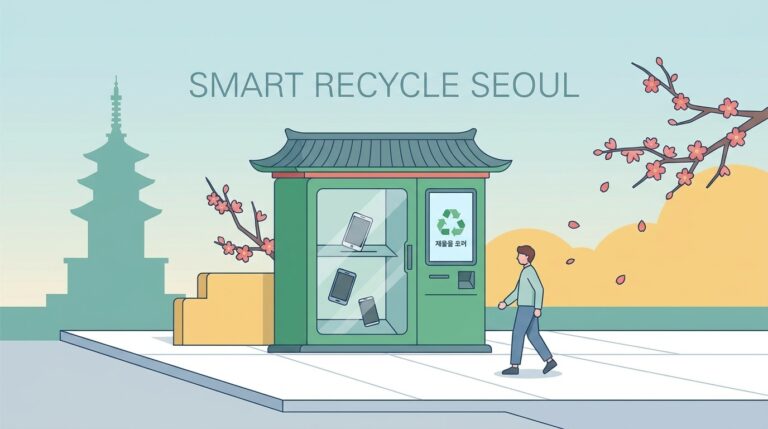
안녕하세요! 매일한글 에디터입니다. 😊 Have you ever stood in front of an automated kiosk at a Korean convenience store or subway station, holding an old smartphone, wondering if you’re executing a eco-friendly upgrade or accidentally triggering a system reset? Trading in used phones via automated platforms like Mintit (민팃) is standard practice in hyper-digitalized Korea. Navigating trade-in appraisals, diagnostic procedures, and circular economy lingo requires mastery of advanced nuances that standard textbooks overlook. This guide is crafted based on real learner feedback to ensure you master C2-level digital Korean effortlessly.
Phase 2: Core Expressions Deep Dive
1. 보상 판매를 진행하다 (Bosang panmae-reul jinhaeng-hada)
- Pronunciation: [Bosang panmae-reul jinhaeng-hada] (Sounds like bo-sang pan-mae)
- Meaning: Direct translation: “Proceed with trade-in compensation sale.” Actual nuance: To systematically process a device trade-in for residual value or upgrade discounts.
- K-Culture Moment: Frequently heard at official carrier stores (SKT, KT, LGU+) or electronics megastores when exchanging last year’s flagship model.
- Editor’s Insight: Advanced speakers use ‘진행하다’ instead of simple verbs like ‘하다’ to indicate formal, structured processes.
- Situation Spectrum: Casual 🚫 | Semi-formal ✅ | Formal ✅
- 🤔 Think About It: How does your culture handle trade-ins compared to Korea’s highly automated, trust-based kiosk systems?
2. 잔존 가치를 평가하다 (Janjon gachi-reul pyeong-ga-hada)
- Pronunciation: [Janjon gachi-reul pyeong-ga-hada]
- Meaning: Direct translation: “Evaluate remaining value.” Actual nuance: Appraising a device’s residual economic value considering market demand and wear.
- K-Culture Moment: Mintit ATM automated screen displays during internal diagnostic checks.
- Editor’s Insight: Combining Sino-Korean terms ‘잔존’ (residual) and ‘가치’ (value) elevates your fluency to executive-level precision.
- Situation Spectrum: Casual 🚫 | Semi-formal ⚠️ | Formal ✅
- 🤔 Think About It: Why is accurate automated evaluation critical in a fast-paced tech society?
3. 자원 순환에 동참하다 (Jawon sunhwan-e dongcham-hada)
- Pronunciation: [Jawon sunhwan-e dongcham-hada]
- Meaning: Direct translation: “Participate in resource circulation.” Actual nuance: Engaging in eco-friendly recycling and e-waste reduction.
- K-Culture Moment: Corporate ESG campaigns and environmental awareness slogans across digital kiosks.
- Editor’s Insight: ‘동참하다’ conveys active civic engagement rather than passive joining (‘참여하다’).
- Situation Spectrum: Casual ⚠️ | Semi-formal ✅ | Formal ✅
- 🤔 Think About It: How does recycling electronic waste reflect modern Korean community values?
Phase 3: Textbook vs. Native Korean
1.
📖 교과서 한국어: 중고 스마트폰을 팔아서 새 전화기를 싸게 사겠습니다.
🗣️ 진짜 한국어: 민팃으로 보상 판매 받아서 기기변경 하려고요.
💡 왜 다를까? Native speakers replace verbose descriptions with brand-integrated terms (민팃) and precise industry vocabulary (기기변경).
2.
📖 교과서 한국어: 이 전화기는 오래되었지만 아직 돈으로 바꿀 수 있습니다.
🗣️ 진짜 한국어: 등급 산정만 잘 나오면 잔존 가치가 생각보다 쏠쏠해요.
💡 왜 다를까? High-level speakers utilize formal business terms (등급 산정, 잔존 가치) paired with vivid native idioms (쏠쏠하다).
Phase 4: K-Culture Deep Dive & Manner
4-1. Nunchi & Non-verbal Etiquette
When using Mintit kiosks in public places like E-Mart or Lotte Mart, clean your phone thoroughly beforehand. Taking too long at the kiosk while a line forms behind you breaks ‘눈치’ (Nunchi). Always wipe off fingerprints so the optical diagnostic scanners work instantly!
4-2. Culture Code
Korea’s emphasis on ESG (Environmental, Social, Governance) has turned e-waste trade-ins into a trendy civic duty. Recycling old tech isn’t just about saving money; it’s seen as responsible digital citizenship.
Phase 5: Interactive Roleplay Scenario
- Location: Mintit Kiosk near Gangnam Station
- Characters: You (C2 Korean Speaker), Kiosk Assistant (민팃 매니저)
- 매니저: 🎭 (친절하게 미소 지으며) 고객님, 중고폰 보상 판매 진행 도와드릴까요?
- You: 🎭 (화면을 가리키며) 네, 현장 진단 기기로 등급 산정부터 받아보고 싶어서요.
- 매니저: 🎭 (수수료 및 절차 안내를 누르며) 액정 파손이나 흠집 여부에 따라 잔존 가치가 달라집니다.
- You: 🎭 (전화기를 깨끗이 닦으며) 외관은 깨끗한 편인데, 내부 시스템 데이터 완전 삭제도 보장되나요?
- 매니저: 🎭 (고개를 끄덕이며) 그럼요. 데이터 영구 삭제 솔루션이 가동되니 안심하셔도 됩니다.
- You: 🎭 (만족스러운 표정으로) 다행이네요. 자원 순환에도 기여하고 보상금도 받는 셈이군요.
- 매니저: 🎭 (검사함 투입구를 열며) 폰을 투입구에 넣으시면 정밀 검사가 시작됩니다.
- You: 🎭 (폰을 넣으며) 네, 결과가 나오는 대로 입금 계좌를 등록하겠습니다.
🔀 Decision Point:
What will you say if the diagnostic result grades your phone lower than expected due to micro-scratches?
* Option A: “잔존 가치 평가 기준표를 자세히 확인해 볼 수 있을까요?”
* Option B: “이거 왜 이렇게 싸요? 그냥 안 팔래요.”
* Option C: “에이, 그냥 최고 등급으로 처리해 주세요.”
Feedback:
* Option A (Best): Polite, professional, and asserts your right to inspect appraisal criteria using C2 terminology.
* Option B (Bad): Too blunt and overly casual for standard service interactions.
* Option C (Risk): Unrealistic request that ignores system-automated diagnostics.
Phase 6: Emotional Shadowing Drill
- [😊 confident & precise] 민팃 Kiosk에서 / 보상 판매를 / 진행하고 싶습니다.
- [🧐 analytical & careful] 데이터 완전 삭제 여부와 / 잔존 가치 평가 기준을 / 설명해 주세요.
- [🌿 proud & eco-conscious] 자원 순환에 동참하면서 / 기기 변경 혜택까지 받으니 / 일석이조네요.
Phase 7: Mini Culture Dictionary
- 보상 판매 (Bosang panmae) | Trade-in compensation sale | Exchanging used goods to discount a new purchase.
- 민팃 (Mintit) | Mintit | Korea’s leading automated AI kiosk brand for used phone trade-ins.
- 잔존 가치 (Janjon gachi) | Residual value | The estimated value of an asset at the end of its useful life.
- 자원 순환 (Jawon sunhwan) | Resource circulation | Eco-friendly recycling systems that reduce e-waste.
Phase 8: Traveler’s Survival Kit
Top 3 Survival Phrases
- 민팃 반납함이 어디에 있나요? (Where is the Mintit drop box?)
- 중고폰 계좌 입금은 얼마나 걸리나요? (How long does the trade-in payout take?)
- 데이터가 완전히 삭제되었는지 확인 가능한가요? (Can I confirm if the data has been completely erased?)
Editor’s Travel Note
Before visiting a kiosk, check nearest locations using the Mintit Official Location Finder. Ensure your battery is charged above 50% before inserting it into the kiosk!
Phase 9: A Step Deeper (Reflective Essay)
Korea’s transition from rapid consumerism to circular tech recycling highlights how communal responsibility adapts to the digital era. The popularity of automated trade-ins shows a balance between technological convenience and eco-conscious values.
💬 Your Turn: Have you ever recycled electronics through an automated system? Share your experience in the comments below!
Phase 10: FAQ & Common Mistakes
Q: Can foreigners without a Korean bank account use Mintit?
A: You need a valid domestic bank account or payment method registered under your identity for security verification.
Q: What happens to personal data left on the phone?
A: Kiosks utilize certified data erasure software, guaranteeing complete unrecoverable wipes.
Q: Are non-Korean model phones accepted for trade-in?
A: Most international models can be processed, though appraisal values may differ slightly from domestic models.
🚨 Common Mistakes TOP 3:
1. Leaving screen protectors on: Remove them! Otherwise, the optical scanner flags them as scratches.
2. Incomplete account registration: Always double-check your bank details for instant payout.
3. Leaving SIM cards inside: Don’t forget to extract your SIM card and micro-SD cards before submission.
Phase 11: Action Missions
- Bronze Level: Practice pronouncing ‘잔존 가치를 평가하다’ 5 times cleanly.
- Silver Level: Explain how Mintit works to a friend in 2 Korean sentences.
- Gold Level: Visit a digital kiosk in Korea and inspect the trade-in menus yourself!
🎮 K-Culture Mission: Keep an eye out for Mintit kiosks in Korean dramas set around convenience stores or electronic markets!
Phase 12: Interactive Quiz Challenge
-
Question: What is the main benefit of ‘보상 판매’?
Click for Answer & Explanation
It allows you to trade in your old device to receive residual cash value or discounts on new models.
-
Fill in the blank: 안 쓰는 스마트폰을 재활용하여 [자원 ____]에 동참합시다.
Click for Answer & Explanation
순환 (Circulation). Full phrase: 자원 순환 (Resource Circulation).
-
True or False: Mintit kiosks leave your screen protector intact during diagnosis.
Click for Answer & Explanation
False. Screen protectors must be removed for accurate scratch diagnosis.







