

Navigating Petiquette in Korea: How to Handle Pet Owner & Non-Pet Owner Tensions Like a Pro
Phase 1: Empathy & Storytelling
안녕하세요! 매일한글 에디터입니다. Have you ever taken a stroll through a bustling park in Seoul—like Yeouido Hangang Park—enjoying the breeze, only to witness a sudden awkward tension between a pet owner and a passerby? Maybe a dog bounced up enthusiastically, or a neighbor looked anxious while waiting for an elevator with a leashed pup. In Korea’s densely populated urban spaces, pet etiquette (affectionately dubbed 펫티켓 – Petiquette) is a hot topic. As a C1 advanced learner, understanding these subtle social boundaries isn’t just about vocabulary—it’s about demonstrating high-level cultural empathy and emotional intelligence. Today, we’re diving deep into real-life scenarios, nuanced expressions, and the underlying societal values of Korean pet culture so you can navigate any conversation with grace!
Phase 2: Core Expressions Deep Dive
1. 입마개를 하다 (Ipmagaereul Hada)
- Pronunciation: [ip-ma-gae-reul ha-da] (Think: eep-mah-gae sound)
- Meaning: To put a muzzle on a pet. Literally, “to do a mouth-cover.”
- K-Culture Moment: Seen in news debates or neighborhood forum apps like Danggeun Market when discussing breed regulations in apartment complexes.
- Editor’s Insight: It carries a heavy responsibility connotation. Using it thoughtfully shows you understand safety concerns without stereotyping dogs.
- Situation Spectrum: Casual ✅ | Semi-formal ✅ | Formal ✅
- 🤔 Think About It: How does public safety outweigh personal freedom in high-density Korean living spaces compared to your country?
2. 불쾌감을 느끼다 (Bulkwaegameul Neokkida)
- Pronunciation: [bul-kwae-gam-eul neu-kki-da] (Think: bool-kway-gahm)
- Meaning: To feel discomfort or displeasure.
- K-Culture Moment: Frequently used in K-Dramas when neighbors negotiate apartment rules or express grievances polite-yet-firmly.
- Editor’s Insight: A sophisticated C1 phrase used to express boundaries formally without resorting to aggressive or rude language.
- Situation Spectrum: Casual ⚠️ | Semi-formal ✅ | Formal ✅
- 🤔 Think About It: Why do Koreans prefer indirect words like “불쾌감” over direct anger in public disputes?
3. 배려하다 (Baeryeohada)
- Pronunciation: [bae-ryeo-ha-da] (Think: bae-ryuh-hah-dah)
- Meaning: To be considerate / to show consideration.
- K-Culture Moment: The ultimate core value in Korean society! Featured in public service ads across Seoul subways.
- Editor’s Insight: The cornerstone of resolving conflict in Korea. Suggesting “서로 배려해요” (Let’s consider each other) defuses almost any heated debate.
- Situation Spectrum: Casual ✅ | Semi-formal ✅ | Formal ✅
- 🤔 Think About It: Is consideration viewed as an individual choice or a collective duty in your home culture?
Phase 3: Textbook vs. Real Korean
Situation 1: Asking someone to hold their dog back
- 📖 Textbook Korean: 개를 멀리 치워 주세요. (Please move the dog far away.)
- 🗣️ Real Korean: 죄송한데, 강아지줄 조금만 바짝 잡아주시겠어요? (I’m sorry, but could you pull the leash a bit shorter/closer?)
- 💡 Why it matters: Asking to move a pet “far away” sounds dismissive. Politely requesting to shorten the leash (줄을 바짝 잡다) acknowledges the owner while ensuring your personal space.
Situation 2: De-escalating an elevator tension
- 📖 Textbook Korean: 저는 개를 안 무서워합니다. (I am not afraid of dogs.)
- 🗣️ Real Korean: 괜찮습니다, 제가 옆으로 좀 비켜드릴게요. (It’s alright, I’ll step aside a little bit for you.)
- 💡 Why it matters: Advanced Korean focuses on spatial consideration (비켜주다) rather than just stating personal feelings.
Phase 4: K-Culture Deep Dive & Non-Verbal Etiquette
4-1. Nunchi (눈치) & Gestures in Shared Spaces
When entering an elevator with a dog in Korea, non-verbal Nunchi is essential:
* Shorten the Leash: Hold the leash close to your chest or hold small dogs in your arms.
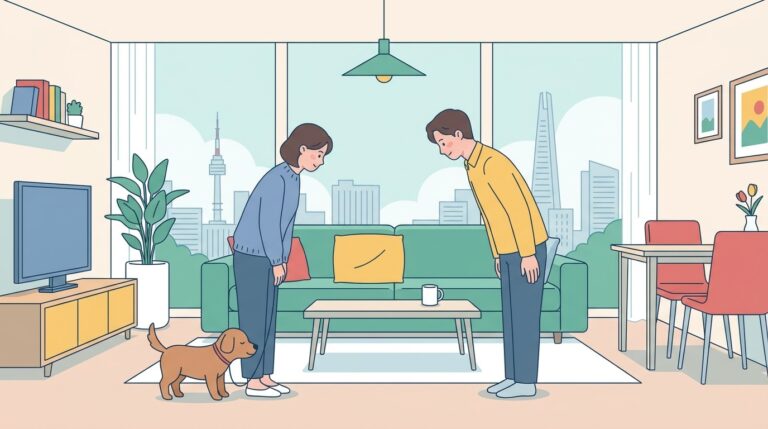
* Slight Bow & Eye Contact: A quick 15-degree nod to neighbors signals respect and lowers tension instantly.
4-2. Culture Code: Urban Density & “펫티켓”
With over 80% of Koreans living in apartments or shared residential complexes, conflict management is built around mutual convenience. Shows like Dogs are Incredible (개는 훌륭하다) have transformed public awareness, turning Petiquette into a symbol of modern civic maturity.
Phase 5: Interactive Roleplay Scenario
Setting: Inside a residential apartment elevator in Mapo-gu. You are riding with your medium-sized dog when a neighbor who looks uneasy steps in.
- Neighbor: (Instinctively steps back) 어머, 개가 좀 크네요…
- You: [안심시키며] 아, 죄송해요. 제가 줄 바짝 잡고 있을게요!
- Neighbor: 요새 뉴스 보면 물림 사고도 많고 해서 좀 무서워서요.
- You: 당연히 불안하실 수 있죠. 먼저 내려가시겠어요, 아니면 제가 안고 탈까요?
- Neighbor: 아니에요, 그렇게까지 안 하셔도 되는데… 줄만 잘 잡아주세요.
- You: 네, 그럼요! 비반려인 분들 마음도 당연히 이해합니다.
- Neighbor: 그렇게 말씀해주시니 감사하네요. 서로 배려해야죠.
- You: 맞습니다. 좋은 하루 되세요!
🔀 Decision Point: How do you react if a passerby scolds you unfairly in a park?
- Option A: “법적으로 문제없는데요?” (It’s legally totally fine?)
- Option B:
Frequently Asked Questions (FAQ)
Q: What does "입마개를 하다 (Ipmagaereul Hada)" mean in Korean and how do you pronounce it?
A: In Korean, "입마개를 하다 (Ipmagaereul Hada)" is pronounced [ip-ma-gae-reul ha-da] and means: To put a muzzle on a pet. Literally, "to do a mouth-cover."
Q: What does "불쾌감을 느끼다 (Bulkwaegameul Neokkida)" mean in Korean and how do you pronounce it?
A: In Korean, "불쾌감을 느끼다 (Bulkwaegameul Neokkida)" is pronounced [bul-kwae-gam-eul neu-kki-da] and means: To feel discomfort or displeasure.
Q: What does "배려하다 (Baeryeohada)" mean in Korean and how do you pronounce it?
A: In Korean, "배려하다 (Baeryeohada)" is pronounced [bae-ryeo-ha-da] and means: To be considerate / to show consideration.






