

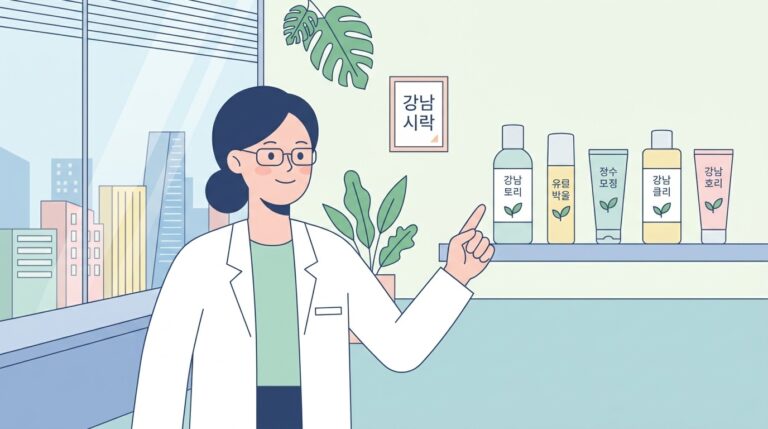
Phase 1: Empathy – Navigating Korean Derma Skincare Like a Pro
안녕하세요! 매일한글 에디터입니다. (Hello! This is your Daily Hangul editor.)
Have you ever walked into a K-beauty store like Olive Young or a dermatology clinic in Gangnam, feeling totally overwhelmed by the rows of sleek, scientific-looking skincare products? You see labels like “Derma,” “Cica,” or “Soothing,” but when you ask the staff for a recommendation for sensitive skin, you suddenly freeze. You know basic Korean, but terms like “skin barrier” or “dermatologist-tested” feel like a whole new language!
Don’t worry, you’re not alone. Many intermediate learners struggle when transitioning from basic daily Korean to specific, functional vocabulary used in Korean clinics and K-beauty shops. Today, we’re unlocking the exact Korean phrases used in Derma skincare (피부과 추천 화장품) so you can get tailored skincare advice with total confidence. This guide is built on real learner feedback and authentic Korean beauty culture insights. Let’s dive in!
Phase 2: Core Expressions Deep Dive
1. 장벽이 무너졌어요 (Jangbyeogi muneojyeosseoyo)
- Pronunciation: [Jang-byeok-ee moo-neo-jyeos-seo-yo] (Sounds like “Jang” + “byeok” like breaking a brick wall + “moo-neo-jyeo” like a structure collapsing)
- Meaning: Literally “The barrier has collapsed,” but used to mean “My skin barrier is damaged/compromised.”
- K-Culture Moment: Seen frequently in K-beauty vlogs when influencers explain why their skin is breaking out or burning after changing products.
- Editor’s Insight: Koreans view skin health through the lens of protection. Saying your skin barrier collapsed instantly signals to a clinic staff member that you need gentle, ceramide-based Derma products rather than harsh exfoliants.
- Situation Spectrum: Casual ⚠️ | Semi-formal ✅ | Formal ✅
- 🤔 Think About It: In English, we often say “My skin is irritated.” How does personifying the skin as having a protective “barrier/wall” change the way you think about skincare?
2. 진정 효과가 탁월해요 (Jinjeong hyogwaga takwolhaeyo)
- Pronunciation: [Jin-jeong hyo-gwa-ga tak-wol-hae-yo] (Pronounce “Jin-jeong” smoothly like soothing a crying baby)
- Meaning: Literally “Soothing effect is outstanding,” meaning “It’s extremely effective for calming down skin.”
- K-Culture Moment: Used by skincare specialists when recommending K-beauty staples containing Centella Asiatica (Cica) or Tea Tree.
- Editor’s Insight: “진정” (calming/soothing) is the #1 keyword in Korean derma-cosmetics. Using “탁월하다” (to be outstanding) elevates your expression to a refined B2 level.
- Situation Spectrum: Casual 🚫 | Semi-formal ✅ | Formal ✅
- 🤔 Think About It: Why do you think Korean beauty culture focuses so much on “soothing” (진정) rather than just “fixing” skin issues?
3. 자극 없이 순해요 (Jageuk eobsi sunhaeyo)
- Pronunciation: [Ja-geuk eob-si sun-hae-yo] (Think of “Sun” pronounced like “soon” meaning gentle/mild)
- Meaning: “It’s gentle and non-irritating.”
- K-Culture Moment: Dermatologists in Seoul clinics routinely use this phrase when prescribing post-treatment moisturizers.
- Editor’s Insight: “순하다” means mild, gentle, or pure. It can describe tea, weather, personality, and skincare products that cause no redness or stinging.
- Situation Spectrum: Casual ✅ | Semi-formal ✅ | Formal ✅
- 🤔 Think About It: What word in your native language best captures the warm, mild nuance of “순하다”?
Phase 3: Textbook Korean vs. Real Korean
- Expressing Sensitive Skin
* 📖 Textbook: 제 피부는 민감합니다. (My skin is sensitive.)
* 🗣️ Real Korean: 제 피부가 요즘 많이 예민해져서, 엄청 순한 걸로 찾고 있어요. (My skin’s been really sensitive lately, so I’m looking for something super gentle.)
* 💡 Why the difference? Textbooks use plain declarative statements. Real Koreans use dynamic verbs like “예민해지다” (to become sensitive) to reflect temporary skin conditions.
- Asking for Clinic Recommendations
* 📖 Textbook: 피부과에서 추천하는 화장품을 주세요. (Give me cosmetics recommended by dermatology.)
* 🗣️ Real Korean: 피부과 시술 받고 쓸 만한 더마 라인 있을까요? (Do you have a derma line suitable to use after a dermatology procedure?)
* 💡 Why the difference? Using modern loanwords like “더마 라인” (Derma line) and soft natural query structures shows cultural fluency.
Phase 4: K-Culture Deep Dive & Non-Verbal Manners
4-1. Nunchi & Gestures in Korean Beauty Clinics
When discussing skin issues with a dermatologist or skincare consultant, gently point toward your cheeks or problem areas with open fingers rather than pointing aggressively with a single index finger. Touch your face lightly with the back of your hand to demonstrate dry or irritated skin. Nodding slowly while listening shows respect for their professional assessment.
4-2. Cultural Code: The Rise of “Derma Culture”
In Korea, skincare is considered preventative healthcare. Korean women and men visit dermatologists (피부과) regularly for laser treatments and skin scaling. Consequently, cosmetics brands partner with skin clinics to launch “Derma” (더마) lines focused on repair ingredients like Panthenol, Ceramides, and Madecassoside.
Phase 5: Interactive Roleplay Scenario
Setting: A high-end Derma clinic boutique in Gangnam, Seoul.
Characters: You (B2 Korean Learner) & Min-ji (Clinic Skincare Specialist)
- Min-ji: 안녕하세요! 오늘 어떤 피부 고민 때문에 오셨나요?
(An-nyeong-ha-se-yo! O-neul eot-teon pi-bu go-min ttae-mou-ne o-syeot-na-yo?)
(Hello! What skin concerns bring you in today?)
🎭 Gestures toward a comfortable consultation chair with a warm smile. - You: 안녕하세요. 제가 최근에 레이저 시술을 받았는데 피부 장벽이 무너진 것 같아요.
(An-nyeong-ha-se-yo. Je-ga chwe-geun-e re-i-jeo si-sul-eul bat-at-neun-de pi-bu jang-byeok-ee moo-neo-jin geot gat-a-yo.)
(Hello. I recently got a laser treatment, and I feel like my skin barrier is compromised.)
🎭 Gently patting your cheek gently. - Min-ji: 아, 그러셨군요. 그럼 지금 붉은기나 붉어짐이 심하신 편인가요?
(A, geu-reo-syeot-gun-yo. Geu-reom ji-geum bulg-eun-gi-na bulg-eo-jim-ee sim-ha-sin pyeon-in-ga-yo?)
(Ah, I see. Is the redness severe right now?) - You: 네, 좀 따갑고 자극에 예민해요. 진정 효과가 탁월한 제품이 필요해요.
(Ne, jom tta-gap-go ja-geuk-e ye-min-hae-yo. Jin-jeong hyo-gwa-ga tak-wol-han je-pum-ee pyeol-yo-hae-yo.)
(Yes, it stings a bit and is sensitive to irritation. I need a product with outstanding soothing effects.) - Min-ji: 그렇다면 시카 성분이 들어간 이 더마 크림을 추천해 드릴게요. 자극 없이 순해요.
(Geu-reot-da-myeon si-ka seong-bun-ee deu-reo-gan i deo-ma keu-rim-eul chu-cheon-hae deu-ril-ge-yo. Ja-geuk eob-si sun-hae-yo.)
(In that case, I recommend this derma cream containing Cica. It’s mild and non-irritating.) - You: 성분이 착하네요! 끈적임은 별로 없나요?
(Seong-bun-ee chak-ha-ne-yo! Kkeun-jeok-im-eun byeol-ro eob-na-yo?)
(The ingredients look clean! Is it sticky at all?) - You: 산뜻하게 흡수되어서 데일리로 바르기 딱 좋아요.
(San-tteut-ha-ge heup-su-doe-eo-seo de-il-li-ro ba-reu-gi ttak jo-a-yo.)
(It absorbs warmly and freshly, so it’s perfect for daily application.) - You: 좋아요, 이걸로 구매할게요. 감사합니다!
(Jo-a-yo, i-geol-ro gu-mae-hal-ge-yo. Gam-sa-ham-ni-da!)
(Great, I’ll buy this one. Thank you!)
🔀 Interactive Branching Point
When Min-ji asks about your redness, how do you respond if you also want to ask about ingredients?
* Option A: “성분이 순한 성분만 들어있는지 성분표 분석해 주세요.” (Analyze the full ingredient list for me.)
* Option B: “주의할 성분은 빠지고 진정 성분만 들어간 거죠?” (Harmful ingredients are left out, and soothing ingredients are in, right?)
* Option C: “몰라요, 그냥 제일 잘 나가는 거 주세요.” (I don’t know, just give me the best seller.)
Feedback:
* Option A (Risk): A bit too demanding for standard retail interaction.
* Option B (Best): Shows deep fluency and natural skin concern phrasing!
* Option C (Bad): Ignores your specific skin needs entirely.
Phase 6: 10-Second Emotion Shadowing Drill
[🥺 Worried & Earnest]피부가 / 너무 예민해져서 / 자극 없는 걸로 / 찾고 있어요.[😊 Delighted & Satisfied]와, / 끈적임도 없고 / 진정 효과가 / 진짜 탁월하네요![😌 Relieved & Confident]피부 장벽이 / 회복되는 느낌이라 / 마음이 놓여요.
Phase 7: K-Culture Mini Dictionary
- 성분이 착하다 (Seong-bun-ee chak-ha-da) | Clean/Safe Ingredients | Used when a cosmetic product contains zero harsh chemicals or synthetic fragrances.
- 시카 (Cica) | Centella Asiatica | The Holy Grail ingredient in K-derma products used for skin soothing and repair.
- 속건조 (Sok-geon-jo) | Inner Dryness | The sensation where the outer layer of skin feels oily, but inner layers feel tight and dehydrated.
- 더마 코스메틱 (Derma Cosmetics) | Medical-grade skincare | Products combining dermatological science and cosmetic usability.
Phase 8: Traveler’s Survival Kit
Top 3 Survival Phrases
- 트러블케어용으로 추천해 주세요. (Teu-reo-beul-ke-eo-yong-eu-ro chu-cheon-hae ju-se-yo.) – Please recommend something for acne/troubled skin care.
- 샘플 좀 써볼 수 있을까요? (Saem-peul jom sseo-bol su is-seul-kka-yo?) – Could I try a sample first?
- 끈적이지 않는 제형인가요? (Kkeun-jeok-i-ji an-neun je-hyeong-in-ga-yo?) – Is this a non-sticky texture?
Editor’s Travel Note
Before shopping for cosmetics in Seoul, search for clinic reviews or product rankings using the Naver Map App Download. You can also look up ingredient safety ratings on the Korean beauty app ‘Hwahae’ (화해) to check for potential allergens instantly.
Phase 9: A Step Deeper (Reflection)
In Western skincare culture, glowing skin is often associated with sun-kissed tanning or heavy active exfoliants like high-dose AHA/BHA. In contrast, Korean skincare culture prioritizes “수분” (moisture balance) and “장벽 강화” (strengthening the skin barrier). This reflects a broader cultural mindset in Korea: long-term balance and careful cultivation yield sustainable beauty.
💬 Your Turn: What is the most important quality you look for in skincare products in your home country? Share your thoughts in the comments below!
Phase 10: FAQ & Common Mistakes
Q: What is the difference between ‘민감’ and ‘예민’ when describing skin?
A: Both mean sensitive, but “민감하다” is often used for skin types (e.g., I have sensitive skin), while “예민하다” is frequently used when skin is temporarily irritated or reacting to something.
Q: Can I use informal speech (반말) when asking skincare staff for help?
A: No, always use semi-formal (존댓말) ending in -요 to show politeness to retail workers.
Q: What does ‘성분이 착하다’ mean literally?
A: Literally “The ingredients are good/kind.” It’s a popular K-beauty slang term for clean, non-toxic formulations.
🚨 Common Mistakes
- Mistake: Saying “피부가 아파요” (My skin hurts) when it stings.
- Correct Action: Use “피부가 따가워요” (My skin stings/prickles).
- Mistake: Confusing “화장품” (cosmetics) with “화장” (makeup context only).
- Correct Action: Say “기초 화장품” or “스킨케어” for skincare products.
- Mistake: Pronouncing “효과” as [hyo-gwa] strictly instead of the natural conversational sound [hyo-kwa].
Phase 11: Action Mission
- Bronze Mission: Practice saying “진정 효과가 탁월해요” 3 times out loud.
- Silver Mission: Leave a comment on a K-beauty Instagram post using the phrase “성분이 정말 착하네요!”
- Gold Mission: Visit a local K-beauty stockist or clinic and ask for a “더마 라인” recommendation in Korean!
🎮 K-Culture Mission: Watch a recent Korean skincare routine video on YouTube and spot how many times the creator says “진정” or







