

Phase 1: Empathy & Connection (Story-Driven Opening)
안녕하세요! I’m your Daily Hangul editor and your Korean culture companion! 🌲✨
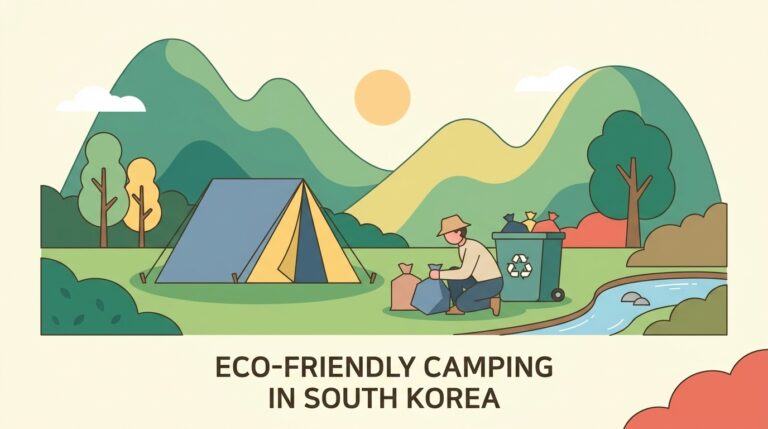
Imagine this: You’ve trekked into the breathtaking valleys of Seoraksan or settled down for an idyllic riverside camping trip along the Namhan River. The campfire is crackling, and the starlit sky is perfect. But as morning comes, you notice leftover food waste near the site or hear fellow campers discussing how to handle trash according to local regulations. You want to speak up gracefully, coordinate cleaning with your Korean camping buddies, or express your commitment to Leave No Trace (LNT) principles—not just in basic phrases, but with the nuanced, natural flow of a native speaker.
Advanced Korean learners (C1) often struggle here. You know how to say “쓰레기를 버리지 마세요” (Don’t throw away trash), but how do you express subtle ecological responsibility, polite boundary-setting, or shared communal duty without sounding preachy or textbook-dry?
Based on real feedback from international outdoor enthusiasts in Korea, this guide equips you with C1-level expressions to navigate LNT (흔적 남기지 않기) effortlessly while respecting local etiquette. Let’s master the art of eco-friendly camping in Korean!
Phase 2: Top 3 Core Expressions Deep Dive
1. 흔적을 남기지 않는 게 캠퍼의 기본 매너죠.
- Pronunciation: [Heun-jeog-eul nam-gi-ji an-neun ge kaem-peo-ui gi-bon mae-neo-jyo] (Think of ‘Heun-jeog’ sounding like a soft breeze rubbing through dry leaves: ‘Hoon-jug’)
- Meaning: “Leaving no trace is a camper’s basic etiquette, isn’t it?”
- K-Culture Moment: Seen frequently in Korean eco-camping vlogs (like Healing Camp style content) where experienced campers gently remind newcomers about eco-responsibility.
- Editor’s Insight: The ending
-죠(short for-지요) adds a warm, persuasive tone, seeking agreement rather than scolding. It establishes common ground smoothly. - Situation Spectrum: Casual ✅ | Semi-formal ✅ | Formal ⚠️
- 🤔 Think About It: How does your culture phrase environmental responsibility? Does it emphasize individual duty or collective social harmony like Korean
-죠?
2. 뒷정리까지 깔끔하게 끝내야 제맛이죠.
- Pronunciation: [Dwit-jeong-ri-kka-ji kkal-kkeum-ha-ge kkeut-nae-ya je-mat-i-jyo]
- Meaning: Lit: “It only tastes real when you finish cleaning up neatly.” -> Real nuance: “True camping satisfaction comes from leaving the site spotless.”
- K-Culture Moment: Korean outdoor enthusiasts love using
~해야 제맛이다when enjoying traditional food or activities at their absolute peak. - Editor’s Insight:
제맛literally means “its proper flavor,” but idiomatically refers to doing something thoroughly to truly appreciate its essence. - Situation Spectrum: Casual ✅ | Semi-formal ✅ | Formal 🚫
- 🤔 Think About It: Why do you think Koreans use food-related idioms (
제맛) to describe the ultimate satisfaction of non-food tasks like cleaning?
3. 자연을 있는 그대로 누리고 가요.
- Pronunciation: [Ja-yeon-eul in-neun geu-dae-ro nu-ri-go ga-yo]
- Meaning: “Let’s enjoy nature as it is and head back.”
- K-Culture Moment: Used in poetic travel shows or when hiking groups wrap up their trek without picking wild flora or disturbing wildlife.
- Editor’s Insight:
누리다is a high-level verb meaning “to enjoy a privilege/blessing.” Using it elevates your expression beyond simple즐기다(to enjoy). - Situation Spectrum: Casual ✅ | Semi-formal ✅ | Formal ✅
- 🤔 Think About It: How does using
누리다change your relationship with nature compared to verbs like “use” or
Frequently Asked Questions (FAQ)
Q: What does "흔적을 남기지 않는 게 캠퍼의 기본 매너죠." mean in Korean and how do you pronounce it?
A: In Korean, "흔적을 남기지 않는 게 캠퍼의 기본 매너죠." is pronounced [Heun-jeog-eul nam-gi-ji an-neun ge kaem-peo-ui gi-bon mae-neo-jyo] and means: "Leaving no trace is a camper's basic etiquette, isn't it?"
Q: What does "뒷정리까지 깔끔하게 끝내야 제맛이죠." mean in Korean and how do you pronounce it?
A: In Korean, "뒷정리까지 깔끔하게 끝내야 제맛이죠." is pronounced [Dwit-jeong-ri-kka-ji kkal-kkeum-ha-ge kkeut-nae-ya je-mat-i-jyo] and means: Lit: "It only tastes real when you finish cleaning up neatly." -> Real nuance: "True camping satisfaction comes from leaving the site spotless."
Q: What does "자연을 있는 그대로 누리고 가요." mean in Korean and how do you pronounce it?
A: In Korean, "자연을 있는 그대로 누리고 가요." is pronounced [Ja-yeon-eul in-neun geu-dae-ro nu-ri-go ga-yo] and means: "Let's enjoy nature as it is and head back."







