

Master Advanced Korean: How to Express Emotional Resilience and Heal Trauma Like a Native
Phase 1: Empathy (스토리 몰입형 오프닝)
안녕하세요! 매일한글 에디터입니다.
Have you ever watched a scene in a K-drama like My Mister or It’s Okay to Not Be Okay where a character endures an overwhelming life setback—a painful betrayal, financial ruin, or deep emotional loss—and thought, “How do Koreans express this level of deep psychological resilience and healing beyond just saying ‘힘내세요’ (Cheer up)?”
As an advanced (C1) Korean learner, you likely know basic empathetic phrases. However, when navigating complex human relationships, mental health, and trauma recovery, relying on elementary textbook phrases can feel cold or overly superficial. Real emotional connection in Korean requires understanding idioms that carry weight, empathy, and cultural depth.
In this guide, backed by years of tutoring experience and real student feedback, you will master nuanced, high-level Korean expressions for overcoming trauma (트라우마 극복) and psychological resilience (회복 탄력성). By the end of this post, you’ll be able to discuss emotional healing with true warmth, nuance, and native sophistication.
Phase 2: 핵심 표현 3선 심층 분석
1. 마음을 추스르다
- Pronunciation: [Ma-eum-eul chu-seu-reu-da] (Imagine gently gathering up fallen leaves into a neat pile: “Ma-um-eul chew-seu-reu-da”)
- Meaning: Literal: To gather/tidy up one’s heart. vs. Nuance: To compose oneself, collect one’s scattered spirit, or steady one’s mind after a severe emotional shock or tragedy.
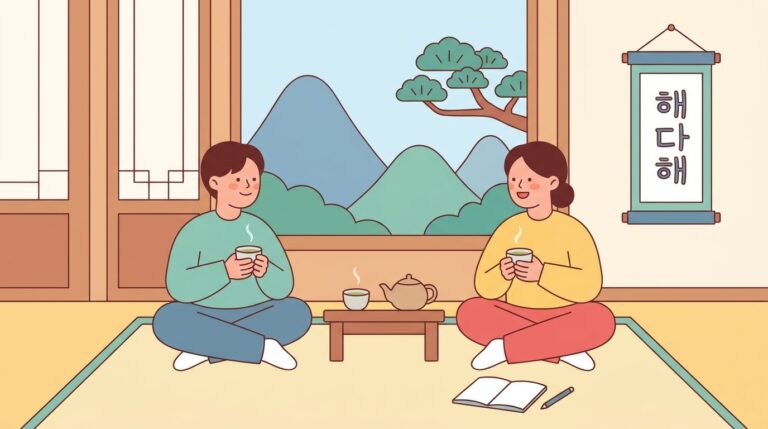
- K-Culture Moment: In K-dramas, after a sudden heartbreak or crisis, a character sits quietly over hot tea, takes a deep breath, and tells a friend: “이제 마음 좀 추스르고 다시 시작해야지.” (Now I need to collect my thoughts and start anew.)
- Editor’s Insight: This phrase isn’t just about “calming down.” It acknowledges that your heart was shattered or scattered, and you are actively picking up the pieces with patient self-care.
- Situation Spectrum: Casual ⚠️ | Semi-formal ✅ | Formal ✅
- 🤔 Think About It: Why does Korean use a physical action verb like “추스르다” (to pull up / tuck in) for intangible human emotions? What does this reveal about Korean views on emotional labor?
2. 털어내다
- Pronunciation: [Teol-eo-nae-da] (Sounds like brushing dust off your coat shoulders: “Tol-oh-nae-da”)
- Meaning: Literal: To brush off / shake out. vs. Nuance: To let go of past pain, guilt, or trauma and move forward with a fresh mindset.
- K-Culture Moment: Over late-night drinks at a pojangmacha (street bar), friends toast together to leave bad luck behind: “아픈 기억은 다 털어버리자!” (Let’s shake off all the painful memories!)
- Editor’s Insight: Using “털어내다” shows active emotional agency. Instead of being trapped in trauma, you choose to brush it off like dust.
- Situation Spectrum: Casual ✅ | Semi-formal ✅ | Formal ⚠️
- 🤔 Think About It: How does the concept of “shaking off” emotional baggage differ in your native culture compared to Korea’s active verb “털어내다”?
3. 시련을 딛고 일어서다
- Pronunciation: [Si-ryeon-eul dit-go il-eo-seo-da] (Like stepping firmly on a stone to cross a river: “See-ryeon-eul deet-go eel-oh-seo-da”)
- Meaning: Literal: To step on ordeal and stand up. vs. Nuance: To overcome severe adversity and rise stronger—the ultimate description of psychological resilience (회복 탄력성).
- K-Culture Moment: Emotional climax scenes in documentaries or sports dramas where a protagonist overcomes injury or trauma to win against all odds.
- Editor’s Insight: Notice the verb “딛다” (to step on). It implies that the hardship itself becomes the physical stepping stone that helps you rise higher.
- Situation Spectrum: Casual 🚫 | Semi-formal ✅ | Formal ✅
- 🤔 Think About It: In your culture, is hardship viewed as something to be demolished, or as a stepping stone to build upon?
Phase 3: 교과서 한국어 vs 진짜 한국어
Situation 1: Offering empathy to someone recovering from deep pain
- 📖 교과서 한국어: “힘내세요. 곧 괜찮아질 거예요.” (Cheer up. It will be okay soon.)
- 🗣️ 진짜 한국어: “얼마나 힘들었을지 감도 안 오지만, 천천히 마음 추스르길 바랄게.” (I can’t even fathom how hard it must have been, but I hope you take all the time you need to collect your spirit.)
- 💡 왜 다를까?: Telling someone facing real trauma to simply “cheer up” (힘내세요) can sound dismissive or rushed. Native C1 Korean empathy validates the magnitude of the pain first and respects their timeline for recovery.
Situation 2: Talking about overcoming past personal trials
- 📖 교과서 한국어: “저는 트라우마를 극복했습니다.” (I overcame trauma.)
- 🗣️ 진짜 한국어: “힘든 시간이었지만, 잘 털어내고 나니까 한 단계 더 성장한 것 같아.” (It was a tough time, but after brushing it off cleanly, I feel like I’ve grown a step further.)
- 💡 왜 다를까?: Native speakers rarely state “I overcame trauma” like a textbook definition. They use dynamic, metaphorical expressions like “털어내다” combined with personal growth nuances.
Phase 4: K-Culture 딥다이브 & 비언어적 매너
4-1. Nunchi & Non-Verbal Gestures
When discussing traumatic experiences or mental health recovery in Korea:
* Eye Contact & Tone: Maintain soft, slightly lowered eye contact. Avoid sharp staring, which can feel aggressive. Keep your voice tone lower and calmer than usual.
* Body Language: Avoid overly boisterous gestures like high-fives or loud clapping when someone shares a story of recovery. Instead, hold a warm cup of tea with both hands, nodding slowly. A gentle, two-handed gesture shows deep respect and presence.
4-2. Cultural Code Analysis: Trauma & Resilience in K-Media
In Korean culture, resilience is rarely portrayed as an isolated, heroic feat. In dramas like My Mister, healing happens through quiet communal presence—sharing a humble meal, walking someone home at night, or offering warm silence. This stems from Korea’s deep-rooted culture of 정 (Jeong) and mutual comfort (위로). Overcoming trauma is not just individual grit; it is nurtured through deep interpersonal safety.
Phase 5: 실전 롤플레이 시나리오
Setting: A quiet cafe in Ikseon-dong, Seoul. You are catching up with Min-jun (민준), a close friend who faced a major professional betrayal and mental burnout a year ago.
- 민준: (찻잔을 만지작거리며) 사실 그때는 정말 세상이 무너지는 것만 같았어.
[Sasi-reun geu-tae-neun jeong-mal se-sang-i mu-neo-ji-neun geot-man gat-at-eo.]
(To be honest, back then it really felt like my world was collapsing.)
🎭 행동 지문: Sips his tea slowly, looking down at the table. -
You: (따뜻한 눈빛으로 바라보며) 그랬을 것 같아. 그때는 누구도 널 위로하기 힘들었을 거야.
[Geu-raet-eul geot gat-a. Geu-tae-neun nu-gu-do neol wi-ro-ha-gi him-deul-eot-eul geoy-a.]
(I can imagine. Back then, no one could have easily comforted you.)
🎭 행동 지문: Leans in slightly with a warm, compassionate expression. -
민준: 응, 하지만 언제까지 슬퍼할 수는 없잖아. 마음을 좀 추스르고 나니까 정신이 들더라고.
[Eung, ha-ji-man eon-je-kka-ji seul-peo-hal su-neun eop-jan-ah. Ma-eum-eul jom chu-seu-reu-go na-ni-kka jeong-sin-i deul-deo-ra-go.]
(Yeah, but I couldn’t stay sad forever. Once I collected my spirit, I snapped out of it.)
🎭 행동 지문: Sighs gently, then looks up with a slight smile. -
You: 정말 대단해. 그 큰 시련을 딛고 이렇게 다시 일어선 거잖아.
[Jeong-mal dae-dan-hae. Geu keun si-ryeon-eul dit-go i-reo-ge da-si il-eo-seon geo-jan-ah.]
(That’s incredible. You stepped on such a huge ordeal and stood up again like this.)
🎭 행동 지문: Nods slowly with genuine admiration. -
민준: 고마워. 과거의 아픈 기억은 이제 깔끔하게 털어내려고 해.
[Go-ma-wo. Gwa-geo-ui a-ppun gi-eok-eun i-je kkal-kkeum-ha-ge teol-eo-nae-ryeo-go hae.]
(Thanks. I’m trying to cleanly shake off those painful memories now.)
🎭 행동 지문: Lightly brushes his palms together in a subtle gesture. -
You: 맞아. 네 회복 탄력성을 보면 나도 정말 많이 배워.
[Ma-ja. Ne hoe-bok tan-ryeok-seong-eul bo-myeon na-do jeong-mal ma-ni bae-wo.]
(Right. Looking at your resilience, I really learn a lot too.)
🎭 행동 지문: Smiles warmly, offering sincere praise. -
민준: 힘든 시간을 지나고 나니 사람을 보는 눈도 깊어진 것 같아.
[Him-deun si-gan-eul ji-na-go na-ni sa-ram-eul bo-neun nun-do gip-eo-jin geot gat-a.]
(Having gone through tough times, I think my perspective on people has deepened too.)
🎭 행동 지문: Takes a deep breath, looking relaxed. -
You: 네가 잘 버텨줘서 정말 다행이야. 오늘은 맛있는 거 내가 살게!
[Ne-ga jal beo-tyeo-jwo-seo jeong-mal da-haeng-i-ya. O-neul-eun mas-in-neun geo nae-ga sal-ge!]
(I’m so glad you held out well. Dinner is on me today!)
🎭 행동 지문: Lightly pats his forearm with a warm, uplifting smile.
🔀 Interactive Branching Point
If Min-jun mentions that he still feels lingering anxiety sometimes, how would you respond?
- Option A: “옛날 일은 잊어버리고 빨리 잊으세요.”
- Option B: “불안한 건 당연해. 천천히 네 페이스대로 털어내면 돼.”
- Option C: “심리학 책을 더 많이 읽어보시는 게 어때요?”
Feedback:
* 🚫 Option A (Bad): Telling someone to “quickly forget” invalidates trauma, and mixing casual/formal speech sound unnatural.
* ✅ Option B (Best): Perfect! Validates their anxiety, respects their timeline, and naturally uses “털어내다”.
* ⚠️ Option C (Risk): Too clinical and detached. Sounds like unsolicited advice rather than friendly comfort.
Phase 6: 10초 감정 섀도잉 드릴
Read these sentences out loud, paying attention to the emotion tags and speech pauses (/):
[🥺 깊은 공감과 위로]
얼마나 힘들었을지 / 감도 안 오지만, / 천천히 마음 추스르길 바랄게.-
[😊 대견함과 진심 어린 응원]
그 큰 시련을 딛고 / 이렇게 다시 일어선 거잖아! / 진짜 멋지다. -
[😌 단단한 마음과 다짐]
아픈 기억은 / 깔끔하게 털어내고 / 앞으로 나아갈 거야.
Phase 7: K-Culture 미니 사전 (핵심 키워드 4개)
- 회복 탄력성 (Hoe-bok Tan-ryeok-seong) | Psychological Resilience | The psychological capacity to bounce back from trauma or adversity. Very common in modern Korean books, talk shows, and podcasts.
- 마음을 다잡다 (Ma-eum-eul da-jap-da) | To pull oneself together | Used when gathering focus or recommitting after facing emotional defeat or distraction.
- 마음의 병 (Ma-eum-ui byeong) | Emotional wound / Mental fatigue | A culturally empathetic and soft way to describe mental health struggles in Korea.
- 트라우마 스위치 (Teu-ra-u-ma seu-wi-chi) | Trauma trigger | Modern urban Korean slang used to describe a word or situation that unexpectedly triggers past traumatic memories.
Phase 8: 여행자를 위한 생존 키트
Survival Expressions TOP 3
- “마음 좀 추스르고 얘기할게요.”
[Ma-eum jom chu-seu-reu-go yae-gi-hal-ge-yo.]
(Let me collect my thoughts/emotions before we talk.) - “힘든 시기를 잘 딛고 일어섰네요.”
[Him-deun si-gi-reu-l jal dit-go il-eo-seot-ne-yo.]
(You’ve overcome a tough period admirably.) - “다 털어버리니까 마음이 한결 가벼워요.”
[Da teol-eo-beo-ri-ni-kka ma-eum-i han-gyeol ga-byeo-wo-yo.]
(Now that I’ve shaken it all off, my heart feels so much lighter.)
- Pro Tip: In Korea, mental health awareness is growing rapidly. If you ever need mental health support while living in Seoul, counseling centers offer confidential support.
- Editor’s Travel Note: To locate nearby wellness and mental support facilities, check the Naver Map App Download Guide and search for “마음건강센터” (Mind Health Center).
Phase 9: “한 발 더 깊이” (생각 질문)
In Korean history and society, individual resilience has always been deeply intertwined with collective resilience. The historic concept of 한 (Han)—a deep, shared grief or unresolved pain—is transformed into 흥 (Heung)—joy, celebration, and vitality—through community support and shared emotional expression. When Koreans say “마음을 추스르다,” they are participating in a long tradition of honoring pain while actively choosing healing.
💬 Your Turn: What idiom or cultural practice in your native language best describes the act of emotional resilience? Share your thoughts in the comments below!
Phase 10: FAQ & 오해 방지 (FAQ Schema)
Q: What is the exact nuance difference between “힘내세요” and “마음을 추스르세요”?
A: “힘내세요” (Cheer up / Stay strong) is used for casual everyday encouragement. However, for deep loss, grief, or trauma, telling someone to “cheer up” can feel invalidating. “마음을 추스르세요” (Take time to collect your spirit) shows profound respect for the person’s emotional processing time.
Q: Can I use “털어내다” in a formal business context?
A: Yes! In business meetings, you can say: “지난 분기의 실패를 털어내고 새로운 전략을 추진하겠습니다” (We will shake off last quarter’s failure and push forward with a new strategy). It highlights proactive leadership and resilience.
Q: Is “회복 탄력성” too academic for everyday conversation?
A: While it originated in academic psychology, “회복 탄력성” is widely used in everyday conversation among adult Koreans, self-help media, and television talk shows.
🚨 Common Mistakes TOP 3
- Mistake: Saying “잊어버리세요!” (Forget about it!) to someone who experienced a serious setback.
- Correct Action: Say “천천히 마음을 추스르세요” (Take your time to gather your heart).
- Mistake: Commanding someone using “극복하세요!” (Overcome it!).
- Correct Action: Say “시련을 잘 딛고 일어서시길 응원합니다” (I root for you to rise above this trial).
- Mistake: Translating “shake it off” literally as “몸을 털다” (shaking one’s physical body).
- Correct Action: Use “과거를 털어내다” or “털어버리다” for emotional weight.
Phase 11: 액션 미션 & 참여 유도
- 🥉 Bronze Mission: Record yourself repeating the 3 shadowing sentences in Phase 6 with emotional nuance.
- 🥈 Silver Mission: Write a comment below using “마음을 추스르다” or “털어내다” in a sentence about a challenge you overcame.
- 🥇 Gold Mission: Watch a K-drama episode (My Mister or It’s Okay to Not Be Okay) and spot a scene where characters comfort each other using resilience vocabulary.
- 🎮 K-Culture Mission: Listen to BTS’s song Life Goes On and identify lyrics that embody the spirit of shaking off adversity.
Phase 12: 인터랙티브 퀴즈 챌린지
1. Situation Judgment
Which expression is most empathetic when a friend is recovering from a deep emotional shock?
* A) 빨리 잊어버리세요.
* B) 천천히 마음 추스르고 힘내.
* C) 원래 세상은 힘든 거야.
Click to view Answer & Explanation
Answer: B
Explanation: B offers compassionate space (“천천히 마음 추스르고”) without rushing their recovery process.
2. Fill-in-the-Blank
“아무리 큰 시련이라도 잘 [ _____ ] 일어서면 더 강해질 수 있어.”
* A) 딛고
* B) 먹고
* C) 잡고
Click to view Answer & Explanation
Answer: A
Explanation: The native idiom is “시련을 딛고 일어서다” (to step on hardship and stand up).
3. True / False Culture Quiz
“In Korean culture, telling someone who suffered serious trauma to ‘힘내세요’ is always the best response.” (True / False)
Click to view Answer & Explanation
Answer: False
Explanation: For deep trauma, “힘내세요” can feel dismissive. Phrases like “마음을 추스르다” show much higher emotional intelligence and respect.







