

Phase 1: Empathy (Storytelling Opening)
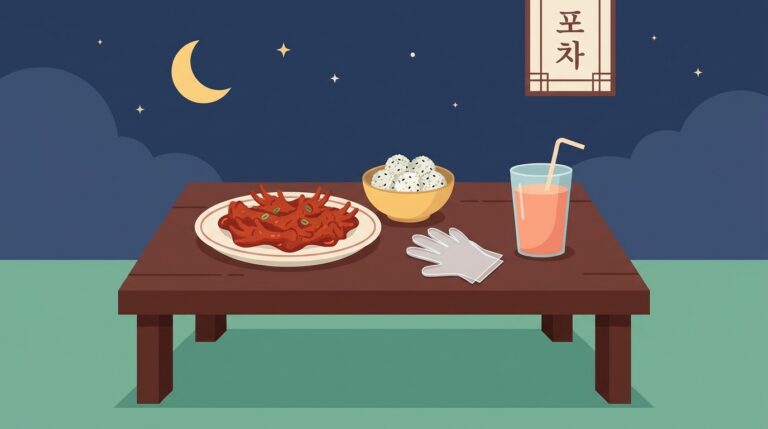
안녕하세요! I’m your Daily Hangul editor and cultural navigator! Picture this: It’s 11:30 PM in Seoul. The vibrant city neon lights flicker outside your window, and your stomach gives a sudden, unmistakable rumble. You decide to jump into Korea’s ultimate late-night ritual—ordering 야식 (ya-sik, late-night snacks). You open a delivery app and order the legendary combo: fiery hot 매운 닭발 (spicy chicken feet) accompanied by a bowl of steaming rice topped with seaweed and sesame oil for making 주먹밥 (rice balls).
When the food arrives, your Korean friends instantly pull on disposable plastic gloves. One person starts kneading the rice balls while another takes a brave bite of the flaming red chicken foot, gasping for air and reaching for sweet peach drink. If you’ve ever felt intimidated by ordering spicy Korean food, adjusting spice levels, or handling the unique DIY dining etiquette of night-pocha culture, you are not alone! Based on feedback from hundreds of intermediate learners, mastering these real-world food conversations will boost your confidence by 200% when hanging out in Seoul. Let’s dive in!
Phase 2: Core 3 Expressions Deep Dive
1. 덜 매운맛으로 주문 가능할까요?
- Pronunciation: [Deol mae-un-mas-eu-ro ju-mun ga-neung-hal-kka-yo?] (Sounds like: Deol mae-oon-mas-oo-ro joo-moon gah-neung-hal-kka-yo?)
- Meaning: Direct: “Is ordering in a less spicy flavor possible?” | Nuance: “Could I please get this made a bit milder?”
- K-Culture Moment: Commonly used when ordering at legendary spicy spots like 신웅동 닭발 or popular late-night delivery chains where default spice levels can be overwhelming.
- Editor’s Insight: In Korea, standard spicy often means 매우 맵다 (extremely spicy). Adding 덜 (less) saves your stomach while keeping the order polite.
- Situation Spectrum: Casual (✅) / Semi-formal (✅) / Formal (⚠️)
- 🤔 Think About It: Why do you think Korean culinary culture values offering custom spice levels, and how does customized food foster hospitality?
2. 주먹밥 예쁘게 동글동글하게 말아줄게!
- Pronunciation: [Ju-meok-bap ye-ppeu-ge dong-geul-dong-geul-ha-ge ma-ra-jul-ge!]
- Meaning: Direct: “I’ll roll the rice balls prettily into round shapes for you!” | Nuance: “Let me roll up these bite-sized rice balls for us!”
- K-Culture Moment: Heard at 포차 (pocha tents) when one friendly squad member voluntarily puts on plastic gloves to make rice balls for everyone.
- Editor’s Insight: 동글동글 (dong-geul-dong-geul) is an mimetic word describing cute, round shapes. Using sensory reduplications makes your Korean sound warm and natural.
- Situation Spectrum: Casual (✅) / Semi-formal (⚠️) / Formal (🚫)
- 🤔 Think About It: How does making DIY food together at the table build intimacy in Korean social dining?
3. 쿨피스로 혀 좀 식혀야겠어!
- Pronunciation: [Kul-pi-seu-ro hyeo jom sik-hyeo-ya-gess-eo!]
- Meaning: Direct: “I need to cool down my tongue with Coolpis!” | Nuance: “Phew, I need some sweet Coolpis to rescue my mouth from this spice!”
- K-Culture Moment: A classic phrase uttered right after biting into spicy food, holding a box of 쿨피스 (a famous Korean sweet peach beverage).
- Editor’s Insight: 식히다 means to cool off. Pair it with 혀 (tongue) or 입안 (inside mouth) to humorously express that the food is burning hot!
- Situation Spectrum: Casual (✅) / Semi-formal (⚠️) / Formal (🚫)
- 🤔 Think About It: What remedies do people in your home country use when eating food that’s way too spicy?
Phase 3: Textbook Korean vs. Real Korean
Scenario 1: Reacting to Intense Spice
- 📖 Textbook Korean: “이 음식이 너무 매워서 물을 많이 마십니다.” (This food is very spicy so I drink a lot of water.)
- 🗣️ Real Korean: “아, 완전 맵찔이라 쿨피스 없이 먹으면 뇌절 와요!” (Ah, I’m such a spice baby that eating this without Coolpis makes my brain short-circuit!)
- 💡 Why is it different?: Native speakers use slang like 맵찔이 (spice weakling) and 뇌절 (brain short-circuit/overload) to add humorous self-deprecation during meals.
Scenario 2: Preparing Table Food
- 📖 Textbook Korean: “제가 비닐장갑을 끼고 주먹밥을 만듭니다.” (I put on plastic gloves and make rice balls.)
- 🗣️ Real Korean: “비닐장갑 딱 끼고 찹찹 뭉쳐 줘야 제맛이지!” (Putting on plastic gloves and shaping them snaps it right into top flavor!)
- 💡 Why is it different?: Onomatopoeias like 찹찹 (the sound of rhythmic shaping/mixing) and the phrase 제맛이다 (to taste authentic/proper) add vivid real-life flavor.
Phase 4: K-Culture Deep Dive & Non-verbal Manners
4-1. Nunchi & Gestures
- The Glove Protocol: When the 주먹밥 set arrives, don’t wait for someone else if you are ready to help. Grab the disposable plastic glove (비닐장갑), put it on one hand (usually non-dominant), and start mixing while others handle the drinks. Showing initiative (눈치, Nunchi) makes you an instant favorite dining companion!
- Bite-Sized Courtesy: Roll the rice balls small enough to be eaten in one bite so your dining friends don’t have to bite them in half.
4-2. Culture Code Analysis
- Stress Relief through Spice: In Korea, eating intensely spicy food like 매운 닭발 or 떡볶이 after work is a major cultural phenomenon known as 매운맛 스트레스 해소 (spicy stress relief). Endorphins released from capsaicin combined with midnight chatting create a deep sense of camaraderie (정, Jeong).
Phase 5: Roleplay Scenario
Setting: A cozy late-night 포차 in Hongdae. You are sitting with your Korean friend Minji (민지), eyeing a glowing plate of spicy chicken feet and a hot bowl of rice ball ingredients.
- Minji: 야, 여기 닭발 나왔어! 비주얼 대박이지 않아?
- (Ya, yeo-gi dak-bal na-was-eo! Bi-ju-eol dae-bak-i-ji a-na?)
- “Hey, chicken feet are here! Doesn’t this look incredible?”
- 🎭 Grabbing chopsticks excitedly
- You: 와, 냄새부터 장난 아니다. 근데 엄청 매워 보여!
- (Wa, naem-sae-bu-teo jang-nan a-ni-da. Geun-de eom-cheong mae-wo beo-yeo!)
- “Wow, the smell is no joke. But it looks insanely spicy!”
- 🎭 Fanning mouth nervously
- Minji: 맞다, 너 매운 거 잘 못 먹지? 내가 주먹밥 만들 테니까 쿨피스 따라줄래?
- (Mat-da, neo mae-un geo jal mot meok-ji? Nae-ga ju-meok-bap man-deul te-ni-kka kul-pi-seu tta-ra-jul-rae?)
- “Right, you can’t eat super spicy stuff well, right? I’ll roll rice balls, can you pour the Coolpis?”
- 🎭 Putting on a plastic glove
- You: 아니야, 주먹밥은 내가 예쁘게 동글동글하게 말아줄게!
- (A-ni-ya, ju-meok-bap-eun nae-ga ye-ppeu-ge dong-geul-dong-geul-ha-ge ma-ra-jul-ge!)
- “No way, let me make the rice balls neat and round for us!”
- 🎭 Reaching for the plastic gloves enthusiastically
- Minji: 오~ 서비스 정신 짱인데? 닭발 하나 주먹밥 하나 조합으로 먹어봐!
- (O~ seo-bi-seu jeong-shin jjang-in-de? Dak-bal ha-na ju-meok-bap ha-na jo-hab-eu-ro meok-eo-bwa!)
- “Oh~ great team spirit! Try eating one chicken foot paired with one rice ball!”
- 🎭 Giggling and sliding the spicy plate closer
- You: (한 입 먹고) 으악, 불타오른다! 쿨피스로 혀 좀 식혀야겠어!
- ((Han ip meok-go) Eu-ak, bul-ta-o-reun-da! Kul-pi-seu-ro hyeo jom sik-hyeo-ya-gess-eo!)
- “(Takes a bite) Argh, my mouth is on fire! Need Coolpis to cool my tongue down!”
- 🎭 Gasping for air and reaching for the cup
- Minji: ㅋㅋㅋ 참기름 듬뿍 들어간 주먹밥 빨리 하나 더 먹어!
- (Kk-kk-kk, cham-gi-reum deum-ppuk deul-eo-gan ju-meok-bap ppal-li ha-na deo meok-eo!)
- “Lol! Quick, eat another rice ball loaded with sesame oil!”
- 🎭 Handing over a fresh rice ball
- You: 후아~ 매운데 자꾸 손이 가네! 이 조합 진짜 완벽하다.
- (Hu-a~ mae-un-de ja-kku son-i ga-ne! I jo-hap jin-jja wan-byeok-ha-da.)
- “Phew~ It’s spicy but so addictive! This combo is truly perfect.”
- 🎭 Smiling while grabbing chopsticks again
🔀 Interactive Branching Point
Minji asks: “혹시 너무 매워서 다음부터는 못 먹겠어?” (Is it too spicy that you can’t eat it next time?)
- Option A: “너무 매워요. 다시는 안 먹을래요.” (Too spicy. I will never eat it again.)
- 🚫 Bad Choice: Ends the mood abruptly and sounds overly rigid.
- Option B: “매운데 은근히 중독성 있어서 다음에 덜 매운맛으로 또 오고 싶어요!”
- ✅ Best Choice: Polite, expressive (mentions 중독성 / addictive quality), and suggests customized order (덜 매운맛) for next time!
- Option C: “괜찮아요. 하나도 안 매워요! (눈물 흘리며)”
- ⚠️ Risk Choice: Funny, but your friend will see your tears and know you’re struggling!
Phase 6: 10-Second Emotional Shadowing Drill
[🥺 Desperately seeking mercy]- 덜 매운맛으로 / 주문 가능할까요?
- (Deol mae-un-mas-eu-ro / ju-mun ga-neung-hal-kka-yo?)
[😊 Cheerful & eager to help]- 주먹밥은 / 내가 예쁘게 / 동글동글하게 말아줄게!
- (Ju-meok-bap-eun / nae-ga ye-ppeu-ge / dong-geul-dong-geul-ha-ge ma-ra-jul-ge!)
[🔥 Dramatic & breathless]- 으악, 너무 매워! / 쿨피스로 / 혀 좀 식혀야겠어!
- (Eu-ak, neo-mu mae-wo! / Kul-pi-seu-ro / hyeo jom sik-hyeo-ya-gess-eo!)
Phase 7: K-Culture Mini Dictionary
- 닭발 (Dak-bal) | Spicy Chicken Feet | A beloved Korean late-night delicacy known for its chewy texture (쫄깃함) and intense spicy seasoning. Served boneless (무뼈) or bone-in (뼈있는).
- 주먹밥 (Ju-meok-bap) | DIY Rice Balls | Literally “fist rice.” Served in a bowl with rice, seaweed flakes, sesame seeds, and mayonnaise to be mixed by hand.
- 맵찔이 (Maep-jjil-i) | Spice Weakling | Slang combining 매운 (spicy) + 찌질이 (weakling). Lighthearted term used when someone can’t handle spice.
- 쿨피스 (Kul-pi-seu) | Coolpis Beverage | A famous sweet dairy-based fruit juice that acts as the ultimate antidote to spicy Korean food.
Phase 8: Traveler’s Survival Kit
Survival Expressions Top 3
- 비닐장갑 더 주실 수 있나요? (Bi-nil-jang-gap deo ju-sil su in-na-yo?) — “Could we get more plastic gloves?”
- 무뼈 닭발로 변경해 주세요. (Mu-ppyeo dak-bal-ro byeon-gyeong-hae ju-se-yo.) — “Please change it to boneless chicken feet.”
- 마요네즈 추가할 수 있어요? (Ma-yo-ne-jeu chu-ga-hal su it-eo-yo?) — “Can I add extra mayonnaise?”
Editor’s Travel Note
When navigating Seoul’s late-night food scene, ordering delivery directly to your hotel or Airbnb is a must-try experience. Make sure to download the Baedal Minjok App Guide for browsing local menus, or use Naver Map App Download to locate nearby popular 닭발 eateries open past midnight.
Phase 9: One Step Deeper (Cultural Reflection)
In Korean culture, food is rarely an individual event—it is a shared sensory bond. The act of sitting around a bubbling dish of spicy 닭발, sharing plastic gloves, and feeding each other freshly rolled 주먹밥 dismantles social hierarchy and builds deep intimacy. Experiencing heat together and laughing off the sweat bridges gaps faster than any formal speech.
💬 Your Turn: What is your absolute favorite comfort late-night food, and do you prefer extremely spicy flavors or mild comfort dishes? Share your experience in the comments below!
Phase 10: FAQ & Common Mistakes
Q: What is the difference between bone-in and boneless dakbal?
A: Boneless (무뼈 닭발) is easy to eat with chopsticks or wrapped inside rice balls, making it perfect for beginners. Bone-in (뼈 닭발) requires nibbling with gloves and offers an authentic chewy texture favored by locals.
Q: What should I do if the food is way too spicy for me?
A: Take a spoonful of 계란찜 (steamed egg pot) or 주먹밥, and sip 쿨피스. Dairy and fats neutralize capsaicin far better than ice water.
Q: Who is supposed to make the rice balls at the table?
A: There is no strict rule! Usually, whoever puts on the plastic glove first takes charge. Offering to do it shows great consideration.
Common Mistakes
| Mistake | What Happens | Correct Action |
|---|---|---|
| Eating bone-in chicken feet with chopsticks | Hard to chew and messy | Wear a disposable plastic glove (비닐장갑) on one hand |
| Drinking cold water when mouth is burning | Capsaicin spreads, increasing burn | Drink sweet dairy (쿨피스) or eat steamed egg |
| Asking for “Not spicy at all” (하나도 안 매게) at an authentic spot | Food loses signature flavor balance | Ask for 덜 매운맛 (less spicy) instead |
Phase 11: Action Mission & Engagement
3-Step Action Mission
- 🥉 Bronze: Practice saying “주먹밥 예쁘게 동글동글하게 말아줄게!” aloud 3 times with rhythm.
- 🥈 Silver: Post a picture of your favorite spicy meal on Instagram using the Korean hashtag
#매일한글_야식챌린지. - 🥇 Gold: Order 덜 매운맛 (less spicy option) in Korean at a local Korean restaurant or via delivery app!
🎮 K-Culture Mission: Watch a late-night K-Drama scene (like in Itaewon Class) and spot whether characters are wearing plastic gloves while eating late-night snacks!
Phase 12: Interactive Quiz Challenge
Test your knowledge before you head out for night snacks!
Click here to reveal Quiz Questions & Answers!
Q1. Situation Judgment: Your Korean friend is sweating heavily while eating spicy chicken feet. What should you offer them?
* A) Hot soup
* B) 쿨피스 (Coolpis) & 주먹밥 (Rice balls)
* C) Black coffee
Answer: B. Sweet beverage and rice neutralize spice effectively!
Q2. Fill in the Blank: “매운 음식 먹을 때 비닐___을 끼고 주먹밥을 만듭니다.”
* A) 신발 (Shoes)
* B) 장갑 (Gloves)
* C) 안경 (Glasses)
Answer: B. 장갑 means gloves (비닐장갑 = plastic gloves).
Q3. True or False: 맵찔이 is a formal business title used for people who love spicy food.
Answer: False! 맵찔이 is light slang meaning a “spice weakling” who cannot eat spicy food well.







