

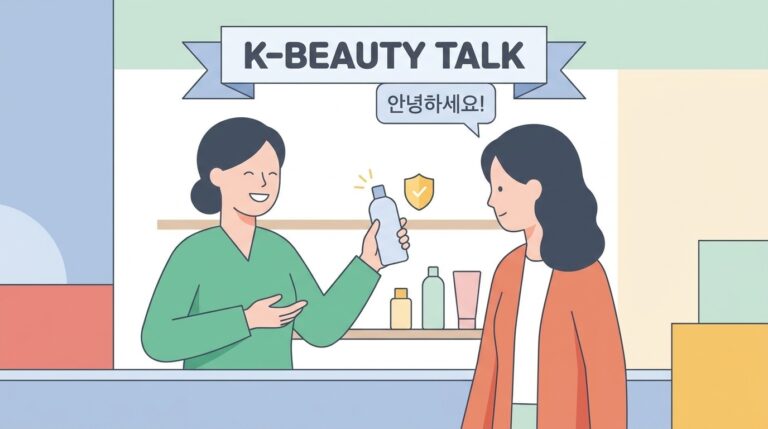
Phase 1: 공감 (Story-driven Opening)
안녕하세요! 매일한글 에디터입니다. 👋
Have you ever walked into a K-beauty store in Seoul like Olive Young or a dermatology clinic storefront, holding a list of sensitive skin concerns, only to be overwhelmed by technical terms? You want something soothing and dermatologist-recommended, but all you see are bottles labeled with unfamiliar terms like ‘더마’ (Derma), ‘시카’ (Cica), or ‘자극 없는’ (Non-irritating).
Many of our B2 learners tell us: “I know basic Korean, but when I step into a K-dermatology shop or look for skincare with active ingredients, I freeze up when the clerk asks about my skin barrier or recommended lines!”
Don’t worry! Navigating Korean dermatological cosmetics (더마 코스메틱) is a game-changer once you master key nuanced terms. In Korea, skincare is treated almost like self-care science. By the end of this guide, you’ll be able to confidently ask for skin-barrier repairs, express sensitivity, and get exact dermatologist-backed product recommendations in fluent Korean!
Phase 2: 핵심 표현 3선 심층 분석
1. 장벽 케어 (Jang-byeok Ke-eo)
- Pronunciation: [Jang-byeok Ke-eo] (Sounds like ‘Jang’ as in ‘jungle’, ‘byeok’ sounding like ‘be-yok’ spoken quickly)
- Meaning: Literal: Barrier Care | Nuance: Skin barrier restoration and strengthening.
- K-Culture Moment: Seen frequently in skincare commercials featuring glowing actors emphasizing skin barrier strength after harsh seasonal changes.
- Editor’s Insight: ‘장벽’ literally means a physical wall or barrier. In Korean skincare, strong skin is often described as having a solid wall that prevents moisture loss.
- Situation Spectrum: Casual ✅ | Semi-formal ✅ | Formal ✅
- 🤔 Think About It: In English, we often say “repairing skin barrier.” Why do you think Korean uses the word ‘Care’ (케어) combined with ‘Wall’ (장벽)?
2. 진정시키다 (Jin-jeong-si-ki-da)
- Pronunciation: [Jin-jeong-shi-ki-da] (Think of ‘Jean’ + ‘Jong’ spoken softly)
- Meaning: Literal: To calm down / soothe | Nuance: To soothe irritated or red skin using gentle ingredients like Cica or Panthenol.
- K-Culture Moment: Frequently used by K-Beauty vloggers when reviewing post-dermatology treatment pads or soothing creams.
- Editor’s Insight: You can use this verb as ‘피부를 진정시켜 줘요’ (It soothes my skin) or in noun form ‘피부 진정’ (Skin soothing).
- Situation Spectrum: Casual ✅ | Semi-formal ✅ | Formal ✅
- 🤔 Think About It: How does your native language differentiate between ‘cooling’, ‘healing’, and ‘soothing’ skin?
3. 더마 라인 (Deo-ma Ra-in)
- Pronunciation: [Deo-ma Ra-in] (Deo sounds like ‘doh/dur’ in English)
- Meaning: Literal: Derma Line | Nuance: Skincare lines specifically formulated or recommended by dermatologists for sensitive/problematic skin.
- K-Culture Moment: In K-Dramas, characters dealing with stressful schedules often grab ‘더마’ creams from their vanity tables to quick-fix redness.
- Editor’s Insight: When shopping in Korea, asking for ‘더마 라인’ immediately signals to staff that you need hypoallergenic, clinical-grade skincare.
- Situation Spectrum: Casual ✅ | Semi-formal ✅ | Formal ✅
- 🤔 Think About It: Is ‘derma’ considered a clinical medical term or a daily cosmetics term in your home country?
Phase 3: 교과서 한국어 vs 진짜 한국어
Situation 1: Asking for non-irritating product
- 📖 교과서 한국어: 자극이 없는 화장품을 주세요. (Please give me cosmetics that have no irritation.)
- 🗣️ 진짜 한국어: 민감성 피부에 맞는 순한 더마 제품 추천해 주세요. (Please recommend a gentle derma product suited for sensitive skin.)
- 💡 왜 다를까? While ‘자극이 없다’ is grammatically correct, real shoppers specify skin type (‘민감성’) and use the word ‘순하다’ (mild/gentle) which sounds far more natural.
Situation 2: Asking if a cream repairs the barrier
- 📖 교과서 한국어: 이 크림은 피부 장벽을 다스립니까? (Does this cream govern the skin barrier?)
- 🗣️ 진짜 한국어: 이 크림 피부 장벽 케어에 효과 있어요? (Is this cream effective for skin barrier care?)
- 💡 왜 다를까? Textbook verbs like ‘다스리다’ are overly archaic. Native speakers prefer concise noun combinations paired with ‘효과 있어요?’ (Is it effective?).
Phase 4: K-Culture 딥다이브 & 비언어적 매너
4-1. Nunchi & Gestures at the Derma Counter
When talking to skincare specialists or clerks in Korea, touching your cheeks gently with the back of your hand while explaining redness or dryness shows precise body language. It highlights your specific area of concern politely without applying dirty fingers to face skin!
4-2. Cultural Code: The ‘Derma’ Skincare Boom in Korea
In Korea, visits to the dermatologist (피부과) are extremely common and normalized as routine self-care. Because of this, consumers demand clinical-grade results from home skincare. Ingredients like Centella Asiatica (Cica), Madecassoside, and Ceramides form the core of ‘Derma’ lines. Expressing interest in these ingredients shows you understand modern Korean skincare culture!
Phase 5: 실전 롤플레이 시나리오
Setting: A sleek derma-cosmetics boutique in Gangnam, Seoul.
Characters: Customer (You), Staff (민지 – Minji, knowledgeable skincare consultant).
- Staff: 🎭 (Smiles warmly, bowing slightly) 안녕하세요! 찾으시는 피부과 추천 라인 있으신가요?
(Annyeonghaseyo! Chaj-eusing-eun pibugwa chu-cheon rain isseusingayo? / Hello! Are you looking for a specific dermatologist-recommended line?) - You: 🎭 (Gently touching cheeks) 네, 제가 요즘 피부가 많이 민감해져서요. 피부 진정에 좋은 거 있을까요?
(Ne, jega yo-jeum pibuga mani min-gam-hae-jyeo-seo-yo. Pibu jin-jeong-e jo-eun geo isseul-kkayo? / Yes, my skin has been really sensitive lately. Do you have something good for skin soothing?) - Staff: 🎭 (Points to a clinical blue bottle line) 이 더마 라인 세럼 어떠세요? 시카 성분이 들어있어서 자극이 적어요.
(I deo-ma ra-in se-reum eo-tteo-seo-yo? Sika seong-bun-i deu-reo-iss-eo-seo ja-geug-i jeog-eo-yo. / How about this derma line serum? It contains Cica, so it has low irritation.) - You: 🎭 (Checking the bottle label) 아, 그렇군요. 피부 장벽 케어에도 효과가 있나요?
(A, geu-reoh-gun-yo. Pibu jang-byeok ke-eo-e-do hyo-gwa-ga in-na-yo? / Ah, I see. Is it also effective for skin barrier care?) - Staff: 🎭 (Nods enthusiastically) 네! 세라마이드 성분도 함께 있어서 장벽 강하에 정말 좋아요.
(Ne! Se-ra-ma-i-deu seong-bun-do ham-kke isseoseo jang-byeok gang-hwa-e jeong-mal jo-a-yo. / Yes! It also has ceramides, so it’s great for barrier strengthening.) - You: 🎭 (Pleased) 다행이네요. 끈적이지 않고 순한가요?
(Da-haeng-i-ne-yo. Kkeun-jeok-i-ji an-go sun-han-ga-yo? / That’s a relief. Is it non-sticky and gentle?) - Staff: 🎭 (Applies a tiny dab on your hand) 네, 텍스처가 가벼워서 끈적임 없이 산뜻하게 흡수돼요.
(Ne, tek-seu-cheo-ga ga-byeo-wo-seo kkeun-jeok-im eobs-i sant-teus-ha-ge heub-su-dwae-yo. / Yes, the texture is light so it absorbs freshly without stickiness.) - You: 🎭 (Nodding in satisfaction) 좋아요! 이걸로 하나 주세요.
(Jo-a-yo! I-geol-ro ha-na ju-se-yo. / Great! I’ll take one of these please.)
🔀 Interactive Branching Choice
If the staff asks: “더마 크림도 같이 보여드릴까요?” (Shall I show you the matching derma cream as well?)
* Option A: 네, 장벽 케어 같이 하면 좋을 것 같아요. 같이 주세요!
* Option B: 아니요, 그냥 이것만 사겠습니다.
* Option C: 이 크림은 무료 샘플 없나요?
Feedback:
* Option A (Best): Perfect B2 response! Demonstrates natural adoption of key vocabulary (‘장벽 케어’) while maintaining polite sales etiquette.
* Option B (Bad): Grammatically correct, but sounds slightly blunt/cold in Korean retail interactions. Better: “아니요, 오늘은 세럼만 살게요!”
* Option C (Risk): Demanding free samples upfront can sound impolite in Korean context. Staff usually offer samples voluntarily at checkout!
Phase 6: 10초 감정 섀도잉 드릴
Practice reading these out loud with the marked pauses / and emotional cues!
[🥺 Worried & Seeking help]
제 피부가 / 요즘 너무 민감해져서 / 진정 케어가 필요해요.
(Je pibuga / yo-jeum neo-mu min-gam-hae-jyeo-seo / jin-jeong ke-eo-ga pil-yo-hae-yo.)-
[😊 Hopeful & Curious]
이 더마 크림이 / 피부 장벽 강화에 / 효과가 있나요?
(I deo-ma keu-rim-i / pibu jang-byeok gang-hwa-e / hyo-gwa-ga in-na-yo?) -
[👍 Satisfied & Decisive]
끈적임도 없고 / 정말 순하네요! / 이걸로 할게요.
(Kkeun-jeok-im-do eobs-go / jeong-mal sun-ha-ne-yo! / I-geol-ro hal-ge-yo.)
Phase 7: K-Culture 미니 사전 (핵심 키워드 4개)
- 더마 (Deo-ma) | Derma / Dermatological cosmetics | Refers to skincare products formulated with pharmaceutical or clinical skincare research.
- 피부 장벽 (Pi-bu Jang-byeok) | Skin Barrier | The outermost layer of skin; a huge buzzword in Korean skincare for healthy skin.
- 순하다 (Sun-ha-da) | Gentle / Mild | Used to describe products that do not cause skin irritation or chemical sting.
- 진정 (Jin-jeong) | Soothing / Calming | Describes ingredients (Cica, Tea Tree, Panthenol) aimed at reducing skin redness.
Phase 8: 여행자를 위한 생존 키트
Survival Phrases TOP 3
- 민감성 피부용인가요? (Min-gam-seong pibu-yong-in-ga-yo?) – Is this for sensitive skin?
- 샘플 좀 써볼 수 있을까요? (Saem-peul jom sseo-bol su iss-eul-kkayo?) – Could I try a sample texture?
- 피부과 추천 상품 추천해 주세요. (Pi-bu-gwa chu-cheon sang-pum chu-cheon-hae ju-se-yo.) – Please recommend dermatologist-recommended products.
Editor’s Travel Note
Before shopping for skincare in Korea, make sure you download Naver Map App Download to easily find top-rated dermatology clinics and official flagship derma stores around Seongsu and Gangnam!
Phase 9:
Frequently Asked Questions (FAQ)
Q: What does "장벽 케어 (Jang-byeok Ke-eo)" mean in Korean and how do you pronounce it?
A: In Korean, "장벽 케어 (Jang-byeok Ke-eo)" is pronounced [Jang-byeok Ke-eo] and means: Literal: Barrier Care | Nuance: Skin barrier restoration and strengthening.
Q: What does "진정시키다 (Jin-jeong-si-ki-da)" mean in Korean and how do you pronounce it?
A: In Korean, "진정시키다 (Jin-jeong-si-ki-da)" is pronounced [Jin-jeong-shi-ki-da] and means: Literal: To calm down / soothe | Nuance: To soothe irritated or red skin using gentle ingredients like Cica or Panthenol.
Q: What does "더마 라인 (Deo-ma Ra-in)" mean in Korean and how do you pronounce it?
A: In Korean, "더마 라인 (Deo-ma Ra-in)" is pronounced [Deo-ma Ra-in] and means: Literal: Derma Line | Nuance: Skincare lines specifically formulated or recommended by dermatologists for sensitive/problematic skin.







